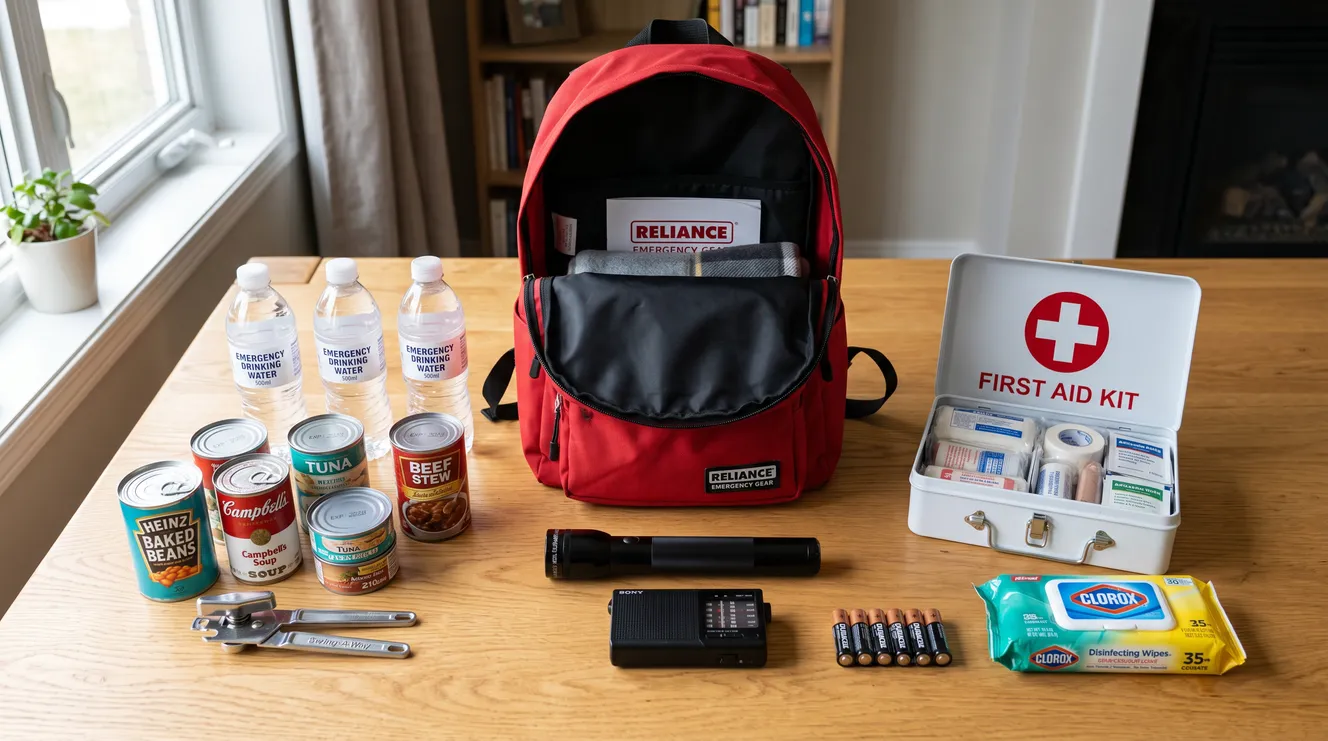
Most emergency-kit articles read like a shopping list a mile long, and that length is part of why so few people ever finish building one. The list feels overwhelming, so it gets put off, and the kit never happens. The truth is more manageable. A genuinely useful kit is built around a small number of categories — water, food, light, information, first aid, sanitation, tools, and documents — and once you understand the logic behind each one, you can stop treating it as a checklist to obey and start treating it as a system to tailor to your own household.
First, the Two-Kit Mindset
Before the contents, the structure. The single most useful idea in home preparedness is that you actually want two kits, because the two disasters you are preparing for are opposites. One is “shelter in place” — the power is out, the roads are closed, but your home is intact and you are staying put for days. The other is “evacuate now” — a wildfire, a flood, a gas leak, and you have minutes to grab and go.
The Red Cross frames the supply quantities around exactly this split: a two-week supply of water and food for staying home, but a lighter three-day supply in a grab-and-go bag for evacuation. So the practical setup is a larger stockpile kept at home, plus a smaller, genuinely portable bag staged by the door or in the car that you could sling over your shoulder and carry out in one motion. If you build only one kit, the home stockpile is too heavy to evacuate with, and a bug-out bag alone won’t sustain you through a two-week outage. Two kits, two jobs.
What Belongs: The Core
Water — the non-negotiable
Water comes first because you can survive weeks without food but only days without water, and in a disaster the tap is one of the first things to fail or become unsafe. The standard both agencies use is one gallon per person, per day — half for drinking, half for cooking and basic sanitation. Multiply that by the number of people (and pets) in your home, then by the number of days you are planning for: three days in the go-bag, two weeks at home. For a family of four, two weeks means well over a hundred gallons, which sounds enormous until you realize it is just commercially bottled cases stored in a closet, or food-grade containers you fill and date yourself.
Food — non-perishable and no-cook
The food that belongs in a kit is food that needs nothing from you: no refrigeration, no real cooking, ideally no heating at all. Canned goods, protein bars, peanut butter, dried fruit, nuts, shelf-stable pouches. Choose things your family will actually eat, account for allergies and special diets, and pack at least a several-day supply in the go-bag and two weeks at home. And do not forget the humble manual can opener — a kit full of canned food and no way to open it is a classic, maddening failure. If you have a baby, formula and baby food belong here; if you have pets, their food does too.
Light and power
A flashlight for every member of the household, plus extra batteries, is the baseline. Headlamps are even better because they leave your hands free. Add a way to keep your phone alive when the grid is down — a charged power bank, and ideally a hand-crank or solar charger that needs no outlet at all. Your phone is your lifeline to alerts, maps, and family, and a dead one in an emergency is a serious liability.
Information — a radio that doesn’t need the internet
When cell networks go down, a battery-powered or hand-crank radio, and a NOAA Weather Radio with tone alert, becomes your window to the outside world — evacuation orders, shelter locations, all-clear announcements. Many models combine a radio, a flashlight, a phone charger, and a hand crank in one device, which makes them a smart anchor for the whole light-and-information category.
First aid and medications
A stocked first aid kit handles the cuts, burns, and sprains that are far more common in a disaster’s chaos than any dramatic injury. Alongside it, pack your medications — the Red Cross suggests at least a seven-day supply — plus over-the-counter basics like pain relievers, antacids, and anti-diarrhea medicine, and any medical items your family relies on: spare glasses, contact supplies, hearing-aid batteries. About half of all Americans take a daily prescription, and an emergency can shut every pharmacy for days, so this category is easy to underrate and dangerous to skip.
Sanitation, tools, and shelter
When the water stops, sanitation gets grim fast, so pack moist towelettes, garbage bags and plastic ties, hand sanitizer, and personal hygiene items. Round out the kit with the small, high-leverage tools the agencies recommend: a multi-purpose tool, a whistle to signal for help without screaming yourself hoarse, a dust mask, plastic sheeting and duct tape for sheltering in place, an emergency blanket, local maps on paper, and an extra set of car and house keys. None of these are expensive, and any one of them could be the thing you are desperately grateful to have.
Documents and cash
Keep copies of the documents that prove who you are and what you own — identification, insurance policies, medication lists, deed or lease, birth certificates — in a waterproof, portable container, and a backup saved electronically. Add cash in small bills, because when the power is out the card readers and ATMs are out with it, and no one can make change for a hundred-dollar bill. And keep a written list of emergency contacts on paper, since the phone that holds all your numbers may be dead exactly when you need them.
The Core Kit at a Glance
Water: 1 gallon/person/day — 3 days in the go-bag, 2 weeks at home.
Food: Non-perishable, no-cook, plus a manual can opener.
Light/power: Flashlight per person, extra batteries, power bank, hand-crank or solar charger.
Information: Battery or hand-crank radio plus a NOAA Weather Radio with tone alert.
Health: First aid kit, 7-day medication supply, OTC basics, glasses/medical items.
Sanitation/tools: Towelettes, garbage bags, hand sanitizer, multi-tool, whistle, dust mask, sheeting + duct tape, blanket, maps.
Documents/cash: Waterproof copies of IDs and policies, contacts on paper, cash in small bills.
What Doesn’t Belong (and Why)
This is the half that gets left out of almost every checklist, and it is just as important as the packing list — because a kit weighed down by the wrong things is slower to grab, harder to maintain, and quietly missing room for what matters.
Candles
Candles feel like the obvious emergency light, and they are exactly the wrong choice. Both the Red Cross and Ready.gov are blunt about it: use flashlights, not candles. An open flame in a dark, possibly damaged home — especially after a storm or earthquake when a gas line might be leaking — is a house fire waiting to happen, often in the exact moment the fire department is stretched thinnest. Battery and crank lighting does the same job with none of the risk. Leave the candles out.
Perishable food and anything that needs cooking
A kit is not a pantry. Food that needs refrigeration, a working stove, or a lot of water to prepare is dead weight in a situation where you may have none of those things. The dried pasta that needs ten minutes of a rolling boil, the meal that assumes a microwave — these belong in your kitchen, not your kit. Pack things you can open and eat as they are.
Anything expired — which is most kits after a year
The most common failure of all is not what’s missing but what’s gone stale. Water and food have shelf lives. Medications lose potency. Batteries corrode and leak, sometimes ruining the very flashlight or radio they were meant to power — which is why some agencies suggest storing batteries in their original packaging, beside the device rather than inside it. A kit built once and forgotten is a kit full of expired water, dead batteries, and a prescription that ran out two years ago. The contents are right; the dates are wrong; the kit fails anyway.
Gear you’ve never used
An emergency is the worst possible classroom. The water filter still in its shrink-wrap, the camp stove you’ve never lit, the hand-crank radio you’ve never tuned — if the first time you operate something is during a crisis, by flashlight, under stress, it may as well not be in the kit. Anything mechanical should be taken out and test-run at least once while everything is calm, so your hands already know it when it counts.
The 60-pound “just in case” pile
There is a strong temptation to pack for every imaginable scenario, and the result is a go-bag so heavy and overstuffed that it defeats its own purpose — you cannot actually carry it out the door in a hurry, which is the one thing a go-bag exists to do. Every “might need it” item you cram in crowds out a “will need it” essential and adds weight you’ll have to haul. A grab-and-go bag should be exactly that: grabbable. If you can’t lift it and move quickly, it’s not a go-bag, it’s a closet.
A digital-only paper trail
Keeping your IDs, insurance, and contacts only on your phone feels modern and tidy, right up until the battery dies, the screen cracks, or the cloud is unreachable. Digital copies are great as a backup, but they are not a substitute for a waterproof folder of physical copies and a handwritten contact list. The same logic applies to money: a wallet full of cards and big bills is useless when the power’s out, so a stash of small cash earns its place where the plastic can’t.
A Kit Is Not “Set and Forget”
The work doesn’t end when the bin is packed. A kit is a living thing that quietly decays on the shelf, and the only way to trust it is to maintain it. Tie the maintenance to something you already do twice a year — the same clock change when you test your smoke and carbon monoxide alarms is a perfect trigger. Twice a year, pull the kit out and run down the list: rotate the water and food before they expire, refresh any medications and check their dates, test the flashlights and radio, and swap batteries that are nearing the end. While you’re in there, update anything that changes with life: a child’s clothing and shoe sizes, a new prescription, an expired passport, a phone number that’s no longer current.
This twenty-minute ritual is the difference between a kit that works and a museum of good intentions. The most beautifully stocked kit in the world is worthless if the water expired in 2022 and the batteries have corroded into the flashlight. Maintenance is not glamorous, but it is the entire reason the kit will function on the day you finally need it.
Build It This Weekend
You do not have to do this all at once, and you do not have to spend a fortune. Start with what you already own — most homes have a flashlight, some canned food, a first aid kit, and a few bottles of water scattered around. Gather those into one place, in one or two sturdy, easy-to-carry containers like a plastic bin or a duffel bag, and you have the beginnings of a kit in an afternoon. Then fill the gaps over the next few grocery trips: a case of water here, extra batteries there, a hand-crank radio when the budget allows. Most of the items are inexpensive and easy to find, and any single one of them could matter enormously on the wrong day.
Once the home kit is solid, build the smaller go-bag and stage it where you could grab it in seconds — by the door, in a closet near the exit, or in the trunk of your car. Tell everyone in the household where both kits live, so that the person who happens to be home alone when the sirens sound knows exactly where to reach.
Pack Calm Now, So You Don’t Pack Panic Later
A good emergency kit isn’t about fear or stockpiling for the apocalypse. It’s about buying yourself a few calm, self-sufficient days in a moment when calm is exactly what’s missing. Get the core right — water, food, light, information, health, sanitation, tools, documents — and you’ve covered the situations that actually happen: the multi-day outage, the sudden evacuation, the night the tap runs dry.
Then keep it honest. Leave out the candles and the cookware and the 60-pound “just in case” pile. Rotate it twice a year so nothing in it has quietly expired. A lean, current, well-placed kit beats an enormous neglected one every single time — because the best kit isn’t the one with the most in it. It’s the one that still works on the day you reach for it.
Start with one bin this weekend. Your future self will thank you.
This article is for general preparedness education. Tailor your kit to your household’s specific needs and the hazards common in your area. For official checklists and guidance, consult Ready.gov (FEMA), the American Red Cross, and your local emergency management office.
Leave a Reply