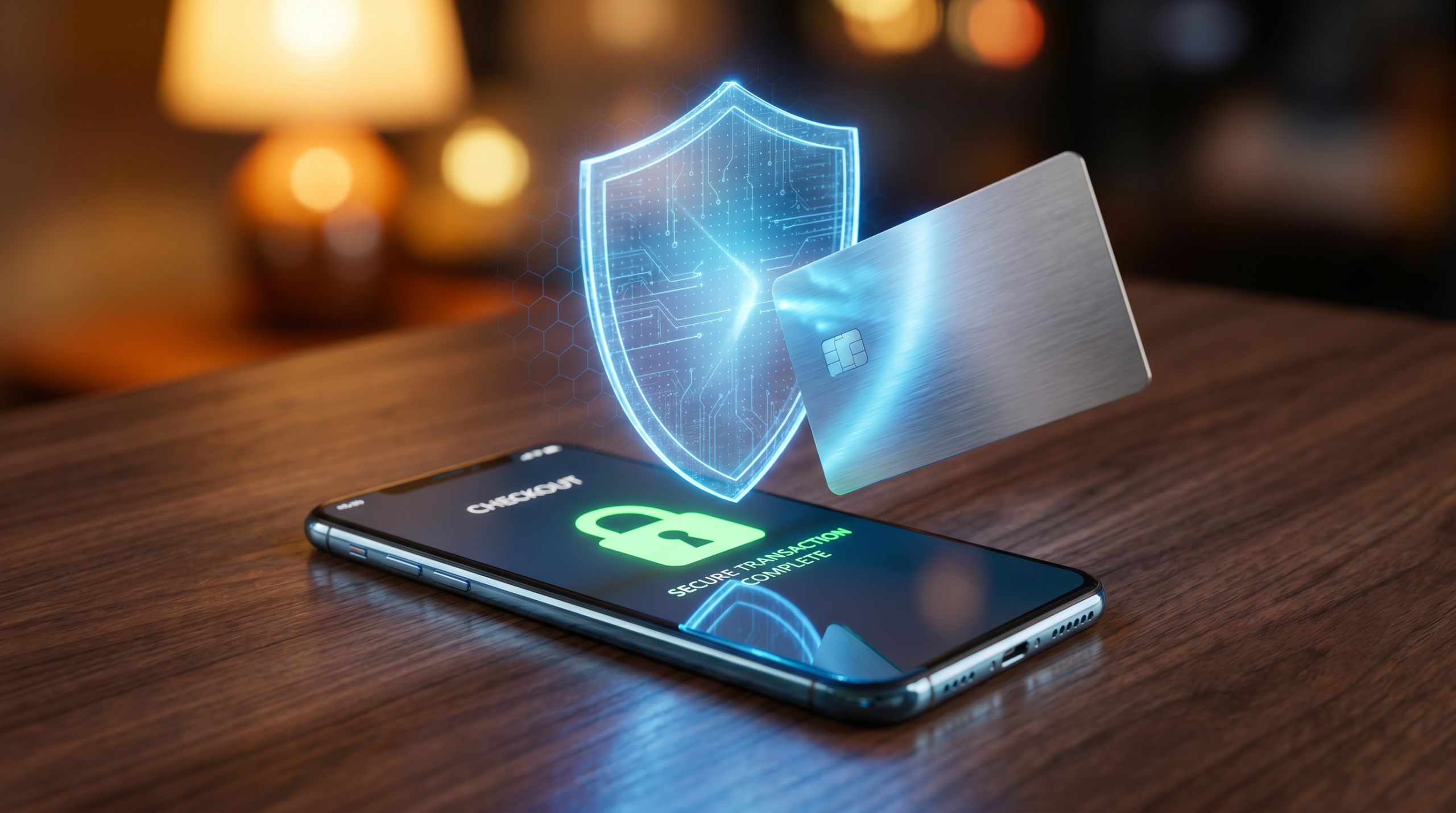
Start by picturing what actually happens when fraud hits. If a thief gets a payment credential that’s tied straight to your checking account — your debit card number, or a bank transfer you authorized — they’re spending your real money, and it leaves your account immediately. You then have to fight to get it back, and while you wait, your rent check might bounce and your bills might go unpaid. But if the thief gets a credential that sits between them and your bank — a credit card, a payment service, a virtual card number — they’re spending someone else’s money, the charge is disputable, and your actual bank balance never moves. Same crime, wildly different consequences. The entire strategy below is about making sure you’re always in that second situation.
The Core Idea: Keep a Buffer Between Sellers and Your Money
A credit card is the simplest buffer there is, and understanding why makes everything else click into place. When you pay with a credit card, you’re not spending your money — you’re spending the card issuer’s money, which you’ll pay back later when your statement comes due. That means no money actually leaves your bank account at the moment of purchase. If a charge turns out to be fraudulent or a purchase goes wrong, you dispute it during that window, and the bogus charge simply never gets paid. Your checking account was never touched. A debit card or a direct bank transfer offers no such cushion: the money is gone the instant you pay, and recovering it is a process, not a guarantee.
This is the whole ballgame. Online shopping feels risky because you’re constantly handing payment details to merchants you can’t see, on sites that can be faked or breached. You can’t control whether a retailer gets hacked. What you can control is what they’re holding when it happens — and a credential with a buffer behind it turns a potential catastrophe into a phone call.
Why a Credit Card Beats a Debit Card Online
The protections aren’t just a matter of convenience — they’re written into different laws, and the gap between them is large. For credit cards, federal law caps your liability for unauthorized charges at $50, and most issuers waive even that with zero-liability policies. Just as importantly, you get strong dispute rights: as the FTC explains, if you’re charged twice, billed for something you never received, or sent the wrong or a defective item, you can dispute the charge and ask the issuer to temporarily withhold payment while it investigates. You generally need to flag the problem within 60 days of the bill on which it appeared — so check your statements — but in practice the card company does most of the work, and you’re not out the money in the meantime.
For debit cards, the protections are weaker and the stakes are higher because the money comes straight out of your checking account. Your liability depends on how fast you report the loss: report before any unauthorized charges and you owe nothing, but wait too long and your exposure climbs — up to $500 if you report within 60 days of your statement, and potentially everything beyond that. Banks can take several days to investigate, and CISA notes the real-world danger plainly: unauthorized debit charges can leave you with insufficient funds to pay your other bills, triggering bounced payments and late fees while you wait for a refund. The fraud might be identical; the fallout is not.
Credit vs. Debit, Online
Credit card: Spends the issuer’s money, not yours. Liability capped at $50 (often $0). Strong dispute rights; the charge can be withheld while it’s investigated. Your bank balance never moves.
Debit card: Pulls real money from your checking account instantly. Liability rises the longer you wait to report. A drained account can bounce your other bills while you wait for a refund.
The Payment Methods to Never Use With a Seller
Some payment methods have no buffer and no undo button at all, and a seller’s insistence on one of them is itself a red flag. The FTC is blunt about it: never buy from an online seller who says you can only pay with a gift card, a wire transfer (through services like Western Union or MoneyGram), a payment app, or cryptocurrency. Scammers love these precisely because they’re designed to be irreversible — once the money moves, it’s almost impossible to claw back, and you have no recourse. A legitimate store wants your business and accepts normal cards; a seller steering you toward gift cards or crypto is, as the FTC puts it, probably running a scam.
It’s worth knowing a quieter danger here too. Money you load into a shopping app or onto a gift card carries, as CISA points out, no legal limit on your liability — unlike a credit or debit card, you’re generally responsible for everything that happens to that balance. So don’t stockpile large balances inside shopping apps, and treat peer-to-peer payment apps the way you’d treat cash: fine for splitting dinner with a friend you trust, dangerous for paying a stranger you found through an ad.
Extra Buffers: Wallets, Gateways, and Virtual Cards
A credit card is the baseline buffer, but you can add even more separation between merchants and your real account number. Mobile wallets and payment gateways — Apple Pay, Google Pay, PayPal — are excellent for this, because they let you pay without ever exposing your actual card number to the store; the merchant receives a stand-in token instead. CISA specifically recommends using a credit card through a payment gateway like these. Virtual card numbers, offered by many banks and card issuers, go a step further: they generate a unique, often single-use or merchant-locked number for an online purchase, so even if that number leaks in a breach, it’s useless anywhere else and can be switched off in seconds.
A couple of simple habits stack more protection on top. CISA suggests funneling all your online purchases through a single, low-limit credit card — that way, if its number is ever compromised, the damage is capped and only one card needs replacing, while the rest of your financial life keeps running. And resist the convenience of saving your card on every site you visit. Use guest checkout when you don’t expect to return, and reserve stored cards for the handful of trusted retailers you actually shop with regularly. The fewer databases your card number sits in, the fewer breaches can expose it.
The Buffer Hierarchy (Best to Worst)
Best: Virtual card number, or a credit card through a wallet (Apple Pay, Google Pay, PayPal) — your real number stays hidden.
Strong: A regular credit card — a true buffer with $50/$0 liability and dispute rights.
Risky: A debit card — real money, weaker protections, slower refunds.
Avoid with sellers: Bank transfers, wire, gift cards, payment apps, crypto — irreversible, no recourse.
Spot the Fake Store Before You Pay
The best payment in the world won’t help if you hand it to a store that was never real. CISA warns that criminals set up convincing fake websites — and clone real ones — especially around busy shopping seasons. A few quick checks weed most of them out. Confirm the address starts with https, which encrypts your information in transit — but know that https alone isn’t proof of legitimacy, since scammers use it too; it’s necessary, not sufficient. Before buying from an unfamiliar shop, search its name alongside the word “scam,” and look for independent reviews on trusted sources like the Better Business Bureau. Be wary of prices that are dramatically too good to be true, missing or vague contact information, heavy pressure and fake scarcity (“only 2 left, offer ends in 5 minutes”), and sloppy spelling or design.
Pay special attention to how you arrived at the store. A deal you typed into your browser yourself is safer than one you reached by tapping a flashy social-media ad or a link in an unexpected email or text — those are the classic delivery routes for fake storefronts. When a great price comes to you out of nowhere, slow down and verify the seller before you verify the deal.
Lock Down Your Side of the Transaction
Safe payment is half the equation; a secure account and device are the other half. Give every shopping account a strong, unique password — a password manager makes this effortless and is something CISA actively recommends — so that a breach at one store can’t unlock your accounts everywhere else. Turn on multi-factor authentication wherever a retailer offers it, so a stolen password alone can’t get someone into your saved cards and addresses. Keep your phone, computer, and browser updated, and switch on transaction alerts from your card issuer so an unfamiliar charge pings your phone the instant it happens.
One more rule worth following: don’t shop on public Wi-Fi. On an unsecured network at a cafe or airport, others may be able to intercept what you send, so save your purchases for your home network or your phone’s own cellular data. None of this is complicated, and together it closes the doors a thief would otherwise use to reach the payment details you’ve worked to protect.
Keep Records, and Know Your Rights
A little paperwork turns a dispute from a headache into a formality. For every purchase, keep the order confirmation, the receipt, and a note of which card you used — a quick screenshot of the listing and the checkout page is even better. If something goes wrong, those records are exactly what you’ll need to get your money back from the seller or to win a dispute with your card company. It also helps to know the law is on your side: an FTC rule requires sellers to ship your order within the time they promised (or by 30 days if they didn’t specify), and to offer you the chance to cancel for a refund if they can’t.
Then make a habit of reviewing your statements. Skim every card and bank statement for charges you don’t recognize, and dispute anything wrong while the clock is still in your favor. If you do get scammed, contact your card issuer or bank right away to dispute the charge, and report it to the FTC at ReportFraud.ftc.gov and the FBI’s Internet Crime Complaint Center at ic3.gov — reporting helps investigators and sometimes helps recover funds. The combination of a buffered payment, a saved receipt, and a quick statement check is what makes online shopping genuinely low-risk.
Shop All You Want — Just Keep the Buffer
You don’t have to be afraid of online shopping, and you don’t have to give up the convenience to stay safe. You just have to remember one thing every time you reach checkout: never hand a seller a straight line to your bank account. Pay with a credit card — better yet, through a wallet or a virtual number — so that if anything goes wrong, you’re disputing a charge, not begging for your own money back. Refuse any seller who demands gift cards, wire transfers, or crypto, because that demand is the scam.
Around that one rule, the rest is easy: check that an unfamiliar store is real, lock your accounts with unique passwords and MFA, skip public Wi-Fi, keep your receipts, and glance at your statements. Do that, and a breach or a bad seller becomes a minor, recoverable annoyance instead of a drained account. The internet’s full of great deals. Go get them — with a buffer between the sellers and your bank.
Credit card or wallet, never your bank account directly.
This article is for general consumer education, not financial advice; protections vary by card and issuer. For official guidance, see the Federal Trade Commission and the Cybersecurity and Infrastructure Security Agency. Report fraud at ReportFraud.ftc.gov or ic3.gov.
Leave a Reply