There is a comforting lie a lot of us tell ourselves: that in an emergency, instinct will take over and we will simply know what to do. Fire does not reward that kind of optimism. Smoke is disorienting. It is black, it is hot, and within a minute or two it fills a room from the ceiling down, stealing your light and your air at the same time. People who survive house fires almost never describe a calm, clear-headed escape. They describe crawling, counting doorways with their hands, and being grateful they had walked the route before, on an ordinary afternoon, when they could still see. That rehearsal is the difference. It is also free.
So let us treat this seriously and break it into two halves that depend on each other. First, the smoke alarm: the device that gives you the warning. Then the escape plan: what you do in the seconds after it goes off. Neither one works alone. An alarm with no plan just tells you to panic. A plan with no alarm never gets triggered in time. Together they are, by a wide margin, the cheapest life insurance you will ever buy.
Why “Two Minutes” Is the Number That Should Scare You
Older homes used to give people more time. Furniture was built from solid wood, mattresses from cotton and wool, and a fire would smolder and creep before it really took hold. That world is gone. Today your couch, your curtains, your mattress, and half the contents of your closet are made from petroleum-based synthetics. They ignite faster, burn hotter, and throw off thick toxic smoke far sooner than the materials our grandparents lived with. Fire researchers who run side-by-side burn tests of a modern living room versus a legacy one watch the modern room reach deadly conditions in a fraction of the time.
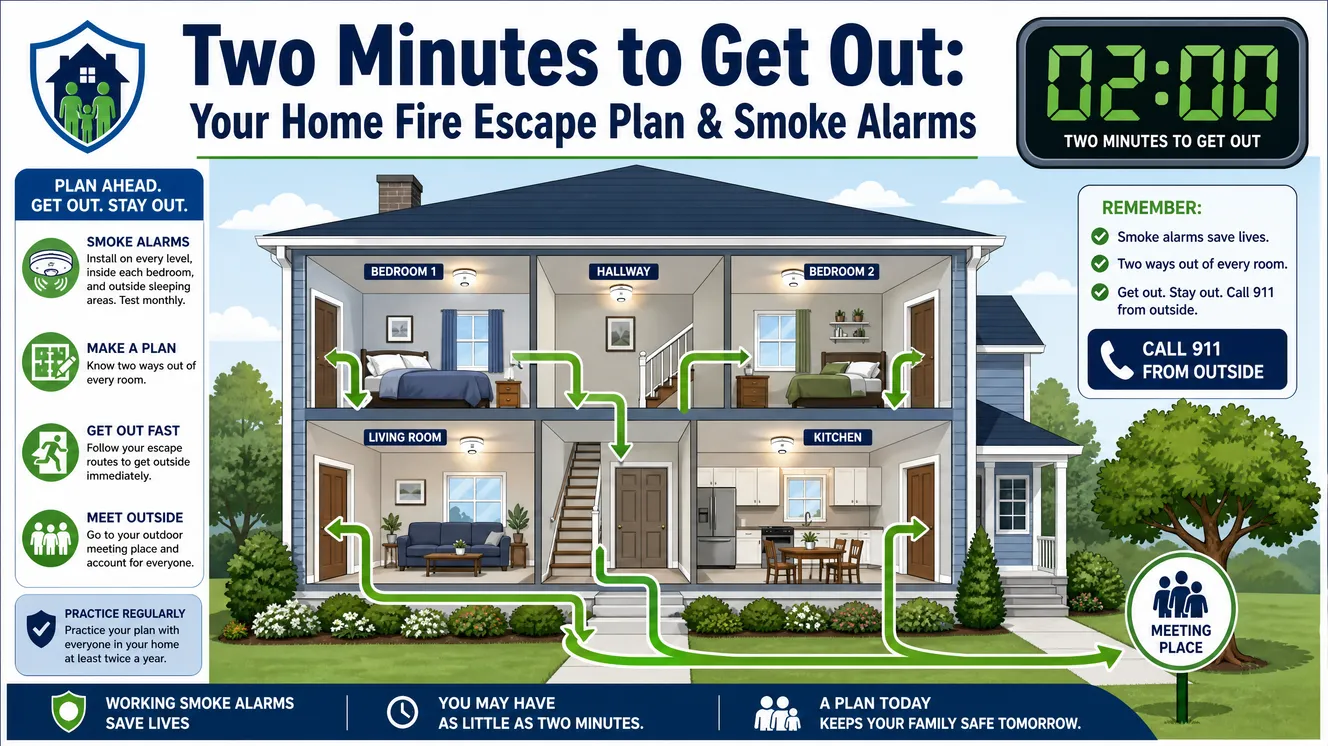
That is the engine behind the two-minute figure. The Red Cross is blunt about it: once a fire starts, you may have as little as two minutes to escape safely. The numbers around the disaster are just as sobering. According to Red Cross figures, an average of seven people die in home fires every day in the United States, more than thirty are injured daily, and home fires cause over seven billion dollars in property damage each year. Children and older adults carry the heaviest share of those deaths, partly because they are the slowest to wake, react, and move.
Two minutes sounds like nothing until you try to spend it well. In two minutes, with the lights out and smoke at the ceiling, you have to wake up, recognize what the sound means, get out of bed, get any children or dependents you are responsible for, choose a route, and reach the outside. If you have to think about any of that for the first time while it is happening, you will lose. The point of everything below is to make those decisions in advance, so that on the night it matters your body already knows the way.
The Smoke Alarm: The Half Everyone Underrates
Almost every home has a smoke alarm somewhere. That is not the problem. The problem is that the alarm is in the wrong place, has a dead battery, or is older than the family dog. The statistics here are not subtle. According to a National Fire Protection Association report, nearly three out of five home fire deaths happen in properties with no smoke alarms at all or with alarms that failed to operate. The death rate in home fires is dramatically lower when a working alarm is present. The keyword in every one of those sentences is working. A dead alarm is just a plastic disc on the ceiling.
Where the alarms actually go
One alarm in a hallway is not coverage. It is a gesture. The U.S. Fire Administration is specific about placement: put a smoke alarm inside every bedroom, outside each separate sleeping area, and on every level of the home, including the basement. Because smoke rises, alarms belong on the ceiling or high on a wall, never tucked low near the floor. The single most valuable upgrade you can make is to use interconnected alarms, so that when the unit in the basement detects smoke, the one beside your bed sounds too. A fire in the far corner of the house should still wake you the instant it is detected, not whenever the smoke finally drifts down the hall to find you.
Ionization, photoelectric, or both
There are two main sensing technologies, and they are not interchangeable. Ionization alarms tend to react faster to flaming, fast-moving fires. Photoelectric alarms tend to react faster to smoldering fires — the slow, smoky kind that starts in a couch cushion or a pile of laundry at three in the morning. Since you cannot predict which kind of fire you will get, the U.S. Fire Administration recommends covering both bases: either install both types, or buy dual-sensor alarms that contain both sensors in one unit. For most families, dual-sensor models are the simplest way to stop guessing.
Testing and the ten-year rule
Here is the maintenance routine in three lines. Test every alarm once a month by holding the test button until it sounds. Replace the batteries in standard units at least once a year, the moment an alarm starts chirping, or follow the manufacturer’s schedule for sealed long-life models. And replace the entire alarm every ten years from the date stamped on the back. That last rule surprises people. Smoke alarms do not last forever; their sensors degrade, and a unit from the last decade may not respond when it counts. Flip yours over and read the manufacture date tonight. If you cannot find one, or the number starts with anything older than ten years ago, that is your answer.
Do this in the next 30 minutes: Walk to every smoke alarm in your home. Press and hold the test button on each one. Note which rooms have no alarm, and flip over each unit to check the manufacture date. You will likely find at least one problem — a silent unit, a missing room, or a ten-year-old disc. That is exactly the gap a fire would exploit.
Building the Escape Plan
The alarm is the warning. The plan is the answer. A real escape plan is not a vague intention to “head for the front door.” It is a drawn map, two exits per room, a fixed meeting place, and a rehearsal that everyone in the house has actually done. The NFPA’s escape-planning guidance lays out the same skeleton every fire department teaches, and it is worth following closely.
Step one: draw the map and find two ways out of every room
Sit down with everyone who lives in the home and sketch a simple floor plan — one box per room, doors and windows marked. For each room, identify two ways out. Usually that is the door and a window. Mark the location of every smoke alarm on the same map while you are at it. The reason for two exits is grim but simple: in a real fire, one of them may be blocked by flame or smoke. The bedroom door you always use could be the one you cannot reach. A window you have never opened, painted shut and forgotten, is not a second exit. Test it now. Make sure it slides, that screens pop out, and that security bars have a quick-release from the inside. An exit that needs a key or a tool at two in the morning is a trap, not an escape.
Step two: pick a meeting place, and make it specific
Choose one fixed spot outside, a safe distance from the house, where everyone goes the moment they are out: the mailbox, a particular tree, the neighbor’s porch light. Specific beats general every time. “Out front” is not a meeting place; “the big oak across the street” is. The meeting place is what lets you do a head count fast, and the head count is what stops the most dangerous decision in any fire: someone running back inside to look for a person who is already standing safely on the lawn. From the meeting place, call the fire department, and once you are out, stay out. Firefighters are trained and equipped to enter burning buildings. You are not.
Step three: practice, in the dark and in daylight
A plan you have never rehearsed is a theory. The Red Cross recommends practicing the drill twice a year and timing yourselves until everyone can get out in under two minutes. Run it once during the day and once at night, because a darkened house is a completely different place. Practice getting low and going under the smoke — the cleanest, coolest air is near the floor, so the move is to drop to hands and knees and crawl. Teach children what the alarm sounds like and what it means; a startling number of kids sleep straight through a smoke alarm or, worse, hide from the noise under a bed. The drill is also how you discover the flaw in your plan while it still costs nothing: the window that sticks, the kid who freezes, the route that takes too long.
The People Who Need a Custom Plan
A generic plan fails the people who are hardest to evacuate, and those are exactly the people fires kill most often. Build the plan around the slowest, most vulnerable person in the house, not the fastest.
Young children need an adult assigned to them by name — one person who knows that their only job, the moment the alarm sounds, is to get that specific child out. Do not assume a child will self-rescue. Older adults and anyone with limited mobility should sleep on the ground floor whenever possible, with the clearest, shortest path to an exit and a phone within arm’s reach. For people who are deaf or hard of hearing, standard alarms are useless during sleep; install alarms with strobe lights and bed-shaker units that physically wake the sleeper. If anyone sleeps on an upper floor, buy a UL-listed collapsible escape ladder, store it under or beside the bed, and let everyone who might need it practice deploying it from a ground-floor window first, so the mechanism is familiar. And pets: love them, plan for them on the way out, but never re-enter a burning building for an animal. Tell the firefighters where the pet is likely to be; they can do what you cannot.
When the Alarm Goes Off: The First 120 Seconds
All the preparation exists to make the next two minutes automatic. Here is the sequence to drill until it is muscle memory.
The Two-Minute Drill
0:00 — Move, don’t investigate. The alarm means out, not “go see if it’s real.” Treat every alarm as a fire.
0:10 — Check the door with the back of your hand. If the door or knob is hot, do not open it — use your second exit instead.
0:20 — Get low and go. Drop below the smoke and crawl toward your exit, staying along walls so you don’t lose your bearings.
0:40 — Get the people you’re responsible for. Each adult goes to their assigned person. No detours for valuables.
1:00 — Close doors behind you. A closed door slows the spread of smoke, heat, and flame and can buy precious time for anyone still inside.
1:30 — Reach the meeting place. Go straight to your fixed outdoor spot and do a head count.
2:00 — Call for help and stay out. Dial emergency services from outside. Never go back in — tell firefighters who or what is missing.
One rule deserves its own line because it is the one panic overrides: if you are trapped, do not hide. Close the door between you and the fire, seal the gap at the bottom with bedding or clothing, open or break a window, and make yourself visible — wave a light or a bright cloth and shout. A child’s instinct is to hide from danger under a bed or in a closet, which is precisely where smoke kills them and rescuers cannot find them. Teach the opposite: get to a window, get seen, get heard.
The Mistakes That Turn a Near-Miss Into a Tragedy
Most fire deaths are not caused by exotic bad luck. They come from a short list of avoidable, human mistakes, made under stress by people who never planned for the moment. Recognize them now, while it is easy.
An Hour This Weekend
None of this requires money or expertise. It requires one focused hour. Test every alarm and check its date. Add alarms to the rooms that have none, aiming for inside every bedroom, outside each sleeping area, and on every level. Sketch the floor plan, mark two exits per room, and pick the meeting place. Then gather everyone and walk it — once with the lights on, once with them off. An hour of slightly awkward family rehearsal is the entire price of admission. The payoff is that if the worst night ever comes, your family does not have to think. They just move.
If buying alarms is a hardship, you are not out of options. Through its Home Fire Campaign, the Red Cross and its partners have installed millions of free smoke alarms in homes across the country and helped countless families build their escape plans. Many local fire departments will also install battery alarms at no cost. A phone call can close the gap between your home and a protected one.
Two Minutes. Two Tasks. Tonight.
A house fire does not announce itself politely, and it does not wait for you to figure things out. It gives you a warning and a deadline — the alarm, and the two minutes that follow. Everything you control sits inside that window. A working smoke alarm in the right room gives you the seconds. A plan you have practiced tells you how to spend them.
So do the two things that matter before you sleep tonight. Walk to your alarms and press the buttons. Then tell your family, in plain words, two ways out of their room and where to meet outside. It is not dramatic. It is not expensive. It is just the difference between a story you tell later and a headline someone else reads.
You have two minutes. Make sure your family already knows the way.
This article is for general safety education. For official, up-to-date guidance, consult the National Fire Protection Association, the U.S. Fire Administration, the American Red Cross, and your local fire department.
Leave a Reply