The Enemy You Can’t See, Smell, or Taste
The first thing to understand is why food poisoning catches careful people off guard: the danger gives no warning. Harmful bacteria like Salmonella, E. coli, and Listeria don’t change how food looks, smells, or tastes, so “it seemed fine” is no protection at all. A chicken breast can be loaded with enough bacteria to make a family sick and look, smell, and taste perfectly normal. That’s what makes the habits below matter so much — they’re defending you against a threat your senses simply can’t detect.
It matters even more because of how fast bacteria multiply. In the temperature range between 40°F and 140°F — what food-safety experts call the “danger zone” — bacteria can double in number in as little as 20 minutes. A small, harmless amount on a warm countertop can become a dangerous dose by dinnertime. Everything that follows is really about two goals: not letting bacteria spread around your kitchen, and not giving them the warmth and time they need to multiply.
Clean: Hands and Surfaces, Often
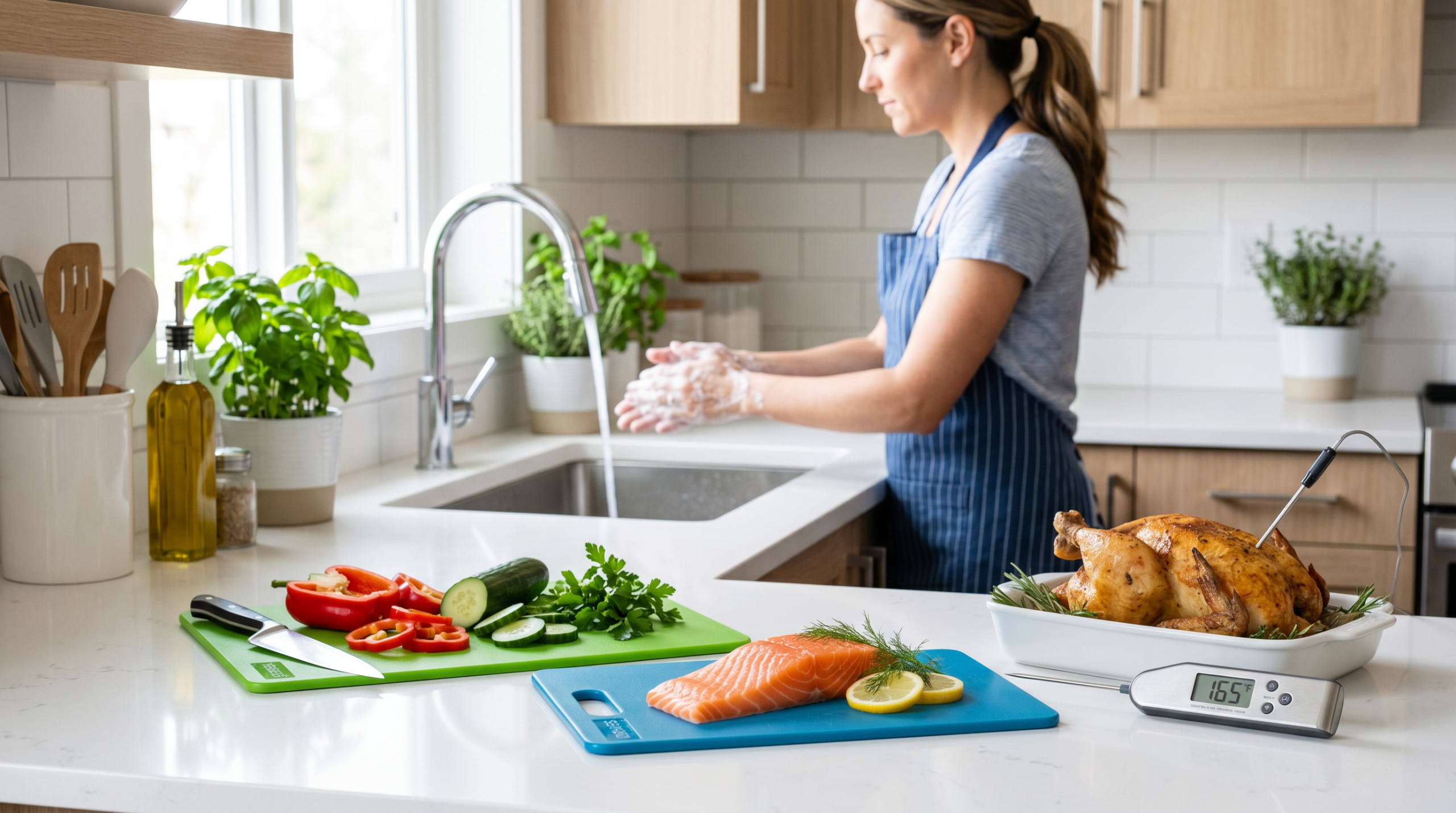
The most basic habit is also the most powerful. Wash your hands with soap and warm water for at least 20 seconds — about as long as humming “Happy Birthday” twice — before you start cooking and, crucially, immediately after handling raw meat, poultry, eggs, or seafood. Plain soap is fine; you don’t need antibacterial. Then extend the same attention to your gear: wash cutting boards, knives, and countertops with hot, soapy water after they touch raw meat, and rinse fresh fruits and vegetables under running water before eating or preparing them. It’s worth rinsing produce even when you plan to peel it — a knife can drag surface bacteria from the rind into the flesh — and giving firm items like melons and cucumbers a scrub with a clean brush. For a deeper clean on cutting boards, the USDA suggests a sanitizing solution of about a tablespoon of unscented liquid bleach per gallon of water.
Now for the habit that needs unlearning, because it’s one of the most common kitchen mistakes there is: do not wash raw chicken — or any raw meat. It feels clean and responsible, but USDA research is clear that rinsing raw poultry or meat doesn’t remove the bacteria; it splashes them. Water hitting the meat aerosolizes contaminated droplets that land on your sink, faucet, counters, and nearby food, sometimes several feet away, spreading the very germs you were trying to remove. Cooking the meat to the right temperature is what actually kills those bacteria — washing only relocates them onto surfaces you’ll touch later. Skip the rinse entirely.
Wash This, Not That
DO wash: your hands (20 seconds), cutting boards, knives, countertops, and fresh produce under running water.
DON’T wash: raw chicken, turkey, beef, pork, or other raw meat — rinsing spreads bacteria around your kitchen. Cooking, not washing, is what makes it safe.
Separate: Keep Raw Away From Ready-to-Eat
Cross-contamination — bacteria hitching a ride from raw meat to food that won’t be cooked — is one of the leading causes of foodborne illness, and it’s entirely preventable with a few deliberate habits. The cornerstone is to keep raw meat, poultry, seafood, and eggs physically separate from everything else. Use two cutting boards: one reserved for raw meat and poultry, another for produce, bread, and anything ready to eat. Never let a salad ingredient touch the board you just cut chicken on, and never put cooked food back on the unwashed plate that held it raw — a classic barbecue mistake that re-contaminates food you just safely grilled.
Carry the principle into the fridge and the store. At home, store raw meat on the bottom shelf in a sealed container or bag, so its juices can’t drip onto produce or leftovers below. Marinate in the refrigerator, never on the counter, and never reuse a marinade that touched raw meat unless you boil it first. At the grocery store, bag raw meat separately from other items so leaking juices stay contained. And throw away the foam trays and plastic wrap that raw meat came in — don’t reuse them. None of these takes real effort; they’re just small choices that keep one contaminated item from infecting a whole meal.
Cook: Use a Thermometer, Not Your Eyes
Here’s a myth that causes real illness: that you can tell food is safely cooked by looking at it. You can’t. The USDA is emphatic that color and juices are not reliable indicators of doneness. Ground beef can turn brown before it’s reached a safe temperature, and a roast can stay slightly pink well after it’s safe to eat — so judging by appearance means you’re guessing. The only way to know food has gotten hot enough to kill bacteria is to measure its internal temperature with a food thermometer, inserted into the thickest part. An inexpensive instant-read thermometer is the single best food-safety tool you can own.
Each food has a target. Cook poultry to 165°F; ground meats and egg dishes to 160°F; and steaks, chops, and roasts of beef, pork, lamb, or veal to 145°F followed by a three-minute rest. Reheat leftovers all the way to 165°F, until steaming hot throughout. And never partially cook meat to finish later — that just gives surviving bacteria a warm head start. Keep the chart below handy until the numbers are memorized.
Chill: Beat the Clock and the Danger Zone
Cooking food safely is only half the battle; how you store it matters just as much, because bacteria can recontaminate cooked food and multiply if it sits out. Keep your refrigerator at 40°F or below and your freezer at 0°F or below — and actually check with an appliance thermometer rather than trusting the dial, since many home fridges run warmer than people assume. Remember the danger zone (40°F to 140°F): hot food should be kept hot, cold food kept cold, and nothing perishable should linger in between.
That’s where the 2-hour rule comes in, and it’s worth burning into memory: perishable food should not sit at room temperature for more than two hours — or just one hour if it’s above 90°F, like at a summer cookout. Past that, discard it, even if it looks and smells fine. When you put leftovers away, divide them into shallow containers so they cool quickly, and get them in the fridge within that two-hour window. Plan to eat or freeze refrigerated leftovers within about three to four days. And thaw frozen food safely — in the refrigerator, in cold water changed every 30 minutes, or in the microwave — but never on the counter, where the outside of the food sits in the danger zone for hours while the center is still frozen.
Two Chilling Rules to Memorize
The 2-hour rule: Toss perishable food left out more than 2 hours — or 1 hour if it’s hotter than 90°F. Refrigerate leftovers in shallow containers within that window.
Thaw safely: In the fridge, in cold water (changed every 30 min), or in the microwave — never on the counter.
Some People — and Some Foods — Need Extra Care
Food poisoning is miserable for anyone, but for certain people it can be genuinely dangerous, so households that include them should hold to these habits especially tightly. The higher-risk groups are pregnant women, young children, adults over 65, and anyone with a weakened immune system — from illness, treatment, or chronic conditions. In these groups, an infection that would give someone else a rough couple of days can lead to hospitalization or worse, which makes the small precautions above non-negotiable rather than optional.
A handful of foods carry more risk than others and deserve extra caution, particularly for those vulnerable groups. These include raw or undercooked eggs, meat, poultry, and seafood (including raw oysters and other shellfish); unpasteurized (raw) milk, soft cheeses, and juices; raw sprouts, which are grown in warm, bacteria-friendly conditions; and deli meats and hot dogs, which can harbor Listeria unless heated until steaming. None of these is forbidden for healthy adults who handle them properly, but if you’re cooking for someone in a high-risk group, it’s worth steering around them or taking the extra step — thoroughly cooking, choosing pasteurized products, and reheating deli meats — to be safe.
The Small Habits That Catch the Rest
A few more quiet habits close the remaining gaps. The most important: don’t taste food to check whether it’s still good. Since you can’t taste the bacteria that cause illness, a sample tells you nothing about safety and may expose you to a dangerous dose. When you’re unsure whether a leftover has been around too long, follow the oldest rule in the kitchen — when in doubt, throw it out. A few dollars of food is never worth a hospital visit.
Pay attention to your sponges and dishcloths, too, since a damp sponge is one of the germiest things in the whole kitchen. Sanitize them regularly — microwaving a wet sponge or running it through the dishwasher helps — and replace them often. Wash your reusable grocery bags periodically, especially any that carry raw meat. Don’t overstuff the refrigerator, because cold air needs room to circulate to keep everything below 40°F. And build the simple reflex of cleaning as you go, wiping down surfaces between tasks so a single raw item doesn’t quietly spread itself across your whole cooking session.
Small Habits, Invisible Protection
Food safety isn’t dramatic. It’s a clean pair of hands, two cutting boards, a thermometer in the drawer, and a fridge you trust because you checked it. None of it is hard, and none of it is memorable — which is exactly the point. The whole reason food poisoning feels like bad luck is that the habits which prevent it are so quiet you forget you’re doing them. Clean, separate, cook, chill: four ideas that fit on a sticky note and protect everyone who eats at your table.
Pick the one habit you’ve been skipping — maybe it’s washing the chicken you should stop washing, or trusting the color of a burger instead of a thermometer, or letting leftovers cool on the stove all evening — and fix that one this week. Then the next. Bit by bit, your kitchen becomes a place where the invisible threat simply never gets a foothold, and a good meal stays nothing but a good meal.
You can’t see the bacteria — so let the habits do the seeing for you.
This article is for general educational purposes. For authoritative, detailed guidance, see FoodSafety.gov and the USDA Food Safety and Inspection Service, including its safe minimum internal temperature chart. If you suspect serious food poisoning — especially with high fever, persistent vomiting, signs of dehydration, bloody stools, or symptoms lasting more than a few days — contact a healthcare provider promptly.
Leave a Reply