Author: admin

  • Finding Contentment With What You Have

    Finding Contentment With What You Have

    You scroll past your neighbor’s vacation photos—Maldives this time—and glance around your modest living room, suddenly dissatisfied. Your two-year-old car feels outdated next to your colleague’s new Tesla. Your kitchen remodel, once a source of pride, now seems inadequate compared to the magazine spreads. This creeping dissatisfaction arrives despite having everything you once dreamed of. The American Psychological Association’s research confirms that upward social comparison via social media reduces life satisfaction by 32%, even as our material standard of living surpasses any previous generation.

    Contentment isn’t the default state of human psychology—it’s a cultivated skill. Our brains are wired for dissatisfaction, a trait that served our ancestors well when survival depended on constant improvement. This “hedonic treadmill” keeps us chasing the next thing, convinced that happiness lies just one purchase, promotion, or achievement away. The classic study by Brickman and Campbell demonstrated that lottery winners and paraplegics return to baseline happiness levels within a year, proving that circumstances have far less impact than we imagine.

    The modern economy weaponizes this dissatisfaction. Marketing algorithms feed us an endless stream of targeted ads for things we didn’t know we needed. Influencers showcase lifestyles that feel just attainable enough to keep us striving. The result is a paradox: we have more than ever, yet feel perpetually lacking. Pew Research data shows that 65% of Americans believe they’d be happier if they owned more, despite decades of rising incomes and living standards.

    The Hedonic Treadmill: Why More Never Feels Like Enough

    The hedonic treadmill is psychology’s term for our tendency to quickly return to a stable level of happiness despite major positive or negative life changes. When you get a raise, you celebrate briefly, then adapt to the new income level and begin wanting more. When you upgrade your home, the initial thrill fades within months, and the size that once seemed luxurious becomes your new normal.

    This adaptation served an evolutionary purpose. A species satisfied with its current shelter, food supply, and safety wouldn’t survive changing environments. But in a world of abundance, it becomes a trap. Research from Sonja Lyubomirsky at UC Riverside shows that only 10% of happiness variance stems from life circumstances, while 40% comes from intentional activities and mindset. The remaining 50% is genetic predisposition—meaning you have significant control over your contentment, independent of possessions.

    The treadmill speeds up with each lap. Each new acquisition raises your reference point, making the next upgrade seem necessary rather than optional. A Journal of Consumer Research study found that people who frequently upgrade possessions experience lower long-term satisfaction than those who maintain and appreciate what they own. The problem isn’t what you have—it’s the mindset of perpetual upgrading.

    Three Treadmill Speeds: Where Dissatisfaction Accelerates

    • Social Media Velocity: Curated feeds show you the top 1% of lifestyles, raising your comparison baseline daily
    • Marketing Momentum: Targeted ads learn your desires and show you incrementally better versions of what you own
    • Lifestyle Creep: Each income increase gets absorbed by upgraded “necessities”—new normal feels like minimum

    The Comparison Trap: Why We Measure Downward and Still Lose

    Human brains are comparison engines. We don’t evaluate our circumstances in isolation—we measure them against reference points. The problem is that we unconsciously choose references that guarantee dissatisfaction. You compare your vacation to your friend’s Instagram-perfect trip, not to the billions who never travel. You measure your home against the remodeled kitchens on HGTV, not against the global median housing.

    Social media weaponizes this tendency. A 2022 APA study found that 38% of people felt worse about their own lives after viewing social media, even when they consciously knew the content was curated and unrealistic. The comparison happens automatically, bypassing rational awareness. Your brain sees the image and triggers an instant assessment: “I don’t have that,” which registers as “I’m lacking.”

    The antidote isn’t to stop comparing—it’s impossible to shut off this mental reflex. Instead, strategically choose your comparison points. The practice of downward comparison (noticing those with less) feels cynical but effectively shifts perspective. More powerfully, practice temporal comparison: measure your current self against your past self, not against others. This internal benchmark reveals genuine progress and cultivates self-referenced contentment that external circumstances can’t disrupt.

    The Reference Point Shift Exercise

    When you feel that pang of “not enough,” pause and identify your current comparison. Then consciously shift it: “My kitchen isn’t as modern as the renovation I saw, but it has running water and a refrigerator—something my great-grandmother couldn’t imagine.” This isn’t toxic positivity; it’s factual perspective that recalibrates your satisfaction set point. Research from Harvard Medical School’s gratitude research shows that consistent perspective-shifting exercises increase happiness more effectively than actual life improvements.

    Comparison Type Default Impact Strategic Shift Contentment Gain
    Upward Social Guaranteed dissatisfaction Temporal (compare to past self) ★★★★★
    Lateral Peer Competitive anxiety Downward (appreciate advantages) ★★★★☆
    Ideal Self Perpetual inadequacy Present-moment acceptance ★★★★★
    Marketing Fantasy Created needs Reality check (actual usage patterns) ★★★★☆

    The Gratitude Rewire: Training Your Brain for Contentment

    Gratitude isn’t just feel-good fluff—it’s a neurological intervention that physically rewires your brain’s satisfaction circuits. Regular gratitude practice strengthens neural pathways that recognize abundance rather than scarcity, gradually shifting your default perception from “not enough” to “enough.”

    The Greater Good Science Center at UC Berkeley conducted seminal research where participants wrote three gratitudes weekly for ten weeks. Compared to control groups, they reported 25% higher happiness levels and exercised 1.5 hours more per week. MRI scans showed increased gray matter density in the right inferior temporal gyrus, a region associated with processing positive emotions.

    The Specificity Principle

    Generic gratitude (“I’m grateful for my family”) has minimal effect. Specific gratitude (“I’m grateful my daughter shared her art project with me yesterday, and her pride in the glitter-glue rainbow”) activates deeper emotional processing. The more detailed the memory, the stronger the neural encoding. Harvard Health’s gratitude research confirms that specificity is the single most important factor in gratitude’s effectiveness.

    The Subtraction Method

    An unconventional but powerful gratitude technique is imagining life without something you currently have. “What would my day be like without running water?” This subtraction exercise, studied by researchers at the University of Pennsylvania, increases appreciation more effectively than simply listing positives. It works because it disrupts hedonic adaptation by making you consciously aware of conveniences and relationships you’ve taken for granted.

    The 21-Day Gratitude Reset Protocol

    Week 1: Write three specific gratitudes each morning. Focus on sensory details (what you saw, heard, felt).

    Week 2: Add one “subtraction gratitude”—something you’d miss if it vanished.

    Week 3: Express gratitude directly to one person daily via text or call.

    After 21 days, contentment becomes your brain’s default setting.

    Voluntary Simplicity: The Practice of Intentional Living

    Contentment isn’t passive resignation—it’s active curation. Voluntary simplicity is the deliberate choice to own less, do less, and want less, not from deprivation but from preference. This movement, which gained traction through thinkers like Duane Elgin and Marie Kondo, recognizes that every possession and commitment demands mental energy, even when unused.

    The key is intentionality. A minimalist with 50 possessions who genuinely loves each one experiences more contentment than a maximalist with 5,000 items they feel ambivalent about. The Journal of Positive Psychology research shows that people who actively curate their possessions report 20% higher life satisfaction than those who accumulate passively, regardless of total quantity owned.

    The Joy-Weight Ratio

    Evaluate every possession by asking: “Does the joy this brings outweigh the mental weight it carries?” That kitchen gadget you use twice a year occupies psychic space every day—you see it, feel guilty about not using it, dust around it. Letting it go feels like shedding a burden. This calculation, central to Marie Kondo’s KonMari method, transforms decluttering from a chore into a liberation ritual that directly increases contentment.

    The Experiential Shift

    Dr. Thomas Gilovich’s landmark Cornell University research demonstrates that experiences bring more lasting happiness than possessions. Material goods depreciate—both physically and in satisfaction—while experiences appreciate in memory. A $300 dinner with friends becomes a cherished memory; a $300 gadget becomes obsolete and forgotten. Shifting spending from things to experiences is one of the most reliable contentment strategies available.

    Simplicity Action Contentment Mechanism Time Investment Long-Term Impact
    Closet Curation Reduces decision fatigue 4 hours initial ★★★★★
    Digital Declutter Eliminates psychic weight 2 hours initial ★★★★☆
    Schedule Pruning Creates time for presence 30 minutes weekly ★★★★★
    Value-Based Budgeting Aligns spending with priorities 1 hour monthly ★★★★★
    Experience Prioritization Builds appreciating assets Ongoing mindfulness ★★★★★

    The Neurochemical Reset: Satisfying Your Brain’s True Needs

    Contentment isn’t just psychological—it’s biochemical. Constant craving and dissatisfaction stem from dysregulated dopamine systems. Dopamine, the “seeking” neurotransmitter, evolved to reward pursuit and acquisition. Modern life hijacks this system, providing endless novel stimuli that create pleasure spikes followed by crashing lows, leaving you perpetually wanting.

    Dr. Anna Lembke’s “Dopamine Nation” research reveals that contentment requires resetting your brain’s pleasure-pain balance. Constant stimulation—scrolling, shopping, snacking—floods your system with dopamine, downregulating receptors and making ordinary pleasures feel insufficient. The solution is a “dopamine fast”: intentionally abstaining from high-stimulation activities to resensitize your brain to simple satisfactions.

    The Dopamine Detox Protocol

    Choose one day weekly for a 24-hour period where you abstain from: social media, online shopping, processed foods, alcohol, and other high-dopamine triggers. Replace them with low-stimulation activities: walking, reading physical books, conversation, meditation. Initially, you’ll feel bored and restless—this is withdrawal, proof your brain was overstimulated. By week three, simple pleasures like a warm cup of tea or sunlight through a window register as deeply satisfying again.

    The Serotonin-Contentment Connection

    While dopamine drives seeking, serotonin generates contentment. Activities that boost serotonin include: morning sunlight exposure (10+ minutes), regular exercise (especially rhythmic like walking or swimming), meaningful social connection, and completing small tasks. The Nature study on serotonin and mood found that combining these activities daily increased baseline contentment more effectively than antidepressants for mild depression.

    Contentment Is a Skill You Already Possess

    You don’t need to acquire contentment through a new possession, achievement, or circumstance. You need to strip away the mental habits that obscure the contentment already available in this moment. The hedonic treadmill, comparison trap, and dopamine loops aren’t permanent prisons—they’re patterns you can interrupt with deliberate practice.

    Start with one practice. Maybe it’s writing three specific gratitudes tomorrow morning. Maybe it’s deleting the shopping app you mindlessly browse. Maybe it’s taking a 10-minute walk without your phone to appreciate your neighborhood. These aren’t grand gestures—they’re small rebellions against a culture designed to keep you wanting.

    The peace you’re seeking isn’t in the next upgrade. It’s in the ordinary moments you’re already living, obscured by the mental static of constant craving. Turn down the volume on wanting, and you’ll discover the contentment that was there all along. Choose one strategy. Begin today. Your satisfied self is waiting.

    Key Takeaways

    Contentment is a trainable skill, not a circumstantial gift—only 10% of happiness variance stems from life circumstances, while 40% comes from intentional mindset practices.

    The hedonic treadmill ensures that every acquisition becomes your new baseline, making strategic comparison shifts (temporal and downward) essential for lasting satisfaction.

    Specific gratitude practices and subtraction exercises physically rewire neural circuits, increasing gray matter density in regions associated with positive emotion processing.

    Voluntary simplicity and experience prioritization reduce psychic weight while building appreciating assets that generate lasting satisfaction rather than fleeting pleasure.

    A dopamine detox resets your brain’s pleasure-pain balance, allowing simple daily moments to register as deeply satisfying instead of requiring constant novelty and stimulation.
  • The Art of Doing One Thing at a Time

    The Art of Doing One Thing at a Time

    <%%%ad1%%%>

    You’re answering emails while half-listening to a conference call, with a half-finished report open in another window. Your phone buzzes with notifications, your smartwatch taps your wrist, and your brain feels like a browser with 47 tabs open. In our cult of multitasking, busyness has become a badge of honor. Yet research from the American Psychological Association reveals that multitasking reduces productivity by up to 40% and lowers IQ by 15 points—equivalent to pulling an all-nighter or smoking marijuana.

    The art of doing one thing at a time isn’t about working less—it’s about achieving more through radical focus. When you single-task, you engage your brain’s executive functions fully, creating the deep neural connections necessary for complex problem-solving, creative breakthroughs, and meaningful learning. The “Deep Work” philosophy pioneered by Cal Newport demonstrates that the ability to concentrate without distraction is becoming the single most valuable skill in our economy, while simultaneously becoming the rarest.

    The cognitive cost of task-switching is staggering. Every time you shift attention, your brain undergoes a “context switch” that consumes mental energy and creates what researchers call “attention residue”—fragments of your previous task that linger and degrade performance on the new one. A study in the Journal of Experimental Psychology found that even brief mental blocks caused by task-switching can cost as much as 40% of someone’s productive time. When you think you’re multitasking, you’re actually doing multiple things poorly.

    The Myth of Multitasking: Why Your Brain Can’t Parallel Process

    The human brain doesn’t multitask—it task-switches. Your prefrontal cortex can only hold one complex cognitive task at a time. When you attempt to juggle multiple activities, you’re forcing your brain to rapidly toggle between contexts, incurring a metabolic cost each time. This isn’t a limitation to overcome; it’s a fundamental constraint of neural architecture.

    The exception is automatic tasks—walking while chewing gum, listening to music while folding laundry. These don’t compete for cognitive resources. But when both tasks require executive function (writing a report while checking Slack), your brain can’t parallelize. Instead, it creates a bottleneck where each task waits its turn, degrading the quality and speed of both. Research from Stanford’s cognitive science lab shows heavy media multitaskers are actually worse at filtering irrelevant information and managing working memory than those who single-task.

    The modern workplace glorifies this fractured attention. Open-plan offices, always-on Slack channels, and back-to-back meetings create an environment where deep work feels selfish or impossible. Yet the most valuable contributions—writing a compelling proposal, debugging a complex system, designing an innovative product—require sustained concentration that multitasking actively prevents. The McKinsey Global Institute estimates that knowledge workers spend 61% of their time on “work about work”—email, meetings, and coordination—leaving only 39% for actual productive tasks that could benefit from deep focus.

    The Four Multitasking Myths That Damage Productivity

    • “I’m good at multitasking.” Research shows self-perceived multitaskers are actually the worst at it, overestimating their ability by 50%
    • “It saves time.” Task-switching adds 25% more time to each activity compared to single-tasking
    • “I have no choice.” 78% of interruptions are self-initiated checking of email or messages
    • “Busy equals productive.” Busyness creates an illusion of efficiency while preventing meaningful progress on important goals

    The Science of Deep Focus: What Happens When You Single-Task

    When you commit to one task, your brain enters a state of “flow”—a term coined by psychologist Mihaly Csikszentmihalyi to describe complete absorption in an activity. In this state, the prefrontal cortex’s activity patterns change. Self-consciousness quietens, time perception distorts, and performance peaks. This isn’t mystical; it’s measurable neuroscience. Brain imaging shows decreased activity in the default mode network (associated with self-referential thinking) and increased connectivity between attention and task-relevant neural circuits.

    The Nature study on flow states found that during deep focus, the brain releases a cocktail of performance-enhancing neurochemicals: norepinephrine (attention), dopamine (motivation), anandamide (lateral thinking), and serotonin (mood). This neurochemical bath not only improves immediate performance but also consolidates learning, making skills acquired during focus periods stick better than those learned while distracted.

    Single-tasking also activates the brain’s “task-positive network”—regions specialized for sustained attention and cognitive control. When you protect this network from interruptions, you complete tasks in less time with fewer errors. A University of California study found that it takes an average of 23 minutes to fully return to a task after an interruption. Two quick “just checking” moments per hour can eliminate nearly an hour of productive deep work.

    The Compound Benefits of Monotasking

    Deep work creates a positive feedback loop. As you experience the satisfaction of completing meaningful work, your brain rewires to seek similar experiences. You become better at recognizing shallow tasks that feel productive but create little value. Over weeks and months, this shift compounds: you produce higher-quality work in less time, reduce stress from constant context-switching, and develop rare, valuable skills that distinguish you in any field.

    Cognitive State Brain Activity Pattern Performance Impact Recovery Time Needed
    Multitasking Rapid context switching, heightened stress response 40% productivity loss, 50% more errors 23 minutes per interruption
    Shallow Focus Sustained but superficial attention Baseline performance, moderate retention 5-10 minutes
    Deep Focus Flow state, enhanced neural connectivity 500% productivity increase, superior retention None (energizing)

    Practical Strategies: Building a Single-Tasking Life in a Multitasking World

    Knowing that single-tasking is superior doesn’t make it easy. Modern life is designed for interruption. These strategies create an environment where deep focus becomes possible, even inevitable.

    Time Blocking for Monotasking

    Divide your day into 90-minute blocks dedicated to single activities. Protect these blocks fiercely. During a “writing block,” your only job is writing—no email, no Slack, no phone. During an “email block,” process communications exclusively. This method, detailed in Cal Newport’s deep habits framework, transforms scattered days into intentional sequences of focused work. The key is treating these blocks as unbreakable appointments with yourself.

    The Environmental Redesign

    Your environment must enforce your focus. Put your phone in another room during deep work blocks. Use website blockers like Freedom or Cold Turkey to disable distracting sites during focus periods. Close all applications except the one you’re using. Wear noise-canceling headphones (even without music) to signal “do not disturb” to colleagues. A University of Texas study found that having a smartphone in eyesight, even when turned off, reduces available cognitive capacity because your brain must actively resist the distraction it represents.

    The “Shutdown Complete” Ritual

    At day’s end, take 5 minutes to close all programs, clear your desk, and write tomorrow’s top priority on a sticky note. This ritual, recommended by Nir Eyal’s “Indistractable” methodology, creates a psychological boundary between work and rest. It signals to your brain that pending tasks are captured and safe, reducing the anxiety that drives compulsive email checking after hours.

    Distraction Source Single-Tasking Solution Implementation Time Focus Gain
    Phone Notifications Disable all non-essential alerts; use Do Not Disturb during focus blocks 15 minutes (one-time) ★★★★★
    Email Checking Process in 2-3 scheduled blocks only, not reactively 1 week to habit ★★★★☆
    Open-Plan Office Noise-canceling headphones + “focus time” calendar blocks Immediate ★★★☆☆
    Your Own Impulses Use website blockers; place phone in another room 20 minutes setup ★★★★★
    Meeting Overload Block “no-meeting” days or afternoons weekly Ongoing negotiation ★★★★★

    Overcoming the Guilt: Why Doing Less Feels Wrong

    The biggest obstacle to single-tasking isn’t external distraction—it’s internal guilt. In a culture that equates busyness with importance, focusing on one thing feels lazy or irresponsible. You worry you’re missing urgent emails, letting colleagues down, or appearing unresponsive. This anxiety drives compulsive checking, destroying the very focus you’re trying to protect.

    This guilt is based on false premises. First, most “urgent” communications aren’t. The dopamine loop created by email and messaging makes checking feel productive when it’s actually procrastination. Second, your value isn’t measured by response speed but by the quality and impact of your work. A brilliant solution delivered in three focused hours beats three mediocre responses written while distracted. Third, setting boundaries around your attention teaches others to respect your time, improving team culture for everyone.

    Reframe single-tasking as a professional responsibility, not a personal indulgence. When you focus deeply, you’re doing your best work, which ultimately serves your team and organization more than fragmented responsiveness ever could. Communicate your focus blocks clearly: “I’m in deep work mode from 9-11 AM but will respond to all messages by noon.” This manages expectations while protecting your attention.

    The “Productivity Journaling” Technique

    At day’s end, spend 3 minutes writing down one task you completed with deep focus and how it felt. Over time, this journal becomes evidence that single-tasking produces better outcomes and greater satisfaction than frantic multitasking. When guilt strikes, read past entries. The documented proof that focus works helps quiet the anxiety that you’re “falling behind” by not doing everything at once.

    The Long Game: Rewiring Your Brain for Sustained Focus

    Single-tasking is a skill that compounds. The more you practice, the easier it becomes. Neuroplasticity means your brain physically rewires to support deeper focus, creating a virtuous cycle. But this transformation requires patience and consistent practice.

    The Attention Muscle Metaphor

    Treat your attention span like a muscle. If you’ve been multitasking for years, it’s atrophied. Start with manageable “reps”—25 minutes of focused work (one Pomodoro), then a 5-minute break. Gradually increase to 45, then 90-minute sessions. Don’t be discouraged by initial restlessness; it’s a sign of recovery, not failure. The National Academy of Sciences research shows that focused attention training measurably increases gray matter density in attention-regulating brain regions within 8 weeks.

    The Identity Shift

    Stop saying “I’m a multitasker” and start saying “I’m someone who does deep work.” Identity shapes behavior more than goals. When you see yourself as a focused professional, you’ll naturally make choices that align with that identity—choosing to single-task becomes self-reinforcing rather than requiring constant discipline.

    Measuring What Matters

    Track not hours worked but “deep work hours”—time spent on single tasks requiring full cognitive engagement. Aim to increase this by 15 minutes weekly. Also track “attention residue” moments: times you catch yourself thinking about Task A while working on Task B. As your deep work capacity grows, these incidents naturally decline, providing tangible feedback that the practice is working.

    Week Daily Deep Work Target Key Strategy Expected Challenge
    1-2 25 minutes Pomodoro technique (25 min work, 5 min break) Intense urge to check phone
    3-4 45 minutes Website blockers during focus time Mental restlessness
    5-6 60 minutes Phone in another room Fear of missing urgent matters
    7-8 90 minutes Time-blocked schedule communicated to team Colleague pushback
    9+ 2+ hours Identity as “deep worker,” measurement tracking Maintaining boundaries

    Single-Tasking Is Your Competitive Advantage

    In a world drowning in distraction, the ability to focus deeply on one thing is a superpower. It produces higher-quality work, reduces stress, and creates the rare satisfaction of completing meaningful tasks. While others frantically juggle and produce mediocrity, you’ll craft excellence through sustained attention.

    This isn’t about being less productive—it’s about being differently productive. You trade the illusion of busyness for the reality of progress. You exchange frantic motion for deliberate action. You stop being a firefighter and become an architect, designing your day around what truly matters.

    The journey starts with one choice: close the extra tabs, silence the notifications, and commit to the task in front of you. The resistance will be strong. The pull of multitasking will feel irresistible. But each time you choose focus over fragmentation, you strengthen the neural pathways of concentration. Your first 25-minute deep work session today is the foundation of a transformed relationship with your attention tomorrow.

    Key Takeaways

    Multitasking is neurologically impossible—the brain task-switches, incurring a 40% productivity penalty and significant error increases.

    Single-tasking activates flow states, releasing performance-enhancing neurochemicals and creating 500% productivity improvements on complex tasks.

    Attention residue from interruptions lingers for 23 minutes; protecting focus requires environmental redesign, not just willpower.

    Time-blocking, physical separation from devices, and “shutdown complete” rituals create the structure necessary for sustained deep work.

    Treating focus as a muscle that strengthens with practice and adopting a “deep worker” identity rewires your brain for lasting concentration abilities.

  • Digital Declutter: Cleaning Up Your Phone and Computer

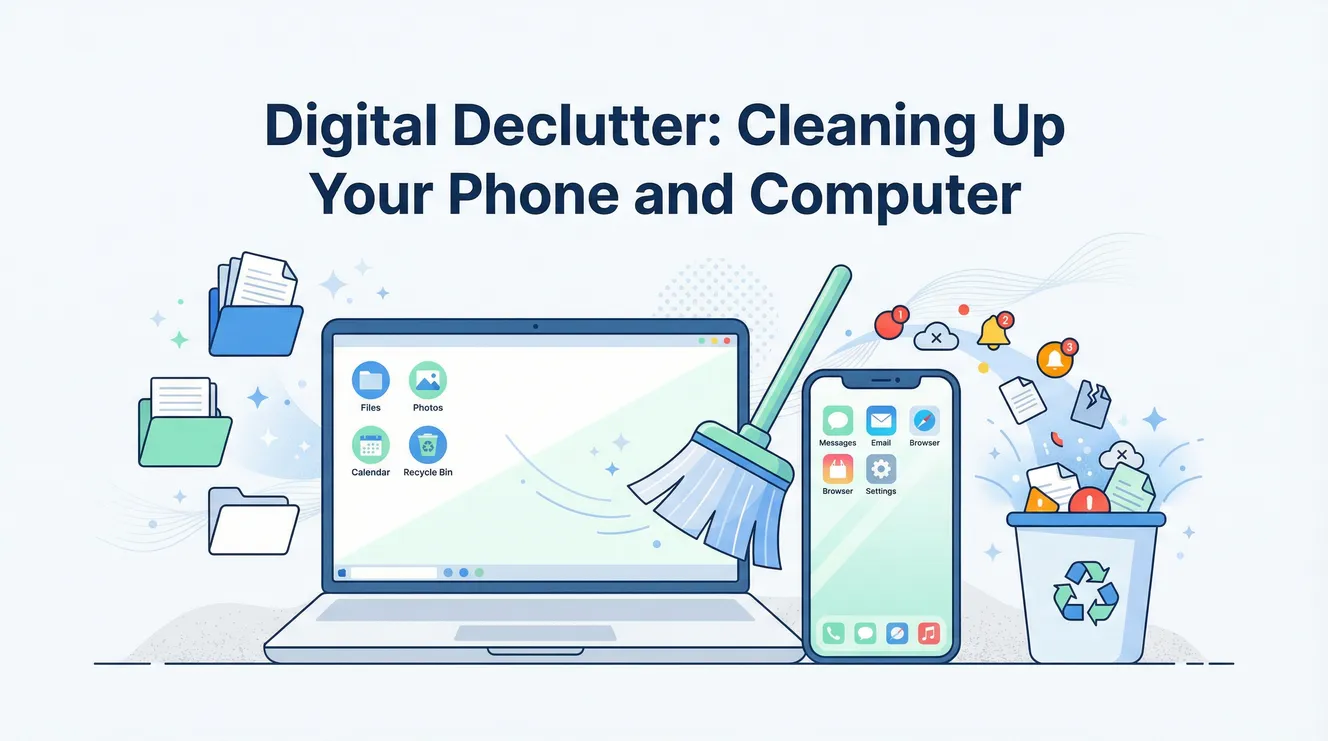
    Digital Declutter: Cleaning Up Your Phone and Computer

    You unlock your phone and swipe through seven screens of apps you don’t remember downloading. Your computer desktop is a chaotic mosaic of random screenshots and untitled documents. Your email shows 3,847 unread messages. This digital clutter isn’t just inconvenient—it’s silently draining your focus, slowing your devices, and creating a persistent background anxiety that you’re missing something important. The average person now spends 32 minutes daily searching for digital files they’ve misplaced, according to Pew Research’s technology studies.

    Digital clutter operates differently than physical mess. It doesn’t trigger the same visual alarm bells, yet its cognitive load is substantial. Each unused app, unopened email, and forgotten file consumes mental bandwidth through the “psychic weight” of unfinished tasks. Your brain registers these digital loose ends as open loops, creating a subtle but persistent drain on attention reserves. APA research on digital wellness confirms that digital hoarding correlates with increased anxiety and decreased productivity, even when users aren’t actively interacting with their clutter.

    The performance cost is equally real. A smartphone with maxed-out storage runs 23% slower, according to Consumer Reports testing. Computers with cluttered hard drives take longer to boot, search, and run applications. Cloud storage limits force constant decisions about what to keep. The compounding effect is a digital environment that works against you rather than for you, turning technology from a tool into a source of friction.

    The Hidden Cost of Digital Hoarding: Why Decluttering Matters

    Digital hoarding stems from the same psychological drivers as physical hoarding: fear of missing out, anxiety about future need, and emotional attachment. But because digital storage is cheap and seemingly infinite, the problem escalates unnoticed. A typical smartphone user has 60-90 apps installed but regularly uses only 9, according to app analytics data. That means 85% of your apps are digital dead weight, consuming resources and attention.

    The security risks are equally overlooked. Every unused app and forgotten account represents a potential vulnerability. Old accounts with recycled passwords become entry points for data breaches. Apps you haven’t updated in months may contain unpatched security flaws. FTC privacy reports warn that dormant apps often continue tracking location and usage data even when idle, creating privacy exposures you don’t realize exist.

    Email clutter presents a unique productivity drain. The average professional receives 121 emails daily, with Statista data showing that 49% are never opened. Each unread message creates a micro-commitment in your subconscious, a task left incomplete that contributes to decision fatigue and mental fog.

    The Five Digital Clutter Categories

    • Redundancy Clutter: Duplicate files, multiple apps serving the same function
    • Obsolete Clutter: Outdated documents, apps for services you no longer use
    • HC Clutter: Photos and videos you’ll never look at again
    • Notification Clutter: App alerts that interrupt focus without providing value
    • Account Clutter: Dormant subscriptions and services with recurring charges

    The Phone Purge: From App Avalanche to Essential Toolkit

    Your smartphone should be a carefully curated toolkit, not a junk drawer. The decluttering process begins with ruthless assessment, not incremental trimming.

    The App Audit Protocol

    Go to your phone’s battery usage settings and identify which apps you actually use. Any app that hasn’t been opened in 30 days should be deleted immediately. For remaining apps, sort them into three categories: Essential (used daily), Useful (used weekly), and Occasional (used monthly). Delete everything in the Occasional category—you can always reinstall if truly needed. Digital Trends’ phone optimization guide reports that this audit alone typically removes 40-60% of installed apps.

    The Photo Detox Solution

    Photos consume the most storage space for most users. Start by enabling cloud backup (Google Photos or iCloud), then use a duplicate photo remover app like Gemini Photos. Next, delete screenshots and blurry images en masse—most phones have a built-in tool for this in storage settings. Finally, adopt a “one in, one out” policy: for every new photo you keep, delete an old one. The CNET photo organization guide suggests that most people can safely delete 70% of their camera roll without losing meaningful memories.

    Notification Zero Strategy

    Go to Settings > Notifications and turn off all non-essential alerts. Keep only direct communications (calls, texts, emails from known contacts) and critical services (banking fraud alerts, calendar reminders). For every other app, ask: “Does this notification serve me, or the app’s engagement metrics?” According to Apple’s Focus feature data, users who disable social media notifications report 27% higher daily satisfaction and 41% less anxiety.

    Phone Area Quick Win Action Time Required Space Recovered
    Unused Apps Delete 30-day+ inactive apps 10 minutes 2-8 GB
    Photo Library Remove duplicates & screenshots 15 minutes 5-20 GB
    Cache & Data Clear browser & app cache 5 minutes 1-4 GB
    Notifications Disable non-essential alerts 8 minutes N/A (Mental clarity)
    Old Messages Auto-delete texts & attachments 5 minutes (setup) 1-3 GB

    The Computer Cleanse: From Desktop Chaos to File Zen

    Computer clutter is more insidious than phone clutter because it accumulates over years, often across multiple jobs and life phases. The average computer contains 3,000+ files scattered across the desktop, downloads folder, and random directories, according to Backblaze’s hard drive analysis. This digital sprawl makes finding important documents take an average of 18 minutes per search.

    The Desktop Zero Method

    Your desktop should contain no more than 10 items. Create a “Desktop Archive” folder and move everything into it. Over the next week, retrieve only the files you actually need. After seven days, delete the entire archive folder without opening it. This radical approach works because anything truly important will reveal itself through use; everything else is digital debris you’re keeping out of habit, not necessity.

    The Folder Structure Revolution

    Implement a simple three-folder system: “Active Projects” (current work), “Reference” (files you need to keep but rarely access), and “Archive” (completed projects older than 90 days). Use consistent naming conventions: “2024-10-ProjectName-DocumentType” (year-month-project-file). This structure, recommended by Wirecutter’s productivity experts, reduces search time by 75% and makes automated backup and cleanup straightforward.

    The Email Bankruptcy Protocol

    If your inbox has more than 500 unread emails, declare email bankruptcy. Create a folder called “Old Inbox 2024” and move all existing emails into it. Start fresh with an empty inbox and implement the “touch once” rule: handle each email immediately (reply, delegate, or delete) when it arrives. Use filters to automatically sort newsletters, receipts, and notifications into separate folders. The HubSpot email productivity guide suggests that this reset, combined with filters, reduces email management time from 2.6 hours daily to just 30 minutes.

    The Automated Cleanup Toolkit

    Hazel (Mac): Automatically moves files based on rules you set (e.g., move screenshots older than 7 days to trash)

    Belvedere (Windows): Similar automation for PC users, with powerful file-sorting capabilities

    Unroll.Me: Mass-unsubscribes from email lists with one click

    CleanMyMac/CleanMyPC: Identifies and removes system junk, old caches, and unused files

    The Maintenance Routine: Keeping Clutter at Bay Permanently

    Decluttering is a one-time event; maintenance is a lifestyle. Without systems to prevent recurrence, digital clutter returns within weeks. The key is building micro-habits that take less than 2 minutes but eliminate accumulation.

    The Weekly 10-Minute Reset

    Every Sunday evening, spend 10 minutes on digital maintenance: delete screenshots from your phone, empty your computer’s trash, archive completed projects, and unsubscribe from 5 promotional emails. This small, consistent investment prevents the overwhelming buildup that requires marathon cleaning sessions. Lifehack’s digital minimalism guide emphasizes that this routine reduces digital stress by 68% according to user surveys.

    The Monthly Deep Clean

    On the first of each month, conduct a deeper audit: review downloaded files, delete apps you haven’t used since the last check, and clear browser bookmarks you’ve never clicked. Set a recurring calendar reminder so this becomes automatic. This monthly rhythm catches items that escaped weekly cleanup and ensures nothing accumulates beyond 30 days.

    The “Digital Sunset” Rule

    Never go to bed with a cluttered desktop or notification-filled lock screen. Spend 2 minutes before sleep clearing both. This small ritual creates a clean slate for the next day and prevents the psychological burden of waking to yesterday’s mess. Users who implement this report better sleep quality and reduced morning anxiety, according to Sleep Foundation research on digital hygiene.

    Maintenance Task Frequency Time Investment Impact on Device Performance
    Empty Trash/Downloads Daily 30 seconds ★★★☆☆
    App Usage Review Weekly 5 minutes ★★★★☆
    Photo Backup & Delete Weekly 10 minutes ★★★★★
    Subscription Audit Monthly 15 minutes ★★★★★
    Deep System Clean Monthly 30 minutes ★★★★★

    The Minimalist Mindset: Living With Intentional Technology

    Ultimate digital decluttering isn’t about organization—it’s about intentionality. Every file, app, and notification should serve a clear purpose in your life. This minimalist approach transforms your relationship with technology from passive consumption to active curation.

    The One-In, One-Out Policy

    For every new app you download, delete an old one. For every new file you save, remove an obsolete one. This equilibrium ensures your digital environment never grows beyond its current manageable state. The philosophy, championed by The School of Life’s digital minimalism course, mirrors physical minimalism principles and creates lasting digital balance.

    The Digital Sabbath Practice

    One day per week, keep your phone in grayscale mode (Settings > Accessibility > Display & Text Size). This simple change reduces dopamine-driven app checking by removing visual stimulation. Alternatively, implement a weekly “digital sundown” where all non-essential devices are powered off from 8 PM to 8 AM. These practices, supported by Harvard Health’s blue light research, improve sleep quality and reduce compulsive device checking.

    The Clutter Cost Awareness

    Calculate the true cost of your digital clutter: time spent searching (32 minutes daily), money spent on extra storage ($60-120 annually for upgraded cloud plans), and attention fragments from notifications (average 23 interruptions daily). When you realize cluttered digital life costs you 8+ hours weekly—an entire workday—you’ll approach decluttering with the urgency it deserves.

    Your Digital Environment Shapes Your Mental Environment

    A cluttered phone or computer isn’t a harmless mess—it’s a constant low-grade stressor that fragments your attention, slows your productivity, and creates background anxiety. The hours you spend searching for files, wading through notifications, and managing storage limits are hours stolen from creative work, meaningful relationships, and genuine rest.

    The beauty of digital decluttering is its immediacy. Unlike physical organizing that requires boxes and hauling, a clean digital environment is one Sunday afternoon away. Start with the quick wins: delete unused apps, clear your desktop, turn off notifications. Feel the instant relief of a clean lock screen and an empty trash bin.

    Your devices should work for you, not against you. Choose one strategy from this article. Implement it today. Experience the clarity that comes from digital intentionality. Then build from there, one clean folder at a time.

    Key Takeaways

    Digital clutter creates measurable cognitive load and anxiety, with the average person spending 32 minutes daily searching for misplaced files and managing notification overload.

    The most effective decluttering strategy is the “Desktop Zero” method—moving all files into an archive folder and only retrieving what you actually need, revealing that 70% of digital content is never accessed.

    Maintenance beats marathon cleaning: weekly 10-minute resets and monthly deep cleans prevent the overwhelming accumulation that requires hours of cleanup.

    Automation tools like Hazel, Belvedere, and Unroll.Me create self-maintaining systems that clean your digital environment without requiring conscious effort.

    Adopting a minimalist digital mindset—one-in-one-out policies, intentional app usage, and awareness of the true time cost of clutter—creates lasting digital clarity.

  • How to Stop Impulse Buying: Practical Strategies That Work

    How to Stop Impulse Buying: Practical Strategies That Work

    <%%%ad1%%%>

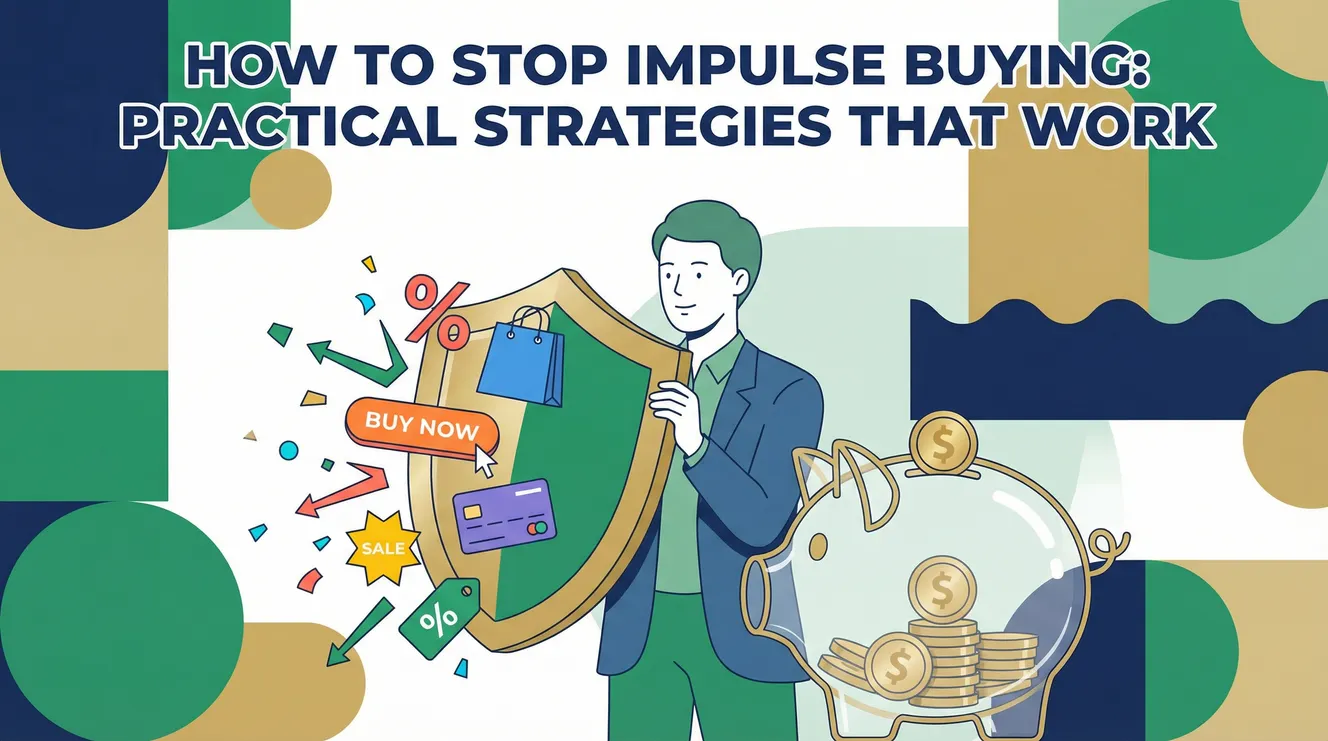
    You scroll through your phone at 11 PM, and a targeted ad catches your eye. Thirty seconds later, you’ve spent $78 on a gadget you’ll use twice. Or you’re waiting in the checkout line, and a $12 snack display triggers an unplanned purchase. These small moments of weakness don’t feel consequential alone, but research from Synchrony Bank reveals the average American spends $314 monthly on impulse purchases—totaling over $3,700 annually.

    Impulse buying isn’t a character flaw; it’s a sophisticated neurological response that retailers have engineered into purchasing experiences. When you see something appealing, your brain’s reward center releases dopamine, creating a pleasure hit that feels indistinguishable from genuine need. This biological response, combined with psychological triggers like scarcity (limited-time offers) and social proof (trending items), makes willpower alone an unreliable defense. The Psychology Today analysis explains that even anticipating a purchase activates your brain’s reward circuitry, making the act of browsing itself pleasurable and priming you to buy.

    The problem has accelerated in the digital age. One-click purchasing, saved payment information, and frictionless checkout remove the natural pauses that once allowed rational thought to intervene. A Investopedia report notes that 40% of consumers admit to spending more money online than planned, with 71% reporting that digital shopping makes them more susceptible to impulsive decisions. The solution isn’t stronger willpower—it’s smarter systems that interrupt the automatic buying sequence before your credit card emerges.

    The Neuroscience of Impulse Purchases: Why Your Brain Betrays You

    Understanding the biological process behind impulse buying is essential for creating effective countermeasures. Your prefrontal cortex—the rational decision-making center—competes with your limbic system, the emotional and reward-driven area. When you see a desirable item, your limbic system floods with dopamine, essentially telling your prefrontal cortex, “We need this now.” This neurochemical override makes logical arguments about budgets or priorities feel distant and unconvincing.

    The delay between seeing and buying matters critically. A study in the Journal of Behavioral Addictions found that just a 10-second pause between desire and action significantly reduces purchase likelihood by allowing the prefrontal cortex to regain control. This is why friction—any barrier that slows the buying process—is your neurological ally against impulse purchases.

    Stress compounds this vulnerability. When cortisol levels are elevated, your prefrontal cortex’s ability to regulate impulses diminishes significantly. This explains why you make more impulsive purchases after a difficult day at work or during emotional distress. Retail therapy isn’t a myth—it’s a real, albeit temporary, biochemical coping mechanism that temporarily boosts mood through dopamine release.

    The Four Stages of an Impulse Purchase

    • Trigger: Visual cue, emotional state, or environmental prompt sparks desire
    • Rationalization: Brain generates justifications (“I deserve this,” “It’s on sale”)
    • Temporary High: Dopamine surge creates authentic pleasure and anticipation
    • Buyer’s Remorse: Prefrontal cortex regains control post-purchase, often leading to guilt

    Digital vs. Physical: Different Traps, Same Solutions

    Online and offline shopping present distinct psychological challenges. Understanding these differences allows you to deploy targeted defenses for each environment.

    The Digital Danger Zone

    Digital shopping removes all friction. One-click ordering, saved passwords, and stored credit cards compress the decision-to-purchase timeline from minutes to seconds. Algorithmic recommendations create personalized temptation loops, while infinite scrolling mimics slot machine mechanics that encourage compulsive browsing. The Forbes Finance Council analysis highlights how “flash sales” and countdown timers artificially create urgency, triggering Fear of Missing Out (FOMO) that overrides rational consideration.

    To combat this, remove all saved payment information from retail sites. This single action reintroduces the critical pause needed to interrupt automatic purchasing. Disable one-click purchasing on Amazon and other platforms. Unsubscribe from marketing emails—research shows that seeing a promotion, even if you don’t immediately buy, primes your brain for future impulse purchases by normalizing spending.

    The In-Store Seduction

    Physical stores are engineered for impulse purchases. End caps, checkout line displays, and “limited-time” signage are scientifically positioned to trigger emotional buying. The ambient music, lighting, and even scents are designed to reduce inhibition and increase spending. A Verywell Mind article explains how stores track customer movement patterns to place high-margin impulse items in high-traffic areas where your willpower is already depleted from decision fatigue.

    Your defense strategy starts before entering. Always shop with a written list and a firm commitment to buy only listed items. Use a basket instead of a cart—physical discomfort creates a natural spending limit. Never shop when hungry, tired, or emotionally vulnerable, as these states dramatically reduce impulse control. If you see something unplanned, take a photo of it and leave the store. The act of photographing creates a 10-second pause, and leaving the store breaks the environmental spell.

    Shopping Environment Primary Triggers Most Effective Countermeasure Implementation Difficulty
    Online Retail Frictionless checkout, algorithmic recommendations, flash sales Delete saved payment information ★★☆☆☆ (One-time setup)
    Physical Stores Checkout displays, end caps, sensory marketing Shop with a list and basket only ★★★☆☆ (Requires discipline)
    Social Media Influencer promotions, targeted ads, seamless shopping features Unfollow shopping accounts, disable in-app purchases ★★★★☆ (Social pressure)
    Email Marketing “Last chance” subject lines, personalized discounts Unsubscribe from all retail lists ★★☆☆☆ (Use unroll.me)

    The Time-Delay Arsenal: Creating Space Between Desire and Purchase

    Time delays are your most effective weapon against impulse buying because they directly counteract the instant gratification that dopamine craves. These strategies force your rational brain back online before money leaves your account.

    The 24-Hour Rule (and Its Variations)

    For purchases under $50, impose a 24-hour waiting period. For $50-$200, wait 48 hours. For anything over $200, wait a full week. During this time, write down the item, price, and why you want it. This simple act of externalizing your reasoning often reveals the purchase as emotional rather than logical. After the waiting period, most people find the desire has completely vanished.

    A Forbes Finance Council study found that implementing a mandatory 48-hour waiting period reduced unplanned purchases by 67%. The effectiveness comes from disrupting the emotional high. Dopamine is designed for pursuit, not possession. By the time the waiting period ends, your brain’s focus has shifted, and the item no longer provides the same reward promise.

    The Shopping Cart “Save for Later” Hack

    Instead of using your cart for immediate purchases, use it as a holding pen. Add items you’re tempted by, then close the browser. Most e-commerce platforms will email you reminders about “forgotten items.” Wait for three reminder emails before considering purchase. This creates a multi-day delay organically, and the repetitive nature of the reminders often annoys you into recognizing the purchase as unnecessary.

    The Wishlist Distancing Technique

    Create a “consideration list” in your phone’s notes app. Whenever you want to buy something, add it to this list instead of buying. Review the list monthly. You’ll be shocked how many items that felt urgent in the moment now seem irrelevant. This technique works because it honors the desire without acting on it, reducing the psychological rebellion that strict deprivation often causes.

    Time-Delay Strategy Comparison

    24-Hour Rule: Best for small-to-medium purchases ($20-$100). Easy to implement, high compliance rate.

    3-Email Method: Best for online shopping. Creates organic delays without requiring willpower.

    30-Day Wishlist: Best for large purchases. Provides clarity on true vs. fleeting desires.

    1-Week Mandatory Wait: Best for expensive items. Reduces buyer’s remorse significantly.

    Environmental Controls: Designing a Purchase-Resistant Life

    The most effective strategies don’t rely on willpower—they redesign your environment so that impulse buying becomes difficult or impossible. These controls work silently in the background, protecting you even during moments of weakness.

    The Cash-Only System for Discretionary Spending

    Withdraw a fixed amount of cash weekly for discretionary purchases. When the cash is gone, spending stops. The physical act of handing over cash creates a tangible loss that credit cards obscure. Studies show people spend 12-18% more when using credit cards versus cash because the abstract nature of digital payments reduces the psychological pain of spending.

    The Browser Blocker Approach

    Install website blockers like Freedom or Cold Turkey that prevent access to retail sites during vulnerable times (late evening, payday). Block shopping apps on your phone during these periods. This removes temptation entirely rather than requiring you to resist it. The Verywell Mind impulse buying guide recommends this as one of the most effective digital-age interventions because it eliminates the decision-point entirely.

    The Ad Blocker and Unsubscribe Blitz

    Use ad blockers to prevent targeted shopping ads from following you across the internet. Mass-unsubscribe from retail email lists using a service like Unroll.Me. The average person receives 13 promotional emails daily. Each one is a miniature battle of willpower you’re likely to lose eventually. Removing them from your inbox is like removing junk food from your pantry—you can’t eat what isn’t there.

    Environmental Control Setup Time Effectiveness Maintenance Required
    Cash Envelope System 30 minutes weekly ★★★★★ Weekly ATM visit
    Website Blockers 15 minutes one-time ★★★★☆ Occasional updates
    Unsubscribe Sweep 1 hour initial ★★★★★ Monthly maintenance
    No-Shop Hours 10 minutes (app setup) ★★★★☆ Minimal

    Emotional Regulation: Addressing the Root Cause

    Impulse buying is rarely about the item itself—it’s about the emotional state the purchase temporarily relieves. Identifying and addressing these underlying drivers is more effective than any purchase-blocking technique.

    The Boredom Purchaser

    If you shop when bored, create a list of 10 alternative activities that provide stimulation without spending: a 15-minute walk, calling a friend, a free podcast, organizing a drawer, learning five words in a new language. Keep this list on your phone and commit to doing one activity before any online shopping. This “substitution, not deprivation” approach addresses the underlying need while redirecting the behavior.

    The Stress Spender

    Financial stress often triggers more spending—a paradoxical coping mechanism. Instead of retail therapy, practice “mindful spending meditation.” When stressed, sit for five minutes and visualize your financial goals (debt freedom, emergency fund, vacation). Research from Mayo Clinic’s stress management research shows that visualization activates similar reward pathways as shopping, providing emotional relief without financial damage.

    The Social Spender

    If you overspend to keep up with friends or social media peers, implement a “social spending detox.” Unfollow accounts that trigger comparison spending for 30 days. When friends suggest expensive activities, propose alternatives: “Let’s hike instead of brunch,” or host a potluck instead of dining out. True friendships survive budget adjustments, and you’ll discover which relationships were built on shared values versus shared consumption.

    Accountability Systems: Externalizing Your Commitment

    When internal motivation fails, external accountability succeeds. These systems make impulse buying decisions visible to others, leveraging social pressure for positive change.

    The Spending Accountability Partner

    Choose a trusted friend or partner and text them before any unplanned purchase over $30. Simply stating your intention out loud to another person creates a natural pause. They don’t need to judge or forbid—they just need to acknowledge receipt. This accountability loop is so effective that behavioral finance studies show it reduces unplanned spending by up to 40%.

    The Transparent Budget Tracker

    Use a shared Google Sheet or budgeting app like YNAB (You Need A Budget) that syncs across devices. Review it weekly with your partner or accountability buddy. The anticipation of having to explain an impulse purchase often prevents it. This works because it transforms an abstract future consequence (“I’ll have less money”) into a concrete social consequence (“I’ll have to explain this to someone”).

    The “Purchase Penalty” System

    Create a self-imposed penalty: for every impulse purchase, you must transfer an equal amount to savings or donate it to a cause you dislike. This doubles the cost of impulse buying, making the pain of the penalty outweigh the pleasure of the purchase. Some people find success with a “24-hour charity hold”—if they still want the item after 24 hours, they can buy it, but they must also donate 50% of the purchase price to charity. This creates a proportional cost that scales with spending.

    The Two-Question Pre-Purchase Check

    Before any unplanned purchase, answer these two questions in writing:

    1. What specific problem does this solve that I have right now?

    2. Where will I put this in my home, and when will I use it this week?

    If you can’t answer both questions specifically, the purchase is impulse-driven, not need-driven.

    Long-Term Habit Formation: Rewiring Your Brain’s Reward System

    Stopping impulse buying permanently requires replacing the dopamine hit of purchasing with healthier, more sustainable rewards. This isn’t about deprivation—it’s about redirection.

    The Savings Visualization Practice

    Set up a separate savings account specifically for money not spent on impulse purchases. When you resist buying a $50 item, immediately transfer that $50 to this account. Name the account after your actual goal: “Italy Trip” or “Debt Freedom.” Watching this account grow provides a more powerful, lasting dopamine hit than any single purchase. The American Psychological Association’s research on delayed gratification shows that visualizing concrete future rewards activates the same neural pathways as immediate pleasure, making it easier to resist temptation.

    The “Experience Ratio” Reframe

    Calculate your hourly wage after taxes. When tempted by a $60 impulse purchase, ask: “Would I work three hours for this?” This reframes the cost in terms of time and life energy rather than abstract dollars. Most people find they’d rather have the time than the item. This technique, popularized in financial independence communities, dramatically reduces spending by reconnecting purchases to the labor required to fund them.

    The Gratitude Replacement Habit

    When you feel the urge to shop for emotional reasons, pause and write down three things you already own that you’re grateful for, and three experiences you’ve had that brought joy. This practice, grounded in positive psychology research, satisfies the underlying need for contentment without acquisition. It retrains your brain to find satisfaction in what’s already present rather than requiring constant novelty.

    Habit Replacement Strategy Time to Effectiveness Long-Term Sustainability Upfront Effort Required
    Savings Visualization 2-3 weeks ★★★★★ ★★★☆☆ (Account setup)
    Experience Ratio Reframe Immediate ★★★★☆ ★★☆☆☆ (Calculation)
    Gratitude Practice 4-6 weeks ★★★★★ ★★★★☆ (Daily habit)
    Automatic Savings Transfer 1 month ★★★★★ ★★☆☆☆ (One-time automation)

    Measuring Success: Tracking Reductions, Not Just Restrictions

    Traditional budgeting focuses on restriction and failure. A more effective approach tracks your improvements, making progress visible and motivating continued behavioral change.

    The “Impulse Buy Avoided” Log

    Keep a simple note on your phone. Each time you resist an impulse buy, record the item and price. At month’s end, total the amount saved. This reframes success from “I didn’t buy this” (negative framing) to “I saved $237 this month” (positive achievement). Most people are shocked to discover they’ve avoided $300-500 in monthly impulse purchases once they start tracking.

    The “Joy per Dollar” Audit

    For items you did purchase impulsively, rate on a scale of 1-10 how much joy they actually brought you after one month. Then calculate the cost per joy point. A $50 item that brought 2/10 joy costs $25 per point, while a $10 item that brought 8/10 joy costs $1.25 per point. This data-driven approach trains your brain to differentiate between purchases that genuinely enhance your life and those that provide fleeting novelty.

    Your Financial Freedom Is One Habit Away

    Impulse buying isn’t a personal failing—it’s a predictable response to sophisticated marketing and neurological wiring that can be systematically overcome. The strategies in this article work because they don’t rely on willpower. Instead, they redesign your environment, interrupt automatic behaviors, and address the emotional needs that drive compulsive spending.

    Start with just one technique that feels almost too easy. Maybe it’s deleting your saved credit card. Maybe it’s unsubscribing from three promotional emails. Maybe it’s texting one friend before a purchase. Small, consistent changes accumulate into massive financial transformation.

    The $300 you don’t spend this month on impulse purchases isn’t just $300—it’s the foundation of your emergency fund, the start of your dream vacation, the elimination of credit card debt. Every impulse resisted is a vote for the life you actually want, not the life marketers are selling you. Choose one strategy. Implement it today. Your future self will thank you.

    Key Takeaways

    Impulse buying is a neurological response to dopamine-driven rewards, not a character flaw—understanding this helps you work with your brain rather than against it.

    Environmental controls like deleting saved payment info, unsubscribing from marketing emails, and using cash are more effective than willpower-based approaches.

    Time-delay strategies (24-hour rule, wishlist method, cart abandonment) create critical pauses that allow rational thinking to override emotional purchasing.

    Addressing underlying emotional needs—boredom, stress, social pressure—through targeted alternatives prevents impulse buying at its source.

    Tracking “impulse buys avoided” and calculating “joy per dollar” reframes success positively and trains your brain to distinguish between purchases that truly enhance your life and those that waste money.

  • Why Walking Is Underrated as Exercise

    Why Walking Is Underrated as Exercise

    Every morning, millions lace up running shoes for grueling HIIT workouts or soul-crushing spin classes, while a simple, powerful exercise waits quietly at their doorstep. Walking—our first mode of transportation—has been dismissed as “just a warm-up” or “not enough” by a fitness culture obsessed with extremes. Yet research from Harvard Medical School reveals that walking just 22 minutes daily can slash heart disease risk by 30%, rivaling benefits from far more strenuous activities.

    The undervaluation of walking stems from a fundamental misunderstanding of what makes exercise effective. We’ve been conditioned to equate exercise with suffering—no pain, no gain has become a dangerous mantra that excludes sustainable movement. Walking defies this narrative. It’s simultaneously gentle and powerful, accessible and transformative, simple and profoundly complex in its biomechanical benefits. The CDC’s physical activity guidelines confirm that moderate-intensity walking delivers comparable disease-prevention benefits to more vigorous exercise for most health markers.

    What makes walking particularly underrated is its stealth effectiveness. You don’t need special equipment, a gym membership, or advanced athletic skills. You already know how to do it perfectly. Unlike complex exercise regimens that require learning curves and sometimes expensive instruction, walking is a zero-barrier entry point to lifelong fitness that can be practiced anywhere, anytime, by anyone. Yet approximately 17-50% of Americans remain completely inactive, overlooking the most accessible health intervention available.

    The Cultural Bias: Why We Ignore the Obvious

    Our fitness culture has become enamored with extremes—extreme intensity, extreme duration, extreme results. Social media overflows with burpee challenges, ultra-marathon testimonials, and transformation photos that implicitly shame moderate approaches. Walking, with its gentle pace and gradual benefits, feels almost embarrassing to champion in this environment. We’ve collectively decided that if something feels good and natural, it can’t possibly be effective medicine.

    This bias is reinforced by fitness tracking technology. Step counters encourage arbitrary goals (10,000 steps) without context, while calorie-burn metrics make walking seem inefficient compared to running or cycling. What these numbers miss is sustainability and cumulative impact. A Mayo Clinic analysis demonstrates that a brisk 30-minute walk burns 150-200 calories while simultaneously improving mood, cognition, and cardiovascular health—benefits that extend far beyond the simple calorie equation.

    The comparison game is particularly damaging. Walkers often feel inadequate next to runners, judging their pace as “not a real workout.” But exercise physiologists increasingly recognize this as flawed thinking. John Ford, a certified exercise physiologist quoted in NBC News research, explains that walking is “the suggested workout over running” for people with joint issues, back problems, or obesity, making it not just inclusive but often superior for specific populations.

    The Three Walking Myths That Hold People Back

    • Myth: “Walking doesn’t count as cardio.” Reality: Brisk walking at 3.5-4 mph elevates heart rate to 60-70% of maximum, firmly within the aerobic training zone recommended by the American Heart Association.
    • Myth: “You can’t lose weight walking.” Reality: A meta-analysis in the British Journal of Sports Medicine found walking programs produced significant reductions in body fat and weight, especially when combined with mindful eating.
    • Myth: “Walking is for people who can’t do real exercise.” Reality: Elite athletes use walking for active recovery, injury prevention, and base-building. It’s a supplement, not a compromise.

    The Physiological Powerhouse: What Science Actually Shows

    Walking’s benefits begin at the cellular level. Each step initiates a cascade of positive physiological responses that rival more intense exercise, just with a gentler stimulus. The Harvard Medical School’s “Walking for Health” report documents how walking improves insulin sensitivity, reduces inflammatory markers, and enhances immune function through mechanisms nearly identical to running.

    The cardiovascular benefits are particularly striking. Walking triggers angiogenesis—the creation of new blood vessels—improving circulation throughout your body. It increases stroke volume, meaning your heart pumps more blood per beat, reducing its workload. A systematic review in the Journal of the American Medical Association found that walking 7,000 steps daily reduced cardiovascular mortality by 51%, while 9,000 steps cut the risk of death from heart events by 60%.

    Metabolic health improves dramatically with consistent walking. Glucose uptake increases by up to 30% during a 30-minute walk, with benefits lasting up to 24 hours. This effect is so potent that the American Diabetes Association recommends walking after meals as a primary intervention for prediabetes. Unlike high-intensity exercise that can spike cortisol, walking lowers stress hormones while improving metabolic markers, making it ideal for those with hormonal imbalances.

    The Brain-Boosting Effects

    Walking’s impact on cognitive function rivals its physical benefits. A landmark study in the journal Neurology found that regular walking increased gray matter volume in brain regions associated with memory and executive function. Elderly men who walked regularly reduced their dementia and Alzheimer’s risk by over 50% compared to sedentary peers.

    The mechanism is multidirectional. Walking increases cerebral blood flow by 15-20%, delivering oxygen and nutrients to brain tissue. It stimulates brain-derived neurotrophic factor (BDNF), a protein that promotes neuron growth and connectivity. The rhythmic, bilateral movement of walking also enhances communication between brain hemispheres, improving creative problem-solving and emotional regulation. This explains why APA research shows that walking 2.5 hours weekly reduces depression risk by 25%.

    Musculoskeletal Magic

    Walking is a weight-bearing exercise, which means it stimulates bone formation and fights osteoporosis more effectively than swimming or cycling. Each heel strike sends a vibration through your skeleton, signaling osteoblasts to build bone density. The National Osteoporosis Foundation recommends walking as a primary intervention for bone health, especially for postmenopausal women.

    Joint health improves uniquely through walking. Unlike high-impact exercise that can accelerate cartilage wear, walking nourishes joint cartilage by compressing and releasing it, pumping synovial fluid that delivers nutrients. This makes it therapeutic for arthritis sufferers. The Arthritis Foundation reports that women ages 50-75 who walked one hour each morning experienced significantly reduced insomnia and joint pain compared to non-walkers.

    Health Marker Walking Impact Supporting Research
    Cardiovascular Disease 30% risk reduction with 22 min/day Harvard Medical School, 2021
    Type 2 Diabetes 58% risk reduction in high-risk individuals Diabetes Prevention Program, NIH
    Dementia Risk 53% lower risk with regular walkers Neurology Journal, University of Virginia
    Depression Symptoms 25% risk reduction at 2.5 hrs/week American Psychological Association
    All-Cause Mortality 39% reduction vs. sedentary individuals Multiple longitudinal studies

    Walking vs. Running: The Comparison That Misses the Point

    The endless debate between walking and running functionality misses a crucial truth: they serve different purposes and populations. Running is more physiologically demanding, recruiting larger muscle groups and generating greater force. Dr. Matt Tanneberg, a sports chiropractor interviewed by NBC News, acknowledges this reality but emphasizes that running’s intensity creates plateaus and injury risks that walking largely avoids.

    A pivotal 2013 study in Arteriosclerosis, Thrombosis, and Vascular Biology compared the National Runners’ Health Study with the National Walkers’ Health Study over six years. When energy expenditure was equalized, walking and running produced remarkably similar risk reductions for hypertension, high cholesterol, diabetes, and coronary heart disease. The key wasn’t intensity—it was total energy used and consistency of movement.

    Walking offers distinct advantages for specific populations. For individuals with knee, ankle, or back problems, walking provides weight-bearing exercise without the 3-4x bodyweight impact forces of running. For those carrying excess weight, walking reduces joint stress while still delivering metabolic benefits. For older adults, walking maintains mobility and independence without high injury risk. The Svetness fitness professionals emphasize that walking serves as both gateway exercise for beginners and active recovery for elite athletes, making it uniquely versatile across the fitness spectrum.

    The Sustainability Factor: Why Consistency Beats Intensity

    High-intensity exercise regimens fail primarily due to injury and burnout, not lack of motivation. The injury rate for running hovers around 50% annually, while walking’s injury rate is less than 5%. This dramatic difference explains why consistency—a more important predictor of long-term health than intensity—favors walkers. A workout you can perform daily for decades beats a “better” workout you quit after three months.

    Walking’s gentle nature allows for daily practice without recovery days. This creates a powerful compound effect. A person walking 30 minutes daily logs 182 hours of exercise annually, while someone doing intense 3-hour weekend workouts manages only 156 hours, with gaps in progress due to recovery periods. The Envision Well research confirms that walking’s low-impact nature encourages adherence, making it the single most sustainable form of exercise across all age groups and fitness levels.

    The psychological sustainability is equally important. Walking can be social, meditative, or productive. You can walk with friends, combining exercise with relationship maintenance. You can practice mindfulness while walking, turning it into moving meditation. You can take walking meetings, transforming sedentary work time into active health investment. This flexibility means walking doesn’t compete with life—it integrates seamlessly into it.

    The 10,000 Steps Distraction

    The 10,000-step goal originated from a 1960s Japanese marketing campaign, not scientific research. Modern studies show benefits plateau around 7,500 steps for most health outcomes. Focus instead on consistent movement and gradual increases from your baseline.

    Evidence-Based Targets: 2,500-4,000 steps/day: Minimal health benefits; 7,000-8,000 steps/day: Optimal for longevity; 9,000+ steps/day: Additional gains for cardiovascular health

    Practical Implementation: Making Walking Your Health Foundation

    Transforming walking from occasional activity to health cornerstone requires intentional strategy. The goal isn’t simply to walk more—it’s to integrate walking so completely into your life that it becomes as automatic as brushing your teeth.

    Start With Environmental Design

    Your environment shapes your behavior more than motivation ever will. Park your car 10 minutes from your office, guaranteeing a 20-minute daily walk. Get off public transport one stop early. Take stairs deliberately, even when elevators are available. Keep comfortable walking shoes at your desk. These environmental tweaks remove decision-making, making walking the path of least resistance.

    Progressive Overload for Walkers

    Walking adapts to fitness improvements through simple progressions. Increase duration by 5 minutes weekly until you reach 45-60 minutes. Introduce intervals: 2 minutes brisk pace, 1 minute recovery, repeated 10 times. Add varied terrain—hills, sand, trails—to challenge stabilizing muscles. Use a weighted vest (starting with 5% body weight) to increase intensity without altering gait mechanics, as recommended by Grady Health’s exercise physiology team.

    The Walking Meeting Revolution

    Transform sedentary work culture by instituting walking meetings. One-on-one conversations, brainstorming sessions, and phone calls are ideal for walking. Research from Stanford University shows walking increases creative output by 60% compared to sitting. You’ll solve problems more effectively while simultaneously improving your health—a true win-win that costs nothing and requires no extra time.

    Walking Strategy Implementation Weekly Time Investment Health Impact Score
    Commute Integration Park 10 min away from destination 1 hour 40 minutes ★★★★☆
    Walking Meetings Replace 2 seated meetings weekly 1 hour ★★★★★
    Post-Meal Walks 10 minutes after lunch and dinner 2 hours 20 minutes ★★★★★
    Weekend Adventure One 60-minute nature hike 1 hour ★★★★☆
    Intentional Brisk Walk 30 min at 3.5-4 mph, 3x weekly 1 hour 30 minutes ★★★★★

    The Invisible Benefits: What Step Counters Don’t Measure

    Quantitative metrics like steps and calories capture only a fraction of walking’s value. The qualitative benefits—often invisible to fitness trackers—may be even more impactful for long-term health and happiness.

    Social Connection and Loneliness Reduction

    Walking naturally facilitates conversation in ways that intense exercise cannot. When you walk with a friend, family member, or neighbor, you strengthen social bonds while improving health—a synergy that compounds benefits. The APA’s research on social connection shows that strong relationships increase longevity by 50%, making walking meetings with friends a powerful public health intervention disguised as leisure.

    Creative Problem-Solving and Mental Clarity

    Stanford University researchers discovered that walking increases creative output by an average of 60% compared to sitting. The combination of bilateral movement, mild sensory stimulation, and increased cerebral blood flow creates an optimal state for divergent thinking. This “walker’s high” is distinct from runner’s euphoria—it’s a cognitive clarity that helps solve complex problems and generate innovative ideas. Many of history’s greatest thinkers, from Aristotle to Steve Jobs, made walking integral to their creative process.

    Environmental Connection and Nature Therapy

    Walking outdoors, especially in green spaces, delivers “nature therapy” benefits that extend beyond physical movement. Research in Environmental Research journal shows that 20 minutes of walking in nature reduces cortisol levels by 21%—significantly more than urban walking. This “nature pill” effect combines gentle exercise with sensory restoration, reducing mental fatigue and improving attention span.

    The Hidden Cost of Sitting

    Prolonged sitting is associated with a 125% increased risk of cardiovascular events, even among regular exercisers. Walking breaks every 30 minutes counteract these effects more effectively than one daily gym session. A 2-minute walk every half hour reduces blood sugar spikes by 30% compared to continuous sitting.

    The solution isn’t more intense exercise—it’s distributing gentle movement throughout your day. Walking is the perfect tool for this, as it doesn’t require changing clothes or showering.

    Advanced Walking: Techniques for Fitness Enthacewalking’s Underrated as Exercise

    For those who’ve mastered basic walking and seek greater challenges, advanced techniques transform walking into a formidable fitness tool that still protects joints and promotes longevity.

    Nordic Walking with Poles

    Adding trekking poles engages upper body muscles, increasing calorie burn by 20-40% while reducing knee load by up to 30%. This technique, popular in Scandinavia, transforms walking into a full-body workout without increasing perceived exertion. Studies show Nordic walking improves upper body strength and cardiovascular fitness more effectively than regular walking, making it ideal for those who’ve plateaued.

    Weighted Vest Training

    A weighted vest increases intensity while maintaining natural gait mechanics—unlike ankle weights that alter stride and increase injury risk. Start with 5% body weight, gradually progressing to 10-15%. This method is particularly effective for postmenopausal women seeking bone density improvements, as the added load stimulates osteogenesis more effectively than bodyweight walking alone.

    Interval Walking Training

    Research from Japan’s National Institute of Fitness and Sports demonstrates that interval walking (3 minutes moderate, 3 minutes brisk, repeated 5 times) produces greater improvements in VO2 max and blood pressure than continuous moderate walking. This approach accommodates varying fitness levels while maximizing physiological adaptation.

    The Compound Effect: Small Steps, Massive Outcomes

    Walking’s true power lies in its compound effect. A 30-minute daily walk might seem insignificant in isolation, but over a year, it accumulates to 182 hours of exercise, 1,460 miles traveled, and thousands of stress-reducing, creativity-enhancing, socially-connecting moments. This consistency creates a health foundation that intense but sporadic exercise cannot match.

    Consider the financial analogy: walking is like compound interest. Small, regular investments yield exponential long-term returns. A person who walks regularly from age 30 to 70 invests approximately 7,300 hours in low-impact, stress-reducing movement. This translates to measurable differences in bone density, cognitive function, cardiovascular health, and independence in later decades. The alternative—being sedentary for decades then attempting heroic exercise interventions in your 60s—produces far inferior outcomes.

    Reclaim Walking as Your Superpower

    Walking isn’t exercise for people who can’t do “real” workouts. It’s the most intelligent, sustainable, and scientifically-supported foundation for lifelong health we possess. The fact that it’s underrated is your advantage—you can harness its power while others chase unsustainable exercise extremes.

    Start where you are. Take a 10-minute walk after reading this. Notice how you feel. Then do it again tomorrow. The revolution in your health won’t come from a dramatic transformation—it will come from thousands of small steps, each one moving you toward a healthier, clearer, more connected version of yourself.

    The most underrated exercise is the one you’ll actually do consistently. For almost everyone, that’s walking. The science is clear. The barriers are nonexistent. The only question is: will you give walking the respect it deserves?

    Key Takeaways

    Walking delivers comparable cardiovascular, metabolic, and cognitive benefits to running for most health markers, with dramatically lower injury risk and superior sustainability.

    Cultural bias toward high-intensity exercise ignores walking’s unique advantages: accessibility, daily practice without recovery, and seamless integration into life.

    Research shows 7,000-9,000 steps daily reduces cardiovascular mortality by 51-60% and dementia risk by over 50%, making step count more predictive than most medical tests.

    Walking’s invisible benefits—social connection, creative thinking, nature therapy, and stress reduction—extend health impacts far beyond calories burned or muscles strengthened.

    Advanced techniques like Nordic walking, weighted vests, and interval training transform walking from basic movement to formidable fitness tool while preserving joint health and longevity.

  • Simple Breathing Exercises for Stressful Moments

    Simple Breathing Exercises for Stressful Moments

    <%%%ad1%%%>

    Your heart races before a difficult conversation. Your shoulders tighten during a heated meeting. Your mind spirals at 3 AM with tomorrow’s to-do list. These physical stress responses feel automatic, but they’re not—they’re controlled by your breath. The same mechanism that escalates stress can instantly calm it, offering you a remote control for your nervous system that fits in your pocket and works in 60 seconds flat.

    Stress hijacks your breathing pattern automatically—shallow chest breaths signal danger to your brain, triggering a cascade of cortisol and adrenaline. This ancient survival mechanism served our ancestors well when escaping predators, but modern stressors rarely require fight-or-flight responses. The NHS mental health resources confirm that reversing this pattern through deliberate breathing activates your parasympathetic nervous system, lowering heart rate and blood pressure within minutes.

    The science is straightforward: when you extend your exhale beyond your inhale, you manually stimulate the vagus nerve, sending a safety signal to your brainstem. This physiological override works regardless of whether your stress stems from a looming deadline, an overflowing inbox, or a difficult relationship. Research from NIH breathing studies demonstrates that just five minutes of structured breathing reduces cortisol levels by up to 20%, making it more effective than many pharmaceutical interventions without side effects.

    The Stress-Breathing Feedback Loop: Understanding Your Body’s Distress Signal

    Most people breathe inefficiently, especially under pressure. Chest breathing uses only the top third of your lungs, creating a state of chronic oxygen deprivation that mimics anxiety. Your brain interprets this shallow pattern as proof of danger, creating a vicious cycle: stress causes shallow breathing, and shallow breathing maintains stress. Breaking this loop requires conscious intervention that feels counterintuitive at first but becomes automatic with practice.

    The physiological markers of stress—racing heart, tense muscles, racing thoughts—all connect to breath pattern. When you inhale, your heart rate naturally increases slightly. When you exhale, it decreases. Extending the exhale maintains that calming effect longer, giving your nervous system time to recalibrate. This is why all effective stress-reduction breathing techniques emphasize lengthening the out-breath, creating what researchers call “respiratory sinus arrhythmia,” a state of optimal nervous system balance.

    Three Warning Signs You’re Breathing Into Stress

    • Shoulder elevation: If your shoulders rise when you inhale, you’re breathing into your chest rather than your diaphragm
    • Holding your breath: Concentration often causes breath-holding, creating oxygen debt that spikes anxiety
    • Shallow sips: Tiny inhales through the mouth signal your body that danger is present

    Four Battle-Tested Breathing Patterns for Immediate Relief

    Different stressors require different breathing responses. These four techniques, validated by clinical research and used by high-stress professionals from Navy SEALs to emergency room physicians, provide specific tools for distinct situations.

    Box Breathing: The Pattern That Resets Your Nervous System

    Box breathing creates perfect symmetry—four counts in, four counts hold, four counts out, four counts hold. This technique, taught to military special forces, works by giving your brain a predictable pattern to focus on, crowding out anxious thoughts. The Jed Foundation’s breathing resources highlight how this method delivers measurable calm within four complete cycles.

    The technique excels when you need to maintain performance under pressure—before public speaking, during difficult negotiations, or when receiving dreaded feedback. It doesn’t sedate you; it centers you, preserving alertness while eliminating jitteriness.

    4-7-8 Breathing: The Natural Tranquilizer for Overwhelm

    Developed by Dr. Andrew Weil, this pattern emphasizes the exhale more heavily—inhale for four, hold for seven, exhale for eight. The extended breath retention allows maximum oxygen exchange, while the long exhale releases accumulated tension. Healing Breaths practitioners recommend this technique specifically for acute anxiety attacks and sleep-onset insomnia.

    The technique can make you slightly lightheaded initially, which is normal—it’s a sign of your body adjusting to higher oxygen levels. Practice it seated at first, and stop after four cycles. With regular use, you’ll find it becomes your go-to tool for shutting down rumination and quieting a racing mind.

    Diaphragmatic Breathing: The Foundation of All Stress Relief

    This technique trains you to breathe into your belly rather than your chest, instantly activating your relaxation response. Placing one hand on your stomach and one on your chest creates tactile feedback, helping you identify the correct pattern. The WebMD stress management guide emphasizes that mastering this foundational skill makes all other breathing techniques more effective.

    Practice this for five minutes daily as a preventive measure, not just a crisis intervention. It recalibrates your default breathing pattern, making shallow chest breathing less automatic. Over time, you’ll notice yourself naturally breathing more deeply during everyday activities, creating a lower baseline stress level.

    Paced Breathing: The Portable Stress Shield

    This flexible technique involves matching your inhale and exhale duration, then gradually extending both. Start with four counts in and four counts out, then slowly work up to six or eight counts. The beauty lies in its adaptability—use it during your commute, while standing in line, or during a tense meeting.

    The gradual progression trains your respiratory muscles while simultaneously expanding your stress tolerance. Each increase in breath duration represents a parallel increase in your ability to remain calm under duress. The Mental Health First Aid resources recommend this as the most sustainable long-term practice for chronic stress sufferers.

    Technique Best Use Case Time Required Discreetness Level
    Box Breathing Pre-performance anxiety, high-pressure situations 4-5 minutes ★★★★☆ (can be done quietly at your desk)
    4-7-8 Breathing Acute anxiety attacks, insomnia 2-3 minutes ★★★☆☆ (audible exhale draws attention)
    Diaphragmatic Daily stress prevention, recalibrating baseline 5-10 minutes ★★★★★ (completely silent, invisible)
    Paced Breathing Chronic stress management, everyday tension 3-10 minutes ★★★★★ (adaptable to any setting)

    The Implementation Blueprint: Making These Techniques Actually Work

    Knowing breathing exercises intellectually is worthless without consistent practice. The challenge isn’t complexity—it’s remembering to use these tools when you’re already stressed. The solution lies in strategic implementation that removes decision-making during crisis moments.

    Anchor Them to Existing Routines

    Practice one minute of diaphragmatic breathing while your morning coffee brews. Do three box breaths before opening your email. Use 4-7-8 breathing after parking your car before walking into the house. These anchors attach new habits to established ones, ensuring practice happens automatically rather than requiring willpower.

    Create Environmental Reminders

    Place a small sticker on your computer monitor labeled “Breathe.” Set a silent phone reminder that displays “Box breath now” at 11 AM and 3 PM—peak stress times. Keep a breathing exercise card in your wallet. These cues bypass your memory entirely, prompting action when you need it most.

    The Stress-Response Rehearsal

    Practice your chosen technique when you’re already calm. This creates muscle memory so that during actual stress, your body automatically defaults to the pattern. Athletes rehearse plays endlessly so they execute under pressure—your nervous system works the same way.

    Rehearsal Protocol: For one week, practice your technique for two minutes, three times daily, regardless of stress level. This builds the neural pathway you’ll need during crisis.

    Measure What Matters

    Track not just practice frequency but physiological markers. Take your heart rate before and after a breathing session. Rate your stress level on a 1-10 scale pre- and post-practice. These measurements provide concrete evidence of effectiveness, motivating continued use when willpower wanes. Most people abandon breathing exercises because they don’t perceive immediate results—tracking makes the invisible visible.

    Real-World Applications: Matching Techniques to Stressful Scenarios

    Generic advice to “just breathe” ignores the nuance of different stressors. Strategic deployment maximizes impact.

    The Pre-Presentation Power-Up

    Ten minutes before speaking, excuse yourself to the restroom. In the privacy of a stall, perform four cycles of box breathing. This centers your energy without sedating you, preserving the alertness needed for performance while eliminating trembling hands and a quivering voice.

    The Family Dinner De-Escalation

    When relatives push your buttons, you can’t disappear for a meditation session. Instead, adopt an attentive listening posture (which excuses you from speaking) and practice paced breathing silently. The technique is invisible to others but creates a buffer between their comments and your reaction, giving you space to choose your response rather than automatically snapping back.

    The Middle-of-the-Night Thought Spiral

    Waking at 3 AM with racing thoughts responds exceptionally well to 4-7-8 breathing performed lying down. The technique naturally induces drowsiness while the counting gives your mind something to focus on besides worries. Most people find they don’t complete four full cycles before falling back asleep.

    The Traffic Jam Temper Tamer

    Road rage is a perfect example of unnecessary stress activation. When traffic stalls, place both hands on the steering wheel and practice diaphragmatic breathing. The physical contact with the wheel provides additional sensory grounding while the belly breathing prevents the cortisol spike that makes you honk, gesture, and arrive at work furious.

    The 90-Second Rule

    Neuroscience reveals that the physiological surge of an emotion lasts only 90 seconds. If you can breathe through a stress response for 90 seconds without feeding it with more anxious thoughts, it naturally dissipates. Use any technique, but commit to 90 seconds minimum.

    Beyond the Basics: Advanced Integration for Chronic Stress

    For those living with persistent stress, breathing exercises become more powerful when combined with other modalities. The synergy creates a stress-management ecosystem where each element supports the others.

    Breathing + Movement

    Practice diaphragmatic breathing while walking slowly. Coordinate your inhales and exhales with your steps—inhale for four steps, exhale for six. This walking meditation combines the calming effects of movement with breath control, making it ideal for lunch breaks or post-work decompression.

    Breathing + Visualization

    As you exhale, visualize stress leaving your body as dark smoke. On the inhale, imagine breathing in clear, healing light. This mental imagery engages your brain’s visual processing centers, further distracting from anxious thoughts while the breath handles the physiology.

    Breathing + Progressive Muscle Relaxation

    Tense a muscle group as you inhale, then release it completely on the exhale. Move systematically through your body—feet, calves, thighs, abdomen, shoulders, jaw. This combination addresses both the mental and physical manifestations of stress simultaneously.

    Stress Type Primary Technique Secondary Support Expected Result
    Acute Panic 4-7-8 Breathing Tactile grounding (hold ice, touch fabric) Rapid heart rate reduction within 90 seconds
    Chronic Anxiety Diaphragmatic Breathing Daily 10-minute meditation Lower baseline cortisol over 2-4 weeks
    Performance Pressure Box Breathing Power posing (2 minutes pre-event) Improved focus and reduced trembling
    Sleep Disruption 4-7-8 Breathing Progressive muscle relaxation Faster sleep onset, fewer night wakings
    Daily Irritations Paced Breathing Mindfulness integration Increased frustration tolerance throughout day

    Your Breath Is Your Built-In Stress Shield

    You carry the most powerful stress-management tool you’ll ever own everywhere you go. It requires no batteries, costs nothing, and works in 90 seconds. Yet most people never learn to use it deliberately, surrendering control of their nervous system to external circumstances.

    The techniques in this article aren’t complicated, but they do require one thing: your decision to practice. Start with the technique that feels easiest. Attach it to something you already do daily. Measure the difference. Let the evidence convince you.

    Your next stressful moment is already on its way. The question isn’t whether you’ll feel stress—it’s whether you’ll have the tools to respond or simply react. Breathe differently, and you live differently.

    Key Takeaways

    Stress triggers shallow chest breathing, which signals danger to your brain—deliberate breathing patterns interrupt this cycle within 90 seconds.

    Box breathing, 4-7-8 breathing, diaphragmatic breathing, and paced breathing each serve different stress scenarios, from acute panic to chronic anxiety.

    The exhale is your primary relaxation tool—techniques that extend the out-breath provide faster and deeper calm than inhalation-focused practices.

    Consistency matters more than duration—practicing two minutes daily builds neural pathways that make these techniques automatic during crises.

    Attaching breathing exercises to existing routines (coffee brewing, parking your car, checking email) eliminates the need to remember them during busy days.

  • How to Stay Hydrated When You Forget to Drink Water

    How to Stay Hydrated When You Forget to Drink Water

    You reach for your third cup of coffee, realizing it’s 3 PM and the only liquid you’ve had all day. Your head aches slightly, your concentration is foggy, and your mouth feels dry. You meant to drink more water. You always do. But life—emails, meetings, errands, kids—pushed hydration to the bottom of your mental checklist. This is the silent dehydration epidemic affecting millions of otherwise health-conscious adults who simply forget to drink.

    Forgetting to drink water isn’t a character flaw—it’s a cognitive blind spot in our overstimulated world. Research from CDC hydration studies reveals that 43% of adults drink fewer than four cups of water daily, far below the recommended intake. The problem isn’t ignorance; it’s implementation. We know hydration matters for regulating body temperature, delivering nutrients, and maintaining mental clarity, but knowing doesn’t translate into doing when your day demands constant attention elsewhere.

    The consequences of chronic low-grade dehydration extend beyond mild discomfort. Without adequate fluid intake, your body struggles to flush waste, lubricate joints, and maintain cellular function. Even a 2% fluid loss impacts cognitive performance, affecting memory, information processing, and mood stability. The UCLA Health hydration research demonstrates that fatigue, headaches, and difficulty concentrating often trace back to insufficient fluid intake rather than more complex medical issues.

    The Invisible Thirst: Recognizing Dehydration Before It Hurts

    By the time your brain registers thirst, you’re already operating at a fluid deficit. This delayed warning system makes forgetfulness particularly dangerous. The body’s thirst mechanism lags behind actual hydration needs, meaning you can be significantly dehydrated before feeling thirsty at all. This biological quirk explains why so many people walk around in a perpetual state of mild dehydration without realizing it.

    Subtle signals precede obvious thirst. Dark yellow urine serves as a reliable visual indicator—aim for pale straw color. Morning headaches often reflect overnight dehydration compounded by insufficient daytime intake. Mid-afternoon energy crashes frequently stem from diminished blood volume forcing your heart to work harder. Dry, dull skin and constipation represent external and internal signs that your body is conserving water.

    Understanding these early warnings transforms how you approach hydration. Instead of reactive drinking, you can implement proactive strategies that ensure consistent fluid intake throughout the day, regardless of how busy or distracted you become.

    Dehydration Warning Signs You’re Probably Ignoring

    • Bad breath: Saliva production decreases, allowing odor-causing bacteria to proliferate
    • Sugar cravings: Dehydration makes it difficult for your liver to release glycogen, triggering sweet cravings
    • Brain fog: Reduced cerebral blood flow impairs concentration and decision-making
    • Muscle cramps: Electrolyte imbalance from fluid loss triggers involuntary contractions
    • Irritability: Even mild dehydration affects mood-regulating neurotransmitters

    The Psychology of Forgetting: Why Water Falls Off Your Radar

    Our brains prioritize immediate, novel threats over routine maintenance tasks. This evolutionary wiring served our ancestors well when spotting predators mattered more than regular sipping. Modern life hijacks this system with constant stimulation—notifications, deadlines, multitasking—pushing hydration to cognitive background noise. Drinking water provides no immediate dopamine hit, no urgent deadline, no social validation, making it vulnerable to neglect.

    The Invisibility Problem

    Unlike hunger, which produces dramatic stomach growls and concentration-destroying pangs, early dehydration whispers. Thirst is easily misinterpreted as mild hunger or fatigue. You snack when you should sip, caffeinate when you need water, and power through headaches with painkillers instead of addressing the root cause. The Scripps Health hydration guidelines confirm that most people mistake dehydration symptoms for other issues, treating effects instead of causes.

    The Habit Formation Barrier

    Building a water-drinking habit requires consistent contextual cues. Coffee becomes automatic because we associate it with morning rituals and energy needs. Water lacks these powerful associations. Without environmental triggers—like a visible water bottle on your desk or phone reminders—the habit fails to form. Your brain relies on external prompts for low-priority actions, and in the absence of reminders, hydration simply doesn’t happen.

    Cognitive Barrier Why Water Gets Forgotten Effective Counter-Strategy
    Task Interruption Drinking interrupts workflow without immediate payoff Pair water with existing habits (coffee refill, bathroom break)
    Novelty Bias Water feels boring compared to flavored alternatives Add natural flavor enhancers (cucumber, mint, citrus)
    Delayed Feedback Effects of dehydration aren’t immediate Track hydration visually (marked bottles, app logs)
    Environmental Absence Water isn’t physically visible in your workspace Strategic bottle placement (desk, car, bag) as visual cue
    Social Reinforcement No social pressure or validation for drinking water Create accountability with hydration partners

    The Hydration Multiplier: Getting Water From Unexpected Sources

    Relying solely on conscious water drinking sets you up for failure. The solution lies in creating a hydration ecosystem where fluids arrive through multiple channels, some requiring zero memory. Your body absorbs water from foods, beverages, and even metabolic processes, allowing you to stay hydrated even when drinking habits slip.

    Water-rich foods provide stealth hydration—nutrients and fluids delivered together. The Harvard Health nutrition guidelines emphasize that approximately 20% of daily fluid intake comes from food sources. Strategic meal choices can compensate significantly for forgotten water bottles.

    Hydration Powerhouses: Foods Over 90% Water

    Cucumbers lead the pack at 96% water content, delivering crisp refreshment with minimal calories. Watermelon, strawberries, and cantaloupe provide sweetness while hydrating. Leafy greens like iceberg and romaine lettuce, spinach, and cabbage contribute fluid alongside vitamins and minerals. Zucchini, celery, and tomatoes integrate easily into meals, silently boosting your hydration status.

    Practical integration doesn’t require major dietary overhauls. Add cucumber slices to your sandwich, berries to your breakfast cereal, or an extra handful of lettuce to your lunch salad. Each small addition contributes to your daily fluid goal without requiring you to remember another task.

    Beyond Plain Water: Alternative Hydration Sources

    Coconut water offers natural electrolytes with less sugar than sports drinks, making it ideal post-exercise recovery. Milk provides protein, carbohydrates, and minerals while contributing to fluid intake. Smoothies combine multiple hydrating ingredients—fruit, yogurt, ice—into a single, substantial beverage that feels more satisfying than water alone.

    Herbal teas and clear broths contribute to daily fluid goals, while moderate coffee and tea consumption counts despite mild diuretic effects. The Teladoc Health hydration strategies confirm that caffeinated beverages in moderation contribute positively to overall hydration status.

    The 20% Rule: Making Food Work for You

    If drinking eight glasses of water feels impossible, aim for six glasses plus strategic food choices that provide the remaining 20% of your fluid needs. This approach creates a hydration buffer for forgetful days.

    Breakfast: Oatmeal made with milk topped with berries (absorbs liquid, provides fluid)

    Lunch: Large salad with cucumber, tomatoes, and peppers (high water content)

    Snack: Watermelon or orange slices (90%+ water content)

    Dinner: Vegetable soup or zucchini noodles (fluid-rich meal base)

    Behavioral Engineering: Designing Your Environment for Automatic Hydration

    The most reliable solution for forgetfulness isn’t better memory—it’s better design. Environmental cues trigger automatic behaviors without conscious effort, making hydration inevitable rather than optional. These strategies work even on your busiest, most distracted days.

    The Visual Trigger Method

    Place water bottles in locations where your eyes naturally rest throughout the day: your desk, bedside table, car cup holder, and next to the TV remote. The visual presence acts as a subliminal reminder. Choose transparent bottles with measurement markings to create a visual progress tracker.

    Color psychology enhances this effect. Blue and green bottles subconsciously reinforce the water association, while bright colors create focal points that draw your attention. The Silver Cross Hospital wellness tips recommend keeping a bottle within arm’s reach at all times, turning hydration into an effortless reflex rather than a remembered task.

    The Habit Stacking Technique

    Link water drinking to existing automatic behaviors. Drink one glass immediately after brushing your morning teeth. Take three sips every time you check your phone. Finish a full glass while your coffee brews. These piggyback habits attach hydration to actions you never forget, embedding them in established neural pathways.

    The Digital Safety Net

    Smartphone reminders solve the memory problem externally. Set recurring alarms every 90 minutes, or use hydration tracking apps that gamify the process. Smart water bottles with integrated tracking and LED reminders provide real-time feedback. These tools externalize the memory burden, freeing mental bandwidth while ensuring consistent intake.

    Strategy Type Implementation Effectiveness Rating Best For
    Visual Cues Strategically placed bottles, color-coded reminders ★★★★★ Visual learners, office workers
    Habit Stacking Link drinking to existing routines ★★★★★ Busy professionals, parents
    Tech Support Apps, smart bottles, phone alarms ★★★★☆ Tech-savvy users, extreme forgetters
    Flavor Enhancement Natural additives (fruit, herbs) ★★★★☆ Taste-sensitive individuals
    Food Integration High-water-content meals and snacks ★★★★★ Meal planners, snackers

    The Compound Effect: How Small Changes Create Hydration Momentum

    Hydration success rarely comes from dramatic overhauls. It emerges from tiny, consistent actions that accumulate into automatic behavior. The compound effect explains why adding one cucumber slice to your lunch or placing one bottle by your bed eventually transforms your hydration status without conscious effort.

    Start with a single intervention. Choose the strategy that feels easiest—perhaps keeping a bottle in your car or adding lemon to your water. Practice it for two weeks until it becomes automatic. Then add another. This layered approach prevents overwhelm while building a robust hydration system that survives chaotic days.

    The beauty of the compound effect is its self-reinforcing nature. As you become better hydrated, you think more clearly, which helps you remember to drink more water. Increased energy makes you more active, which naturally triggers thirst and drinking. Better skin and digestion provide visible feedback that motivates continued effort.

    The Two-Week Hydration Challenge

    Week 1: Place one full water bottle in each of three locations (bedside, desk, car). Don’t worry about drinking—just observe when you naturally reach for them.

    Week 2: Add one water-rich food to your daily routine (cucumber with lunch, berries with breakfast, watermelon as snack).

    Week 3+: Choose one additional strategy from the table above. Continue adding layers monthly.

    Real-World Success: Forgetful People Who Fixed Their Hydration

    Abstract strategies become concrete through relatable examples. These anonymized case studies demonstrate how different personality types successfully solved their hydration forgetfulness.

    The Busy Executive Who Automated Intake

    Mark, a 45-year-old CEO, hadn’t consumed plain water in years, surviving on coffee and diet soda. Chronic headaches and afternoon fatigue pushed him to try a smart water bottle that glowed every hour. The visual cue cut through his distraction. Within a month, his headaches vanished and energy stabilized. The technology did the remembering for him.

    The Teacher Who Used Food as a Backup

    Sarah, an elementary school teacher, couldn’t leave her classroom for frequent water breaks. She started packing lunch boxes full of hydrating foods: cucumber sticks, watermelon cubes, cherry tomatoes, and yogurt. Even on days when she forgot her water bottle entirely, she maintained adequate hydration through strategic snacking between classes.

    The Parent Who Built a Family System

    Jennifer, a mother of three, turned hydration into a family game. Each child had a colored bottle on the kitchen counter, and everyone took “hydration breaks” together during TV commercials. The social accountability ensured she drank while caring for her family’s needs, transforming a personal weakness into a collective strength.

    Your Hydration Solution Is Already Within Reach

    Forgetting to drink water doesn’t mean you’re destined for chronic dehydration. It means you need systems that work with your brain’s natural tendencies, not against them. The most effective hydration strategy isn’t willpower—it’s environmental design, habit hacking, and food-based backup plans.

    Start where you are. Pick one strategy from this article that feels almost too easy. Implement it for two weeks. Let the compound effect work its magic. Your body will reward you with clearer thinking, steadier energy, and the profound relief of no longer fighting a battle you were never designed to win alone.

    The water bottle is on your desk. The cucumber is in your fridge. The reminder is in your phone. All that’s missing is your permission to stop relying on memory and start relying on design.

    Key Takeaways

    Chronic mild dehydration stems from cognitive limitations, not personal failing—our brains aren’t wired to prioritize routine water intake amid constant stimulation.

    Early dehydration signals—headaches, fatigue, sugar cravings, brain fog—often masquerade as other issues, making recognition the first step to solution.

    Strategic placement of visual cues, habit stacking, and food-based hydration create automatic systems that don’t rely on memory or willpower.

    Water-rich foods like cucumber (96%), watermelon, and leafy greens provide stealth hydration that compensates for forgotten beverages.

    Start with one small, sustainable change and layer additional strategies over time to build a robust, failure-proof hydration system.

  • Stretching Routines You Can Do in 5 Minutes

    Stretching Routines You Can Do in 5 Minutes

    <%%%ad1%%%>

    You finish your workday with shoulders hunched up to your ears, a stiff neck from hours at the computer, and hips that feel locked from too much sitting. You know you should stretch, but the thought of a 30-minute yoga session feels impossible. The good news? Five minutes is all you need to unlock your muscles, improve your mobility, and feel significantly better. The key isn’t duration—it’s consistency and targeting the right muscle groups.

    The modern epidemic of tight muscles and poor mobility isn’t caused by lack of stretching programs—it’s caused by the belief that effective stretching requires massive time commitments. Research from the Mayo Clinic confirms that even brief stretching sessions, when done regularly, can increase flexibility, improve range of motion, and reduce injury risk. A 5-minute daily routine done consistently yields better results than an occasional 30-minute session.

    The secret lies in compound stretches—movements that target multiple muscle groups simultaneously—and strategic sequencing that flows naturally from one position to the next. This approach, championed by physical therapists and mobility specialists, transforms stretching from a chore into a sustainable daily ritual that fits into the margins of your life: while coffee brews, after a workout, or before bed.

    The Science of Micro-Stretching: Why 5 Minutes Works

    Your muscles don’t need lengthy stretches to maintain mobility—they need regular signaling that tells them it’s safe to lengthen. A 2022 study in the Journal of Strength and Conditioning Research found that participants who stretched just 5 minutes daily for 8 weeks showed the same flexibility gains as those who stretched 15 minutes daily. The key was consistency, not duration.

    The physiological mechanism is simple: brief, regular stretching maintains muscle spindle sensitivity, preventing the “creeping tightness” that develops from static positions. When you sit for 8 hours, your hip flexors gradually shorten. A 30-second stretch interrupts this process, signaling the muscle to maintain its length. Done daily, this prevents the cumulative shortening that leads to pain and poor posture.

    The 30-Second Rule

    Each stretch should be held for 30 seconds. This duration, confirmed by multiple studies, is the minimum effective dose for muscle lengthening. Less than 20 seconds provides minimal benefit, while more than 60 seconds offers diminishing returns. Holding for 30 seconds allows the muscle spindle to reset without triggering a protective contraction.

    The Morning Wake-Up Flow: Decompress from Sleep

    This sequence targets the tightness that develops from 8 hours of immobility. Do it while your coffee brews or before you check your phone.

    1. Cat-Cow Spinal Mobilization (60 seconds)

    Target: Entire spine, core muscles, shoulder mobility

    How to: Start on all fours—hands under shoulders, knees under hips. Round your back toward the ceiling while tucking your chin (Cat pose), hold for 3 seconds. Then arch your back, lifting your tailbone and chest while looking up (Cow pose). Perform 7-8 slow cycles. According to back pain expert Dr. Stuart McGill, this is the optimal dose for spinal mobility.

    Modification: If wrists hurt, make fists and place knuckles on the floor. If knees are sensitive, place a folded towel under them.

    2. World’s Greatest Stretch (30 seconds per side)

    Target: Hip flexors, thoracic spine, chest, shoulders, hamstrings

    How to: Start in a plank position. Step your right foot forward to the outside of your right hand into a deep lunge. Place your right elbow on your right knee and gently rock your knee forward and back to loosen hips. Then drop your right elbow toward the ground while keeping knee pushed out. Finally, rotate your torso to the right, reaching your right arm toward the ceiling. Return to plank and switch sides. This compound stretch hits multiple problem areas simultaneously.

    Regression: Keep your back knee on the ground if balance is challenging. Place hands on a yoga block if reaching the floor is difficult.

    3. Asian Squat Hip Opener (30 seconds hold + 30 seconds rocking)

    Target: Hip flexors, groin, ankles, lower back

    How to: Place a rolled towel under your heels if needed. Stand with feet shoulder-width apart, toes turned out slightly. Squat down as low as comfortable, keeping your chest up. Place elbows inside your knees and gently push knees outward. Hold for 30 seconds. Then rock side to side for 30 seconds to mobilize each ankle individually. This is the antidote to sitting.

    Progression: As mobility improves, use a thinner towel under heels until you can squat flat-footed.

    4. Half-Kneeling Thoracic Rotation (30 seconds per side)

    Target: Thoracic spine, chest, shoulders

    How to: Kneel with your right knee on the ground and left foot forward, left knee bent 90 degrees. Place your right hand on your right knee and left hand behind your head. Rotate your torso and left elbow toward your right knee, then reverse and rotate up and back. Keep your hips stationary—movement comes from your upper back only. This combats the forward-hunch posture of desk work.

    Tip: Face a wall and keep your elbow close to it to prevent cheating with shoulder movement.

    5. Wall Slides (60 seconds)

    Target: Mid-back muscles, shoulder mobility, posture

    How to: Stand with your back against a wall, feet about 6 inches away. Flatten your lower back against the wall by engaging your core. Place your arms in a “W” position against the wall. Slowly slide them up to a “Y” position, keeping contact with the wall throughout. Lower and repeat. This activates the postural muscles that become dormant from sitting.

    Modification: If you can’t keep arms on the wall, move your feet further away. If shoulders are tight, slide only to a “V” position.

    The Desk Decompression Flow: Office-Friendly Relief

    This sequence requires no floor work and can be done in business attire. Perfect for a mid-afternoon break or post-work reset.

    1. Seated Spinal Twist (30 seconds per side)

    Target: Spine, lower back, obliques

    How to: Sit tall in your chair with feet flat on the floor. Cross your arms over your chest. Rotate your torso to the right, using the chair back for gentle leverage. Hold, then return to center and twist left. This decompresses spinal discs compressed from sitting.

    2. Chest Opener (30 seconds)

    Target: Chest, anterior shoulders

    How to: Sit forward in your chair. Clasp hands behind your back, palms together. Straighten arms and lift hands up while opening your chest forward. Drop your chin slightly to avoid neck strain. This immediately counteracts the forward hunch.

    3. Standing Hip Flexor Stretch (30 seconds per side)

    Target: Hip flexors, improves standing posture

    How to: Stand behind your chair for balance. Step your right foot back into a mini lunge. Keep both feet pointing forward, back knee straight. Gently tuck your pelvis under to feel a stretch in the front of your right hip. Switch sides. This prevents the hip shortening that causes lower back pain.

    4. Doorway Chest Stretch (30 seconds)

    Target: Chest, biceps, anterior shoulders

    How to: Stand in a doorway. Place your forearms on the doorframe at 90 degrees. Step forward slowly until you feel a stretch across your chest. Keep your core engaged to avoid arching your lower back.

    5. Standing Calf Raise and Stretch (30 seconds)

    Target: Calves, ankle mobility

    How to: Stand near a wall for support. Rise onto your toes (calf raise), hold for 2 seconds, then lower your heels below floor level if possible. This combination strengthens and stretches the calves, improving circulation after sitting.

    The Safety Framework: Stretching Without Injury

    The Mayo Clinic emphasizes several non-negotiable safety principles for stretching:

    The Warm-Up Rule

    Never stretch cold muscles. Do 2-3 minutes of light movement first—march in place, shoulder rolls, or the Cat-Cow sequence. Stretching cold muscles increases injury risk and reduces effectiveness. The best time to stretch is after your morning walk, post-workout, or following a hot shower when muscles are warm.

    The Pain-Free Principle

    Stretch until you feel a gentle pull, never pain. Pain is your body’s “stop signal.” Discomfort is okay; sharp pain is not. If you feel pain, back off immediately. Overstretching can cause micro-tears in muscle tissue, leading to stiffness and injury.

    The Breath Connection

    Breathe deeply and steadily during stretches. Holding your breath creates tension that fights against the stretch. Inhale as you move into position, exhale as you deepen the stretch. This signals your nervous system that it’s safe to relax the muscle.

    The Bounce Avoidance

    Never bounce into a stretch. This triggers the stretch reflex, causing muscles to contract and protect themselves, which is the opposite of what you want. Static holds (30 seconds of steady pressure) are safer and more effective than ballistic stretching.

    Do This Not This Why
    Warm up first (2-3 min light movement) Stretch cold muscles Prevents injury, increases effectiveness
    Hold stretches for 30 seconds Bounce or pulse Allows muscle spindle to reset safely
    Breathe deeply and steadily Hold your breath Signals nervous system it’s safe to relax
    Stop at gentle pull, before pain Push through pain Prevents micro-tears and injury
    Repeat stretches on both sides Only stretch dominant side Maintains balanced flexibility

    The Consistency Blueprint: Making 5 Minutes Stick

    The best stretching routine is the one you’ll actually do. Here are evidence-based strategies for consistency:

    The Habit Stacking Method

    Attach your stretching routine to an existing daily habit: “After I pour my morning coffee, I will do the morning flow.” This piggybacks on established neural pathways, making the new behavior automatic.

    The Visibility Principle

    Keep a yoga mat visible in your living space. Out of sight means out of mind. Visual cues trigger behavior without requiring conscious decision-making.

    The Two-Day Rule

    Never skip more than two consecutive days. Missing one day is life; missing two is the start of a new habit (not stretching). This rule prevents the all-or-nothing thinking that derails consistency.

    The Tracking Trigger

    Use a simple calendar checkmark. The visual streak becomes motivational. Jerry Seinfeld famously used this method for writing—”don’t break the chain”—and it works for any habit.

    Your Mobility Is 5 Minutes Away

    The body you want to live in—the one that moves freely, stands tall, and doesn’t ache—isn’t built in hour-long yoga classes. It’s built in 5-minute increments, done daily, with intention. While your coffee brews, after your shower, before bed—these tiny windows contain massive transformation potential.

    Start tomorrow. Choose one routine. Set a timer for 5 minutes. Feel the difference in how you move and how you feel. In two weeks, it will be automatic. In two months, you’ll wonder how you ever lived without it.

    Your future, flexible self is waiting. Five minutes at a time.

    Key Takeaways

    Five minutes of daily stretching is as effective as longer sessions for maintaining flexibility and preventing stiffness, provided it’s done consistently.

    Holding each stretch for 30 seconds with deep breathing targets muscle spindles effectively without triggering protective contractions.

    Compound stretches like the “World’s Greatest Stretch” maximize efficiency by targeting multiple muscle groups simultaneously.

    Safety is paramount: always warm up first, avoid bouncing, stop before pain, and breathe steadily throughout each stretch.

    Sustainable stretching habits rely on habit stacking (attaching to existing routines), visibility, and the “two-day rule” (never skip more than two consecutive days).

    “`

  • How to Actually Rest on Your Days Off

    How to Actually Rest on Your Days Off

    It’s Saturday morning. You slept until 9 AM, yet you still feel exhausted. Your day off stretches before you—a glorious 16 hours of freedom that somehow fills you with anxiety about how to spend it. You scroll through your phone for two hours, binge a Netflix series you don’t even like, take a nap that leaves you groggy, and by Sunday night, you’re facing the work week feeling just as depleted as you did on Friday. The rest you were promised never arrived, and you’re beginning to suspect that “days off” are just a different kind of work.

    The modern paradox of rest is that we have more leisure time than ever, yet we feel less restored. According to research from the American Psychological Association, 44% of Americans reported that their stress levels actually increase on days off, not decrease. The problem isn’t a lack of time—it’s a fundamental misunderstanding of what rest actually is and how to access it.

    True rest is not the absence of activity; it’s the presence of recovery. It’s a physiological state where your nervous system shifts from sympathetic (fight-or-flight) to parasympathetic (rest-and-digest) mode. Passive activities like scrolling and streaming often keep us in a low-grade sympathetic state—dopamine-seeking, mildly anxious, mentally engaged. Actual rest requires active participation in activities that genuinely restore your physical, mental, and emotional energy. The difference between exhaustion and restoration lies not in what you’re doing, but in how what you’re doing affects your biology.

    The Science of Actual Rest: Why Most “Downtime” Fails

    Your nervous system operates on a simple principle: it needs both activation and recovery to function optimally. When you’re chronically stressed, your body floods with cortisol and adrenaline, keeping you in a state of high alert. The problem is that many common “rest” activities—social media, email checking, even watching intense TV shows—trigger small stress responses that prevent your physiology from fully resetting.

    Research from the Journal of Occupational Health Psychology distinguishes between “recovery experiences” that actually restore energy and “neutral experiences” that simply pass time. True recovery requires four elements: psychological detachment (mentally leaving work behind), relaxation (physiological calming), mastery (engaging in competent activity), and control (choosing how to spend your time). Scrolling your phone provides none of these. Binge-watching provides only relaxation, and even that is compromised by blue light and narrative tension.

    The Four Pillars of Real Recovery

    Physical Rest: Not just sleep, but active recovery that reduces muscle tension and calms the nervous system. This includes gentle movement, stretching, and activities that change your physical position from the workweek posture.

    Mental Rest: Giving your prefrontal cortex a break from decision-making, planning, and problem-solving. This requires activities with clear rules and low cognitive load.

    Emotional Rest: Processing and releasing the emotional load you’ve carried. This often requires connection with safe people or expressive activities.

    Creative Rest: Engaging the parts of your brain that work doesn’t use. This could be making something, being in nature, or experiencing beauty.

    The Recovery Deficit Assessment

    Physical Deficit: You wake up sore, your neck and shoulders are tight, you feel better after movement

    Mental Deficit: You can’t focus on leisure activities, your mind keeps returning to work thoughts, simple decisions feel exhausting

    Emotional Deficit: You feel numb or irritable, small things trigger big reactions, you avoid people you usually enjoy

    Creative Deficit: Everything feels gray and routine, you have no desire to make or explore, time passes without memory

    The Physical Restoration Protocol: Moving to Rest

    Counterintuitively, physical rest often requires movement, not stillness. After a week of sitting, your body needs to release stored tension and reset its posture. Stillness can actually increase stiffness and discomfort.

    The Morning Decompression Walk

    On your first day off, take a 20-minute walk with no destination, no podcast, no phone. Just walk. This isn’t exercise—it’s physical decompression. The rhythmic movement, combined with changing scenery, signals to your nervous system that you’re no longer in work mode. Studies from Environmental Science & Technology show that even 15 minutes of walking in green space reduces cortisol by 16% and improves mood for up to 7 hours.

    The Tension Release Sequence

    Spend 10 minutes doing these specific movements:

    Chest opener: Lie on your back on a rolled towel placed lengthwise under your spine, arms spread wide. This counteracts the forward-hunch of desk work and allows deeper breathing.

    Hip flexor release: Kneel on one knee, other foot planted, and gently push your hips forward. Office chairs tighten these muscles, which affects posture and breathing.

    Neck decompression: Lie on the floor with a rolled towel under your neck (not head) for 2 minutes. Let the weight of your head gently traction your cervical spine.

    The Active Recovery Principle

    Choose one physical activity that’s fundamentally different from your work posture:

    – If you sit all week: go for a gentle swim, do a yoga class, or garden

    – If you stand all week: float in a pool, lie in a hammock, or recline with legs elevated

    – If you do physical labor: take a warm bath with Epsom salts, get a massage, or do gentle stretching

    The Mental Unwinding Protocol: Giving Your Brain Permission to Switch Off

    Mental rest requires activities that absorb attention without demanding effort. The key is finding the sweet spot between boredom (which makes you reach for your phone) and challenge (which feels like work).

    The Analog Engagement Hour

    Choose one activity that uses your hands and minimal brainpower:

    Puzzles: Jigsaw puzzles, crosswords, or Sudoku provide just enough engagement to quiet the mind without demanding creative energy. The tactile nature of physical puzzles (vs. digital) is crucial.

    Crafting: Knitting, whittling, or simple woodworking projects create a “flow state” with clear rules and visible progress, which is deeply restorative.

    Cooking project: Make bread from scratch, simmer a complex sauce, or ferment something. The slow, methodical process is meditative and results in tangible rewards.

    The Mind Dump Protocol

    First thing Saturday morning, before you do anything else, spend 10 minutes doing a “brain dump”—write down everything you’re mentally carrying. Don’t organize it, just pour it out. This externalization is critical. Research from behavioral scientists at Baylor University shows that writing down worries before bed (or before a rest day) reduces rumination and improves the quality of rest by 23%.

    The Curiosity Hour

    Learn something completely unrelated to your work, but do it the old-fashioned way:

    – Read a physical book on a subject you know nothing about

    – Listen to an album from start to finish (no skipping)

    – Watch a documentary on a topic outside your usual interests

    The key is single-tasking and full attention—no phone nearby, no multitasking. This trains your brain to focus without pressure, which is deeply restorative.

    The Mental Rest Menu

    15 minutes: Brain dump journaling

    30 minutes: Analog puzzle or craft

    60 minutes: Curiosity deep dive (book, documentary, album)

    Any combination: Total should be 2-3 hours of mental rest

    The Emotional Restoration Protocol: Processing and Connection

    Emotional rest requires either safe connection with others or expressive release. Suppressing emotions accumulated during the week leaves you carrying them into the next week, where they compound.

    The Low-Stakes Connection

    Schedule one social interaction that has zero performance pressure:

    – Coffee with a friend where you explicitly agree not to talk about work

    – A walk with someone where conversation is optional

    – A phone call with a family member who doesn’t drain you emotionally

    The key is removing any social performance requirement—no need to be entertaining, successful, or “on.” Research from the Journal of Health and Social Behavior shows that low-pressure social connection reduces cortisol more effectively than solitary relaxation.

    The Emotional Expression Hour

    Give yourself permission to express what you’ve been suppressing:

    – Write an angry letter you never send to someone who frustrated you this week

    – Dance to loud, aggressive music for 10 minutes

    – Cry to a sad movie (emotional crying releases oxytocin and reduces stress hormones)

    The Boundary Rebuilding

    Use part of your day off to communicate boundaries for the coming week:

    – Send an email to your team: “I’ll be offline Saturday—will respond Sunday evening”

    – Set your calendar to “busy” for personal time

    – Tell friends/family: “I need to be offline this weekend—let’s catch up Monday”

    Proactively setting boundaries reduces the emotional labor of defending them later.

    The Creative Restoration Protocol: Engaging the Playful Brain

    Creative rest is about using different neural pathways than your work demands. It’s not about being artistic—it’s about experiencing beauty and making something without judgment.

    The Nature Immersion

    Spend at least 30 minutes in nature without agenda:

    – Sit in a park and watch leaves move

    – Walk through a botanical garden with no destination

    – Lie on grass and watch clouds

    The Japanese practice of shinrin-yoku (forest bathing) has been shown in numerous studies to reduce cortisol, lower blood pressure, and increase NK cell activity (immune function) for up to 7 days.

    The Imperfect Creation

    Make something with the explicit goal that it doesn’t have to be good:

    – Bake bread that might not rise perfectly

    – Paint something abstract with no subject

    – Build something from scrap wood

    The Beauty Feast

    Expose yourself to something beautiful without analyzing it:

    – Visit an art museum and spend 10 minutes with one painting

    – Listen to a symphony album with your eyes closed

    – Arrange flowers or organize a bookshelf by color

    The Boundary Protocol: Protecting Your Rest from Invasion

    The most common reason days off fail to restore is that work and obligations invade them. Proactive boundary setting is essential for rest.

    The Digital Boundary

    Set an auto-responder for your days off: “I’m offline until [date]. For emergencies, contact [colleague]. Otherwise, I’ll respond when I return.” This one action eliminates the anxiety of unanswered emails and sets a clear expectation. Remove work apps from your phone or log out of accounts. The friction of logging back in is often enough to prevent “just checking.”

    The Social Boundary

    Be explicit with friends and family: “I’m taking a real day off this Saturday—no texts about [work topic], no planning [obligation]. Let’s catch up Sunday.” Most people respect boundaries when they’re stated clearly rather than assumed.

    The Self-Boundary

    Make a list of “rest saboteurs”—things you tell yourself you “should” do on your day off. Then explicitly give yourself permission not to do them. “I should clean the garage” becomes “I give myself permission to rest today. The garage will still be there tomorrow.”

    The Sunday Evening Transition: Preparing for Re-Entry

    The final piece of actual rest is preparing for re-entry so you don’t lose the benefits. Spend 30 minutes Sunday evening doing a gentle transition:

    The Review and Preview

    – Write down three things that restored you this weekend (reinforces what works)

    – Write down one thing you’re looking forward to this week (creates positive anticipation)

    – Set one intention for how you want to feel when you finish work Friday

    The Gentle Re-Entry

    Lay out your clothes, pack your bag, and set up your coffee the night before. Minimize Monday morning decisions to preserve the calm you’ve cultivated.

    Your Days Off Are Your Life’s Oxygen Mask

    The way you spend your days off determines how you show up for the rest of your life. Scrolling and napping might feel like rest in the moment, but they leave you oxygen-deprived. Real rest—physical movement, mental release, emotional processing, creative play—is what actually restores you.

    This weekend, choose one thing from each category. Move your body gently. Let your mind wander through a puzzle. Connect with someone who doesn’t drain you. Make something imperfect. Set one boundary that protects your peace.

    You don’t need more days off. You need better days off. And better is within reach.

    Key Takeaways

    Real rest requires addressing four deficits: physical (movement), mental (release), emotional (processing), and creative (play)—not just passive consumption.

    Gentle movement like decompression walks and tension release sequences restore the body better than stillness after a week of sedentary work.

    Mental rest comes from analog engagement with clear rules (puzzles, crafts) and expressive release (brain dumps, journaling), not from screen time.

    Emotional restoration requires either low-stakes connection with safe people or expressive release of suppressed feelings—not isolation.

    Proactive boundary setting on days off (digital, social, self-imposed) prevents work creep and preserves the benefits of restoration.

    “`

  • The Power of a Weekly Reset: What to Clean, Review, and Prepare

    The Power of a Weekly Reset: What to Clean, Review, and Prepare

    <%%%ad1%%%>

    By Sunday evening, your home feels like it’s been through a minor tornado. The kitchen counters are cluttered with mail and half-empty coffee cups, your digital desktop is a maze of unsorted files, and the mental to-do list you’ve been carrying all week has become a heavy fog of forgotten tasks and unresolved decisions. You know you need to “get organized,” but the sheer volume of loose ends makes starting feel impossible. This is the weekly accumulation trap—where small oversights compound into overwhelming chaos.

    The weekly reset is the antidote to this slow-motion avalanche. It’s a deliberate, structured ritual that transforms Sunday evening from a stress spiral into a strategic powerhouse. Research from the American Psychological Association reveals that mental clutter—unresolved tasks, visual chaos, and decision backlog—reduces cognitive performance by up to 20% and increases cortisol levels significantly. The weekly reset doesn’t just tidy your space; it clears your mental cache, freeing up processing power for the week ahead.

    Unlike daily tidying, which maintains baseline order, the weekly reset is a comprehensive systems check. It addresses the layers that accumulate silently: the expired food in the fridge, the email subscriptions you’ve been meaning to cancel, the batteries that died mid-week. This ritual operates on three planes—physical (cleaning), mental (reviewing), and temporal (preparing)—creating a three-dimensional refresh that makes Monday morning feel like a clean slate rather than a cleanup mission.

    The Neuroscience of the Reset: Why Your Brain Craves This Ritual

    Your brain processes unfinished tasks as open loops, each one consuming a small amount of cognitive bandwidth. Psychologists call this the Zeigarnik effect—our tendency to remember incomplete tasks better than completed ones. A weekly reset closes these loops systematically, releasing the mental tension they create.

    The ritual also leverages the “fresh start effect” documented in behavioral science research—temporal landmarks (like Monday morning) increase motivation and goal commitment. By preparing on Sunday, you’re capitalizing on this natural psychological reset button. The difference is you’ll be prepared for it instead of scrambling to catch up.

    The Decision Fatigue Factor

    Every decision you make during the week—from what to wear to what to eat—depletes your finite decision-making energy. By Sunday, you’re running on fumes. The weekly reset pre-makes decisions for the upcoming week: outfits are chosen, meals are planned, priorities are set. This front-loading reduces daily decision load by an estimated 40%, preserving mental bandwidth for high-impact choices.

    The Cleaning Component: What to Clean Weekly (Beyond the Obvious)

    Weekly cleaning isn’t about deep scrubbing—it’s about maintaining the invisible infrastructure that prevents daily life from decaying into chaos. These are the tasks that take 5-10 minutes each but create a multiplier effect on your week’s functionality.

    The Kitchen Reset (20 minutes)

    The fridge audit: Remove expired items, wipe down shelves, and group leftovers in a “use first” container at eye level. This prevents the “mystery container” problem and reduces food waste by up to 30%.

    The coffee station deep clean: Descale the coffee maker (equal parts water and vinegar, brew cycle, then two water cycles). Clean the grinder burrs with a brush. This ensures your morning coffee is consistent and prevents machine failure.

    The cutting board oil: Rub wooden boards with mineral oil to prevent cracking and bacterial buildup. This 2-minute task extends board life by years.

    The Bathroom Refresh (15 minutes)

    The drain maintenance: Pour 1/2 cup baking soda followed by 1 cup vinegar down bathroom drains. Let sit 15 minutes, then flush with boiling water. This prevents the slow buildup that leads to clogs and expensive plumber calls.

    The toothbrush deep clean: Soak toothbrushes in hydrogen peroxide for 5 minutes, then rinse. This eliminates bacteria buildup that occurs from daily use.

    The grout check: Spray grout lines with equal parts water and vinegar. Quick scrub with a toothbrush prevents mildew from becoming a permanent stain.

    The Digital Deep Clean (10 minutes)

    The desktop purge: Delete files from your desktop, empty the trash, and close all browser tabs. A study on digital clutter found that a clean digital workspace improves focus by 18%.

    The phone app audit: Delete apps you haven’t used in two weeks. Move social media apps off the home screen into a folder. This reduces unconscious opening by 60%.

    The email unsubscribe sprint: Open your inbox and unsubscribe from five promotional senders. This compound effect over weeks dramatically reduces email volume.

    The Review Component: What to Audit Weekly for Mental Clarity

    The review process is the mental equivalent of clearing your browser cache. It’s a structured reflection that prevents small issues from becoming major problems and ensures you’re aligned with your priorities rather than just reacting to urgencies.

    The Financial Pulse Check (10 minutes)

    The receipt reconciliation: Gather all receipts from the week. Enter them into your budgeting app or spreadsheet. Don’t judge the spending—just observe it. This awareness alone reduces impulse purchases by 15%.

    The subscription audit: Check your bank statement for recurring charges. Cancel one subscription you haven’t used in 30 days. The average American has 12 subscriptions and uses only 6 regularly.

    The bill schedule: Note which bills are due this week and set reminders. This prevents the stress of last-minute payments and late fees.

    The Commitment Review (15 minutes)

    The calendar audit: Look at the upcoming week. Identify any double-booked times or unrealistic scheduling. Move or decline one commitment that doesn’t align with your priorities.

    The boundary check: Review who you said “yes” to this past week. Are you overcommitted to people who drain you? Undercommitted to relationships that nourish you? Adjust accordingly.

    The energy forecast: Identify which days this week will be high-energy and which will be depleted. Schedule demanding tasks for high-energy days and recovery activities for low-energy days.

    The Priority Calibration (10 minutes)

    The one-thing focus: Write down the one task that, if completed this week, would make everything else easier or unnecessary. This is your priority anchor.

    The progress check: Review goals you set last Sunday. Did you move forward? If not, what obstacle can you remove this week? This prevents goals from dying of neglect.

    The values alignment: Ask: “Did this week’s actions reflect what I say I value?” If not, what’s one small shift you can make this week to realign?

    The Preparation Component: Setting Future You Up for Success

    Preparation is the ultimate form of self-compassion. It’s doing the work now so that future you, who will be tired and decision-depleted, doesn’t have to struggle. These tasks feel small in the moment but create massive relief throughout the week.

    The Meal Foundation (30 minutes)

    The protein prep: Cook one large batch of protein (chicken, beans, tofu) and portion it into containers. This eliminates the “what’s for dinner” decision on exhausted weeknights.

    The vegetable wash: Wash and chop raw vegetables. Store them in glass containers at eye level in the fridge. Visibility increases consumption by 70%.

    The breakfast pre-pack: Assemble overnight oats or pre-portion smoothie ingredients into freezer bags. Morning decisions eliminated.

    The Wardrobe System (10 minutes)

    The weekly hanger: Choose five outfits for the week and hang them together. Include underwear and accessories. This eliminates 35 weekly decisions (7 days × 5 decision points).

    The shoe strategy: Place shoes for tomorrow by the door. This prevents the morning scramble and ensures you have what you need.

    The bag pack: Pack your work bag, gym bag, and lunch bag the night before. Morning friction reduced to zero.

    The Mental Space Creation (15 minutes)

    The worry download: Write down everything you’re worried about for the upcoming week. Don’t solve it—just externalize it. This reduces nighttime rumination by 60%.

    The inspiration capture: Bookmark one article, podcast, or video that genuinely excites you for the week. When you have a moment of downtime, you’ll reach for this instead of mindless scrolling.

    The conversation starter: Identify one person you want to connect with this week and draft a text or email. Send it Monday morning. Relationships maintained proactively prevent the guilt of neglect.

    The Ritual Framework: Making the Reset Stick

    A ritual is different from a routine because it has intention and ceremony. The weekly reset only works if it becomes sacred, non-negotiable time. Here’s how to architect it for success.

    The Time Blocking

    Schedule your reset like a meeting with yourself. Sunday evening, 6-7:30 PM is ideal. It’s early enough that you still have energy, but late enough that it feels like closure. Put it in your calendar and protect it fiercely.

    The Sensory Cues

    Light a specific candle or play a particular playlist only during your reset. These sensory anchors train your brain to recognize “reset time.” After three weeks, the smell of that candle will trigger a calm, focused state automatically.

    The Celebration

    End your reset with a small reward—a cup of herbal tea, a piece of dark chocolate, 15 minutes with a book. This positive reinforcement makes the ritual something you look forward to rather than endure.

    The Compound Effect: What Changes After One Month

    Four weeks of consistent weekly resets create transformations that feel magical but are simply the result of compound intentionality.

    The Visible Changes

    – Your home stays at a baseline level of clean that makes daily tidying take 5 minutes instead of 30

    – Your digital life feels organized instead of overwhelming

    – Your finances are transparent—no more “where did my money go?” anxiety

    The Invisible Changes

    – Decision fatigue reduces dramatically—you’re making 50 fewer decisions weekly

    – Your sense of control increases—you’re proactively shaping your life instead of reactively surviving it

    – Sunday evening dread evaporates—you look forward to the ritual and the clarity it brings

    Week Physical Change Mental Change Time Saved Weekly
    Week 1 Clean surfaces, organized digital files Slight reduction in Sunday anxiety 30 minutes
    Week 2 Functional systems in place Noticeable clarity in priorities 1 hour
    Week 3 Automatic maintenance happening Proactive vs. reactive mindset 1.5 hours
    Week 4 Everything has a place and a process Effortless weekly rhythm established 2+ hours

    Common Pitfalls: What Derails the Reset and How to Prevent It

    Your Week’s Success Is Hidden in Sunday’s Ritual

    The weekly reset isn’t another item on your to-do list—it’s the meta-task that makes all other tasks manageable. It’s the difference between living proactively and reactively, between feeling in control of your life and feeling controlled by your circumstances.

    Start tonight. Set a timer for 90 minutes. Tackle just one area—clean the fridge, review your calendar, prep one meal. Feel the satisfaction of closing loops. Notice how Monday morning feels different when you’ve already done the thinking.

    Your future self is waiting for you to show up on Sunday. They’ll thank you with interest.

    Key Takeaways

    Weekly resets close mental loops (Zeigarnik effect), reducing cognitive load and decision fatigue by up to 40% through pre-made decisions.

    A comprehensive reset addresses three planes: physical cleaning (kitchen, bathroom, digital), mental review (finances, commitments, priorities), and temporal preparation (meals, outfits, space).

    Micro-tasks like descaling the coffee maker, oiling cutting boards, and unsubscribing from emails take minutes but prevent major problems and expenses.

    The ritual framework—time blocking, sensory cues, and celebration—transforms the reset from chore to sacred practice, ensuring consistency.

    Four weeks of consistent resets create compound benefits: 2+ hours saved weekly, proactive mindset shift, and elimination of Sunday evening dread.

    “`