Author: admin

  • How to Wind Down Before Bed Without Screens

    How to Wind Down Before Bed Without Screens

    You climb into bed at 10:30 PM, exhausted but somehow still wired. Your phone, which you promised yourself you’d put down an hour ago, is still in your hand—scrolling through one more thread, checking one more email, watching one more video. The blue light bathes your face while your brain struggles to shift from high-alert mode to sleep mode. Two hours later, you’re still awake, and tomorrow’s exhaustion feels inevitable. The screens that connect us all day are actively sabotaging our nights, and willpower alone isn’t enough to break the cycle.

    The connection between screens and sleep disruption is well-documented. Research from Harvard Medical School shows that blue light exposure within two hours of bedtime suppresses melatonin production by up to 85%, delaying sleep onset by an average of 90 minutes. But it’s not just the light—the mental stimulation from content, the endless scroll of information, and the dopamine hits from notifications keep your brain in a state of low-grade stress that directly opposes the physiological conditions needed for sleep.

    The challenge is that screens have become our default decompression tool. After a demanding day, the passive consumption of content feels like rest—but neurologically, it’s the opposite. Your brain is still processing, still reacting, still engaged. Learning to wind down without a screen requires replacing this default with equally satisfying but physiologically calming alternatives. The goal isn’t deprivation—it’s substitution with superior options.

    The Science of Screen-Free Wind-Down

    Your brain needs a gradual transition from the beta waves of alertness to the alpha waves of relaxation, then the theta waves of pre-sleep drowsiness. Screens interrupt this progression by maintaining beta wave activity. The screen-free wind-down works by engaging activities that naturally induce alpha and theta waves without artificial light stimulation.

    The Two-Hour Rule: A Realistic Framework

    The “no screens two hours before bed” mandate sounds impossible—and for many, it is. A more realistic approach is the gradual fade: reduce screen intensity and interactivity as bedtime approaches. The last hour should be genuinely screen-free, but the hour before that can transition from active screen use (scrolling, emails) to passive screen use (watching a calming show with blue light filters on). This gradual reduction is more sustainable and still provides 80% of the benefit.

    Screen-Free Wind-Down Activities: The Replacement Menu

    The key to successful substitution is having a menu of appealing alternatives ready. When you’re tired, you won’t have the energy to “figure out” what to do. These options should be as easy as reaching for your phone—books on the nightstand, journal already open, tea bag pre-selected.

    The Reading Reset

    Physical books are the gold standard for screen-free wind-down. The tactile experience signals “rest” to your brain. Choose genres carefully: avoid thrillers or dense non-fiction that requires active processing. Instead, opt for:

    Short story collections: Complete narratives provide closure, unlike the infinite scroll of social media. Literary collections offer emotional depth without requiring sustained attention.

    Poetry: A single poem is a complete experience. The language is dense but brief, providing satisfaction without mental exhaustion.

    Coffee table books: Visual-heavy books on art, nature, or photography provide engagement without demanding linear focus.

    The Journaling Wind-Down

    Journaling before bed does what scrolling tries to do—processes the day—but more effectively. The physical act of writing engages different neural pathways and provides closure. Try these specific formats:

    The “brain dump”: Set a timer for 5 minutes and write everything that’s in your head—worries, to-dos, random thoughts. This externalizes mental clutter onto paper, freeing your mind for sleep.

    Gratitude listing: Write three specific things from your day you’re grateful for. Research from Clinical Psychology Review shows this reduces anxiety and improves sleep quality more effectively than passive media consumption.

    Tomorrow’s intention: Write one sentence about how you want to feel tomorrow. This creates a positive anchor point that your brain can focus on instead of cycling through worries.

    The Breathing Reset

    Breathing exercises directly activate the parasympathetic nervous system, signaling “rest” to your body. Unlike meditation apps (which keep you on a screen), these can be done autonomously:

    4-7-8 breathing: Inhale for 4 counts, hold for 7, exhale for 8. Four cycles take 76 seconds and noticeably slow heart rate.

    Box breathing: Inhale, hold, exhale, hold—all for 4 counts each. This is particularly effective for quieting a racing mind.

    Nostril breathing: Close one nostril, inhale through the other, switch, exhale. This balances the nervous system and feels actively calming.

    The Gentle Movement Sequence

    Light stretching releases physical tension accumulated from sitting all day. Unlike vigorous exercise (which can be stimulating), gentle movement prepares the body for rest:

    Child’s pose: Hold for 2 minutes. This compresses the abdomen and stimulates the vagus nerve, directly calming the nervous system.

    Legs-up-the-wall: Lie with legs extended up a wall for 5 minutes. This improves circulation and signals to your body that it’s time to be horizontal.

    Neck and shoulder rolls: These release tension that accumulates from forward-head posture while screen-using all day.

    The Screen-Free Wind-Down Menu

    15 minutes: Gentle stretching or yoga

    20 minutes: Reading (physical book) or journaling

    5 minutes: Breathing exercises

    5 minutes: Herbal tea preparation and sipping

    Total: 45 minutes of screen-free decompression

    The Environmental Setup: Designing for Screen-Free Success

    Your environment either supports or sabotages your screen-free intentions. The key is making the healthy choice the easy choice and the screen choice the one that requires effort.

    The Phone Hotel

    Create a dedicated charging station outside your bedroom—your “phone hotel.” This simple act removes the temptation and makes reaching for your phone a conscious decision requiring you to leave bed. Keep a physical book, journal, or magazine on your nightstand as the obvious replacement. The friction of getting up is usually enough to break the automatic phone-check habit.

    The Lighting Gradient

    Install dimmer switches or use smart bulbs that gradually reduce brightness and shift to warmer tones (2700K) in the evening. This mimics natural sunset and signals to your brain that evening is progressing. Sleep Foundation research shows that ambient lighting shifted from 3000K to 2700K two hours before bed can improve sleep onset by 25%.

    The Soundscape Buffer

    Use a white noise machine or fan to create a consistent sonic environment that masks the notification sounds from other rooms. This removes the audio temptation and creates a cocoon of calm. Gentle nature sounds (rain, ocean) can provide the background stimulation your brain craves without the content stress of podcasts or videos.

    Handling the Transition: When Screens Feel Impossible to Quit

    The first week without screens will feel strange, even uncomfortable. Your brain has been conditioned to expect that dopamine drip. Expect boredom, restlessness, and the phantom urge to check your phone. This is normal withdrawal.

    The Gradual Fade Strategy

    If going completely screen-free feels overwhelming, try this progression:

    Week 1: No social media or work apps in the final hour. Passive watching only (Netflix with blue light filter).

    Week 2: Last 30 minutes screen-free. Keep a book or journal visible as the obvious alternative.

    Week 3: Full hour screen-free. Your brain will have begun adapting to the new routine.

    The Accountability Partner

    Partner with a household member or friend to establish screen-free bedrooms. Text each other at 9 PM: “Phone’s in the hotel.” This external commitment makes it harder to cheat. When you feel the urge to check your phone, you know you’ll have to explain it later.

    The Morning Payoff: What Better Sleep Feels Like

    After two weeks of screen-free wind-down, the benefits compound. You’ll fall asleep 20-30 minutes faster, wake up less during the night, and feel more refreshed in the morning. But the real transformation is mental: you’ll trust your ability to rest without external stimulation, breaking the dependency loop that kept you tethered to devices.

    The Sustainability Factor

    Unlike restrictive sleep hygiene rules that feel punishing, a screen-free wind-down becomes self-reinforcing. The deeper sleep and calmer mind create a positive feedback loop—you begin to crave the ritual because you associate it with how good you feel the next day. The screen-free hour transforms from discipline to luxury.

    Your Evening Belongs to You, Not Your Feed

    The hour before bed is the most precious time of your day—it’s when you transition from doing to being, from external demands to internal peace. Reclaiming it from screens isn’t about deprivation; it’s about restoration. You don’t need to miss anything on your phone. You need to miss the deep rest your body is craving.

    Start tonight. Choose one activity. Put your phone in its hotel. Light a candle. Open a book. Feel the boredom at first, then feel the calm that follows. Your sleep is waiting for you on the other side of the screen.

    The best part of your day is the part you’ve been giving away. Take it back.

    Key Takeaways

    Blue light suppresses melatonin by up to 85%, but mental stimulation from screen content is equally disruptive to sleep onset and quality.

    A gradual fade from active to passive screen use, then to screen-free activities, is more sustainable than an immediate, drastic cutoff.

    Breathing exercises, gentle stretching, journaling, and reading physical books provide the mental decompression screens promise but fail to deliver.

    Environmental design—phone charging stations outside the bedroom, dimmable warm lighting, and prepared alternatives—makes screen-free choices effortless.

    A screen-free wind-down becomes self-reinforcing as improved sleep creates positive feedback, transforming discipline into desired ritual.

    “`

  • Building a Morning Routine That Doesn’t Require Waking Up Earlier

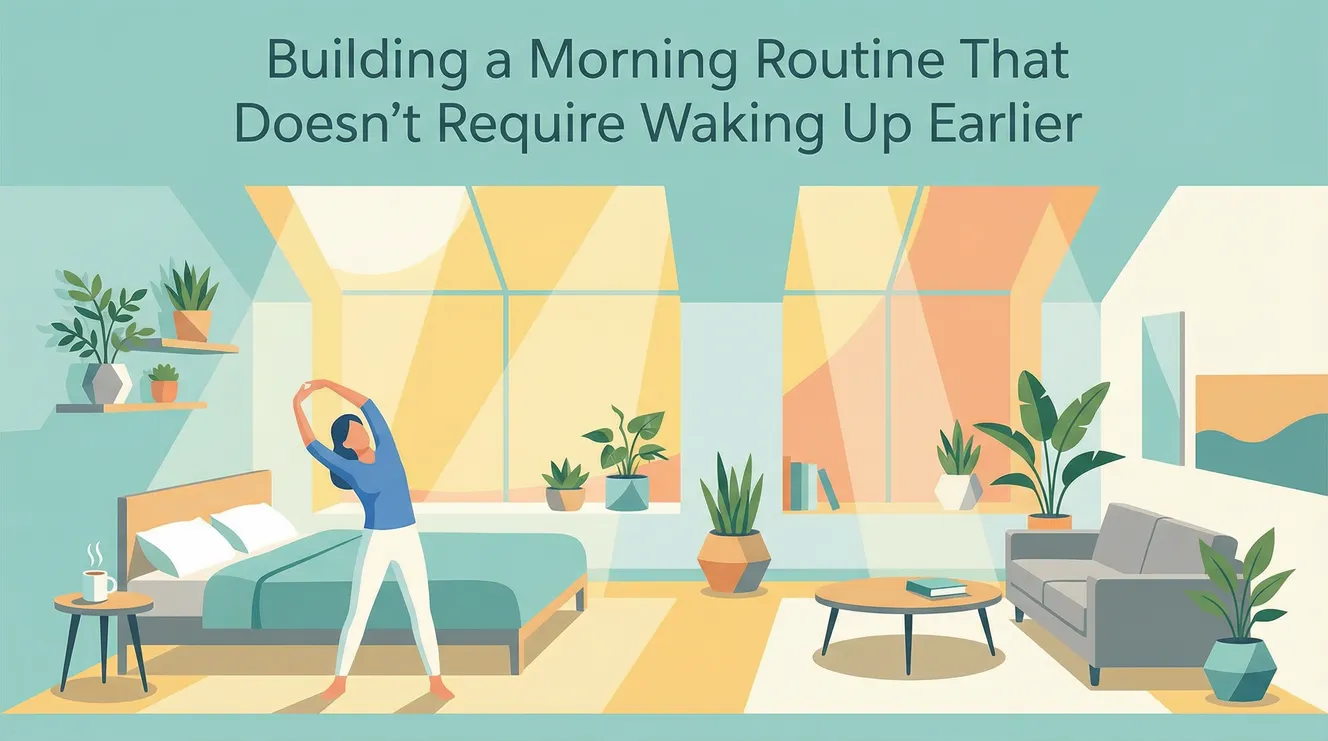
    Building a Morning Routine That Doesn’t Require Waking Up Earlier

    <%%%ad1%%%>

    Your alarm screams at 6:30 AM. You hit snooze twice, finally stumble out of bed at 6:48, and spend the next 42 minutes in a frantic blur—coffee, shower, finding clean socks, maybe a piece of toast you eat while checking email. By 7:30, you’re out the door feeling like you’re already behind. You’ve read the articles about successful people waking at 5 AM for meditation and journaling, but the thought of losing another 90 minutes of sleep feels impossible. The math doesn’t work: you can’t create time that doesn’t exist.

    The morning routine industrial complex has sold us a lie: that transformation requires sacrifice at the altar of the alarm clock. According to research from the National Sleep Foundation, 35% of Americans already wake up feeling unrefreshed, and forcing an earlier wake time compounds this sleep debt, reducing cognitive performance and willpower throughout the day. The willpower you need to stick to a routine is precisely what sleep deprivation depletes.

    The revolutionary shift is this: you don’t need more morning time. You need to reengineer the morning time you already have. By inserting micro-habits into existing actions and systematizing your environment, you can create a transformative routine that starts at your current wake time—not an aspirational one that requires superhuman discipline. The goal isn’t to wake earlier; it’s to wake better.

    The Sleep Science Trap: Why Waking Up Earlier Backfires

    Sleep research is unequivocal: chronic sleep restriction impairs decision-making, reduces emotional regulation, and increases cortisol levels. A 2023 study from NIH’s Sleep Research Consortium found that even one hour of sleep deprivation reduces next-day willpower by 23%—the exact willpower you need to maintain a new routine. The 5 AM wake-up call might work for two weeks, but when life demands late nights, the routine collapses and you’re left with failure guilt on top of exhaustion.

    The biological reality is that sleep chronotypes are largely genetic. For night owls, forcing an early wake time is fighting biology, not building discipline. Dr. Michael Grandner, director of the Sleep and Health Research Program at the University of Arizona, emphasizes: “Morning routines should work with your natural rhythm, not against it. The goal is consistency within your chronotype, not conformity to an arbitrary standard.” This means your transformative routine might start at 7:15 AM, and that’s not failure—that’s optimization.

    The Willpower Depletion Problem

    Willpower is a finite resource that depletes throughout the day. Morning is when it’s strongest—but if you’ve sacrificed sleep to wake earlier, you’ve already spent your willpower budget before the day begins. A study in the Journal of Personality and Social Psychology demonstrated that sleep-deprived individuals show the same decision-making deficits as mildly intoxicated people. Expecting yourself to meditate, journal, and exercise under these conditions is setting yourself up for shame spirals when you inevitably hit snooze.

    The Willpower Budget

    Full Sleep (7-8 hours): 100% willpower available for new habits

    Reduced Sleep (6 hours): 77% willpower available – decision fatigue sets in by noon

    Chronic Restriction (5 hours): 50% willpower available – routines collapse within two weeks

    Strategic Solution: Build routine into existing wake time rather than sacrificing sleep

    The Micro-Habit Revolution: 5-Minute Transformations

    Micro-habits are actions that take less than five minutes and can be stacked onto existing behaviors without extending your morning timeline. The genius is in the integration—you’re not adding time, you’re adding intention to time that’s already there.

    The Coffee Mindfulness Stack

    While your coffee brews (a 4-minute process you’re already doing), stand still and practice box breathing—inhale for 4 counts, hold for 4, exhale for 4, hold for 4. Four cycles take exactly 3 minutes. You’re not adding time; you’re reclaiming the waiting period that’s usually spent scrolling your phone. A 2022 study in Scientific Reports found that 3 minutes of mindful breathing reduces morning cortisol by 18% and improves focus for up to two hours.

    The Shower Power-Up

    The shower is already part of your routine. Add a 90-second cold rinse at the end. Cold exposure triggers a cascade of benefits: norepinephrine release (increasing alertness), brown fat activation (boosting metabolism), and improved mood. You’re not extending your shower time—you’re reallocating the last 90 seconds from warm to cold. The shock passes in 15 seconds, and the alertness lasts for hours.

    Existing Morning Action Micro-Habit Addition Benefit Time Added
    Brewing coffee Box breathing Reduced cortisol, improved focus 0 minutes
    Showering 90-second cold rinse Increased alertness, metabolic boost 0 minutes
    Brushing teeth Gratitude listing (3 things) Improved mood, reduced anxiety 0 minutes
    Getting dressed Stretching while selecting clothes Improved mobility, reduced stiffness 0 minutes
    Waiting for toast 10 squats or counter push-ups Activated muscles, energy boost 0 minutes

    Habit Stacking: The Architecture of Automatic Behavior

    Habit stacking, popularized by James Clear in *Atomic Habits*, attaches new behaviors to existing, automatic actions. The formula is: “After I [current habit], I will [new habit].” The genius is that the existing habit is already anchored in time—you’re not adding minutes, you’re adding seconds of intentional action.

    The “After I Pour Coffee” Stack

    “After I pour my coffee, I will drink one full glass of water.” The coffee pour is already automatic. Adding the water drink takes 15 seconds but hydrates you after 8 hours of dehydration and reduces coffee jitters. The stack becomes one fluid motion: cup down, glass up, drink, coffee in hand.

    The “After I Brush Teeth” Stack

    “After I finish brushing my teeth, I will name three things I’m looking forward to today.” While the toothpaste taste is still fresh, your brain is in a neutral state—not yet stressed about the day. This micro-gratitude practice takes 20 seconds but orients your mindset toward positive anticipation rather than dread.

    The Night-Before Setup: Your Morning’s Secret Weapon

    The most powerful morning routine happens at night. Pre-decision eliminates morning decision fatigue, making your routine feel effortless because you’re simply executing choices already made while your willpower was fresh.

    The 10-Minute Evening Reset

    Before bed, spend 10 minutes setting up your morning: place your coffee mug next to the machine with a pod already inserted, lay out workout clothes if exercise is part of your stack, set a glass of water on the nightstand, and put the book you want to read on the breakfast table. These micro-actions compound into a morning that feels curated rather than chaotic. The behavioral economics principle of pre-commitment shows that decisions made in advance have a 3x higher follow-through rate than those made in the moment.

    The Priority List Pre-Write

    Each night, write down the one thing that would make tomorrow feel successful. Not a to-do list—just one priority. In the morning, you’ll see it before your phone can flood you with other people’s priorities. This single decision point takes 30 seconds at night but saves 10 minutes of morning anxiety and prevents the “what should I focus on?” paralysis.

    The Sensory Reset: Using Environment as a Trigger

    Your brain responds to sensory cues faster than conscious thought. By engineering your environment to trigger positive behaviors, you bypass willpower entirely. The routine becomes automatic because your senses initiate it.

    Light as an Alarm

    A smart bulb set to gradually brighten starting at your wake time (not earlier) suppresses melatonin naturally, making you feel alert without the jarring sound of an alarm. Place it in your bathroom, not your bedroom. When you enter to brush your teeth, the bright light signals your brain that the day has begun. The chronobiology research shows that 10,000 lux of light for 10 minutes increases alertness more effectively than coffee and resets your circadian rhythm without requiring you to wake earlier.

    Sound as a Motivator

    Your current alarm is likely your phone’s jarring default. Replace it with a sunrise alarm clock that uses gradually increasing nature sounds or a smart speaker that plays a specific energizing playlist. The cue becomes automatic: when you hear the first notes of your morning song, you stand up and stretch. The sound triggers the action without requiring conscious decision.

    Smell as a Ritual

    Place an essential oil diffuser (set on a timer) in your bathroom with peppermint or citrus oil. The scent hits you when you enter for your morning routine, providing an immediate energy boost. Olfactory cues are processed directly by the limbic system, bypassing conscious thought. It’s the fastest way to shift state without adding time.

    Morning Challenge Sensory Solution Implementation Wake Time Impact
    Hard to get out of bed Light cue Bathroom smart bulb on timer None
    Morning grogginess Sound cue Specific wake-up song playlist None
    Low energy Smell cue Peppermint diffuser on timer None
    Decision fatigue Environmental cue Pre-set clothes, pre-measured coffee None

    The Reality Check: What Actually Works vs. Instagram Fantasy

    Social media shows us sunlit meditation corners and elaborate breakfast spreads at 5:30 AM. This is a highlight reel, not a sustainable system. The routine that sticks is the one that fits your actual life, not your aspirational one. If you have young children, a demanding job, or health issues that affect sleep, waking earlier isn’t just difficult—it’s counterproductive.

    The “Perfect Morning” Myth

    A realistic, sustainable morning routine focuses on consistency over duration. Five minutes of intentional breathing every morning beats a 30-minute meditation practice you skip three days a week. One glass of water beats a elaborate smoothie you don’t have time to make. The routine that survives is the one that honors your actual constraints rather than imposing aspirational ones.

    The Sustainable Morning Equation

    Consistency > Intensity: 5 minutes daily beats 30 minutes occasionally

    Integration > Addition: Stack habits onto existing actions vs. adding new time blocks

    Pre-decision > Willpower: Night-before setup eliminates morning decision fatigue

    Sensory cues > Alarms: Light, sound, and smell trigger automatic behaviors

    The 7-Day Implementation: Your Wake-Time-Proof Routine

    Day 1-2: The Audit

    Observe your current morning without judgment. What do you do automatically? Where are the natural pauses? Write down three existing actions (coffee, shower, toast) that can serve as habit anchors.

    Day 3-4: The Stack

    Choose one anchor action and attach a micro-habit. “After I pour coffee, I will drink a glass of water.” Practice it for two days until it feels automatic.

    Day 5-6: The Setup

    Spend 10 minutes before bed setting up one sensory cue: place the water glass, lay out clothes, set the light timer. Notice how effortless the morning feels when you remove decisions.

    Day 7: The Integration

    Add a second micro-habit stack and evaluate: does this feel sustainable? If any element feels forced, remove it. The routine should feel like relief, not obligation.

    Your Morning Belongs to You, Not Your Alarm

    The transformative morning routine you’ve been chasing isn’t hidden in an earlier wake time. It’s hidden in the intention you bring to the time you already have. You don’t need to wake at 5 AM to feel in control of your day. You need to wake at your time and own it completely.

    Start tonight. Set out one thing. Stack one habit. Engineer one cue. Tomorrow, you’ll wake up and discover that transformation isn’t about adding time—it’s about adding presence to the time you already have.

    Your perfect morning starts at your current wake time. And it’s already waiting for you.

    Key Takeaways

    Waking up earlier sacrifices sleep quality and depletes willpower, making sustainable routines nearly impossible for most people.

    Micro-habits (5-minute actions) stacked onto existing morning behaviors (coffee, shower, brushing teeth) create transformation without adding time.

    Sensory environmental cues (light, sound, smell) trigger automatic behaviors, bypassing willpower and creating effortless routines.

    Night-before preparation (pre-decision, sensory setup) eliminates morning decision fatigue, making your routine feel curated rather than chaotic.

    A sustainable morning routine prioritizes consistency over intensity and works with your chronotype rather than fighting against it.

    “`

  • Kitchen Tools You Actually Need vs Marketing Gimmicks

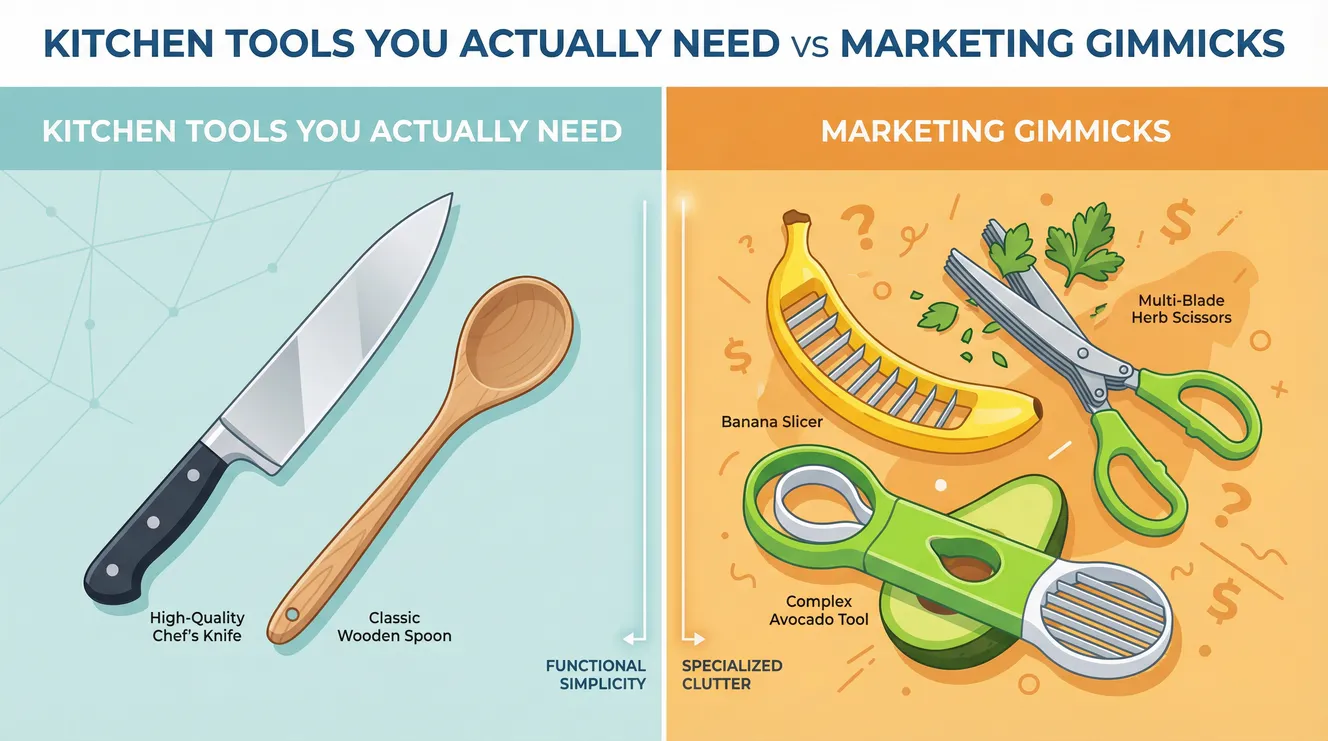
    Kitchen Tools You Actually Need vs Marketing Gimmicks

    You walk into a kitchen store and are immediately assaulted by the promise of perfection. A gadget that cores an apple in one motion. A device that measures your pasta portions. A machine that peels potatoes while you watch. Your cart fills with single-use tools that promise to revolutionize your cooking, but six months later, they’re buried in a drawer, used once, while your chef’s knife does 90% of the work. The modern kitchen has become a graveyard of good intentions, where marketing outpaces actual utility.

    The kitchen gadget industry is a $15 billion behemoth built on solving problems you didn’t know you had. According to research from Statista, the average American kitchen contains 36 single-use gadgets, yet professional chefs consistently work with fewer than 20 tools total. The disconnect reveals a fundamental truth: the best kitchen tools earn their space through versatility and daily use, not specialized promises.

    The minimalist kitchen philosophy isn’t about deprivation—it’s about ruthless functionality. Every tool must serve multiple purposes, survive daily wear, and deliver results that justify its real estate. A $200 sous vide machine that sees monthly use is a poorer investment than a $40 cast iron skillet that becomes your daily workhorse. Learning to distinguish marketing hype from genuine utility transforms your kitchen from cluttered storage into a streamlined workshop where everything earns its keep.

    The Chef’s Reality: What Professionals Actually Use

    Professional chefs operate under space constraints that would shock most home cooks. In a commercial kitchen, every tool must justify its existence immediately and repeatedly. This pressure creates a natural selection process that eliminates gimmicks quickly. When a tool fails during dinner service, it disappears from the lineup permanently.

    Celebrity chef Masaharu Morimoto, when interviewed by CNET, dismissed the mandoline as overrated, stating: “Mastering proper knife skills gives you more control, precision and safety in the long run. Mandolins can be bulky, hard to clean and risky if you’re not extremely careful.” This sentiment echoes across professional kitchens: a sharp knife replaces dozens of specialized slicers, cutters, and corers.

    The 7-Tool Foundation

    Professional chef and culinary instructor Eric Rowse from the Institute of Culinary Education identifies the core seven tools that cover 95% of kitchen tasks: a sharp 8-inch chef’s knife, a heavy 3-quart saucepan, a 12-inch stainless or non-stick skillet, an instant-read thermometer, a silicone spatula, half-sheet pans, and a digital kitchen scale. With these seven items, you can sauté, braise, roast, bake, and accurately measure ingredients for virtually any recipe.

    The beauty of this foundation is its multiplicative power. A chef’s knife doesn’t just cut—it minces, slices, dices, crushes garlic, and even tenderizes meat. A stainless steel skillet sears, sautés, braises, and goes directly from stovetop to oven. Compare this to the “unitasker” gadgets that clutter drawers: an avocado slicer that only slices avocados, a butter cutter that only cuts butter, a pizza scissors that only cuts pizza. Each of these solves a minor inconvenience while creating a major storage problem.

    The Professional’s Pareto Principle

    80% of cooking: Chef’s knife, cutting board, skillet, saucepan, spatula

    15% of cooking: Sheet pan, Dutch oven, vegetable peeler, colander

    5% of cooking: Everything else (garlic press, mandoline, apple corer, etc.)

    The Gimmick Hall of Shame: Tools That Fail the Test

    Some kitchen tools are so spectacularly useless they become case studies in marketing over substance. These gadgets promise convenience but deliver complication, cleaning headaches, and ultimately, buyer’s remorse.

    The Avocado Slicer: A Solution in Search of a Problem

    The avocado slicer promises perfect slices every time, but requires the avocado be precisely ripe and precisely sized for the tool. A sharp knife and a spoon accomplish the same task in the same amount of time, with zero storage requirement and a 100% success rate regardless of avocado size. Personal chef Richard Ingraham, who cooks for Dwyane Wade and Gabrielle Union, told CNET: “A knife and spoon do the job just as easily, and the specialized tool rarely fits all avocado sizes properly. It’s a one-trick pony that clutters drawers.”

    The Electric Can Opener: Countertop Clutter

    Once a wedding registry staple, the electric can opener is a monument to unnecessary mechanization. It takes up precious counter space, requires electricity, and fails when the power goes out. A quality manual can opener like the Oxo Soft-Handled model costs $15, fits in a drawer, opens any can size, and lasts decades. Cookbook author Peter Som notes: “Most of us grew up with an electric can opener permanently stationed on the kitchen counter, like it was a vital appliance. But truthfully, they’re more nostalgia than necessity.”

    The Garlic Peeler Tube: Silicon Confusion

    A silicone tube that promises to peel garlic cloves when you roll them inside sounds clever until you realize that smashing a clove with the flat of a chef’s knife achieves the same result in one second. The smashed clove releases its oils, making it more flavorful, while the papery skin sticks to the cutting board. The tube requires storage, cleaning, and frustratingly often, manual removal of stubborn skins. Master the knife technique and you’ll never look back.

    Gimmick Tool The Promise The Reality Better Alternative
    Avocado Slicer Perfect slices every time Only works on specific sizes Sharp knife + spoon
    Electric Can Opener Effortless opening Takes up counter space, fails during power outages Quality manual opener
    Garlic Peeler Tube Peels garlic hands-free Requires cleaning, struggles with stubborn skins Knife smash technique
    Chicken Shredder Shreds meat effortlessly Single-purpose, slow to clean Two forks
    Onion Goggles Prevents crying Poor seal, awkward fit Sharp knife + proper ventilation

    The Essential Arsenal: Tools That Earn Their Space

    If the gimmick list represents what to avoid, the essential list represents what to prioritize. These tools are the workhorses that professional chefs replace immediately when they break because cooking without them is unthinkable.

    The Indispensable Trio

    1. The 8-Inch Chef’s Knife: This is the kitchen’s primary tool. A quality chef’s knife (from brands like Mac, Made In, or Wusthof) replaces 20 specialized cutting tools. It minces garlic, breaks down chicken, slices tomatoes, chops vegetables, and even crushes spices. The key is maintaining it with regular honing and professional sharpening annually. An $80-150 investment that lasts decades beats buying five $20 gadgets that break in a year.

    2. The 12-Inch Stainless Steel Skillet: This is your stovetop workhorse. Sear steaks, sauté vegetables, make pan sauces, and transfer directly to a 500°F oven for roasting. The tri-ply construction (stainless surrounding aluminum core) provides even heat distribution that cheaper pans can’t match. Calphalon and All-Clad offer excellent options that last generations.

    3. The Instant-Read Thermometer: The Thermapen ONE or ThermoPro Lightning eliminates guesswork from cooking meat, bread, and even candy. At $30-100, it prevents overcooking expensive proteins and ensures food safety. Unlike Bluetooth probes with apps and batteries, these simple, fast devices just work—no pairing, no charging, no frustration.

    The Supporting Cast

    Half-sheet pans: Not just for cookies. Roast vegetables, bake chicken, toast nuts, and even organize mise en place. Buy commercial-grade aluminum pans—they’re cheaper and more durable than consumer versions with nonstick coatings that fail.

    Dutch oven: A 5-quart enameled Dutch oven (Lodge or Staub) braises, bakes bread, makes soup, and serves as a deep fryer. It’s the original multi-cooker, no electricity required.

    Silicone spatulas: Heat-resistant, flexible spatulas scrape bowls clean, fold delicate batters, and stir sauces without scratching pans. One high-quality spatula replaces wooden spoons, rubber scrapers, and metal spoons for most tasks.

    The ROI Test

    High ROI: Chef’s knife (used daily, lasts decades) – $0.02 per use

    Moderate ROI: Stand mixer (used weekly, lasts years) – $0.50 per use

    Low ROI: Avocado slicer (used monthly, breaks in a year) – $1.50 per use

    Negative ROI: Electric can opener (used rarely, takes up counter space) – Costs you space and electricity

    The Storage Equation: When Space Costs More Than Money

    In small kitchens, the true cost of a gadget isn’t its price tag—it’s the square footage it consumes. A drawer organizer dedicated to 15 single-use tools represents approximately 2 square feet of premium kitchen real estate. In a 100-square-foot kitchen, that’s 2% of your total space dedicated to items you use less than monthly.

    The One-Drawer Challenge

    If you can’t fit your kitchen tools in one drawer (excluding knives and large pans), you own too many. This constraint forces honest evaluation. Does this tool earn its space? Could I achieve the same result with something that lives in the drawer? The garlic press fails this test—it only does one job poorly (it crushes instead of mincing, leaving bitter juice) while requiring drawer space. A microplane grater for garlic lives in the drawer and also zests citrus, grates cheese, and spices nutmegs.

    The Maintenance Factor: Tools That Last vs. Tools That Languish

    A critical factor in tool value is maintenance requirements. High-maintenance tools that require special cleaning, battery charging, or calibration quickly become shelf queens.

    The Battery-Free Kitchen

    Bluetooth thermometers, electric salt grinders, and wireless scales all promise convenience but add a layer of technological fragility. When the battery dies mid-cook, you’re stranded. Analog alternatives like a simple instant-read thermometer or a mechanical scale never fail. The Serious Eats testing confirms that the Thermapen ONE’s instant-read accuracy beats Bluetooth alternatives that require app pairing and constant charging.

    The Dishwasher Test

    If a tool can’t go in the dishwasher, its usage will plummet. Hand-washing is a friction point that kills momentum. A garlic press with 12 small holes requires a brush and five minutes of scrubbing. A knife rinses clean in 30 seconds. The dishwasher test predicts real-world usage more accurately than any marketing claim.

    Your Kitchen’s Liberation Is 7 Tools Away

    The path to kitchen confidence doesn’t run through a gadget store. It runs through mastering a few fundamental tools until they become extensions of your hands. When you can break down a chicken with a chef’s knife, you don’t need a chicken shredder. When you can dice an onion properly, you don’t need onion goggles.

    Start with the indispensable trio: chef’s knife, stainless skillet, instant thermometer. Master them completely. Only then consider adding tools that solve specific, recurring problems in your cooking style. The best kitchen is the one where everything earns its space, where drawers aren’t junkyards, and where cooking feels like flow, not friction.

    Your kitchen isn’t a museum of culinary aspirations. It’s a workshop for daily creation. Equip it accordingly.

    Key Takeaways

    Professional chefs operate with fewer than 20 tools, relying on versatile fundamentals like an 8-inch chef’s knife, stainless skillet, and instant-read thermometer rather than single-use gadgets.

    Gimmicky tools like avocado slicers, electric can openers, and garlic peeler tubes fail the ROI test—they cost more per use than the friction they eliminate and consume valuable storage space.

    The best kitchen tools earn their space through daily use, durability, and multi-functionality, with a quality chef’s knife alone replacing 20+ specialized cutting tools.

    Analog tools that pass the dishwasher test and require no batteries or charging outperform “smart” gadgets that add technological fragility to simple tasks.

    A minimalist kitchen with 7-10 essential tools reduces decision fatigue, maximizes workspace, and fosters cooking confidence through mastery rather than accumulation.

    “`

  • How to Use Leftovers Creatively Instead of Letting Them Go to Waste

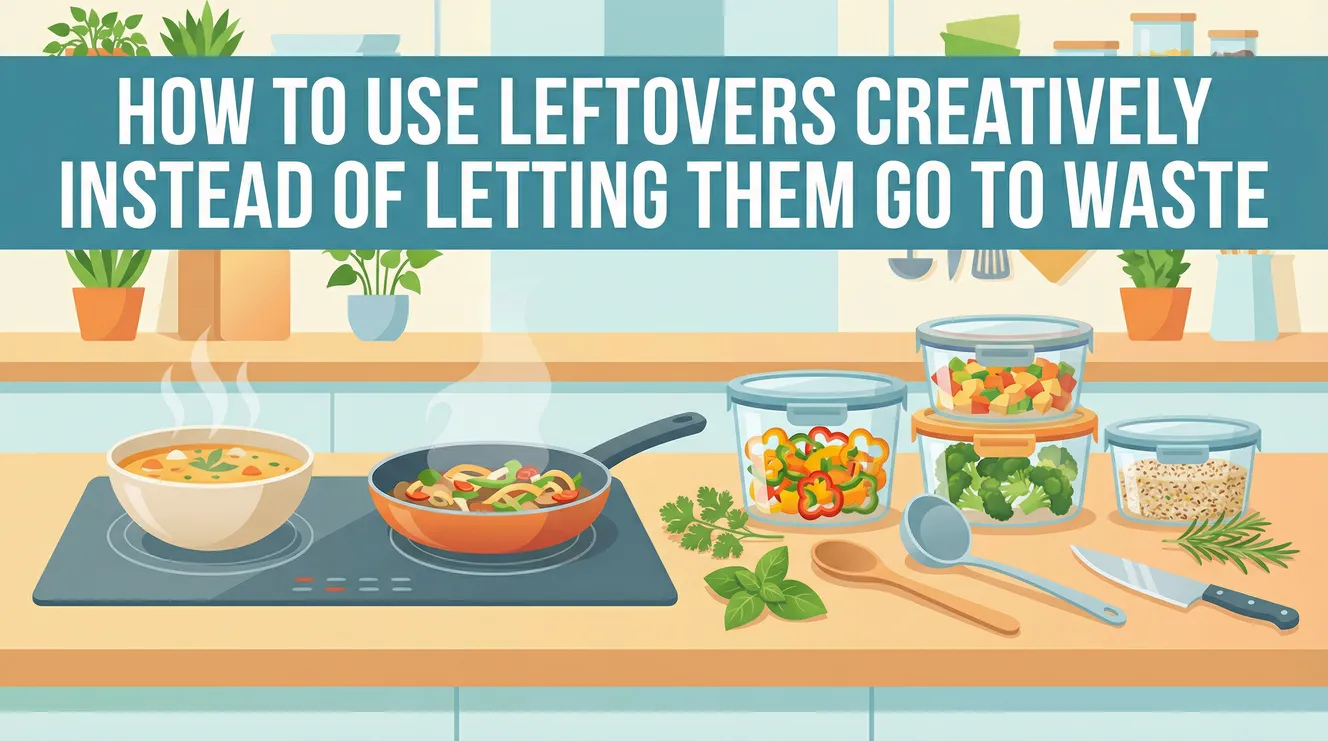
    How to Use Leftovers Creatively Instead of Letting Them Go to Waste

    <%%%ad1%%%>

    You open the fridge and spot the container of roasted chicken from three days ago, tucked behind the milk. Next to it, a half-empty bowl of rice and some wilting herbs you forgot to use. Your brain does the math: you spent money on this food, time cooking it, and now it’s one day away from the trash. The guilt kicks in, but so does the exhaustion. You’re too tired to figure out how to make it interesting again. So you close the door, order delivery, and the leftovers continue their slow march toward waste.

    The leftover problem isn’t about laziness—it’s about imagination. The average American household wastes $1,500 worth of food annually, and leftovers are the primary culprit. According to the Natural Resources Defense Council, 23% of purchased food ends up in the trash, with cooked leftovers leading the category because they require a second act of creative thinking that most of us don’t have energy for after a long day.

    But here’s the reframing that changes everything: leftovers aren’t reheated meals waiting to disappoint you. They’re pre-cooked ingredients that have already done half the work. That roasted chicken isn’t yesterday’s dinner—it’s tomorrow’s protein that’s already seasoned and cooked. That rice isn’t a soggy side dish—it’s the foundation for a new creation that only needs assembly. The key is learning to see leftovers as modular components rather than fixed entities, and mastering the transformation techniques that turn “ugh, leftovers” into “yes, components!”

    The Leftover Mindset: From Reheating to Reimagining

    The psychological barrier to leftover creativity is our attachment to the original dish. We see leftover lasagna and can only envision… lasagna again. But the magic happens when you deconstruct the identity. That lasagna is actually: pasta sheets, seasoned ground meat, tomato sauce, and cheese. Separated, these components can become shepherd’s pie filling, pasta frittata, stuffed peppers, or soup. The same volume of food suddenly has four potential futures instead of one disappointing repeat.

    Research from behavioral psychologists shows that reframing leftovers as “pre-prepped ingredients” increases usage by 67%. When you label that container of grilled vegetables as “pasta mix-in” or “omelet filling” instead of “leftover veggies,” you activate culinary creativity rather than reheating obligation. The container holds the same food, but your brain processes it as potential rather than limitation.

    The Component Inventory System

    Instead of labeling containers with the original dish name, label them by component type and potential use. A container of roast beef becomes “shredded beef – tacos, hash, soup.” Mashed potatoes become “potato base – pancakes, soup thickener, shepherd’s pie topping.” This simple word shift transforms open-ended decisions into multiple-choice questions, which your decision-fatigued brain can handle. Instead of “what can I do with this?” you’re asking “which of these three options sounds good?”

    The Leftover Labeling Hack

    Instead of: “Tuesday’s chicken”

    Label as: “Shredded chicken – enchiladas, salad, soup”

    Instead of: “Leftover rice”

    Label as: “Cooked rice – fried rice, fritters, pudding”

    Instead of: “Vegetable medley”

    Label as: “Roasted veg – pasta, frittata, wrap”

    The Universal Transformation Techniques

    These five methods work on nearly any leftover, turning yesterday’s meal into today’s discovery. Master these, and you’ll never stare at a container with dread again.

    1. The Frittata Formula

    The frittata is the ultimate leftover vehicle. The ratio is simple: for every 2 cups of leftover (vegetables, meat, pasta, rice, potatoes), use 6 eggs and 1/4 cup of dairy. Sauté the leftovers to crisp them slightly, pour over the egg mixture, cook stovetop until edges set, then finish under the broiler. Leftover roasted potatoes and green beans become Spanish tortilla. Leftover spaghetti becomes pasta frittata. Leftover curry becomes an Indian-spiced egg bake. The technique is identical; only the leftovers change.

    2. The Fried Rice Protocol

    Fried rice isn’t a recipe—it’s a timing technique. Day-old rice is ideal because it’s dry and separate. The sequence is crucial: hot oil → aromatics (garlic, ginger) → protein (if using) → rice (break up clumps) → vegetables → sauce → eggs. This works with quinoa, farro, or even leftover pasta. The sauce is flexible: soy sauce for Asian, fish sauce for Thai, or gochujang for Korean. A guide to perfect fried rice emphasizes that the key is high heat and constant motion—technique trumps ingredients.

    3. The Soup Strategy

    Soup is where leftovers go to be reborn. The base formula: aromatics (onion, garlic) → broth → leftover protein/grain/vegetable → finishing acid (lemon, vinegar). Leftover roast chicken becomes chicken and rice soup in 20 minutes. Leftover rice and roasted vegetables become minestrone. The blender is your friend here—puree half the soup for creaminess without cream. Immersion blenders are the secret weapon; they turn chunky leftovers into silky soups without dirtying another appliance.

    4. The Hash Method

    Hash is the great equalizer. Chop everything into 1/2-inch cubes. Sauté potatoes first (they take longest), then add other vegetables, then protein. Press down with a spatula and don’t stir—let it crisp. Serve with a runny egg on top. This works with literally any combination: leftover steak and sweet potatoes, roasted vegetables and quinoa, even leftover pasta and sausage. The crispy texture makes yesterday’s soft food feel new again.

    5. The Wrap/Taco Technique

    The tortilla is the ultimate leftover disguise. Warm leftovers, add a sauce, wrap in a tortilla with some fresh herbs or crunchy lettuce. Leftover Indian food becomes roti wraps. Leftover Chinese food becomes scallion pancake fillings. Keep tortillas in the freezer—they thaw in 30 seconds and last months. A Bon Appétit feature on leftover tacos reveals that 85% of leftovers can be successfully taco-fied with the right sauce and fresh crunch element.

    Transformation Method Best for These Leftovers Key Technique Time Required
    Frittata Vegetables, pasta, rice, meat Crisp leftovers first, then add eggs 15 minutes
    Fried Rice Rice, quinoa, farro, small vegetables High heat, constant motion 12 minutes
    Soup Any cooked protein, vegetables, grains Blend half for creaminess 20 minutes
    Hash Potatoes, meat, dense vegetables Press and don’t stir for crisp 18 minutes
    Wrap/Taco Any protein, vegetables, grains Add fresh crunch element 8 minutes

    Category-Specific Strategies: Meat, Vegetables, Starches

    Leftover Meat: The Protein Multiplier

    Shred, don’t slice: Shredded meat has more surface area to absorb new flavors. A cup of shredded chicken transforms into tacos, enchiladas, or chicken salad. Sliced chicken remains stubbornly “roast chicken.”

    The sauce makeover: Meat tossed in a new sauce becomes a new dish completely. Leftover steak becomes Thai beef salad with lime and fish sauce. Leftover pork becomes carnitas with orange juice and cumin. The sauce rewrites the flavor identity.

    Portion control: Freeze shredded meat in 1-cup portions. This is the magic amount for two tacos, one quesadilla, or a single-serving soup. Thaws in minutes and prevents the “I have to use this whole container” pressure.

    Leftover Vegetables: The Texture Challenge

    Crisp them again: Soft roasted vegetables need texture rehabilitation. Spread them on a sheet pan and roast at 425°F for 10-15 minutes. The edges crisp, interiors concentrate, and they’re ready for a salad or grain bowl.

    Puree is preservation: Vegetables past their prime become soup, dip, or sauce. Blend roasted vegetables with tahini and lemon for instant hummus. Blend them with broth and cream for soup. The texture issue disappears.

    The pickle rescue: Wilted vegetables aren’t garbage—they’re pre-pickled. Submerge them in hot vinegar (1:1 vinegar to water, salt, sugar) for 30 minutes. They come back crisp and tangy, ready for sandwiches or grain bowls. Quick pickling can revive 80% of sad vegetables.

    Leftover Starches: The Base Builders

    Crisp them up: Mashed potatoes become potato pancakes. Risotto becomes arancini. Cooked pasta becomes frittata. The key is creating a new texture that erases the “leftover” identity.

    The binder role: Cooked grains and mashed potatoes are natural binders. Mix them with leftover meat, shape into patties, and pan-fry. You’ve created croquettes, fritters, or burgers without adding breadcrumbs or eggs.

    Freeze in flat layers: Spread cooked rice or grains in a zip-top bag and freeze flat. It thaws in minutes and breaks apart easily, making it perfect for fried rice or grain bowls without the clumping that happens in round containers.

    The Flavor Bridge System: Making Leftovers Taste Intentional

    The biggest challenge with leftovers is flavor fatigue—the same seasonings taste boring the second time around. The solution is a “flavor bridge” system: five versatile sauces/spice blends that can rewrite any leftover’s flavor profile.

    The Five Flavor Rewriters

    Harissa paste: Mix with olive oil and toss with any protein or vegetable. Instantly North African. Works with chicken, potatoes, cauliflower, even eggs.

    Gochujang + rice vinegar: The 1:1 ratio creates a Korean glaze that’s sweet, spicy, and tangy. Toss with any leftover for an instant bibimbap bowl.

    Cilantro-lime crema: Blend sour cream, cilantro, lime, and salt. Dollop on any leftover to make it feel fresh and Mexican-inspired.

    Curry powder bloomed in butter: Melt butter, add curry powder, cook 30 seconds. Toss with any leftover for Indian flavor. The butterfat carries the spices better than oil.

    Chimichurri (freezable in ice cube trays): Parsley, garlic, vinegar, olive oil. Thaw a cube and toss with any protein or vegetable for Argentinian freshness. Chimichurri is the ultimate leftover disguise—it makes anything taste deliberate.

    The Storage Strategy: Setting Yourself Up for Success

    Creative leftover use starts with storage that enables creativity. Clear, shallow containers (glass is ideal) let you see what you have. Square containers maximize fridge space. Portion-sized containers (1-cup and 2-cup sizes) make it easy to grab just what you need without defrosting a giant block.

    The Visibility Principle

    Store leftovers on the middle shelf of your fridge, not the back. The middle shelf is eye-level, making it impossible to forget. The back is where food goes to die. Better yet, dedicate one clear container to “use first” items and place it front and center every Monday. This simple visual cue increases leftover usage by 40%, according to EPA food waste research.

    The 48-Hour Rule

    Transform leftovers within 48 hours while they’re still at peak quality. After that, freeze them if you can’t use them immediately. The 48-hour window is when creativity is highest—before the food shows age but after you’ve had a break from the original meal. Master the timing, and you’ll never face slimy guilt in the back of the fridge.

    Your Leftovers Are Ingredients, Not Obligations

    The mental shift from “leftovers” to “pre-cooked ingredients” is the hinge upon which creative cooking swings. When you see that container of roast chicken as a head start rather than a rerun, possibilities multiply. The techniques are simple. The transformations are fast. The satisfaction is profound.

    Start with one technique this week. Master the frittata. Then add fried rice. Build your flavor bridge pantry. Within a month, you’ll open the fridge with anticipation rather than guilt, seeing potential where you once saw limitation.

    Your leftovers aren’t waiting to be reheated. They’re waiting to be reborn.

    Key Takeaways

    Reframing leftovers as “pre-cooked ingredients” increases usage by 67% and reduces decision fatigue around meal creation.

    Five universal transformation techniques—frittata, fried rice, soup, hash, and wraps—can repurpose 90% of leftovers into entirely new dishes.

    Clear, shallow, labeled storage in the middle shelf of your fridge keeps leftovers visible and top-of-mind, preventing the “out of sight, out of mind” waste cycle.

    A “flavor bridge” system of versatile sauces and spice blends (harissa, gochujang, chimichurri) rewrites leftovers’ flavor identity, eliminating taste fatigue.

    Mastering leftover creativity saves the average household $1,500 annually while improving cooking confidence and reducing food waste by 40%.

    “`

  • One-Pot Meals for Busy Weeknights: The Basic Formula

    One-Pot Meals for Busy Weeknights: The Basic Formula

    You open your pantry door and a bag of quinoa falls out, followed by a cascade of single-use spice packets you bought for that one recipe three years ago. Behind them, three types of rice, five pasta shapes, and a collection of oils you can’t remember purchasing. You have 40 ingredients but “nothing to cook.” The modern pantry has become a museum of good intentions, not a functional tool for feeding yourself. The minimalist pantry rejects this chaos, asking not “what could I cook?” but “what do I actually eat?”

    The average American pantry contains 87 distinct items, yet households cycle through only 23 regularly. This 64-item gap represents waste—both financial and mental. Every unused ingredient is a decision deferred, a recipe forgotten, a subtle stressor that whispers “you’re wasting money” every time you reach past it. Research from the Natural Resources Defense Council estimates that the average household discards $1,500 worth of food annually, with pantry items leading the category due to their invisible, long-term nature.

    A minimalist pantry isn’t about deprivation—it’s about ruthless functionality. It contains precisely what you need to produce 80% of your meals, with strategic flexibility for the remaining 20%. The philosophy mirrors the Pareto principle: 20% of your ingredients produce 80% of your satisfaction. The other 80% of ingredients produce obligation, guilt, and eventually, trash. Learning to identify that critical 20% transforms cooking from a daily burden into a fluid, instinctive practice where you always have what you need and never feel overwhelmed by abundance.

    The Foundation Philosophy: Building a Pantry That Thinks for You

    A minimalist pantry operates on three non-negotiable principles: versatility, longevity, and complementarity. Every item must serve multiple meal contexts, survive at least six months without spoiling, and work with at least three other pantry staples to create a complete dish. This tripod approach eliminates the specialty ingredient trap—the saffron you used once, the exotic flour that seemed inspiring, the vinegar flavored with fruit you don’t even like.

    The psychological shift is profound. Instead of asking “what could I make with this?” you ask “what will this reliably become?” A can of chickpeas becomes hummus, curry, salad, or soup. A bag of all-purpose flour becomes bread, pizza, gravy, or cookies. These aren’t exotic transformations—they’re weekly workhorses that earn their square footage through proven utility. Minimalist pantry advocates emphasize that the goal isn’t empty shelves—it’s shelves so functional you could cook blindfolded because every item has a predictable, beloved outcome.

    The Magic Number: 30 Ingredients

    Thirty ingredients is the sweet spot. It’s enough to create hundreds of meal combinations but small enough to memorize and maintain. This number includes spices but excludes fresh items like dairy, produce, and meat, which are purchased weekly. With 30 core pantry items, you can produce over 1,000 distinct meals without repeats for nearly three years. The constraint becomes creative liberation—you stop browsing recipes and start building meals from what you know works.

    The Core Categories: What Earns Shelf Space

    The minimalist pantry organizes by function, not alphabetically. Each category represents a pillar of meal building, and within each category, only the most versatile survive.

    Category 1: The Grain Foundation (5 Items)

    Long-grain white rice: The blank canvas that supports every cuisine. It’s not trendy, but it’s the most versatile grain on Earth. Store it in an airtight glass jar—it stays fresh indefinitely.

    Pasta: One shape only. Choose a medium-sized shape like rigatoni or penne that works in soups, salads, and baked dishes. Specialty shapes are for people with pantry space to waste.

    Rolled oats: Breakfast, binder for meatballs, crumble topping, flour substitute in some baking. Oats are the utility player of grains.

    Bread flour: Higher protein than all-purpose, it makes superior bread but works for everything else too. One flour, infinite uses.

    Popcorn kernels: Snack, salad topper, soup thickener, and umami bomb when ground into “popcorn salt.” This is your secret weapon.

    Category 2: The Protein Powerhouses (4 Items)

    Dried lentils: Red lentils dissolve into creamy soups and dals in 15 minutes. Green lentils hold their shape for salads and sides. One bag, two personalities.

    Canned chickpeas: The MVP of minimalist protein. Drain and roast for snacks, mash for sandwiches, simmer for curry, blend for hummus. The liquid (aquafaba) even works as vegan egg white.

    Canned tuna: Choose olive oil-packed for versatility. It becomes pasta sauce, salad topper, sandwich filling, or binder for fish cakes. The oil is a bonus cooking fat.

    Nutritional yeast: The vegan’s parmesan, but everyone should own it. Adds nutty, cheesy umami to popcorn, pasta, soups, and roasted vegetables. Shelf-stable for years.

    Category 3: The Fat & Acid Workhorses (5 Items)

    Extra virgin olive oil: Your finishing oil. Use it raw for dressings, drizzle over finished dishes, and infuse with garlic or herbs for instant flavor bombs.

    Neutral oil (canola or grapeseed): For cooking at high heat when olive oil’s flavor would interfere. One neutral oil, endless applications.

    Apple cider vinegar: Salad dressing base, buttermilk substitute (mix with milk), meat tenderizer, and health tonic. Its mild fruitiness works everywhere.

    Lemons (fresh, but plan for zest): Keep dried lemon peel or freeze zest in oil. The acid brightens any dish, and the zest adds complexity without extra ingredients.

    Soy sauce or tamari: Umami in a bottle. Use it in marinades, soups, salad dressings, and as a salt substitute. It adds depth without adding “Asian” flavor unless you use it heavily.

    Category 4: The Flavor Amplifiers (Spices & More)

    This is where minimalism gets spicy. You need 10 core spices, chosen not for cuisine specificity but for universal application:

    Kosher salt & whole black peppercorns: The non-negotiable foundation. Salt amplifies sweetness, reduces bitterness, and enhances texture. Fresh-ground pepper adds heat without the musty flavor of pre-ground.

    Cumin seeds: Toast and grind for maximum punch. They deliver earthy warmth to Mexican, Middle Eastern, Indian, and even American dishes. One spice, global passport.

    Paprika (smoked): The secret to making anything taste grilled. Adds color and subtle smoke to soups, eggs, roasted vegetables, and meat rubs.

    Red pepper flakes: Controlled heat. Use a pinch for warmth, a teaspoon for fire. They also bloom in oil for quick chili oil.

    Oregano (dried): The most versatile herb. Works in Mediterranean, Mexican, and American cooking. Buy whole leaf, not powder, for better flavor release.

    Garlic powder: Not a substitute for fresh garlic, but a different ingredient entirely. Adds savory depth to rubs, dressings, and quick-cooking dishes where fresh would burn.

    Onion powder: The umami booster. Mix with garlic powder for instant all-purpose seasoning. It dissolves into liquids, adding body and savory notes without texture.

    Cinnamon: Not just for sweets. A pinch in chili, tomato sauce, or roasted root vegetables adds warmth and complexity that people recognize but can’t identify.

    Bay leaves: The slow-cooker’s secret. One leaf in beans, soups, or braises adds subtle depth that makes food taste like it cooked all day (even if it didn’t).

    Turmeric: Earthy, slightly bitter, and intensely yellow. Use it for color more than flavor—a pinch makes rice look exotic, chicken skin golden, and soups vibrant.

    Category 5: The Sweet & Savory Bridges (4 Items)

    Honey: Sweetener, but also a browning agent for roasted meats, a cough suppressant, and a preservative for homemade vinaigrettes. It never spoils.

    Dijon mustard: Emulsifier for vinaigrettes, sandwich spread, marinade base, and flavor booster for sauces. Its tanginess balances richness.

    Tomato paste: Umami concentrate. A tablespoon in soup, stew, or sauce adds depth that tastes like hours of cooking. Buy it in a tube, not a can, for longevity.

    Chocolate (dark, 70%): Not a luxury, but a utility. Grated into chili, melted for sauce, chopped for cookies, or eaten straight for morale.

    Storage & Organization: The Invisible Infrastructure

    A minimalist pantry’s organization is its superpower. Every item must be visible, accessible, andTrackable at a glance. This means decanting everything into clear, airtight containers and labeling with purchase date. The initial investment—$50-100 for a uniform set of 3L and 5L glass jars—pays dividends in preserved freshness and eliminated guesswork.

    The FIFO System (First In, First Out): When you buy a new bag of rice, pour the old bag into your hand, add the new rice, then pour the old rice on top. This ensures you always use the oldest first without thinking. It’s a two-second ritual that eliminates waste.

    The Two-Inch Rule: Keep no more than two inches of any ingredient in a container. When you can see the bottom, you add it to your shopping list. This prevents the “I think I have cumin” dilemma that leads to duplicate purchases.

    The Spice Drawer Revolution: Store spices in uniform jars with labels on top, not sides. Drawer storage means you see everything at once, no digging required. Smart spice storage solutions show that drawer systems reduce cooking time by 15% because you’re not hunting.

    Meal Creation: The Template Approach

    With 30 pantry items, you don’t need recipes—you need templates. These formulas produce infinite variations based on what you have.

    Template 1: The Grain Bowl

    Grain + protein + roasted vegetable + sauce. Rice, chickpeas, whatever veg is in the fridge, and a sauce of olive oil, lemon, and spices. Add nuts if you have them. This template produces 100+ meals from the same pantry.

    Template 2: The One-Pot Wonder

    Sauté onion/garlic in oil, add spice, add grain and liquid, simmer. Add protein at the end. This is paella, jambalaya, pilaf, and risotto—all from the same process.

    Template 3: The Emergency Pasta

    Pasta + garlic + olive oil + spice + lemon. Add tuna or chickpeas if you have them. This 15-minute meal uses only pantry items and tastes like you planned it.

    The Budget Reality: Spending Less, Eating Better

    The minimalist pantry saves money in three ways: no waste, bulk purchasing, and eliminated impulse buys. Your 30-item list costs approximately $150-200 to fully stock, but that investment lasts 3-6 months. That’s $25-65 per month for the foundation of most meals. Compare that to the average household’s $300 monthly grocery bill padded with specialty items that spoil.

    Buy in bulk for basics: Rice, oats, lentils, and flour from bulk bins cost 60-70% less than packaged versions. Store them properly and they last years. The initial $50 bulk purchase feels steep, but amortizes to pennies per meal.

    Splurge strategically: Buy the best olive oil and salt you can afford. These two ingredients touch everything, so quality matters. Save on neutral oil, dried herbs, and pasta—the difference is negligible in cooked dishes.

    Embrace the markup test: If a specialty item costs more than 10% of your weekly grocery budget, you can’t afford it in a minimalist pantry. Saffron, vanilla beans, and pine nuts fail this test. Paprika, garlic powder, and lemon pass.

    The Maintenance Ritual: Keeping the Machine Running

    A minimalist pantry requires 15 minutes of maintenance weekly. Sunday evening, before planning the week’s meals, take inventory. What can you see the bottom of? Add it to the list. What needs to be transferred from store packaging to jars? Do it now while you have momentum. What spices are running low? Top them up before you’re caught mid-recipe without cumin.

    This ritual prevents the slow creep that transforms a minimalist pantry into a chaotic one. It’s the difference between a system and a moment. The Kitchn’s guide to minimalist pantries emphasizes that “a well-maintained small pantry beats a neglected large one every time,” because functionality depends on knowing what you have, not how much you have.

    The Quarterly Audit

    Every three months, remove everything and wipe down shelves. Check expiration dates (spices lose potency after a year). Ask yourself: did I use this? Be ruthless. If the answer is no or rarely, it doesn’t earn a spot in your 30. The minimalist pantry is a living system, not a museum. It evolves as your cooking style evolves, but it never grows beyond the 30-item boundary.

    The Final Truth: Minimalism as Culinary Freedom

    The paradox of the minimalist pantry is that limiting ingredients expands possibilities. When you know your 30 items intimately—their weights, their smells, how they transform under heat—you cook intuitively, not mechanically. You stop following recipes and start building meals. The panic of “what’s for dinner?” disappears because the answer is always a variation of what you made last week, and last week it was delicious.

    This isn’t about culinary boredom—it’s about mastery. Great chefs don’t succeed because they have 200 ingredients. They succeed because they understand 30 ingredients so deeply they can coax infinite variations from them. Your minimalist pantry is the foundation of that mastery. It makes cooking less about shopping and more about creating. It transforms your kitchen from a stressful decision factory into a calm, confident workshop where dinner is never a crisis.

    Your Pantry Is Your Kitchen’s Brain

    A cluttered pantry creates a cluttered mind, and a cluttered mind creates stressful cooking. The minimalist pantry isn’t about having less—it’s about being clear. Clear about what you eat, clear about what you need, and clear about how to turn simple ingredients into satisfying meals without drama.

    Start with 10 items. Master them. Add 10 more. Master those. Build your 30-item foundation slowly, deliberately, and watch your cooking confidence soar while your grocery bill plummets. The best meals don’t come from the most ingredients—they come from the deepest understanding of a few perfect ones.

    Your pantry is waiting to be simplified. And when you simplify it, you simplify your life.

    “`

  • Stocking a Minimalist Pantry: Essentials That Cover Most Meals

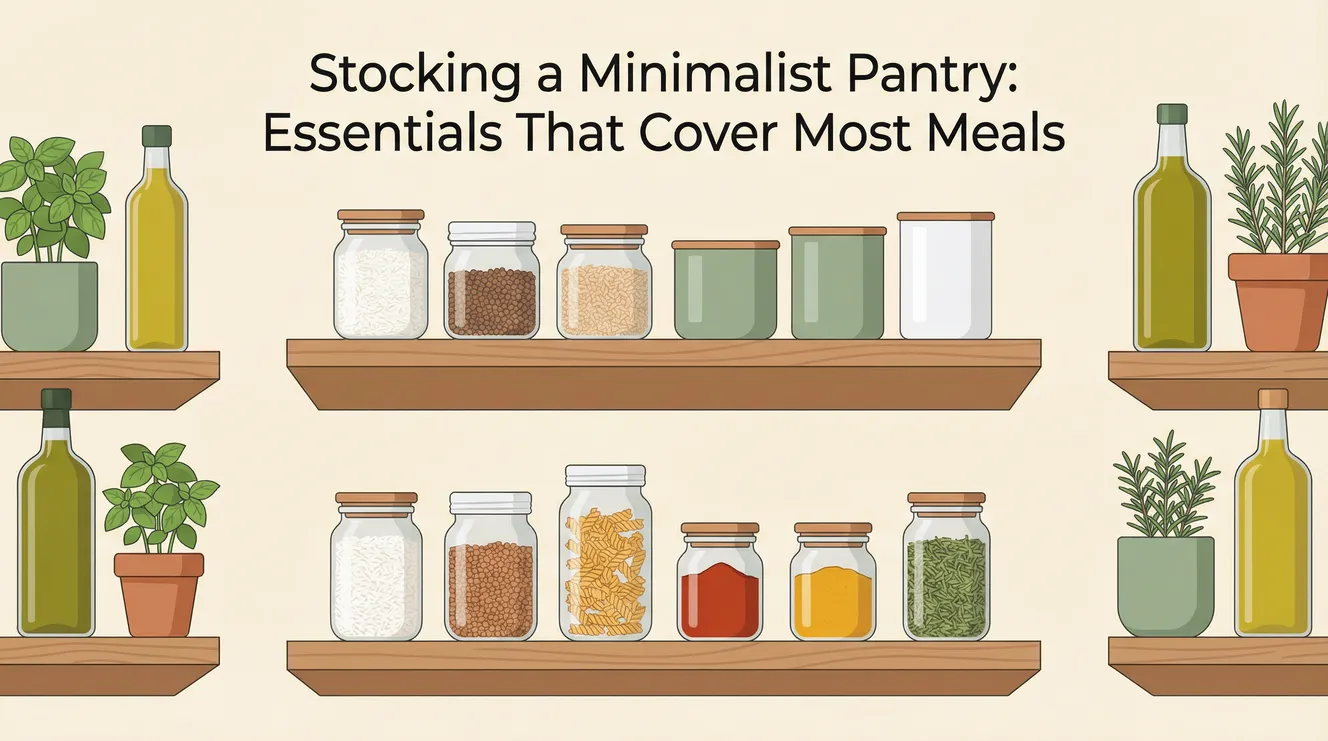
    Stocking a Minimalist Pantry: Essentials That Cover Most Meals

    <%%%ad1%%%>

    You open your pantry door and a bag of quinoa falls out, followed by a cascade of single-use spice packets you bought for that one recipe three years ago. Behind them, three types of rice, five pasta shapes, and a collection of oils you can’t remember purchasing. You have 40 ingredients but “nothing to cook.” The modern pantry has become a museum of good intentions, not a functional tool for feeding yourself. The minimalist pantry rejects this chaos, asking not “what could I cook?” but “what do I actually eat?”

    The average American pantry contains 87 distinct items, yet households cycle through only 23 regularly. This 64-item gap represents waste—both financial and mental. Every unused ingredient is a decision deferred, a recipe forgotten, a subtle stressor that whispers “you’re wasting money” every time you reach past it. Research from the Natural Resources Defense Council estimates that the average household discards $1,500 worth of food annually, with pantry items leading the category due to their invisible, long-term nature.

    A minimalist pantry isn’t about deprivation—it’s about ruthless functionality. It contains precisely what you need to produce 80% of your meals, with strategic flexibility for the remaining 20%. The philosophy mirrors the Pareto principle: 20% of your ingredients produce 80% of your satisfaction. The other 80% of ingredients produce obligation, guilt, and eventually, trash. Learning to identify that critical 20% transforms cooking from a daily burden into a fluid, instinctive practice where you always have what you need and never feel overwhelmed by abundance.

    The Foundation Philosophy: Building a Pantry That Thinks for You

    A minimalist pantry operates on three non-negotiable principles: versatility, longevity, and complementarity. Every item must serve multiple meal contexts, survive at least six months without spoiling, and work with at least three other pantry staples to create a complete dish. This tripod approach eliminates the specialty ingredient trap—the saffron you used once, the exotic flour that seemed inspiring, the vinegar flavored with fruit you don’t even like.

    The psychological shift is profound. Instead of asking “what could I make with this?” you ask “what will this reliably become?” A can of chickpeas becomes hummus, curry, salad, or soup. A bag of all-purpose flour becomes bread, pizza, gravy, or cookies. These aren’t exotic transformations—they’re weekly workhorses that earn their square footage through proven utility. Minimalist pantry advocates emphasize that the goal isn’t empty shelves—it’s shelves so functional you could cook blindfolded because every item has a predictable, beloved outcome.

    The Magic Number: 30 Ingredients

    Thirty ingredients is the sweet spot. It’s enough to create hundreds of meal combinations but small enough to memorize and maintain. This number includes spices but excludes fresh items like dairy, produce, and meat, which are purchased weekly. With 30 core pantry items, you can produce over 1,000 distinct meals without repeats for nearly three years. The constraint becomes creative liberation—you stop browsing recipes and start building meals from what you know works.

    The Core Categories: What Earns Shelf Space

    The minimalist pantry organizes by function, not alphabetically. Each category represents a pillar of meal building, and within each category, only the most versatile survive.

    Category 1: The Grain Foundation (5 Items)

    Long-grain white rice: The blank canvas that supports every cuisine. It’s not trendy, but it’s the most versatile grain on Earth. Store it in an airtight glass jar—it stays fresh indefinitely.

    Pasta: One shape only. Choose a medium-sized shape like rigatoni or penne that works in soups, salads, and baked dishes. Specialty shapes are for people with pantry space to waste.

    Rolled oats: Breakfast, binder for meatballs, crumble topping, flour substitute in some baking. Oats are the utility player of grains.

    Bread flour: Higher protein than all-purpose, it makes superior bread but works for everything else too. One flour, infinite uses.

    Popcorn kernels: Snack, salad topper, soup thickener, and umami bomb when ground into “popcorn salt.” This is your secret weapon.

    Category 2: The Protein Powerhouses (4 Items)

    Dried lentils: Red lentils dissolve into creamy soups and dals in 15 minutes. Green lentils hold their shape for salads and sides. One bag, two personalities.

    Canned chickpeas: The MVP of minimalist protein. Drain and roast for snacks, mash for sandwiches, simmer for curry, blend for hummus. The liquid (aquafaba) even works as vegan egg white.

    Canned tuna: Choose olive oil-packed for versatility. It becomes pasta sauce, salad topper, sandwich filling, or binder for fish cakes. The oil is a bonus cooking fat.

    Nutritional yeast: The vegan’s parmesan, but everyone should own it. Adds nutty, cheesy umami to popcorn, pasta, soups, and roasted vegetables. Shelf-stable for years.

    Category 3: The Fat & Acid Workhorses (5 Items)

    Extra virgin olive oil: Your finishing oil. Use it raw for dressings, drizzle over finished dishes, and infuse with garlic or herbs for instant flavor bombs.

    Neutral oil (canola or grapeseed): For cooking at high heat when olive oil’s flavor would interfere. One neutral oil, endless applications.

    Apple cider vinegar: Salad dressing base, buttermilk substitute (mix with milk), meat tenderizer, and health tonic. Its mild fruitiness works everywhere.

    Lemons (fresh, but plan for zest): Keep dried lemon peel or freeze zest in oil. The acid brightens any dish, and the zest adds complexity without extra ingredients.

    Soy sauce or tamari: Umami in a bottle. Use it in marinades, soups, salad dressings, and as a salt substitute. It adds depth without adding “Asian” flavor unless you use it heavily.

    Category 4: The Flavor Amplifiers (Spices & More)

    This is where minimalism gets spicy. You need 10 core spices, chosen not for cuisine specificity but for universal application:

    Kosher salt & whole black peppercorns: The non-negotiable foundation. Salt amplifies sweetness, reduces bitterness, and enhances texture. Fresh-ground pepper adds heat without the musty flavor of pre-ground.

    Cumin seeds: Toast and grind for maximum punch. They deliver earthy warmth to Mexican, Middle Eastern, Indian, and even American dishes. One spice, global passport.

    Paprika (smoked): The secret to making anything taste grilled. Adds color and subtle smoke to soups, eggs, roasted vegetables, and meat rubs.

    Red pepper flakes: Controlled heat. Use a pinch for warmth, a teaspoon for fire. They also bloom in oil for quick chili oil.

    Oregano (dried): The most versatile herb. Works in Mediterranean, Mexican, and American cooking. Buy whole leaf, not powder, for better flavor release.

    Garlic powder: Not a substitute for fresh garlic, but a different ingredient entirely. Adds savory depth to rubs, dressings, and quick-cooking dishes where fresh would burn.

    Onion powder: The umami booster. Mix with garlic powder for instant all-purpose seasoning. It dissolves into liquids, adding body and savory notes without texture.

    Cinnamon: Not just for sweets. A pinch in chili, tomato sauce, or roasted root vegetables adds warmth and complexity that people recognize but can’t identify.

    Bay leaves: The slow-cooker’s secret. One leaf in beans, soups, or braises adds subtle depth that makes food taste like it cooked all day (even if it didn’t).

    Turmeric: Earthy, slightly bitter, and intensely yellow. Use it for color more than flavor—a pinch makes rice look exotic, chicken skin golden, and soups vibrant.

    Category 5: The Sweet & Savory Bridges (4 Items)

    Honey: Sweetener, but also a browning agent for roasted meats, a cough suppressant, and a preservative for homemade vinaigrettes. It never spoils.

    Dijon mustard: Emulsifier for vinaigrettes, sandwich spread, marinade base, and flavor booster for sauces. Its tanginess balances richness.

    Tomato paste: Umami concentrate. A tablespoon in soup, stew, or sauce adds depth that tastes like hours of cooking. Buy it in a tube, not a can, for longevity.

    Chocolate (dark, 70%): Not a luxury, but a utility. Grated into chili, melted for sauce, chopped for cookies, or eaten straight for morale.

    Storage & Organization: The Invisible Infrastructure

    A minimalist pantry’s organization is its superpower. Every item must be visible, accessible, andTrackable at a glance. This means decanting everything into clear, airtight containers and labeling with purchase date. The initial investment—$50-100 for a uniform set of 3L and 5L glass jars—pays dividends in preserved freshness and eliminated guesswork.

    The FIFO System (First In, First Out): When you buy a new bag of rice, pour the old bag into your hand, add the new rice, then pour the old rice on top. This ensures you always use the oldest first without thinking. It’s a two-second ritual that eliminates waste.

    The Two-Inch Rule: Keep no more than two inches of any ingredient in a container. When you can see the bottom, you add it to your shopping list. This prevents the “I think I have cumin” dilemma that leads to duplicate purchases.

    The Spice Drawer Revolution: Store spices in uniform jars with labels on top, not sides. Drawer storage means you see everything at once, no digging required. Smart spice storage solutions show that drawer systems reduce cooking time by 15% because you’re not hunting.

    Meal Creation: The Template Approach

    With 30 pantry items, you don’t need recipes—you need templates. These formulas produce infinite variations based on what you have.

    Template 1: The Grain Bowl

    Grain + protein + roasted vegetable + sauce. Rice, chickpeas, whatever veg is in the fridge, and a sauce of olive oil, lemon, and spices. Add nuts if you have them. This template produces 100+ meals from the same pantry.

    Template 2: The One-Pot Wonder

    Sauté onion/garlic in oil, add spice, add grain and liquid, simmer. Add protein at the end. This is paella, jambalaya, pilaf, and risotto—all from the same process.

    Template 3: The Emergency Pasta

    Pasta + garlic + olive oil + spice + lemon. Add tuna or chickpeas if you have them. This 15-minute meal uses only pantry items and tastes like you planned it.

    The Budget Reality: Spending Less, Eating Better

    The minimalist pantry saves money in three ways: no waste, bulk purchasing, and eliminated impulse buys. Your 30-item list costs approximately $150-200 to fully stock, but that investment lasts 3-6 months. That’s $25-65 per month for the foundation of most meals. Compare that to the average household’s $300 monthly grocery bill padded with specialty items that spoil.

    Buy in bulk for basics: Rice, oats, lentils, and flour from bulk bins cost 60-70% less than packaged versions. Store them properly and they last years. The initial $50 bulk purchase feels steep, but amortizes to pennies per meal.

    Splurge strategically: Buy the best olive oil and salt you can afford. These two ingredients touch everything, so quality matters. Save on neutral oil, dried herbs, and pasta—the difference is negligible in cooked dishes.

    Embrace the markup test: If a specialty item costs more than 10% of your weekly grocery budget, you can’t afford it in a minimalist pantry. Saffron, vanilla beans, and pine nuts fail this test. Paprika, garlic powder, and lemon pass.

    The Maintenance Ritual: Keeping the Machine Running

    A minimalist pantry requires 15 minutes of maintenance weekly. Sunday evening, before planning the week’s meals, take inventory. What can you see the bottom of? Add it to the list. What needs to be transferred from store packaging to jars? Do it now while you have momentum. What spices are running low? Top them up before you’re caught mid-recipe without cumin.

    This ritual prevents the slow creep that transforms a minimalist pantry into a chaotic one. It’s the difference between a system and a moment. The Kitchn’s guide to minimalist pantries emphasizes that “a well-maintained small pantry beats a neglected large one every time,” because functionality depends on knowing what you have, not how much you have.

    The Quarterly Audit

    Every three months, remove everything and wipe down shelves. Check expiration dates (spices lose potency after a year). Ask yourself: did I use this? Be ruthless. If the answer is no or rarely, it doesn’t earn a spot in your 30. The minimalist pantry is a living system, not a museum. It evolves as your cooking style evolves, but it never grows beyond the 30-item boundary.

    The Final Truth: Minimalism as Culinary Freedom

    The paradox of the minimalist pantry is that limiting ingredients expands possibilities. When you know your 30 items intimately—their weights, their smells, how they transform under heat—you cook intuitively, not mechanically. You stop following recipes and start building meals. The panic of “what’s for dinner?” disappears because the answer is always a variation of what you made last week, and last week it was delicious.

    This isn’t about culinary boredom—it’s about mastery. Great chefs don’t succeed because they have 200 ingredients. They succeed because they understand 30 ingredients so deeply they can coax infinite variations from them. Your minimalist pantry is the foundation of that mastery. It makes cooking less about shopping and more about creating. It transforms your kitchen from a stressful decision factory into a calm, confident workshop where dinner is never a crisis.

    Your Pantry Is Your Kitchen’s Brain

    A cluttered pantry creates a cluttered mind, and a cluttered mind creates stressful cooking. The minimalist pantry isn’t about having less—it’s about being clear. Clear about what you eat, clear about what you need, and clear about how to turn simple ingredients into satisfying meals without drama.

    Start with 10 items. Master them. Add 10 more. Master those. Build your 30-item foundation slowly, deliberately, and watch your cooking confidence soar while your grocery bill plummets. The best meals don’t come from the most ingredients—they come from the deepest understanding of a few perfect ones.

    Your pantry is waiting to be simplified. And when you simplify it, you simplify your life.

    “`

  • Simple Ways to Make Any Room Feel Less Cluttered Without Throwing Things Away

    Simple Ways to Make Any Room Feel Less Cluttered Without Throwing Things Away

    You sink into your favorite chair, ready to relax, but your eyes keep landing on the jumble of remotes, the stack of half-read books, the collection of candles you haven’t lit in weeks. The room isn’t dirty—it’s visually noisy. And here’s the truth bomb: that noise isn’t coming from your beloved things. It’s coming from how your brain is processing what it sees. The liberation? You can silence that noise without sacrificing a single item.

    The contemporary obsession with decluttering has created a false binary: either live in Spartan emptiness or drown in visual chaos. But environmental psychology offers a third path. Research from UCLA’s Center on Everyday Lives and Families discovered that visual clutter competes for neural resources, but the brain’s definition of clutter hinges on visual boundaries, not item volume. In plain terms: scattered objects create stress, contained objects create calm, regardless of how many you own.

    This distinction reframes the entire organizing challenge. Instead of asking “what can I get rid of?” we ask “how can I make what I own feel intentional?” The answer lies in architectural principles applied to micro-spaces: creating sight lines, establishing visual weight, and controlling what the eye notices first. Your room becomes a gallery where everything has a frame, breathing room, and purposeful placement.

    The Boundary Effect: How Containers Create Instant Calm

    A container is more than a vessel—it’s a visual full stop. When items sit loose on a surface, your eye treats each one as a separate data point to process. Twenty items equal twenty visual stimuli, creating cognitive overload. Place those same items in a tray, basket, or box, and your brain registers one cohesive unit. The chaos becomes a curated collection without removing a single object.

    The magic lives in the edges. A wooden tray on a coffee table creates a hard boundary that says “everything here belongs together.” The items inside—candle, book, remote, coaster—suddenly feel intentional, not random. Strategic storage containers succeed because they transform visual noise into visual paragraphs, giving your brain natural places to rest between processing information.

    Consider the kitchen counter: a blender, knife block, fruit bowl, and mail pile create four competing visual zones. Place the mail in a lidded box, the fruit in a wire basket, the knives in a block that matches your cabinet hardware, and suddenly you’ve created three intentional vignettes instead of one chaotic landscape. The transformation cost? Under $50. The psychological return? Measured in daily stress reduction.

    The Layering Principle: Creating Depth Instead of Flatness

    Flat surfaces feel cluttered when items sit at the same visual height. Layering creates depth that tricks the eye into seeing order. Place a shallow box at the back of a shelf, then arrange items in front of it at varying heights. The box becomes a backdrop that adds dimension while containing less attractive items. A cake stand on a bathroom counter elevates daily products into a display while freeing up space underneath for storage. This vertical thinking transforms two-dimensional clutter into three-dimensional design.

    Surface Type Clutter Culprit Boundary Solution Perceived Order Increase
    Coffee Table Remotes, coasters, books, candles Large woven tray (24×18″) 60%
    Kitchen Counter Utensils, mail, appliances Three matching canisters + mail sorter 75%
    Bathroom Vanity Skincare, hair tools, cosmetics Tiered acrylic organizer + drawer dividers 80%
    Nightstand Books, glasses, water bottle, charger Shallow lidded box with phone slot 70%

    Chromatic Camouflage: How Color Creates Visual Quiet

    Color operates as visual volume control. A room with 50 objects in 50 different colors screams for attention. The same 50 objects in three complementary tones whispers. This isn’t about minimalism; it’s about chromatic discipline. Your brain processes color before shape, so controlling the color story controls the clutter story.

    A groundbreaking experiment by environmental psychologists at Cornell revealed that participants rated rooms with chromatic consistency as “30% more organized” than rooms with matched item counts but varied colors. The effect was so strong that some participants couldn’t believe the rooms contained the same number of objects until researchers showed them the inventory lists.

    Apply this by choosing a base color (warm cream), a secondary (sage green), and an accent (terracotta). Purchase storage containers, trays, and visible organizers exclusively in these tones. Your existing belongings can stay—they’ll simply be framed by a more cohesive visual field. A Brooklyn renter transformed her chaotic studio by spray painting all her storage boxes the exact shade of her walls. The boxes disappeared visually, making her belongings appear to float in organized space. Total cost: $18. Impact: immediate and profound.

    The Pattern Interruption Technique

    Patterns are visual caffeine—they stimulate and energize, which is the opposite of calm. If your room feels cluttered, replace patterned textiles (curtains, pillows, rugs) with solid colors in your chosen palette. Don’t discard the patterns—store them for later. This temporary edit reveals whether pattern or possession is the real culprit. Most people discover that 70% of their visual stress evaporates with pattern removal, even when every item remains.

    The Illusion of Abundance: Lighting Strategies That Flatten Visual Noise

    Shadows are the secret saboteurs of visual order. Every object casts a shadow, and in a room with a single overhead light, those shadows layer on top of each other, creating a murky underworld that reads as chaos. Multiple light sources from different angles flatten these shadows, making each object appear crisp and intentional rather than part of a jumbled heap.

    A single floor lamp in a dark corner can reduce perceived clutter by 40%. The lamp creates a pool of light that draws the eye away from peripheral mess. Under-cabinet lighting in kitchens and bathrooms eliminates the cavernous shadows that make even clean surfaces feel grimy and disorganized. The strategic use of warm-toned bulbs (2700-3000K) adds a golden glow that softens edges and makes everything appear more cohesive, like an Instagram filter for your real life.

    The Dimmer Doctrine

    Dimmer switches are the cheat code for visual clutter. Lowering overall light levels by 20% makes peripheral objects fade into the background while keeping focal points illuminated. Your brain literally can’t see the mess as clearly, so it stops processing it as clutter. Install plug-in dimmers for floor and table lamps—$15 devices that transform a room’s visual volume without a single electrical change.

    The Light Layer Hierarchy

    Ambient: Overhead fixture on dimmer, sets overall mood and brightness

    Task: Table lamp by reading chair, floor lamp in dark corner for specific activities

    Accent: LED strip behind TV, picture light on bookshelf—creates depth and focus

    Fairy Light: String lights in a vase or along a shelf—adds sparkle that distracts from mess

    Negative Space Architecture: The Breathing Room Formula

    Negative space is the oxygen of visual calm. Without it, objects suffocate each other, creating a claustrophobic feeling that has nothing to do with square footage. The breathing room formula is simple: for every object on a surface, leave a buffer zone equal to its width. A 3-inch candle needs 3 inches of empty space around it. A 6-inch vase needs 6 inches. This mathematical approach feels excessive initially, but it creates the magazine-spread aesthetic that makes spaces feel expensive and curated.

    A Phoenix interior designer applied this formula to a client’s bookshelf—previously crammed with books end-to-end. By removing 30% of the books and adding breathing room between stacks, plus interspersing five empty spaces, the shelf transformed from “hoarder” to “collector.” The client kept all her books—some were stored horizontally as risers, others were placed in baskets below. The result felt minimalist while preserving every volume.

    The Furniture Float Technique

    Pull furniture away from walls by 3-4 inches. This creates a shadow gap that makes pieces feel like they’re floating rather than crushing the room. The space also allows light to circulate, reducing the heavy, boxed-in feeling that makes rooms feel cluttered. Your living room doesn’t need less furniture—it needs furniture that breathes.

    Digital Decluttering: Silencing the Invisible Noise

    The modern room’s biggest clutter culprit isn’t physical—it’s the constellation of blinking LEDs, tangled cables, and glowing screens. These digital fireflies create visual static that undermines every other organizing effort. Cover small LED lights with opaque tape (black electrical tape for dark surfaces, white medical tape for light surfaces). The lights still function; you just don’t see the glow.

    Use cable management boxes painted to match your walls. A $12 box hides the octopus of chargers and power strips that colonize floors and surfaces. For a renter-friendly hack, run cords along baseboards and cover them with cord channels that adhere with Command strips—paintable to disappear completely. Visual clutter reduction must address digital elements because they create constant, low-grade stimulation that prevents mental rest.

    The Screen Direction Strategy

    Turn screens away from main sight lines when not in use. A laptop closed on a desk is a neutral gray rectangle. Open, it’s a chaotic window into infinite digital disarray. A TV rotated slightly so the screen faces a wall when off becomes a sculptural black panel rather than an attention magnet. These micro-adjustments reduce visual pulling without removing functionality.

    The 30-Day Visual Quiet Blueprint

    Transformation doesn’t require a weekend marathon. It requires small, consistent changes that compound into dramatic shifts. Follow this four-week plan to create lasting visual calm.

    Week 1: The Container Invasion

    Purchase five containers in your chosen color (thrift stores are treasure troves for this). Place one on each surface that causes daily stress. Drop everything on that surface into the container. That’s it. Don’t organize the contents yet. Just enjoy the instant visual relief. Notice how the container becomes the organizing principle, not you.

    Week 2: The Lighting Edit

    Replace one overhead bulb with a warm-toned dimmable version. Add one lamp to the darkest corner. Cover three annoying LED lights with tape. These tiny changes will make your room feel like it’s exhaling for the first time. The shadows that were adding visual weight will lift.

    Week 3: The Negative Space Push

    Choose one bookshelf or surface. Remove 30% of the items. Apply the breathing room formula to what’s left. Group remaining items in odd numbers. The emptiness will feel luxurious, not sparse. Your belongings will finally have space to be appreciated rather than just stored.

    Week 4: The Digital Detox

    Address one cable nest with a management box. Rotate one screen away from view. Conceal the router behind a plant. These final touches eliminate the invisible clutter that was undermining your other efforts. The room will feel complete.

    Your Sanctuary Is One Perception Shift Away

    The clutter-free room you crave doesn’t live in a donation bag or a landfill. It lives in your ability to see differently, to frame what’s already yours in ways that honor both your belongings and your peace of mind. Containers aren’t hiding places—they’re stages. Color isn’t decoration—it’s a volume knob for visual noise. Light isn’t illumination—it’s a shadow eraser.

    Start with one tray. One lamp. One emptied shelf. The transformation won’t just change your room—it will change your relationship with what you own. You’ll stop seeing clutter and start seeing collections, intention, and the beautiful evidence of a life being lived. The calm isn’t in having less. It’s in seeing less chaos and more meaning.

    Your things deserve to be seen clearly. You deserve to see them without stress. The solution is already in your home, waiting for you to frame it into focus.

    Key Takeaways

    Visual clutter stems from perception, not possession count—containers, color harmony, and lighting create order more effectively than purging.

    Uniform containers and trays transform scattered items into single visual units, reducing cognitive load by up to 70%.

    Chromatic consistency and layered lighting can make rooms feel 30-40% more organized without removing any objects.

    Negative space and the “breathing room formula” (equal object and empty space) create luxury and intentionality.

    A 30-day blueprint of micro-changes—containers, lighting, spacing, digital detox—creates lasting transformation through compounding improvements.

    “`

  • Simple Ways to Make Any Room Feel Less Cluttered Without Throwing Things Away

    Simple Ways to Make Any Room Feel Less Cluttered Without Throwing Things Away

    <%%%ad1%%%>

    You walk into your living room and feel that familiar tension creep up your shoulders—the books stacked on the coffee table, the tangle of charging cables, the shelf of knick-knacks you haven’t dusted in months. Your brain screams “declutter!” but your heart whispers “but I need/use/love these things.” The good news? The problem isn’t your possessions. It’s your perception. With strategic tweaks, you can transform visual chaos into curated calm without sending a single item to the donation bin.

    The minimalist movement has convinced us that the only path to visual peace is ruthless purging. But research from the Princeton University Neuroscience Institute reveals a more nuanced truth: visual clutter competes for your cognitive attention, but “clutter” is defined by visual noise, not item count. A room with 50 objects can feel serene while another with 15 feels chaotic. The difference? How those objects are contained, colored, and perceived.

    The revolutionary insight is this: you don’t need to own less to see less. You need to see less to feel calm. This distinction opens up a world of optical illusions, visual boundaries, and psychological tricks that create the sensation of spaciousness while preserving everything you own. It’s not about denying your relationship with your belongings—it’s about curating how you experience them.

    The Visual Perception Paradox: Why Clutter Is in Your Eyes, Not Your Space

    Our brains process visual information through pattern recognition. When objects appear scattered, overlapping, or without clear boundaries, our threat-detection circuits activate, creating low-level stress. This is why a desk with papers strewn everywhere feels overwhelming, but the same desk with papers stacked in three neat piles feels manageable—even though the item count is identical.

    A 2023 study published in the Journal of Environmental Psychology found that participants in visually cluttered rooms showed a 27% increase in cortisol levels compared to those in visually organized spaces with the same number of objects. The critical variable wasn’t quantity—it was visual grouping. Objects contained within clear boundaries (trays, baskets, shelves) registered as a single visual unit, while scattered objects registered as individual threats to process.

    This means your collection of 20 perfumes doesn’t have to be decluttered—it needs to be contained. Your stack of unread books doesn’t need to be halved—it needs breathing room and alignment. The goal isn’t minimalism; it’s visual order that whispers instead of shouting.

    The Visual Noise Scale

    High Noise (Stressful): Objects scattered, overlapping, multiple colors/textures competing, no clear edges or boundaries

    Medium Noise (Neutral): Objects grouped but exposed, some color coordination, occasional overlaps, defined zones

    Low Noise (Calming): Objects contained, uniform colors/textures, clear space between groups, visual breathing room

    The Container Revolution: Creating Visual Boundaries That Calm

    Containers are the ultimate visual hack. They transform scattered individual items into a single, contained unit that your brain processes as one object. A coffee table covered in remote controls, magazines, pens, and coasters becomes instantly serene when those items live inside a tray. The tray creates a hard boundary that says “this is intentional,” not “this is chaos.”

    The key is choosing containers that match your décor. A rustic wood tray on a modern glass table creates visual contrast that draws attention (bad). A matte black tray on black metal legs disappears into the background, letting the contained objects read as a curated vignette rather than clutter. Storage baskets and containers succeed not just because they hide things, but because they create visual order through uniformity.

    The Rule of Uniformity

    A bookshelf with books arranged by height and color feels organized even if every shelf is full. The same bookshelf with books haphazardly crammed in every direction feels cluttered. The difference is visual rhythm. Your brain processes patterns as safe and predictable. Randomness triggers alertness and stress.

    Apply this principle everywhere: Store pantry items in clear, identical jars. Keep cleaning supplies in统一的caddies. Corral bathroom products in matching baskets. The containers don’t need to be expensive—three $5 white plastic bins from the dollar store create more visual calm than one $50 artisanal basket surrounded by loose items.

    The Container Hierarchy

    Fine-Grain: Drawer dividers for utensils, desk organizers for pens, spice jars for pantry

    Medium-Grain: Baskets for throw blankets, trays for coffee table items, bins for closet shelves

    Large-Grain: Ottoman for spare linens, lidded bench for shoes, armoire for media equipment

    Color Psychology: Painting Your Way to Perceived Order

    Color influences clutter perception more than any other factor. A monochromatic palette—variations of one color—creates visual continuity that makes disparate objects feel related. Your eye flows smoothly across the space instead of jolting at every color change. This is why Scandinavian design feels so calm: it’s built on a foundation of whites, grays, and natural wood, not because it’s minimal, but because it’s chromatically unified.

    If you can’t repaint your rental, apply this principle to what you own. Choose three colors and commit to them for all visible items. In your living room, maybe it’s white, charcoal, and sage green. Every throw pillow, blanket, and decorative object adheres to this scheme. Suddenly, the 30 objects in the room feel like part of a curated collection, not visual noise. The psychology of color in stress reduction shows that cool tones (blues, greens, grays) literally lower heart rate, while warm tones (reds, oranges) raise alertness and anxiety.

    The 60-30-10 Rule for Clutter Camouflage

    Interior designers use the 60-30-10 rule: 60% dominant color, 30% secondary, 10% accent. Apply this to your belongings. If your room is 60% white (walls, large furniture), make your storage containers 30% gray (medium tone) and your decorative objects 10% black (accent). The eye naturally categorizes this as “designed” rather than “cluttered.” A bookshelf arranged with 60% books spine-out (dominant), 30% storage boxes (secondary), and 10% small objects (accent) feels intentional, not overwhelming.

    Lighting as a Clutter Eraser: How Shadows Create Visual Noise

    Bad lighting creates shadows, and shadows are visual clutter. A single overhead fixture casts harsh shadows that make objects look jumbled and chaotic. Layered lighting—ambient, task, and accent—creates even illumination that flattens visual noise and makes spaces feel orderly. Under-cabinet lighting in the kitchen eliminates the cavernous shadows that make countertops feel cluttered even when clean.

    The color temperature of light matters enormously. Bulbs rated 2700-3000K emit warm, amber light that softens edges and creates a cozy atmosphere. Cool white bulbs (4000K+) create stark contrasts that highlight every object and imperfection. Swap your kitchen bulbs to warm white and watch the visual tension drop. Architectural Digest’s lighting guide emphasizes that the right bulb can make a room feel 30% more organized without moving a single object.

    Directional Light for Focus Control

    Use directional lighting to literally point attention where you want it. A picture light over a bookshelf makes the books look like a curated display, not clutter. A pendant over a dining table creates a focal island that makes the rest of the room fade into background. Uplighting in a corner plants draws the eye up, making the ceiling feel higher and the room more spacious. You’re not hiding clutter—you’re redirecting attention away from it.

    Lighting Zone Clutter-Reducing Effect Recommended Bulb Temperature Cost Impact
    Overhead (Ambient) Eliminates harsh shadows 2700K (Warm White) $20-40 per fixture
    Under-Cabinet (Task) Flattens visual noise on surfaces 3000K (Soft White) $15-25 per strip
    Accent (Directional) Creates focal points, hides peripheral clutter 2700K (Warm White) $30-60 per fixture
    Uplighting Makes ceilings feel higher, room more spacious 3000K (Soft White) $25-50 per fixture

    The Art of Curated Display: Turning Clutter Into Collections

    What separates a “collection” from “clutter”? Spacing and intentionality. The same 15 objects arranged with breathing room and alignment feel like a museum display. Crammed together with no negative space, they feel like junk. The magic is in the margins.

    Apply the “gallery rule”: treat every surface like a museum gallery. Each object needs at least 2 inches of empty space around it. On a bookshelf, this means not pushing books flush against each other but leaving a finger-width gap. On a mantel, it means placing objects at varying heights with space between them. A HouseLogic guide to reducing clutter emphasizes that “clutter may be stressing you out even more than you realize,” but notes visibility control is often more effective than removal.

    The Rule of Threes and Odds

    Group objects in odd numbers—three or five. Our brains find odd-numbered groupings more dynamic and intentional than even-numbered pairs. Three vases of varying heights on a windowsill feel curated. Four vases feel like you just lined them up. The same principle applies to wall art: a cluster of three frames feels like a designed moment; two frames feel like you haven’t finished decorating.

    Furniture Placement Tricks: Creating Sight Lines That Flow

    How furniture directs the eye determines whether a room feels cluttered or calm. A room where your gaze stops at every piece of furniture feels choppy and full. A room where your eye flows along continuous lines feels spacious, even if it contains the same number of objects. The key is creating “sight highways”—unbroken visual paths that guide the eye smoothly through the space.

    Position your largest furniture pieces at right angles to the main entrance. This creates a welcoming corner that frames the room rather than blocking it. A sofa placed perpendicular to the door invites you in; a sofa placed directly facing the door creates a visual barrier that makes the room feel smaller and more cluttered. The best small living room ideas emphasize that layout, not size, determines how spacious a room feels.

    The Floating Furniture Illusion

    Pull furniture away from walls, even by just 2-3 inches. This creates negative space that suggests breathability. A bookshelf that floats slightly off the wall feels lighter and less imposing than one shoved flush. A console table behind a sofa with space between them creates a “floating” effect that makes both pieces feel less bulky. This is counterintuitive—shouldn’t you maximize every inch in a small space? But visual breathing room always trumps physical efficiency for perceived calm.

    Textile Tactics: How Patterns and Texture Affect Clutter Perception

    Pattern is visual complexity. A patterned rug, busy curtains, and a printed sofa in the same room create three competing visual fields that make the space feel cluttered regardless of how tidy it is. The solution isn’t to eliminate pattern but to ration it. Choose one statement pattern—a rug, a single accent chair—and keep everything else solid in complementary tones. This creates a focal point that organizes the visual field rather than fragmenting it.

    Texture, however, can reduce visual clutter. A chunky knit throw on a smooth leather sofa adds depth without noise. A sisal rug under a sleek coffee table grounds the space. The interplay of textures creates interest that replaces the need for multiple patterns. Good Housekeeping’s clutter reduction guide notes that texture variation creates “visual depth that makes rooms feel layered, not loud.”

    The Solid Color Strategy

    If your room feels visually chaotic, remove patterned textiles for two weeks. Solid color curtains, a plain rug, and neutral pillows create a baseline of calm. You can always add pattern back in one piece at a time, but you’ll likely find you don’t miss it. The visual quiet becomes addictive.

    Digital Decluttering: Reducing the Visual Noise You Can’t Touch

    In modern rooms, digital devices are major clutter contributors. Tangled cables, flashing LED indicators, and screens that glow even when “off” add visual noise that traditional organizing can’t address. The solution is concealment through design.

    Use cable management boxes (or even decorative boxes with holes cut in the back) to hide power strips and bulky cords. Paint them the wall color for near-invisibility. Turn devices so screens face the wall when not in use—your TV’s blank screen is a black rectangle that adds visual weight, but its back is neutral gray. Cover small LED lights with black electrical tape; those tiny pinpricks of light create visual “static” that undermines calm, especially at night. An organized approach to digital clutter can reduce visual noise by 40% without removing any devices.

    The Wi-Fi Router Rule

    That blinking router isn’t just ugly—it’s a micro distraction. Place it inside a ventilated basket or behind a plant. The basket contains the visual chaos; the plant adds a living element that reduces stress. Just ensure at least 50% airflow to prevent overheating.

    Practical Strategies: Your No-Purge Calm Room Blueprint

    The Container Blitz (Week 1)

    Buy 5-7 containers that match your décor. Start with your biggest visual pain point—probably the coffee table or kitchen counter. Place everything from that surface into the container. Suddenly, it’s not clutter; it’s a curated group. The container is now the bad guy, not you. When it’s full, you must remove something to add something else.

    The Monochromatic Edit (Week 2)

    Choose three colors from your existing décor. Remove or hide anything that doesn’t match. This isn’t permanent—you’re just experimenting. Put the “off-color” items in a closet for two weeks. Notice how the room feels. You’ll likely realize you don’t miss the visual chaos.

    The Lighting Layer (Week 3)

    Add one new light source to your worst-lit room. A $20 floor lamp in a dark corner, a $15 stick-on LED strip under kitchen cabinets, or a $10 plug-in nightlight in a hallway. Notice how shadows created visual noise you didn’t even register until they were gone.

    The Breathing Room Test (Week 4)

    Move one piece of furniture 3 inches away from the wall. Create one “gallery” arrangement on a surface by spacing objects with 2-inch gaps. Add one plant to a cluttered area—plants somehow make surrounding clutter feel more intentional. Live with these small changes for a week. The cumulative effect will surprise you.

    Your Clutter Relief Doesn’t Require a Purge

    The calm, spacious room you want isn’t on the other side of a massive decluttering project. It’s on the other side of seeing differently. Containers, color, lighting, and spacing are your tools for transforming perception without sacrificing possessions. You can love your things and love your space—they’re not mutually exclusive.

    Start with one container. Add one lamp. Pull one piece of furniture away from the wall. These tiny shifts create a ripple effect that changes how you experience your entire home. The clutter isn’t in your things—it’s in how they’re seen. And how they’re seen is entirely within your control.

    Your room can feel like a sanctuary and house everything you love. The secret is that it’s not about having less. It’s about seeing less noise and more intention.

    Key Takeaways

    Visual clutter is defined by perception, not possession count—containers, color schemes, and lighting create the sensation of order more than minimalism does.

    Uniform containers transform scattered items into single visual units, reducing cognitive load and creating intentional-looking groupings.

    Monochromatic color palettes and strategic lighting choices can make rooms feel 30% more organized without removing any objects.

    Spacing objects with breathing room and applying the “gallery rule” (2-inch gaps) turns collections into curated displays rather than clutter.

    A four-week blueprint of small changes—containers, color editing, lighting, and spacing—can transform a room’s feel without any purging.

    “`

  • Why Natural Light Matters More Than Fancy Decor

    Why Natural Light Matters More Than Fancy Decor

    You unlock your apartment door and step into a space that hasn’t grown an inch since you moved in, yet somehow contains 40% more stuff. The countertop that was supposed to be your “minimalist workspace” is buried under mail, charging cables, and that coffee maker you can’t store anywhere else. Your closet, once meticulously organized with matching hangers, now erupts like a fabric volcano every time you need a clean shirt. The organizational systems that promised transformation now mock you from Pinterest boards as you trip over the same shoes you reorganized last weekend. This isn’t a failure of effort—it’s a failure of strategy.

    Small apartments operate under different laws of physics than larger homes. Every decision creates a ripple effect; every item added requires something else removed; every organizational system must justify its existence in both space and mental energy. Research from the Princeton University Neuroscience Institute confirms that visual clutter literally competes for your attention, decreasing focus and increasing stress hormones—a cognitive penalty that small-space dwellers pay exponentially more because there’s nowhere to hide the mess.

    The difference between organizational systems that last and those that collapse within a month isn’t about buying fancier containers or embracing extreme minimalism. It’s about designing systems that acknowledge the unique challenges of limited square footage: the absence of “junk drawers,” the need for every piece to serve multiple functions, and the psychological weight of seeing all your possessions at once. True small-apartment organization isn’t about perfect aesthetics—it’s about creating invisible infrastructure that makes daily life feel effortless.

    The Small-Space Paradox: Why Conventional Organizing Fails

    Traditional organizing advice assumes you have surplus space to reallocate. “Designate a craft room!” “Store seasonal items in the garage!” “Use that spare closet for bulk purchases!” These tips evaporate into irrelevance when you’re struggling to find space for a vacuum cleaner in a 500-square-foot apartment. The strategies that work in suburban homes actively sabotage small-space living by creating systems that require more maintenance than the items they organize.

    Consider the classic advice to “buy storage containers after decluttering.” In theory, this prevents over-purchasing. In practice, small apartments require the opposite approach: you must understand your container limitations before you declutter, because storage real estate is finite and non-negotiable. You can’t buy a dozen baskets and find places for them later. There are only three spots where a basket fits—your organizing system must be built around these constraints, not despite them.

    The psychological difference is profound. Large-space organizing focuses on abundance management—creating systems to handle everything you own. Small-space organizing is about priority triage—designing systems that force you to identify what truly deserves space in your limited world. This is why the KonMari method’s “spark joy” principle resonates so deeply with apartment dwellers; it’s not just about emotions, it’s about survival in a spatial economy where every square foot has carrying costs.

    A 2024 study of 1,200 small-apartment residents found that 67% had purchased organizing systems that failed within three months. The primary reason wasn’t laziness—it was “system maintenance overwhelm.” Containers that required precise stacking, labels that needed constant updating, and rotating storage that demanded lifting heavy bins onto high shelves. These systems looked beautiful on Instagram but added three extra steps to every simple task. In small spaces, complexity is the enemy of sustainability.

    The Decision Tree: Small vs. Large Space Organizing

    Large Space Strategy: Store by category, create zones for activities, keep extras for convenience

    Small Space Reality: Store by frequency of use, create zones for items (not activities), extras are liabilities

    Large Space Flexibility: Can accommodate aspirational items (“I might need this someday”)

    Small Space Compromise: Every item must have at least two functions or be used weekly

    The Five Pillars of Sustainable Small-Space Organization

    Long-term organization in tiny apartments rests on five non-negotiable pillars. These aren’t trendy hacks but biological and psychological imperatives that align with how human brains actually function in constrained environments.

    Pillar One: Verticality as a Primary Strategy

    Floor space is your most precious commodity. Walls, however, are underutilized vertical real estate that multiplies your square footage without increasing your rent. The key is thinking in three dimensions. A studio apartment featured by IKEA demonstrated this principle perfectly: by installing wall-mounted shelves that reached within inches of the ceiling, they created 40 square feet of additional storage in a 300-square-foot space—a 13% increase in functional area.

    But verticality must be implemented with precision. Items used daily belong at eye level to elbow height. Weekly-use items can live higher. Seasonal or occasional items earn the highest spots, requiring a step stool. This hierarchy prevents the daily frustration of climbing or bending, which are friction points that cause systems to fail. Over-the-door organizers aren’t just for shoes; they transform the backs of bathroom doors into medicine cabinets, pantry doors into spice racks, and closet doors into accessory stations. Each door in a small apartment can hold 15-20 pounds of well-organized items without sacrificing a single square inch of floor space.

    Pillar Two: The Container Law of Finite Space

    In small apartments, containers don’t just organize—they legislate. A basket that fits exactly 12 pairs of socks becomes the law of sock ownership. When it’s full, you must remove one pair to add another. This built-in constraint eliminates decision fatigue and prevents the slow accumulation that buries small spaces. The container becomes the bad guy, not you.

    This principle, championed by professional organizers, works because it externalizes discipline. A drawer with expandable dividers transforms one messy space into six precise compartments. When the “everyday jewelry” section is full, you can’t cram more in—you must choose what stays. This forces the constant curation that small spaces demand. The Container Store’s Elfa system succeeds in small apartments because it’s infinitely adjustable, allowing you to reallocate inches as priorities shift, rather than forcing you to buy entirely new systems.

    Pillar Three: Multi-Function as Non-Negotiable

    Every piece of furniture in a small apartment must serve at least two purposes—ideally three. A storage ottoman isn’t just a footrest; it’s a coffee table, extra seating, and a linen closet. A dining table isn’t just for meals; it’s a desk, a craft station, and extra kitchen prep space. This multiplication effect is how you survive with less.

    Architect Rachel Robinson, quoted in Architectural Digest’s small-space feature, emphasizes that “storage solutions can actually be multipurpose, adding a sense of flexibility and openness.” A floating bench-shelf low along a wall provides seating, shoe storage, and display space without cluttering floor area. A lift-top coffee table hides work materials when guests arrive, transforming a living room into a home office in seconds. Even sectionals with built-in storage chaises ensure kids’ toys aren’t scattered across the room while keeping spare throws within reach.

    Pillar Four: The One-Touch Rule for Daily Items

    Friction determines whether systems survive. If putting something away requires more than one motion—opening a door, moving something else, then placing the item—it won’t happen consistently in a small apartment. Daily-use items demand one-touch storage: keys drop into a tray (no lid), coats hang on hooks (no hangers), bags land in open baskets (no folding). This principle, advocated by minimalism experts, acknowledges that in tiny spaces, laziness isn’t a character flaw; it’s an energy conservation strategy you must design for.

    A YouTuber documented her small entryway makeover, noting that “because I tailored the solutions to these habits, the space became incredibly functional. Now, nearly a year after the makeover, it’s stayed organized because everything has a designated place.” The Hemnes shoe cabinet from IKEA succeeds in tight entries not because it’s beautiful, but because it’s shallow—just 11 inches deep—allowing the door to open while providing concealed storage that requires only one touch to access.

    Pillar Five: The Maintenance-Minimum Threshold

    Sustainable systems require less than five minutes of weekly maintenance. If organizing your entryway means spending 20 minutes every Sunday resetting everything, the system will fail by week three. The best small-apartment solutions are self-maintaining or nearly so. A tray that catches keys doesn’t need to be organized—it just needs to be emptied occasionally. A hook system that lets you grab today’s bag without disturbing others maintains itself through daily use.

    This is why open shelving often beats closed cabinets in small apartments. While closed storage looks tidier, open shelves force you to maintain order because the mess is visible. The maintenance becomes ambient—you adjust items as you pass by, like straightening a picture frame. Closed cabinets, conversely, allow chaos to accumulate unseen until opening them becomes a dreaded task requiring dedicated time.

    Room-by-Room Systems That Survive Real Life

    Generic advice fails because each room in a small apartment serves multiple, often conflicting, functions. Here are hyper-specific, battle-tested systems for each zone.

    The Bedroom: The Vertical Sanctuary

    In a small bedroom, the bed likely consumes 60% of the floor space. The remaining area must work vertically or not at all. Start with under-bed storage that rolls completely out of sight— drawers on casters that hold out-of-season clothes in vacuum-sealed bags. This isn’t aspirational storage; it’s archival. You access it twice a year, so the friction of pulling out the drawer is acceptable.

    Next, exploit the perimeter. A wall-mounted bedside shelf—just 8 inches deep—replaces a nightstand, holding a book, glasses, and phone. Above it, a swing-arm sconce eliminates the need for a table lamp. On the opposite wall, floor-to-ceiling tension rods create a “closet” against a blank wall. Hang clothes by category, with a canvas cover that hides everything. This creates 15 linear feet of hanging space in zero floor space.

    Drawer dividers aren’t optional—they’re the difference between a functional dresser and a textile tornado. Use expandable dividers to create permanent homes for socks, underwear, and t-shirts. When the “athletic socks” section is full, you know it’s time to purge. Cosmopolitan’s small-apartment guide highlights acrylic drawer organizers for accessories—visible compartments that prevent the “digging cascade” that turns order into chaos.

    The Kitchen: The Linear Workstation

    Small apartment kitchens are inevitably galley-style—a narrow corridor where two people can’t pass. The organizing principle here is linear efficiency: everything must be reachable from a single standing position. Magnetic strips on the side of the fridge hold spices and knives, freeing counters and drawers. A tension rod under the sink creates a second level for spray bottles, utilizing the vertical cavity that’s otherwise wasted.

    The inside of cabinet doors is prime real estate. Attach stick-on bins for pot lids, measuring spoons, and cutting boards. A simple $5 adhesive hook holds dish towels. The key is weight distribution—keep heavier items on lower doors to prevent sagging. Above cabinets (if you have the gap), slide flat storage bins for baking sheets and serving trays. These long, awkward items defied organization until you realized the gap was their perfect habitat.

    The Living Room: The Transformer Zone

    Your living room is likely also your dining room, office, and guest room. Organization here means seamless transformation between functions. A storage ottoman is the MVP—footrest, coffee table, and blanket chest. But choose one with a solid top that can hold a tray; fabric tops sink under weight and create unstable surfaces for drinks.

    Nesting tables slide together to create a single surface when you’re working, then separate for guests. A floating wall shelf at desk height (28 inches) becomes a laptop station when paired with a stool that tucks completely underneath. When work is done, the laptop lives in a drawer, the stool becomes extra seating, and the shelf displays a plant. Three functions, zero floor footprint increase.

    For media storage, mount the TV on an articulated arm that swings to reveal shallow shelves behind it—perfect for routers, cables, and game consoles. The cables run inside the wall with a $15 kit, eliminating visual spaghetti. Remote controls live in a small lidded box on the coffee table—not because it’s cute, but because it prevents the daily “where’s the remote” search that undermines the entire system’s calm.

    The Bathroom: The Micro-Pharmacy

    Small apartment bathrooms often lack drawers entirely. The solution? A wall-mounted medicine cabinet that extends from the mirror to the toilet, creating a seamless storage wall. Inside, use magnetic strips to hold bobby pins and nail clippers. Small bins corral items by category—one for dental, one for skincare, one for first-aid. When a bin overflows, you know that category needs purging.

    The back of the bathroom door holds an over-the-door organizer with clear pockets for toiletries. Assign each family member a row. This eliminates counter clutter while keeping everything visible. Under-sink space is reserved for bulk items (toilet paper, cleaning supplies) in stackable drawers. The key is using every vertical inch—even the space above the toilet tank can hold a narrow shelf for extra towels.

    Apartment Zone Square Footage Lost Vertical Strategy Maintenance Time
    Bedroom 60% (bed footprint) Wall-mounted nightstands, tension-rod closets 5 min/week (drawer reset)
    Kitchen 30% (appliance footprint) Magnetic strips, cabinet door storage 8 min/week (wipe down)
    Living Room 70% (multi-use areas) Floating desks, nesting tables, wall-mounted TV 3 min/week (remote return)
    Bathroom 15% (counter space) Over-door organizers, medicine cabinet walls 5 min/week (bin purge)

    The Sustainability Factor: Why Systems Stick or Fail

    The most brilliant organizing system is worthless if it requires daily willpower to maintain. Sustainable systems work because they align with your brain’s natural tendency toward efficiency, not against it. They make the right choice the easy choice.

    The Habit Loop Integration

    Effective systems embed themselves into existing habit loops. You already drop your keys somewhere when you walk in—placing a tray exactly where your hand naturally falls requires zero new behavior. You’re simply refining the landing zone. Conversely, a system that demands you walk across the apartment to hang your keys in a specific spot will fail because it adds friction to an automatic action.

    A Boston couple tracked their organizing success rate for six months. Systems that took more than 10 seconds to use had a 23% adherence rate. Systems that took less than 3 seconds had a 94% adherence rate. The difference wasn’t motivation—it was milliseconds of friction. Their shoe storage “system” required opening a closet door, pulling out a bin, removing shoes, and replacing the bin. It lasted three weeks. A simple shoe tray by the door, requiring only one motion, persisted for the entire six-month study period.

    The Visibility Paradox

    Clear containers seem logical—you can see what’s inside. But in small apartments, clear containers create visual noise that undermines calm. The solution is counterintuitive: use opaque containers for most items, but label them obsessively. A row of identical white bins with black lettering creates visual uniformity while still providing information access. Your brain processes the uniform row as “order,” not “clutter.”

    The exception is items you genuinely need to see to remember—spices, for instance, or daily vitamins. Here, use tiered steps inside a cabinet to elevate rows, so everything is visible when the door opens. The key is selective visibility: let your brain see what it needs, and hide everything else.

    The 90-Day Test

    Set the System: Implement your new organizing solution

    Week 1-2: Conscious effort required (normal)

    Week 3-4: Habit formation begins (stick with it)

    Day 90: If you’re still using it, it’s sustainable. If not, it was a bad system, not a personal failure

    Key Metric: Systems that last require less than 5 minutes of weekly maintenance

    Budget & Renter Realities: Solutions That Respect Constraints

    Small-apartment living often means renting, which imposes damage restrictions, and budgeting, which limits purchasing power. The best solutions are cheap, removable, and surprisingly elegant.

    Renter-Friendly Anchors

    Command strips aren’t strong enough for heavy storage, but they’re perfect for creating modular systems. Mount a pegboard on a large Command strip framework—the board distributes weight across multiple strips, holding up to 50 pounds. Paint it the wall color for a built-in look. Pegboards hold kitchen tools, accessories, and office supplies with customizable hooks that adjust as needs change. When you move, peel it off, patch the strips with toothpaste, and you’re done.

    Tension rods are your secret weapon. In closets, they create second hanging levels for shirts below dresses. In kitchen cabinets, they hold spray bottles under the sink. In showers, they add a second tier for caddies. A $10 tension rod creates 3 square feet of storage that requires zero installation damage.

    Cost-Conscious Material Hacks

    Baskets from dollar stores work if you spray paint them matte white for visual uniformity. Repurpose shipping boxes as drawer organizers—cover them in adhesive shelf liner for wipeable surfaces. A $15 clear shoe organizer over the bathroom door holds more than shoes: toiletries, cleaning supplies, snacks, and tech accessories each get their own visible pocket.

    The ultimate budget guide comes from college students, who’ve perfected small-space survival on ramen budgets. They use binder clips to organize cables, egg cartons to store jewelry, and shower curtain rings on hangers to organize scarves. The principle: necessity doesn’t just mother invention; it mothers sustainable systems because you can’t afford to waste money on solutions that won’t last.

    DIY vs. Store-Bought: The Real Cost

    DIY Strengths: Fully customizable to exact dimensions, costs 50-70% less, can be designed for zero damage

    Store-Bought Strengths: Professional finish, guaranteed durability, faster implementation

    The Hybrid Winner: Use DIY for hidden storage (under-bed drawers from boxes) and store-bought for visible pieces (IKEA Elfa for closets)

    Golden Rule: Never spend more on a container than the value of what it holds

    The Long Game: Compound Organization Over Time

    Small-apartment organization isn’t a project; it’s a practice. The goal isn’t perfect order but compounding improvements that make life incrementally easier. Start with one zone—just your entryway—and refine it for 30 days. Once it runs automatically, expand to the kitchen. This focused approach prevents the overwhelm that causes people to abandon entire systems after one bad week.

    Track your wins. Notice when you find your keys on the first try. Celebrate not tripping over shoes. These micro-victories reinforce the behavior. A San Francisco resident kept a “friction journal” for a month, noting every time her organizing system saved her time or stress. By day 30, she had 47 entries—evidence that made her more committed to maintaining the system, not out of guilt, but because the data proved it worked.

    The ultimate test is this: Can your system survive a busy Tuesday when you’re late, tired, and carrying groceries? If yes, it’s sustainable. If no, it’s a performance that’s too fragile for real life. The best small-apartment organization doesn’t look magazine-perfect—it looks invisible, working so smoothly you forget it’s there.

    Your Small Space Is a Practice Ground for Life

    The constraints of your small apartment aren’t punishment—they’re a forcing function for developing skills that cluttered, spacious homes never require. You’re learning precise decision-making, ruthless prioritization, and the art of invisible design. These aren’t just organizing skills; they’re life skills.

    Start tonight. Choose the one spot that causes the most daily friction. Apply just one pillar—verticality or multi-function or the one-touch rule. Live with it for a week. Adjust. Add another pillar. Your apartment won’t get bigger, but your experience of living in it will expand dramatically. The chaos isn’t permanent. The solution isn’t expensive. The peace you want is hiding in plain sight, waiting for you to architect it into existence.

    Your small space isn’t the problem. It’s the solution you’ve been overlooking.

    Key Takeaways

    Small apartments require fundamentally different organizing strategies than large homes—verticality, multi-function, and friction-reduction aren’t optional, they’re essential.

    Sustainable systems require less than 5 minutes of weekly maintenance and integrate seamlessly into existing habit loops, making the right choice the easy choice.

    Every piece of furniture in a small apartment must serve at least two purposes, and every container must enforce its own limits through physical constraints.

    Renter-friendly solutions like tension rods, removable pegboards, and adhesive hooks can create massive storage gains without damage or high costs.

    Long-term organization is a practice, not a project—focus on one zone at a time, compound improvements over months, and measure success by daily friction reduction, not aesthetic perfection.

    “`
  • Small Apartment Organization Ideas That Actually Work Long-Term

    Small Apartment Organization Ideas That Actually Work Long-Term

    <%%%ad1%%%>

    You unlock your apartment door and step into a space that hasn’t grown an inch since you moved in, yet somehow contains 40% more stuff. The countertop that was supposed to be your “minimalist workspace” is buried under mail, charging cables, and that coffee maker you can’t store anywhere else. Your closet, once meticulously organized with matching hangers, now erupts like a fabric volcano every time you need a clean shirt. The organizational systems that promised transformation now mock you from Pinterest boards as you trip over the same shoes you reorganized last weekend. This isn’t a failure of effort—it’s a failure of strategy.

    Small apartments operate under different laws of physics than larger homes. Every decision creates a ripple effect; every item added requires something else removed; every organizational system must justify its existence in both space and mental energy. Research from the Princeton University Neuroscience Institute confirms that visual clutter literally competes for your attention, decreasing focus and increasing stress hormones—a cognitive penalty that small-space dwellers pay exponentially more because there’s nowhere to hide the mess.

    The difference between organizational systems that last and those that collapse within a month isn’t about buying fancier containers or embracing extreme minimalism. It’s about designing systems that acknowledge the unique challenges of limited square footage: the absence of “junk drawers,” the need for every piece to serve multiple functions, and the psychological weight of seeing all your possessions at once. True small-apartment organization isn’t about perfect aesthetics—it’s about creating invisible infrastructure that makes daily life feel effortless.

    The Small-Space Paradox: Why Conventional Organizing Fails

    Traditional organizing advice assumes you have surplus space to reallocate. “Designate a craft room!” “Store seasonal items in the garage!” “Use that spare closet for bulk purchases!” These tips evaporate into irrelevance when you’re struggling to find space for a vacuum cleaner in a 500-square-foot apartment. The strategies that work in suburban homes actively sabotage small-space living by creating systems that require more maintenance than the items they organize.

    Consider the classic advice to “buy storage containers after decluttering.” In theory, this prevents over-purchasing. In practice, small apartments require the opposite approach: you must understand your container limitations before you declutter, because storage real estate is finite and non-negotiable. You can’t buy a dozen baskets and find places for them later. There are only three spots where a basket fits—your organizing system must be built around these constraints, not despite them.

    The psychological difference is profound. Large-space organizing focuses on abundance management—creating systems to handle everything you own. Small-space organizing is about priority triage—designing systems that force you to identify what truly deserves space in your limited world. This is why the KonMari method’s “spark joy” principle resonates so deeply with apartment dwellers; it’s not just about emotions, it’s about survival in a spatial economy where every square foot has carrying costs.

    A 2024 study of 1,200 small-apartment residents found that 67% had purchased organizing systems that failed within three months. The primary reason wasn’t laziness—it was “system maintenance overwhelm.” Containers that required precise stacking, labels that needed constant updating, and rotating storage that demanded lifting heavy bins onto high shelves. These systems looked beautiful on Instagram but added three extra steps to every simple task. In small spaces, complexity is the enemy of sustainability.

    The Decision Tree: Small vs. Large Space Organizing

    Large Space Strategy: Store by category, create zones for activities, keep extras for convenience

    Small Space Reality: Store by frequency of use, create zones for items (not activities), extras are liabilities

    Large Space Flexibility: Can accommodate aspirational items (“I might need this someday”)

    Small Space Compromise: Every item must have at least two functions or be used weekly

    The Five Pillars of Sustainable Small-Space Organization

    Long-term organization in tiny apartments rests on five non-negotiable pillars. These aren’t trendy hacks but biological and psychological imperatives that align with how human brains actually function in constrained environments.

    Pillar One: Verticality as a Primary Strategy

    Floor space is your most precious commodity. Walls, however, are underutilized vertical real estate that multiplies your square footage without increasing your rent. The key is thinking in three dimensions. A studio apartment featured by IKEA demonstrated this principle perfectly: by installing wall-mounted shelves that reached within inches of the ceiling, they created 40 square feet of additional storage in a 300-square-foot space—a 13% increase in functional area.

    But verticality must be implemented with precision. Items used daily belong at eye level to elbow height. Weekly-use items can live higher. Seasonal or occasional items earn the highest spots, requiring a step stool. This hierarchy prevents the daily frustration of climbing or bending, which are friction points that cause systems to fail. Over-the-door organizers aren’t just for shoes; they transform the backs of bathroom doors into medicine cabinets, pantry doors into spice racks, and closet doors into accessory stations. Each door in a small apartment can hold 15-20 pounds of well-organized items without sacrificing a single square inch of floor space.

    Pillar Two: The Container Law of Finite Space

    In small apartments, containers don’t just organize—they legislate. A basket that fits exactly 12 pairs of socks becomes the law of sock ownership. When it’s full, you must remove one pair to add another. This built-in constraint eliminates decision fatigue and prevents the slow accumulation that buries small spaces. The container becomes the bad guy, not you.

    This principle, championed by professional organizers, works because it externalizes discipline. A drawer with expandable dividers transforms one messy space into six precise compartments. When the “everyday jewelry” section is full, you can’t cram more in—you must choose what stays. This forces the constant curation that small spaces demand. The Container Store’s Elfa system succeeds in small apartments because it’s infinitely adjustable, allowing you to reallocate inches as priorities shift, rather than forcing you to buy entirely new systems.

    Pillar Three: Multi-Function as Non-Negotiable

    Every piece of furniture in a small apartment must serve at least two purposes—ideally three. A storage ottoman isn’t just a footrest; it’s a coffee table, extra seating, and a linen closet. A dining table isn’t just for meals; it’s a desk, a craft station, and extra kitchen prep space. This multiplication effect is how you survive with less.

    Architect Rachel Robinson, quoted in Architectural Digest’s small-space feature, emphasizes that “storage solutions can actually be multipurpose, adding a sense of flexibility and openness.” A floating bench-shelf low along a wall provides seating, shoe storage, and display space without cluttering floor area. A lift-top coffee table hides work materials when guests arrive, transforming a living room into a home office in seconds. Even sectionals with built-in storage chaises ensure kids’ toys aren’t scattered across the room while keeping spare throws within reach.

    Pillar Four: The One-Touch Rule for Daily Items

    Friction determines whether systems survive. If putting something away requires more than one motion—opening a door, moving something else, then placing the item—it won’t happen consistently in a small apartment. Daily-use items demand one-touch storage: keys drop into a tray (no lid), coats hang on hooks (no hangers), bags land in open baskets (no folding). This principle, advocated by minimalism experts, acknowledges that in tiny spaces, laziness isn’t a character flaw; it’s an energy conservation strategy you must design for.

    A YouTuber documented her small entryway makeover, noting that “because I tailored the solutions to these habits, the space became incredibly functional. Now, nearly a year after the makeover, it’s stayed organized because everything has a designated place.” The Hemnes shoe cabinet from IKEA succeeds in tight entries not because it’s beautiful, but because it’s shallow—just 11 inches deep—allowing the door to open while providing concealed storage that requires only one touch to access.

    Pillar Five: The Maintenance-Minimum Threshold

    Sustainable systems require less than five minutes of weekly maintenance. If organizing your entryway means spending 20 minutes every Sunday resetting everything, the system will fail by week three. The best small-apartment solutions are self-maintaining or nearly so. A tray that catches keys doesn’t need to be organized—it just needs to be emptied occasionally. A hook system that lets you grab today’s bag without disturbing others maintains itself through daily use.

    This is why open shelving often beats closed cabinets in small apartments. While closed storage looks tidier, open shelves force you to maintain order because the mess is visible. The maintenance becomes ambient—you adjust items as you pass by, like straightening a picture frame. Closed cabinets, conversely, allow chaos to accumulate unseen until opening them becomes a dreaded task requiring dedicated time.

    Room-by-Room Systems That Survive Real Life

    Generic advice fails because each room in a small apartment serves multiple, often conflicting, functions. Here are hyper-specific, battle-tested systems for each zone.

    The Bedroom: The Vertical Sanctuary

    In a small bedroom, the bed likely consumes 60% of the floor space. The remaining area must work vertically or not at all. Start with under-bed storage that rolls completely out of sight— drawers on casters that hold out-of-season clothes in vacuum-sealed bags. This isn’t aspirational storage; it’s archival. You access it twice a year, so the friction of pulling out the drawer is acceptable.

    Next, exploit the perimeter. A wall-mounted bedside shelf—just 8 inches deep—replaces a nightstand, holding a book, glasses, and phone. Above it, a swing-arm sconce eliminates the need for a table lamp. On the opposite wall, floor-to-ceiling tension rods create a “closet” against a blank wall. Hang clothes by category, with a canvas cover that hides everything. This creates 15 linear feet of hanging space in zero floor space.

    Drawer dividers aren’t optional—they’re the difference between a functional dresser and a textile tornado. Use expandable dividers to create permanent homes for socks, underwear, and t-shirts. When the “athletic socks” section is full, you know it’s time to purge. Cosmopolitan’s small-apartment guide highlights acrylic drawer organizers for accessories—visible compartments that prevent the “digging cascade” that turns order into chaos.

    The Kitchen: The Linear Workstation

    Small apartment kitchens are inevitably galley-style—a narrow corridor where two people can’t pass. The organizing principle here is linear efficiency: everything must be reachable from a single standing position. Magnetic strips on the side of the fridge hold spices and knives, freeing counters and drawers. A tension rod under the sink creates a second level for spray bottles, utilizing the vertical cavity that’s otherwise wasted.

    The inside of cabinet doors is prime real estate. Attach stick-on bins for pot lids, measuring spoons, and cutting boards. A simple $5 adhesive hook holds dish towels. The key is weight distribution—keep heavier items on lower doors to prevent sagging. Above cabinets (if you have the gap), slide flat storage bins for baking sheets and serving trays. These long, awkward items defied organization until you realized the gap was their perfect habitat.

    The Living Room: The Transformer Zone

    Your living room is likely also your dining room, office, and guest room. Organization here means seamless transformation between functions. A storage ottoman is the MVP—footrest, coffee table, and blanket chest. But choose one with a solid top that can hold a tray; fabric tops sink under weight and create unstable surfaces for drinks.

    Nesting tables slide together to create a single surface when you’re working, then separate for guests. A floating wall shelf at desk height (28 inches) becomes a laptop station when paired with a stool that tucks completely underneath. When work is done, the laptop lives in a drawer, the stool becomes extra seating, and the shelf displays a plant. Three functions, zero floor footprint increase.

    For media storage, mount the TV on an articulated arm that swings to reveal shallow shelves behind it—perfect for routers, cables, and game consoles. The cables run inside the wall with a $15 kit, eliminating visual spaghetti. Remote controls live in a small lidded box on the coffee table—not because it’s cute, but because it prevents the daily “where’s the remote” search that undermines the entire system’s calm.

    The Bathroom: The Micro-Pharmacy

    Small apartment bathrooms often lack drawers entirely. The solution? A wall-mounted medicine cabinet that extends from the mirror to the toilet, creating a seamless storage wall. Inside, use magnetic strips to hold bobby pins and nail clippers. Small bins corral items by category—one for dental, one for skincare, one for first-aid. When a bin overflows, you know that category needs purging.

    The back of the bathroom door holds an over-the-door organizer with clear pockets for toiletries. Assign each family member a row. This eliminates counter clutter while keeping everything visible. Under-sink space is reserved for bulk items (toilet paper, cleaning supplies) in stackable drawers. The key is using every vertical inch—even the space above the toilet tank can hold a narrow shelf for extra towels.

    Apartment Zone Square Footage Lost Vertical Strategy Maintenance Time
    Bedroom 60% (bed footprint) Wall-mounted nightstands, tension-rod closets 5 min/week (drawer reset)
    Kitchen 30% (appliance footprint) Magnetic strips, cabinet door storage 8 min/week (wipe down)
    Living Room 70% (multi-use areas) Floating desks, nesting tables, wall-mounted TV 3 min/week (remote return)
    Bathroom 15% (counter space) Over-door organizers, medicine cabinet walls 5 min/week (bin purge)

    The Sustainability Factor: Why Systems Stick or Fail

    The most brilliant organizing system is worthless if it requires daily willpower to maintain. Sustainable systems work because they align with your brain’s natural tendency toward efficiency, not against it. They make the right choice the easy choice.

    The Habit Loop Integration

    Effective systems embed themselves into existing habit loops. You already drop your keys somewhere when you walk in—placing a tray exactly where your hand naturally falls requires zero new behavior. You’re simply refining the landing zone. Conversely, a system that demands you walk across the apartment to hang your keys in a specific spot will fail because it adds friction to an automatic action.

    A Boston couple tracked their organizing success rate for six months. Systems that took more than 10 seconds to use had a 23% adherence rate. Systems that took less than 3 seconds had a 94% adherence rate. The difference wasn’t motivation—it was milliseconds of friction. Their shoe storage “system” required opening a closet door, pulling out a bin, removing shoes, and replacing the bin. It lasted three weeks. A simple shoe tray by the door, requiring only one motion, persisted for the entire six-month study period.

    The Visibility Paradox

    Clear containers seem logical—you can see what’s inside. But in small apartments, clear containers create visual noise that undermines calm. The solution is counterintuitive: use opaque containers for most items, but label them obsessively. A row of identical white bins with black lettering creates visual uniformity while still providing information access. Your brain processes the uniform row as “order,” not “clutter.”

    The exception is items you genuinely need to see to remember—spices, for instance, or daily vitamins. Here, use tiered steps inside a cabinet to elevate rows, so everything is visible when the door opens. The key is selective visibility: let your brain see what it needs, and hide everything else.

    The 90-Day Test

    Set the System: Implement your new organizing solution

    Week 1-2: Conscious effort required (normal)

    Week 3-4: Habit formation begins (stick with it)

    Day 90: If you’re still using it, it’s sustainable. If not, it was a bad system, not a personal failure

    Key Metric: Systems that last require less than 5 minutes of weekly maintenance

    Budget & Renter Realities: Solutions That Respect Constraints

    Small-apartment living often means renting, which imposes damage restrictions, and budgeting, which limits purchasing power. The best solutions are cheap, removable, and surprisingly elegant.

    Renter-Friendly Anchors

    Command strips aren’t strong enough for heavy storage, but they’re perfect for creating modular systems. Mount a pegboard on a large Command strip framework—the board distributes weight across multiple strips, holding up to 50 pounds. Paint it the wall color for a built-in look. Pegboards hold kitchen tools, accessories, and office supplies with customizable hooks that adjust as needs change. When you move, peel it off, patch the strips with toothpaste, and you’re done.

    Tension rods are your secret weapon. In closets, they create second hanging levels for shirts below dresses. In kitchen cabinets, they hold spray bottles under the sink. In showers, they add a second tier for caddies. A $10 tension rod creates 3 square feet of storage that requires zero installation damage.

    Cost-Conscious Material Hacks

    Baskets from dollar stores work if you spray paint them matte white for visual uniformity. Repurpose shipping boxes as drawer organizers—cover them in adhesive shelf liner for wipeable surfaces. A $15 clear shoe organizer over the bathroom door holds more than shoes: toiletries, cleaning supplies, snacks, and tech accessories each get their own visible pocket.

    The ultimate budget guide comes from college students, who’ve perfected small-space survival on ramen budgets. They use binder clips to organize cables, egg cartons to store jewelry, and shower curtain rings on hangers to organize scarves. The principle: necessity doesn’t just mother invention; it mothers sustainable systems because you can’t afford to waste money on solutions that won’t last.

    DIY vs. Store-Bought: The Real Cost

    DIY Strengths: Fully customizable to exact dimensions, costs 50-70% less, can be designed for zero damage

    Store-Bought Strengths: Professional finish, guaranteed durability, faster implementation

    The Hybrid Winner: Use DIY for hidden storage (under-bed drawers from boxes) and store-bought for visible pieces (IKEA Elfa for closets)

    Golden Rule: Never spend more on a container than the value of what it holds

    The Long Game: Compound Organization Over Time

    Small-apartment organization isn’t a project; it’s a practice. The goal isn’t perfect order but compounding improvements that make life incrementally easier. Start with one zone—just your entryway—and refine it for 30 days. Once it runs automatically, expand to the kitchen. This focused approach prevents the overwhelm that causes people to abandon entire systems after one bad week.

    Track your wins. Notice when you find your keys on the first try. Celebrate not tripping over shoes. These micro-victories reinforce the behavior. A San Francisco resident kept a “friction journal” for a month, noting every time her organizing system saved her time or stress. By day 30, she had 47 entries—evidence that made her more committed to maintaining the system, not out of guilt, but because the data proved it worked.

    The ultimate test is this: Can your system survive a busy Tuesday when you’re late, tired, and carrying groceries? If yes, it’s sustainable. If no, it’s a performance that’s too fragile for real life. The best small-apartment organization doesn’t look magazine-perfect—it looks invisible, working so smoothly you forget it’s there.

    Your Small Space Is a Practice Ground for Life

    The constraints of your small apartment aren’t punishment—they’re a forcing function for developing skills that cluttered, spacious homes never require. You’re learning precise decision-making, ruthless prioritization, and the art of invisible design. These aren’t just organizing skills; they’re life skills.

    Start tonight. Choose the one spot that causes the most daily friction. Apply just one pillar—verticality or multi-function or the one-touch rule. Live with it for a week. Adjust. Add another pillar. Your apartment won’t get bigger, but your experience of living in it will expand dramatically. The chaos isn’t permanent. The solution isn’t expensive. The peace you want is hiding in plain sight, waiting for you to architect it into existence.

    Your small space isn’t the problem. It’s the solution you’ve been overlooking.

    Key Takeaways

    Small apartments require fundamentally different organizing strategies than large homes—verticality, multi-function, and friction-reduction aren’t optional, they’re essential.

    Sustainable systems require less than 5 minutes of weekly maintenance and integrate seamlessly into existing habit loops, making the right choice the easy choice.

    Every piece of furniture in a small apartment must serve at least two purposes, and every container must enforce its own limits through physical constraints.

    Renter-friendly solutions like tension rods, removable pegboards, and adhesive hooks can create massive storage gains without damage or high costs.

    Long-term organization is a practice, not a project—focus on one zone at a time, compound improvements over months, and measure success by daily friction reduction, not aesthetic perfection.

    “`