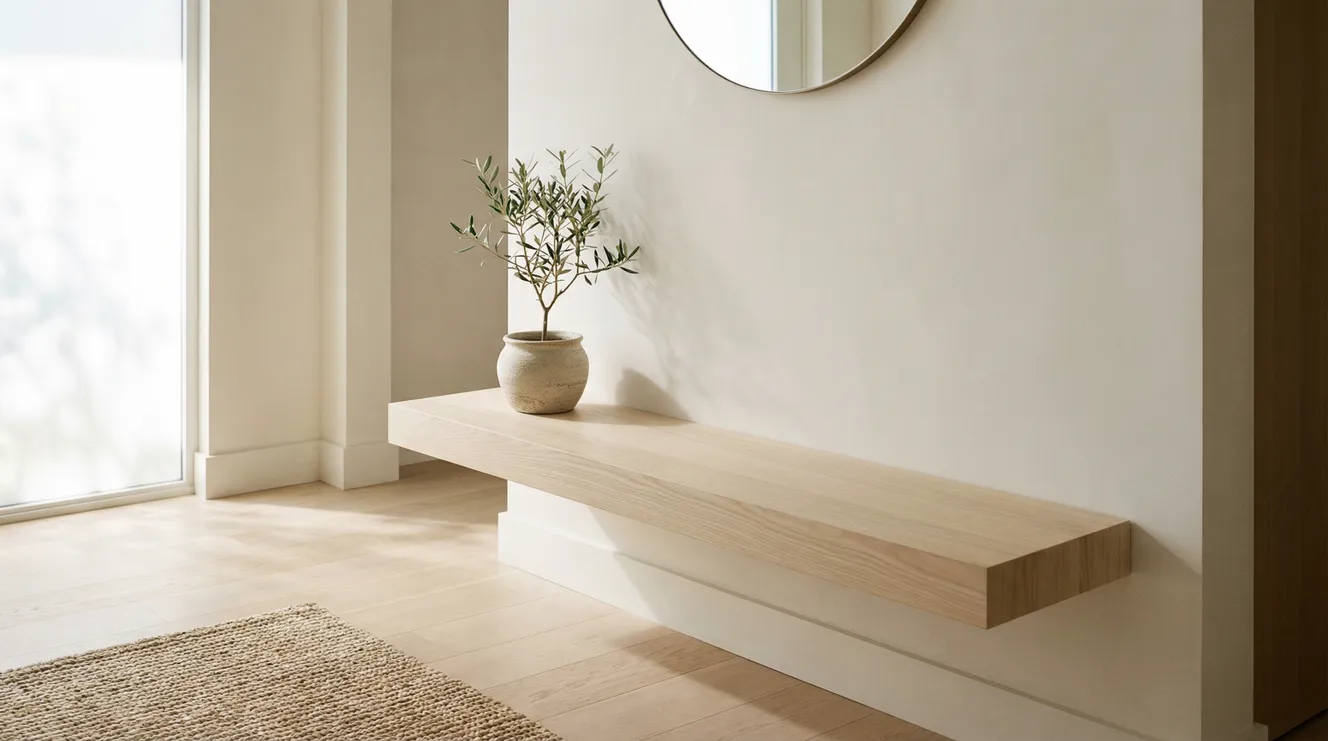
Your entryway functions as the psychological airlock between the outside world and your personal sanctuary. Research from the Princeton University Neuroscience Institute demonstrates that visual clutter competes for your attention, decreasing focus and increasing cortisol levels. Yet this critical transition zone rarely receives the design attention we lavish on living rooms or kitchens. We treat it as a dumping ground, not a destination.
The paradox is striking: the first space you encounter upon returning home shapes your mental state more directly than any designer sofa or curated gallery wall, yet it remains the most neglected area in most houses. Understanding how to architect calm in this compact zone transforms not just your home’s first impression, but your entire daily experience. The principles that create an entryway sanctuary cascade through your routines, relationships, and sense of well-being.
The Invisible Architecture: Why Your Entryway Shapes Your Brain
Every design choice in your entryway sends immediate signals to your nervous system. A well-lit, organized space triggers what environmental psychologists call “cognitive relief”—the mental exhale that occurs when your environment feels manageable and safe. Conversely, a chaotic entry activates your brain’s threat-detection circuits, keeping you in a low-grade state of stress.
Consider the simple act of placing your keys. In a calm entryway, a dedicated hook or tray sits within easy reach, its position so consistent that your hand finds it automatically. This muscle memory creates what design experts at Apartment Therapy call “environmental scaffolding”—your space literally supports your intentions. Without this structure, keys become another decision point in a day already overloaded with choices, contributing to decision fatigue before you’ve even changed out of your work clothes.
The materials matter too. A rough, splintered bench creates subtle physical tension as you perch to remove shoes. A smooth, cool stone surface invites touch and grounding. A soft, textured rug absorbs sound and feels welcoming underfoot. These tactile experiences bypass conscious thought, speaking directly to your limbic system about whether this space—and by extension, this home—is a place of safety or stress.
The cumulative effect of these micro-choices creates what designers call “ambient personality.” A Minneapolis family transformed their cramped 5×7′ entry from a stress trigger into a calming ritual by simply relocating their shoe storage from an open rack to a closed bench with internal compartments. The visual noise disappeared, and with it, the morning arguments about misplaced footwear. Their teenage daughter reported feeling “less overwhelmed” just walking through the door—a testament to how deeply physical order affects emotional states.
The Decision Tree: What Controls Your Entryway Experience
Lighting: Brightness level, color temperature, fixture placement determine visual clarity and mood
Storage: Open vs. closed, vertical vs. horizontal, accessibility vs. concealment shape visual noise
Seating: Presence, comfort, height, material affect the physical ease of transition
Surfaces: Texture, color, durability, maintenance requirements influence tactile experience
Personal Touches: Artwork, mirrors, plants, scent create emotional resonance and identity
The Chaos Tax: Calculating the Hidden Cost of Entryway Disorder
We rarely quantify how much mental energy a disorganized entry extracts daily, but the math reveals a staggering hidden cost. If you spend just 3 minutes each day searching for misplaced items—keys, umbrella, child’s homework—you’ve lost 18 hours annually to unnecessary friction. That’s more than two full workdays vanished into a vortex of clutter.
The emotional cost compounds too. A study from UCLA’s Center on Everyday Lives of Families found that women who described their homes as “cluttered” showed higher levels of the stress hormone cortisol throughout the day. The entryway, being the primary threshold, generates the first and last impression of this stress. It’s where you frantically search for keys while running late, where you step over messes while carrying groceries, where you greet guests with embarrassed apologies about the mess.
The Psychological Spillover Effect
The cognitive load doesn’t stay contained in the entry. Research published in the Journal of Environmental Psychology reveals that visual disorder in transition spaces creates a “spillover effect,” reducing your ability to feel restored even in otherwise organized rooms. Your brain carries the visual stress from the threshold into the living room, the bedroom, the kitchen. You can’t fully relax in your sanctuary because the memory of chaos at the gate lingers.
A Portland couple documented this phenomenon through weekly mood surveys. When their entry was cluttered, they reported 40% higher stress levels throughout the evening, even when spending time in their beautifully appointed living room. After implementing a simple closed-storage system, their evening stress scores dropped dramatically—despite no changes to other areas of the home. The calm entry literally calmed their entire domestic experience.
The Five Pillars of Entryway Serenity
Creating a calm entryway rests on five non-negotiable principles. These aren’t aesthetic preferences but functional requirements that work together to eliminate friction and promote peace.
Pillar One: Everything Earns Its Place
The calm entryway operates under ruthless minimalism. Every item—furniture, decoration, storage—must serve a clear function. That beautiful antique table that collects junk mail? It hasn’t earned its place. The decorative bowl that becomes a key dumping ground? It’s enabling chaos. The most successful entryway designs start with nothing, then add elements only when their purpose is undeniable.
A Seattle architect implemented this principle by removing 80% of the items from her client’s entry. The result wasn’t emptiness—it was clarity. The remaining pieces (a floating shelf, two hooks, a slim bench) each performed essential functions without visual competition. The client reported that the space “breathed” for the first time in years.
Pillar Two: Concealment Creates Calm
Open storage is the enemy of serenity. Our brains process every visible item as a task undone—shoes to put away, coats to hang, mail to sort. Closed storage eliminates this cognitive load instantly. A row of identical baskets inside a bench creates visual uniformity while hiding individual chaos. A closed cabinet disguises the electronics charging station. A drawer conceals the dog’s leash and waste bags.
The principle extends to visual noise. Corral loose items in matching containers. Hide the wifi router behind a plant. Store cleaning supplies in a closed closet, not under an open console. Every concealed item is one fewer signal screaming for your attention.
Pillar Three: Light as a Mood Director
Most entryways suffer from lighting anorexia—a single overhead fixture creating harsh shadows and unwelcoming ambiance. Layered lighting transforms the experience. A soft wall sconce at eye level warms the face, making greetings more pleasant. A subtle LED strip under a floating shelf provides gentle illumination for finding keys. Natural light, when available, should be maximized with sheer curtains that filter without blocking.
Color temperature matters enormously. Bulbs rated 2700-3000K emit warm, amber light that signals “evening” and “rest” to your circadian rhythm. Cool white bulbs (4000K+) create a stark, institutional feel that raises alertness in a space meant for transition and calm. The right lighting choice can make a narrow hallway feel expansive and a dark corner feel intentional.
Pillar Four: Seating as a Psychological Anchor
A place to sit isn’t a luxury—it’s a necessity for mental transition. The physical act of sitting to remove shoes forces a pause, a moment of arrival. Without seating, you remain in motion, carrying the momentum of the outside world directly into your living space. A bench, even a narrow 12-inch deep perch, creates a boundary: here I stop, here I arrive.
Pillar Five: Sensory Delight as a Reset Button
Calm doesn’t mean sterile. One thoughtfully chosen sensory element—a fragrant plant, a piece of art that makes you smile, a smooth stone you picked up on vacation—acts as a pattern interrupt. It breaks the chain of stressful thoughts and replaces it with a micro-moment of pleasure. This is the difference between a minimalist space that feels cold and one that feels peaceful. The sensory element is what makes it yours.
Power Mapping Your Entryway Elements
Essential: Closed storage for shoes, dedicated spot for keys, adequate lighting
High-Impact: Comfortable seating, mirror for last-check before leaving, charging station
Optional Luxury: Umbrella stand, coat closet, artwork, live plant, scent diffuser
Eliminate: Open bins of miscellaneous items, excess furniture, decorative objects without function
The Multiplier Effect: How Small Entryway Changes Cascade
A single improvement in your entryway generates ripple effects throughout your home and daily routine. This cascade effect explains why a $30 basket can create more peace than a $3,000 sofa.
Consider installing a simple key hook. Directly, you save two minutes daily searching. Indirectly, you eliminate the morning panic that makes you snappish with your partner. You arrive at work calmer, which improves your first meeting. You come home without the residual tension from the morning’s chaos, leading to a more pleasant evening. Your partner, no longer on the receiving end of your key-related stress, responds more warmly. The positive interaction lifts both your moods. A $5 hook improved your relationship.
This cascade operates in reverse too. Ignoring entry clutter leads to daily micro-aggressions against yourself—tripping, searching, apologizing. Each small friction builds resentment toward your home, your family, your life circumstances. You begin to feel that “everything is stressful” when really, it’s just one unmanaged space creating systemic friction.
The Tipping Point Phenomenon
Entryway transformations often work silently for weeks before suddenly changing everything. You implement closed storage, but habits lag. Two weeks in, you instinctively place your bag in the new cabinet without thought. A month later, you realize you haven’t searched for keys in days. The habit tipped. The space is now working for you, not against you.
A Phoenix family documented their 60-day entryway makeover on Reddit’s Organization forum. Days 1-30 showed minimal change—frustration, forgotten habits, skepticism. Day 31, their six-year-old spontaneously put her backpack in the new hooks. By day 45, the parents reported “forgetting what the old chaos felt like.” The tipping point arrived silently, but it stuck.
The Cascade Effect in Action
Initial Change: Install closed shoe storage bench with internal dividers
Direct Result: No visual shoe clutter, faster morning departure
Secondary Effects: Partner stops complaining about mess, reducing evening tension
Tertiary Effects: Living room feels more orderly by association, encouraging whole-home tidiness
Quaternary Effects: Guests comment on “how peaceful” your home feels, reinforcing positive identity
Real Transformations: Entryway Makeovers That Changed Everything
Abstract principles become concrete through real stories. These case studies show how focused effort on a small space created outsized life improvements.
The 48-Square-Foot Revolution
A Brooklyn renter’s 4×12′ hallway entry was a disaster of bikes, bags, and boots in a shared apartment. With landlord restrictions preventing permanent changes, she created a removable system: a narrow console with hidden storage, over-the-door hooks for bags, and a long, slim mirror to double the sense of space. Total cost: $240. The result: her roommate stopped leaving items in the living room, the daily arguments ceased, and she reported feeling “like an adult” in her space for the first time. Two years later, she credits the entryway organization with helping her develop the confidence to buy her own apartment.
The Family Command Center
A suburban Atlanta family of five was constantly missing appointments, losing permission slips, and starting mornings in chaos. They transformed their entry closet into a “command center” with a magnetic board for each child, a charging station hidden in a drawer, and a family calendar visible the moment you walk in. The morning scramble disappeared. Their pediatrician noticed the kids seemed “less anxious” at appointments. The parents realized the entry had been creating a baseline level of family stress that colored every interaction.
The Senior’s Safety Net
After a fall while rushing to answer the door, a 72-year-old widow in Chicago reimagined her entry with safety and calm as priorities. She added a stable bench with arms for support, motion-sensor lighting that eliminated fumbling for switches, and removed a rug that had been a tripping hazard. The changes prevented further accidents, but more importantly, they eliminated her fear of entering her own home. She began inviting friends over again, reversing a slide into isolation. Her doctor noted improvements in both her physical health and depression scores.
Before & After Impact Metrics
Brooklyn Renter: Daily stress rating dropped from 7/10 to 3/10 within one month
Atlanta Family: Morning arguments decreased 80%, on-time departures increased to 95%
Chicago Senior: Zero falls in 18 months post-redesign, social invitations up 300%
Practical Strategies: How to Architect Your Calm Entryway
Understanding entryway psychology is useless without action. Here are concrete strategies for moving from chaos to calm.
Start With Brutal Honesty
Photograph your entryway at its worst. Not the staged version—the real, cluttered, Tuesday-night version. Print it. This is your “before.” Now, write down every frustration you experience in that space: tripping, searching, apologizing, feeling overwhelmed. This list is your design brief. Every solution must address a specific frustration. If it doesn’t, it’s decorative fluff that will eventually become clutter.
Implement the One-Touch Rule
Every item in your entry should have a destination that requires only one touch. You drop keys in a tray—you don’t open a drawer, move something, then place them inside. You hang a coat on a hook—you don’t drape it over a chair to deal with later. This principle, championed by minimalism advocates, eliminates the “I’ll deal with it later” procrastination that creates clutter.
Create Zones of Control
Divide your entry into functional zones, even in tiny spaces. Zone 1: Key drop (small tray). Zone 2: Shoe transition (mat or bench). Zone 3: Bag hang (hooks). Zone 4: Outerwear (closet or rack). Even a 3-foot wall can accommodate all four zones vertically. This zoning creates muscle memory—your hand knows where to go without conscious thought.
Use Vertical Space Ruthlessly
Most entries are narrow, but walls rise high. Install floating shelves near the ceiling for seasonal items. Use the inside of closet doors for shoe organizers. Mount hooks at varying heights for different family members. A wall-mounted charging station keeps cords off surfaces. The floor should be as clear as possible—everything that can go up, must go up.
Schedule a Weekly Reset
Even the best systems drift. Schedule 10 minutes every Sunday evening to reset the entry. Return stray items to their zones. Wipe surfaces. Refill the fragrance diffuser. This maintenance prevents the slow creep of chaos that undermines your system. It’s the difference between a quick tidy and another full-scale reorganization project.
Your Calm Entryway Is a Daily Gift to Yourself
The power to transform your daily experience isn’t hiding in a renovation budget or a professional organizer’s contact list. It’s in the deliberate choices you make about the first space you encounter when you come home. A calm entryway doesn’t just happen—it’s architected through thoughtful decisions about what belongs, what conceals, what delights.
You don’t need to remodel. You need to edit. You don’t need more space. You need clearer purpose. You don’t need perfection. You need one small zone of peace that greets you every time you cross the threshold, reminding you that this is your sanctuary, your calm center in a chaotic world.
Start tonight. Remove three things that don’t serve your entry’s purpose. Feel the slight shift in energy. Build from there. Your calm home begins at the door—and the door is already open.
Key Takeaways
Your entryway acts as a psychological airlock that directly impacts your stress levels and mental state upon arriving home or leaving for the day.
Visual clutter in transition spaces creates a spillover effect that reduces your ability to feel restored even in otherwise organized areas of your home.
Five essential principles—earning placement, concealment, layered lighting, seating, and sensory delight—form the foundation of a truly calm entryway.
Small, focused changes in your entry create cascading positive effects on your daily routines, relationships, and overall sense of domestic peace.
Transforming your entryway requires observation, editing, and implementing one-touch systems—not major renovations or expensive purchases.
“`