Category: Daily Routines & Habits

  • How to Stay Hydrated When You Forget to Drink Water

    How to Stay Hydrated When You Forget to Drink Water

    You reach for your third cup of coffee, realizing it’s 3 PM and the only liquid you’ve had all day. Your head aches slightly, your concentration is foggy, and your mouth feels dry. You meant to drink more water. You always do. But life—emails, meetings, errands, kids—pushed hydration to the bottom of your mental checklist. This is the silent dehydration epidemic affecting millions of otherwise health-conscious adults who simply forget to drink.

    Forgetting to drink water isn’t a character flaw—it’s a cognitive blind spot in our overstimulated world. Research from CDC hydration studies reveals that 43% of adults drink fewer than four cups of water daily, far below the recommended intake. The problem isn’t ignorance; it’s implementation. We know hydration matters for regulating body temperature, delivering nutrients, and maintaining mental clarity, but knowing doesn’t translate into doing when your day demands constant attention elsewhere.

    The consequences of chronic low-grade dehydration extend beyond mild discomfort. Without adequate fluid intake, your body struggles to flush waste, lubricate joints, and maintain cellular function. Even a 2% fluid loss impacts cognitive performance, affecting memory, information processing, and mood stability. The UCLA Health hydration research demonstrates that fatigue, headaches, and difficulty concentrating often trace back to insufficient fluid intake rather than more complex medical issues.

    The Invisible Thirst: Recognizing Dehydration Before It Hurts

    By the time your brain registers thirst, you’re already operating at a fluid deficit. This delayed warning system makes forgetfulness particularly dangerous. The body’s thirst mechanism lags behind actual hydration needs, meaning you can be significantly dehydrated before feeling thirsty at all. This biological quirk explains why so many people walk around in a perpetual state of mild dehydration without realizing it.

    Subtle signals precede obvious thirst. Dark yellow urine serves as a reliable visual indicator—aim for pale straw color. Morning headaches often reflect overnight dehydration compounded by insufficient daytime intake. Mid-afternoon energy crashes frequently stem from diminished blood volume forcing your heart to work harder. Dry, dull skin and constipation represent external and internal signs that your body is conserving water.

    Understanding these early warnings transforms how you approach hydration. Instead of reactive drinking, you can implement proactive strategies that ensure consistent fluid intake throughout the day, regardless of how busy or distracted you become.

    Dehydration Warning Signs You’re Probably Ignoring

    • Bad breath: Saliva production decreases, allowing odor-causing bacteria to proliferate
    • Sugar cravings: Dehydration makes it difficult for your liver to release glycogen, triggering sweet cravings
    • Brain fog: Reduced cerebral blood flow impairs concentration and decision-making
    • Muscle cramps: Electrolyte imbalance from fluid loss triggers involuntary contractions
    • Irritability: Even mild dehydration affects mood-regulating neurotransmitters

    The Psychology of Forgetting: Why Water Falls Off Your Radar

    Our brains prioritize immediate, novel threats over routine maintenance tasks. This evolutionary wiring served our ancestors well when spotting predators mattered more than regular sipping. Modern life hijacks this system with constant stimulation—notifications, deadlines, multitasking—pushing hydration to cognitive background noise. Drinking water provides no immediate dopamine hit, no urgent deadline, no social validation, making it vulnerable to neglect.

    The Invisibility Problem

    Unlike hunger, which produces dramatic stomach growls and concentration-destroying pangs, early dehydration whispers. Thirst is easily misinterpreted as mild hunger or fatigue. You snack when you should sip, caffeinate when you need water, and power through headaches with painkillers instead of addressing the root cause. The Scripps Health hydration guidelines confirm that most people mistake dehydration symptoms for other issues, treating effects instead of causes.

    The Habit Formation Barrier

    Building a water-drinking habit requires consistent contextual cues. Coffee becomes automatic because we associate it with morning rituals and energy needs. Water lacks these powerful associations. Without environmental triggers—like a visible water bottle on your desk or phone reminders—the habit fails to form. Your brain relies on external prompts for low-priority actions, and in the absence of reminders, hydration simply doesn’t happen.

    Cognitive Barrier Why Water Gets Forgotten Effective Counter-Strategy
    Task Interruption Drinking interrupts workflow without immediate payoff Pair water with existing habits (coffee refill, bathroom break)
    Novelty Bias Water feels boring compared to flavored alternatives Add natural flavor enhancers (cucumber, mint, citrus)
    Delayed Feedback Effects of dehydration aren’t immediate Track hydration visually (marked bottles, app logs)
    Environmental Absence Water isn’t physically visible in your workspace Strategic bottle placement (desk, car, bag) as visual cue
    Social Reinforcement No social pressure or validation for drinking water Create accountability with hydration partners

    The Hydration Multiplier: Getting Water From Unexpected Sources

    Relying solely on conscious water drinking sets you up for failure. The solution lies in creating a hydration ecosystem where fluids arrive through multiple channels, some requiring zero memory. Your body absorbs water from foods, beverages, and even metabolic processes, allowing you to stay hydrated even when drinking habits slip.

    Water-rich foods provide stealth hydration—nutrients and fluids delivered together. The Harvard Health nutrition guidelines emphasize that approximately 20% of daily fluid intake comes from food sources. Strategic meal choices can compensate significantly for forgotten water bottles.

    Hydration Powerhouses: Foods Over 90% Water

    Cucumbers lead the pack at 96% water content, delivering crisp refreshment with minimal calories. Watermelon, strawberries, and cantaloupe provide sweetness while hydrating. Leafy greens like iceberg and romaine lettuce, spinach, and cabbage contribute fluid alongside vitamins and minerals. Zucchini, celery, and tomatoes integrate easily into meals, silently boosting your hydration status.

    Practical integration doesn’t require major dietary overhauls. Add cucumber slices to your sandwich, berries to your breakfast cereal, or an extra handful of lettuce to your lunch salad. Each small addition contributes to your daily fluid goal without requiring you to remember another task.

    Beyond Plain Water: Alternative Hydration Sources

    Coconut water offers natural electrolytes with less sugar than sports drinks, making it ideal post-exercise recovery. Milk provides protein, carbohydrates, and minerals while contributing to fluid intake. Smoothies combine multiple hydrating ingredients—fruit, yogurt, ice—into a single, substantial beverage that feels more satisfying than water alone.

    Herbal teas and clear broths contribute to daily fluid goals, while moderate coffee and tea consumption counts despite mild diuretic effects. The Teladoc Health hydration strategies confirm that caffeinated beverages in moderation contribute positively to overall hydration status.

    The 20% Rule: Making Food Work for You

    If drinking eight glasses of water feels impossible, aim for six glasses plus strategic food choices that provide the remaining 20% of your fluid needs. This approach creates a hydration buffer for forgetful days.

    Breakfast: Oatmeal made with milk topped with berries (absorbs liquid, provides fluid)

    Lunch: Large salad with cucumber, tomatoes, and peppers (high water content)

    Snack: Watermelon or orange slices (90%+ water content)

    Dinner: Vegetable soup or zucchini noodles (fluid-rich meal base)

    Behavioral Engineering: Designing Your Environment for Automatic Hydration

    The most reliable solution for forgetfulness isn’t better memory—it’s better design. Environmental cues trigger automatic behaviors without conscious effort, making hydration inevitable rather than optional. These strategies work even on your busiest, most distracted days.

    The Visual Trigger Method

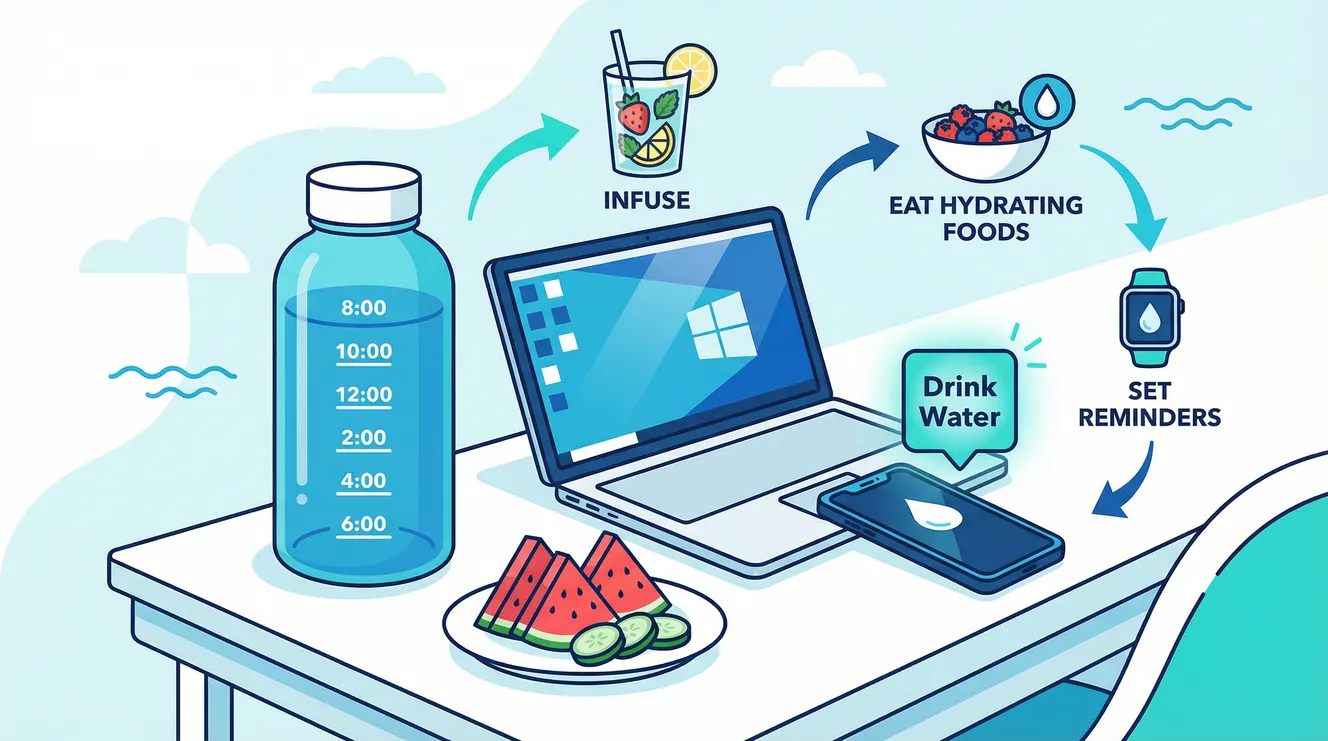
    Place water bottles in locations where your eyes naturally rest throughout the day: your desk, bedside table, car cup holder, and next to the TV remote. The visual presence acts as a subliminal reminder. Choose transparent bottles with measurement markings to create a visual progress tracker.

    Color psychology enhances this effect. Blue and green bottles subconsciously reinforce the water association, while bright colors create focal points that draw your attention. The Silver Cross Hospital wellness tips recommend keeping a bottle within arm’s reach at all times, turning hydration into an effortless reflex rather than a remembered task.

    The Habit Stacking Technique

    Link water drinking to existing automatic behaviors. Drink one glass immediately after brushing your morning teeth. Take three sips every time you check your phone. Finish a full glass while your coffee brews. These piggyback habits attach hydration to actions you never forget, embedding them in established neural pathways.

    The Digital Safety Net

    Smartphone reminders solve the memory problem externally. Set recurring alarms every 90 minutes, or use hydration tracking apps that gamify the process. Smart water bottles with integrated tracking and LED reminders provide real-time feedback. These tools externalize the memory burden, freeing mental bandwidth while ensuring consistent intake.

    Strategy Type Implementation Effectiveness Rating Best For
    Visual Cues Strategically placed bottles, color-coded reminders ★★★★★ Visual learners, office workers
    Habit Stacking Link drinking to existing routines ★★★★★ Busy professionals, parents
    Tech Support Apps, smart bottles, phone alarms ★★★★☆ Tech-savvy users, extreme forgetters
    Flavor Enhancement Natural additives (fruit, herbs) ★★★★☆ Taste-sensitive individuals
    Food Integration High-water-content meals and snacks ★★★★★ Meal planners, snackers

    The Compound Effect: How Small Changes Create Hydration Momentum

    Hydration success rarely comes from dramatic overhauls. It emerges from tiny, consistent actions that accumulate into automatic behavior. The compound effect explains why adding one cucumber slice to your lunch or placing one bottle by your bed eventually transforms your hydration status without conscious effort.

    Start with a single intervention. Choose the strategy that feels easiest—perhaps keeping a bottle in your car or adding lemon to your water. Practice it for two weeks until it becomes automatic. Then add another. This layered approach prevents overwhelm while building a robust hydration system that survives chaotic days.

    The beauty of the compound effect is its self-reinforcing nature. As you become better hydrated, you think more clearly, which helps you remember to drink more water. Increased energy makes you more active, which naturally triggers thirst and drinking. Better skin and digestion provide visible feedback that motivates continued effort.

    The Two-Week Hydration Challenge

    Week 1: Place one full water bottle in each of three locations (bedside, desk, car). Don’t worry about drinking—just observe when you naturally reach for them.

    Week 2: Add one water-rich food to your daily routine (cucumber with lunch, berries with breakfast, watermelon as snack).

    Week 3+: Choose one additional strategy from the table above. Continue adding layers monthly.

    Real-World Success: Forgetful People Who Fixed Their Hydration

    Abstract strategies become concrete through relatable examples. These anonymized case studies demonstrate how different personality types successfully solved their hydration forgetfulness.

    The Busy Executive Who Automated Intake

    Mark, a 45-year-old CEO, hadn’t consumed plain water in years, surviving on coffee and diet soda. Chronic headaches and afternoon fatigue pushed him to try a smart water bottle that glowed every hour. The visual cue cut through his distraction. Within a month, his headaches vanished and energy stabilized. The technology did the remembering for him.

    The Teacher Who Used Food as a Backup

    Sarah, an elementary school teacher, couldn’t leave her classroom for frequent water breaks. She started packing lunch boxes full of hydrating foods: cucumber sticks, watermelon cubes, cherry tomatoes, and yogurt. Even on days when she forgot her water bottle entirely, she maintained adequate hydration through strategic snacking between classes.

    The Parent Who Built a Family System

    Jennifer, a mother of three, turned hydration into a family game. Each child had a colored bottle on the kitchen counter, and everyone took “hydration breaks” together during TV commercials. The social accountability ensured she drank while caring for her family’s needs, transforming a personal weakness into a collective strength.

    Your Hydration Solution Is Already Within Reach

    Forgetting to drink water doesn’t mean you’re destined for chronic dehydration. It means you need systems that work with your brain’s natural tendencies, not against them. The most effective hydration strategy isn’t willpower—it’s environmental design, habit hacking, and food-based backup plans.

    Start where you are. Pick one strategy from this article that feels almost too easy. Implement it for two weeks. Let the compound effect work its magic. Your body will reward you with clearer thinking, steadier energy, and the profound relief of no longer fighting a battle you were never designed to win alone.

    The water bottle is on your desk. The cucumber is in your fridge. The reminder is in your phone. All that’s missing is your permission to stop relying on memory and start relying on design.

    Key Takeaways

    Chronic mild dehydration stems from cognitive limitations, not personal failing—our brains aren’t wired to prioritize routine water intake amid constant stimulation.

    Early dehydration signals—headaches, fatigue, sugar cravings, brain fog—often masquerade as other issues, making recognition the first step to solution.

    Strategic placement of visual cues, habit stacking, and food-based hydration create automatic systems that don’t rely on memory or willpower.

    Water-rich foods like cucumber (96%), watermelon, and leafy greens provide stealth hydration that compensates for forgotten beverages.

    Start with one small, sustainable change and layer additional strategies over time to build a robust, failure-proof hydration system.


  • Stretching Routines You Can Do in 5 Minutes

    Stretching Routines You Can Do in 5 Minutes

    <%%%ad1%%%>

    You finish your workday with shoulders hunched up to your ears, a stiff neck from hours at the computer, and hips that feel locked from too much sitting. You know you should stretch, but the thought of a 30-minute yoga session feels impossible. The good news? Five minutes is all you need to unlock your muscles, improve your mobility, and feel significantly better. The key isn’t duration—it’s consistency and targeting the right muscle groups.

    The modern epidemic of tight muscles and poor mobility isn’t caused by lack of stretching programs—it’s caused by the belief that effective stretching requires massive time commitments. Research from the Mayo Clinic confirms that even brief stretching sessions, when done regularly, can increase flexibility, improve range of motion, and reduce injury risk. A 5-minute daily routine done consistently yields better results than an occasional 30-minute session.

    The secret lies in compound stretches—movements that target multiple muscle groups simultaneously—and strategic sequencing that flows naturally from one position to the next. This approach, championed by physical therapists and mobility specialists, transforms stretching from a chore into a sustainable daily ritual that fits into the margins of your life: while coffee brews, after a workout, or before bed.

    The Science of Micro-Stretching: Why 5 Minutes Works

    Your muscles don’t need lengthy stretches to maintain mobility—they need regular signaling that tells them it’s safe to lengthen. A 2022 study in the Journal of Strength and Conditioning Research found that participants who stretched just 5 minutes daily for 8 weeks showed the same flexibility gains as those who stretched 15 minutes daily. The key was consistency, not duration.

    The physiological mechanism is simple: brief, regular stretching maintains muscle spindle sensitivity, preventing the “creeping tightness” that develops from static positions. When you sit for 8 hours, your hip flexors gradually shorten. A 30-second stretch interrupts this process, signaling the muscle to maintain its length. Done daily, this prevents the cumulative shortening that leads to pain and poor posture.

    The 30-Second Rule

    Each stretch should be held for 30 seconds. This duration, confirmed by multiple studies, is the minimum effective dose for muscle lengthening. Less than 20 seconds provides minimal benefit, while more than 60 seconds offers diminishing returns. Holding for 30 seconds allows the muscle spindle to reset without triggering a protective contraction.

    The Morning Wake-Up Flow: Decompress from Sleep

    This sequence targets the tightness that develops from 8 hours of immobility. Do it while your coffee brews or before you check your phone.

    1. Cat-Cow Spinal Mobilization (60 seconds)

    Target: Entire spine, core muscles, shoulder mobility

    How to: Start on all fours—hands under shoulders, knees under hips. Round your back toward the ceiling while tucking your chin (Cat pose), hold for 3 seconds. Then arch your back, lifting your tailbone and chest while looking up (Cow pose). Perform 7-8 slow cycles. According to back pain expert Dr. Stuart McGill, this is the optimal dose for spinal mobility.

    Modification: If wrists hurt, make fists and place knuckles on the floor. If knees are sensitive, place a folded towel under them.

    2. World’s Greatest Stretch (30 seconds per side)

    Target: Hip flexors, thoracic spine, chest, shoulders, hamstrings

    How to: Start in a plank position. Step your right foot forward to the outside of your right hand into a deep lunge. Place your right elbow on your right knee and gently rock your knee forward and back to loosen hips. Then drop your right elbow toward the ground while keeping knee pushed out. Finally, rotate your torso to the right, reaching your right arm toward the ceiling. Return to plank and switch sides. This compound stretch hits multiple problem areas simultaneously.

    Regression: Keep your back knee on the ground if balance is challenging. Place hands on a yoga block if reaching the floor is difficult.

    3. Asian Squat Hip Opener (30 seconds hold + 30 seconds rocking)

    Target: Hip flexors, groin, ankles, lower back

    How to: Place a rolled towel under your heels if needed. Stand with feet shoulder-width apart, toes turned out slightly. Squat down as low as comfortable, keeping your chest up. Place elbows inside your knees and gently push knees outward. Hold for 30 seconds. Then rock side to side for 30 seconds to mobilize each ankle individually. This is the antidote to sitting.

    Progression: As mobility improves, use a thinner towel under heels until you can squat flat-footed.

    4. Half-Kneeling Thoracic Rotation (30 seconds per side)

    Target: Thoracic spine, chest, shoulders

    How to: Kneel with your right knee on the ground and left foot forward, left knee bent 90 degrees. Place your right hand on your right knee and left hand behind your head. Rotate your torso and left elbow toward your right knee, then reverse and rotate up and back. Keep your hips stationary—movement comes from your upper back only. This combats the forward-hunch posture of desk work.

    Tip: Face a wall and keep your elbow close to it to prevent cheating with shoulder movement.

    5. Wall Slides (60 seconds)

    Target: Mid-back muscles, shoulder mobility, posture

    How to: Stand with your back against a wall, feet about 6 inches away. Flatten your lower back against the wall by engaging your core. Place your arms in a “W” position against the wall. Slowly slide them up to a “Y” position, keeping contact with the wall throughout. Lower and repeat. This activates the postural muscles that become dormant from sitting.

    Modification: If you can’t keep arms on the wall, move your feet further away. If shoulders are tight, slide only to a “V” position.

    The Desk Decompression Flow: Office-Friendly Relief

    This sequence requires no floor work and can be done in business attire. Perfect for a mid-afternoon break or post-work reset.

    1. Seated Spinal Twist (30 seconds per side)

    Target: Spine, lower back, obliques

    How to: Sit tall in your chair with feet flat on the floor. Cross your arms over your chest. Rotate your torso to the right, using the chair back for gentle leverage. Hold, then return to center and twist left. This decompresses spinal discs compressed from sitting.

    2. Chest Opener (30 seconds)

    Target: Chest, anterior shoulders

    How to: Sit forward in your chair. Clasp hands behind your back, palms together. Straighten arms and lift hands up while opening your chest forward. Drop your chin slightly to avoid neck strain. This immediately counteracts the forward hunch.

    3. Standing Hip Flexor Stretch (30 seconds per side)

    Target: Hip flexors, improves standing posture

    How to: Stand behind your chair for balance. Step your right foot back into a mini lunge. Keep both feet pointing forward, back knee straight. Gently tuck your pelvis under to feel a stretch in the front of your right hip. Switch sides. This prevents the hip shortening that causes lower back pain.

    4. Doorway Chest Stretch (30 seconds)

    Target: Chest, biceps, anterior shoulders

    How to: Stand in a doorway. Place your forearms on the doorframe at 90 degrees. Step forward slowly until you feel a stretch across your chest. Keep your core engaged to avoid arching your lower back.

    5. Standing Calf Raise and Stretch (30 seconds)

    Target: Calves, ankle mobility

    How to: Stand near a wall for support. Rise onto your toes (calf raise), hold for 2 seconds, then lower your heels below floor level if possible. This combination strengthens and stretches the calves, improving circulation after sitting.

    The Safety Framework: Stretching Without Injury

    The Mayo Clinic emphasizes several non-negotiable safety principles for stretching:

    The Warm-Up Rule

    Never stretch cold muscles. Do 2-3 minutes of light movement first—march in place, shoulder rolls, or the Cat-Cow sequence. Stretching cold muscles increases injury risk and reduces effectiveness. The best time to stretch is after your morning walk, post-workout, or following a hot shower when muscles are warm.

    The Pain-Free Principle

    Stretch until you feel a gentle pull, never pain. Pain is your body’s “stop signal.” Discomfort is okay; sharp pain is not. If you feel pain, back off immediately. Overstretching can cause micro-tears in muscle tissue, leading to stiffness and injury.

    The Breath Connection

    Breathe deeply and steadily during stretches. Holding your breath creates tension that fights against the stretch. Inhale as you move into position, exhale as you deepen the stretch. This signals your nervous system that it’s safe to relax the muscle.

    The Bounce Avoidance

    Never bounce into a stretch. This triggers the stretch reflex, causing muscles to contract and protect themselves, which is the opposite of what you want. Static holds (30 seconds of steady pressure) are safer and more effective than ballistic stretching.

    Do This Not This Why
    Warm up first (2-3 min light movement) Stretch cold muscles Prevents injury, increases effectiveness
    Hold stretches for 30 seconds Bounce or pulse Allows muscle spindle to reset safely
    Breathe deeply and steadily Hold your breath Signals nervous system it’s safe to relax
    Stop at gentle pull, before pain Push through pain Prevents micro-tears and injury
    Repeat stretches on both sides Only stretch dominant side Maintains balanced flexibility

    The Consistency Blueprint: Making 5 Minutes Stick

    The best stretching routine is the one you’ll actually do. Here are evidence-based strategies for consistency:

    The Habit Stacking Method

    Attach your stretching routine to an existing daily habit: “After I pour my morning coffee, I will do the morning flow.” This piggybacks on established neural pathways, making the new behavior automatic.

    The Visibility Principle

    Keep a yoga mat visible in your living space. Out of sight means out of mind. Visual cues trigger behavior without requiring conscious decision-making.

    The Two-Day Rule

    Never skip more than two consecutive days. Missing one day is life; missing two is the start of a new habit (not stretching). This rule prevents the all-or-nothing thinking that derails consistency.

    The Tracking Trigger

    Use a simple calendar checkmark. The visual streak becomes motivational. Jerry Seinfeld famously used this method for writing—”don’t break the chain”—and it works for any habit.

    Your Mobility Is 5 Minutes Away

    The body you want to live in—the one that moves freely, stands tall, and doesn’t ache—isn’t built in hour-long yoga classes. It’s built in 5-minute increments, done daily, with intention. While your coffee brews, after your shower, before bed—these tiny windows contain massive transformation potential.

    Start tomorrow. Choose one routine. Set a timer for 5 minutes. Feel the difference in how you move and how you feel. In two weeks, it will be automatic. In two months, you’ll wonder how you ever lived without it.

    Your future, flexible self is waiting. Five minutes at a time.

    Key Takeaways

    Five minutes of daily stretching is as effective as longer sessions for maintaining flexibility and preventing stiffness, provided it’s done consistently.

    Holding each stretch for 30 seconds with deep breathing targets muscle spindles effectively without triggering protective contractions.

    Compound stretches like the “World’s Greatest Stretch” maximize efficiency by targeting multiple muscle groups simultaneously.

    Safety is paramount: always warm up first, avoid bouncing, stop before pain, and breathe steadily throughout each stretch.

    Sustainable stretching habits rely on habit stacking (attaching to existing routines), visibility, and the “two-day rule” (never skip more than two consecutive days).

    “`

  • How to Actually Rest on Your Days Off

    How to Actually Rest on Your Days Off

    It’s Saturday morning. You slept until 9 AM, yet you still feel exhausted. Your day off stretches before you—a glorious 16 hours of freedom that somehow fills you with anxiety about how to spend it. You scroll through your phone for two hours, binge a Netflix series you don’t even like, take a nap that leaves you groggy, and by Sunday night, you’re facing the work week feeling just as depleted as you did on Friday. The rest you were promised never arrived, and you’re beginning to suspect that “days off” are just a different kind of work.

    The modern paradox of rest is that we have more leisure time than ever, yet we feel less restored. According to research from the American Psychological Association, 44% of Americans reported that their stress levels actually increase on days off, not decrease. The problem isn’t a lack of time—it’s a fundamental misunderstanding of what rest actually is and how to access it.

    True rest is not the absence of activity; it’s the presence of recovery. It’s a physiological state where your nervous system shifts from sympathetic (fight-or-flight) to parasympathetic (rest-and-digest) mode. Passive activities like scrolling and streaming often keep us in a low-grade sympathetic state—dopamine-seeking, mildly anxious, mentally engaged. Actual rest requires active participation in activities that genuinely restore your physical, mental, and emotional energy. The difference between exhaustion and restoration lies not in what you’re doing, but in how what you’re doing affects your biology.

    The Science of Actual Rest: Why Most “Downtime” Fails

    Your nervous system operates on a simple principle: it needs both activation and recovery to function optimally. When you’re chronically stressed, your body floods with cortisol and adrenaline, keeping you in a state of high alert. The problem is that many common “rest” activities—social media, email checking, even watching intense TV shows—trigger small stress responses that prevent your physiology from fully resetting.

    Research from the Journal of Occupational Health Psychology distinguishes between “recovery experiences” that actually restore energy and “neutral experiences” that simply pass time. True recovery requires four elements: psychological detachment (mentally leaving work behind), relaxation (physiological calming), mastery (engaging in competent activity), and control (choosing how to spend your time). Scrolling your phone provides none of these. Binge-watching provides only relaxation, and even that is compromised by blue light and narrative tension.

    The Four Pillars of Real Recovery

    Physical Rest: Not just sleep, but active recovery that reduces muscle tension and calms the nervous system. This includes gentle movement, stretching, and activities that change your physical position from the workweek posture.

    Mental Rest: Giving your prefrontal cortex a break from decision-making, planning, and problem-solving. This requires activities with clear rules and low cognitive load.

    Emotional Rest: Processing and releasing the emotional load you’ve carried. This often requires connection with safe people or expressive activities.

    Creative Rest: Engaging the parts of your brain that work doesn’t use. This could be making something, being in nature, or experiencing beauty.

    The Recovery Deficit Assessment

    Physical Deficit: You wake up sore, your neck and shoulders are tight, you feel better after movement

    Mental Deficit: You can’t focus on leisure activities, your mind keeps returning to work thoughts, simple decisions feel exhausting

    Emotional Deficit: You feel numb or irritable, small things trigger big reactions, you avoid people you usually enjoy

    Creative Deficit: Everything feels gray and routine, you have no desire to make or explore, time passes without memory

    The Physical Restoration Protocol: Moving to Rest

    Counterintuitively, physical rest often requires movement, not stillness. After a week of sitting, your body needs to release stored tension and reset its posture. Stillness can actually increase stiffness and discomfort.

    The Morning Decompression Walk

    On your first day off, take a 20-minute walk with no destination, no podcast, no phone. Just walk. This isn’t exercise—it’s physical decompression. The rhythmic movement, combined with changing scenery, signals to your nervous system that you’re no longer in work mode. Studies from Environmental Science & Technology show that even 15 minutes of walking in green space reduces cortisol by 16% and improves mood for up to 7 hours.

    The Tension Release Sequence

    Spend 10 minutes doing these specific movements:

    Chest opener: Lie on your back on a rolled towel placed lengthwise under your spine, arms spread wide. This counteracts the forward-hunch of desk work and allows deeper breathing.

    Hip flexor release: Kneel on one knee, other foot planted, and gently push your hips forward. Office chairs tighten these muscles, which affects posture and breathing.

    Neck decompression: Lie on the floor with a rolled towel under your neck (not head) for 2 minutes. Let the weight of your head gently traction your cervical spine.

    The Active Recovery Principle

    Choose one physical activity that’s fundamentally different from your work posture:

    – If you sit all week: go for a gentle swim, do a yoga class, or garden

    – If you stand all week: float in a pool, lie in a hammock, or recline with legs elevated

    – If you do physical labor: take a warm bath with Epsom salts, get a massage, or do gentle stretching

    The Mental Unwinding Protocol: Giving Your Brain Permission to Switch Off

    Mental rest requires activities that absorb attention without demanding effort. The key is finding the sweet spot between boredom (which makes you reach for your phone) and challenge (which feels like work).

    The Analog Engagement Hour

    Choose one activity that uses your hands and minimal brainpower:

    Puzzles: Jigsaw puzzles, crosswords, or Sudoku provide just enough engagement to quiet the mind without demanding creative energy. The tactile nature of physical puzzles (vs. digital) is crucial.

    Crafting: Knitting, whittling, or simple woodworking projects create a “flow state” with clear rules and visible progress, which is deeply restorative.

    Cooking project: Make bread from scratch, simmer a complex sauce, or ferment something. The slow, methodical process is meditative and results in tangible rewards.

    The Mind Dump Protocol

    First thing Saturday morning, before you do anything else, spend 10 minutes doing a “brain dump”—write down everything you’re mentally carrying. Don’t organize it, just pour it out. This externalization is critical. Research from behavioral scientists at Baylor University shows that writing down worries before bed (or before a rest day) reduces rumination and improves the quality of rest by 23%.

    The Curiosity Hour

    Learn something completely unrelated to your work, but do it the old-fashioned way:

    – Read a physical book on a subject you know nothing about

    – Listen to an album from start to finish (no skipping)

    – Watch a documentary on a topic outside your usual interests

    The key is single-tasking and full attention—no phone nearby, no multitasking. This trains your brain to focus without pressure, which is deeply restorative.

    The Mental Rest Menu

    15 minutes: Brain dump journaling

    30 minutes: Analog puzzle or craft

    60 minutes: Curiosity deep dive (book, documentary, album)

    Any combination: Total should be 2-3 hours of mental rest

    The Emotional Restoration Protocol: Processing and Connection

    Emotional rest requires either safe connection with others or expressive release. Suppressing emotions accumulated during the week leaves you carrying them into the next week, where they compound.

    The Low-Stakes Connection

    Schedule one social interaction that has zero performance pressure:

    – Coffee with a friend where you explicitly agree not to talk about work

    – A walk with someone where conversation is optional

    – A phone call with a family member who doesn’t drain you emotionally

    The key is removing any social performance requirement—no need to be entertaining, successful, or “on.” Research from the Journal of Health and Social Behavior shows that low-pressure social connection reduces cortisol more effectively than solitary relaxation.

    The Emotional Expression Hour

    Give yourself permission to express what you’ve been suppressing:

    – Write an angry letter you never send to someone who frustrated you this week

    – Dance to loud, aggressive music for 10 minutes

    – Cry to a sad movie (emotional crying releases oxytocin and reduces stress hormones)

    The Boundary Rebuilding

    Use part of your day off to communicate boundaries for the coming week:

    – Send an email to your team: “I’ll be offline Saturday—will respond Sunday evening”

    – Set your calendar to “busy” for personal time

    – Tell friends/family: “I need to be offline this weekend—let’s catch up Monday”

    Proactively setting boundaries reduces the emotional labor of defending them later.

    The Creative Restoration Protocol: Engaging the Playful Brain

    Creative rest is about using different neural pathways than your work demands. It’s not about being artistic—it’s about experiencing beauty and making something without judgment.

    The Nature Immersion

    Spend at least 30 minutes in nature without agenda:

    – Sit in a park and watch leaves move

    – Walk through a botanical garden with no destination

    – Lie on grass and watch clouds

    The Japanese practice of shinrin-yoku (forest bathing) has been shown in numerous studies to reduce cortisol, lower blood pressure, and increase NK cell activity (immune function) for up to 7 days.

    The Imperfect Creation

    Make something with the explicit goal that it doesn’t have to be good:

    – Bake bread that might not rise perfectly

    – Paint something abstract with no subject

    – Build something from scrap wood

    The Beauty Feast

    Expose yourself to something beautiful without analyzing it:

    – Visit an art museum and spend 10 minutes with one painting

    – Listen to a symphony album with your eyes closed

    – Arrange flowers or organize a bookshelf by color

    The Boundary Protocol: Protecting Your Rest from Invasion

    The most common reason days off fail to restore is that work and obligations invade them. Proactive boundary setting is essential for rest.

    The Digital Boundary

    Set an auto-responder for your days off: “I’m offline until [date]. For emergencies, contact [colleague]. Otherwise, I’ll respond when I return.” This one action eliminates the anxiety of unanswered emails and sets a clear expectation. Remove work apps from your phone or log out of accounts. The friction of logging back in is often enough to prevent “just checking.”

    The Social Boundary

    Be explicit with friends and family: “I’m taking a real day off this Saturday—no texts about [work topic], no planning [obligation]. Let’s catch up Sunday.” Most people respect boundaries when they’re stated clearly rather than assumed.

    The Self-Boundary

    Make a list of “rest saboteurs”—things you tell yourself you “should” do on your day off. Then explicitly give yourself permission not to do them. “I should clean the garage” becomes “I give myself permission to rest today. The garage will still be there tomorrow.”

    The Sunday Evening Transition: Preparing for Re-Entry

    The final piece of actual rest is preparing for re-entry so you don’t lose the benefits. Spend 30 minutes Sunday evening doing a gentle transition:

    The Review and Preview

    – Write down three things that restored you this weekend (reinforces what works)

    – Write down one thing you’re looking forward to this week (creates positive anticipation)

    – Set one intention for how you want to feel when you finish work Friday

    The Gentle Re-Entry

    Lay out your clothes, pack your bag, and set up your coffee the night before. Minimize Monday morning decisions to preserve the calm you’ve cultivated.

    Your Days Off Are Your Life’s Oxygen Mask

    The way you spend your days off determines how you show up for the rest of your life. Scrolling and napping might feel like rest in the moment, but they leave you oxygen-deprived. Real rest—physical movement, mental release, emotional processing, creative play—is what actually restores you.

    This weekend, choose one thing from each category. Move your body gently. Let your mind wander through a puzzle. Connect with someone who doesn’t drain you. Make something imperfect. Set one boundary that protects your peace.

    You don’t need more days off. You need better days off. And better is within reach.

    Key Takeaways

    Real rest requires addressing four deficits: physical (movement), mental (release), emotional (processing), and creative (play)—not just passive consumption.

    Gentle movement like decompression walks and tension release sequences restore the body better than stillness after a week of sedentary work.

    Mental rest comes from analog engagement with clear rules (puzzles, crafts) and expressive release (brain dumps, journaling), not from screen time.

    Emotional restoration requires either low-stakes connection with safe people or expressive release of suppressed feelings—not isolation.

    Proactive boundary setting on days off (digital, social, self-imposed) prevents work creep and preserves the benefits of restoration.

    “`

  • The Power of a Weekly Reset: What to Clean, Review, and Prepare

    The Power of a Weekly Reset: What to Clean, Review, and Prepare

    <%%%ad1%%%>

    By Sunday evening, your home feels like it’s been through a minor tornado. The kitchen counters are cluttered with mail and half-empty coffee cups, your digital desktop is a maze of unsorted files, and the mental to-do list you’ve been carrying all week has become a heavy fog of forgotten tasks and unresolved decisions. You know you need to “get organized,” but the sheer volume of loose ends makes starting feel impossible. This is the weekly accumulation trap—where small oversights compound into overwhelming chaos.

    The weekly reset is the antidote to this slow-motion avalanche. It’s a deliberate, structured ritual that transforms Sunday evening from a stress spiral into a strategic powerhouse. Research from the American Psychological Association reveals that mental clutter—unresolved tasks, visual chaos, and decision backlog—reduces cognitive performance by up to 20% and increases cortisol levels significantly. The weekly reset doesn’t just tidy your space; it clears your mental cache, freeing up processing power for the week ahead.

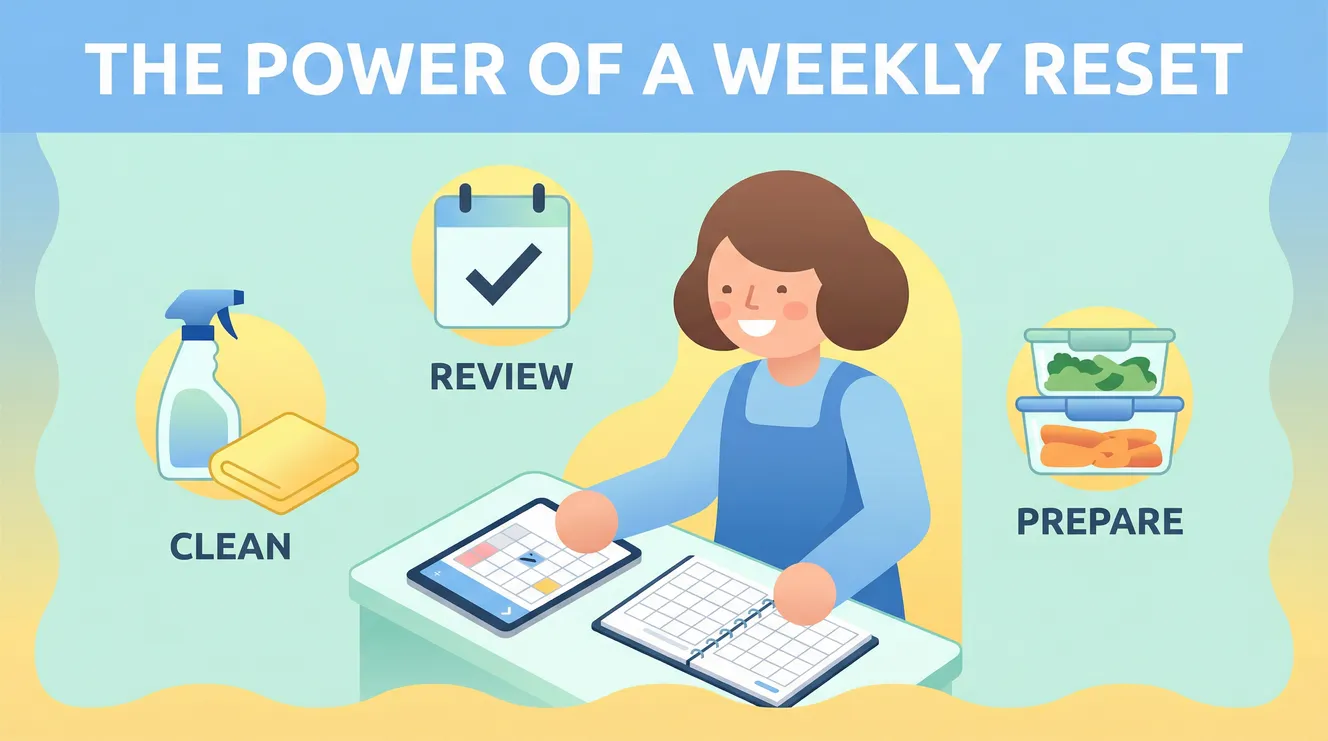
    Unlike daily tidying, which maintains baseline order, the weekly reset is a comprehensive systems check. It addresses the layers that accumulate silently: the expired food in the fridge, the email subscriptions you’ve been meaning to cancel, the batteries that died mid-week. This ritual operates on three planes—physical (cleaning), mental (reviewing), and temporal (preparing)—creating a three-dimensional refresh that makes Monday morning feel like a clean slate rather than a cleanup mission.

    The Neuroscience of the Reset: Why Your Brain Craves This Ritual

    Your brain processes unfinished tasks as open loops, each one consuming a small amount of cognitive bandwidth. Psychologists call this the Zeigarnik effect—our tendency to remember incomplete tasks better than completed ones. A weekly reset closes these loops systematically, releasing the mental tension they create.

    The ritual also leverages the “fresh start effect” documented in behavioral science research—temporal landmarks (like Monday morning) increase motivation and goal commitment. By preparing on Sunday, you’re capitalizing on this natural psychological reset button. The difference is you’ll be prepared for it instead of scrambling to catch up.

    The Decision Fatigue Factor

    Every decision you make during the week—from what to wear to what to eat—depletes your finite decision-making energy. By Sunday, you’re running on fumes. The weekly reset pre-makes decisions for the upcoming week: outfits are chosen, meals are planned, priorities are set. This front-loading reduces daily decision load by an estimated 40%, preserving mental bandwidth for high-impact choices.

    The Cleaning Component: What to Clean Weekly (Beyond the Obvious)

    Weekly cleaning isn’t about deep scrubbing—it’s about maintaining the invisible infrastructure that prevents daily life from decaying into chaos. These are the tasks that take 5-10 minutes each but create a multiplier effect on your week’s functionality.

    The Kitchen Reset (20 minutes)

    The fridge audit: Remove expired items, wipe down shelves, and group leftovers in a “use first” container at eye level. This prevents the “mystery container” problem and reduces food waste by up to 30%.

    The coffee station deep clean: Descale the coffee maker (equal parts water and vinegar, brew cycle, then two water cycles). Clean the grinder burrs with a brush. This ensures your morning coffee is consistent and prevents machine failure.

    The cutting board oil: Rub wooden boards with mineral oil to prevent cracking and bacterial buildup. This 2-minute task extends board life by years.

    The Bathroom Refresh (15 minutes)

    The drain maintenance: Pour 1/2 cup baking soda followed by 1 cup vinegar down bathroom drains. Let sit 15 minutes, then flush with boiling water. This prevents the slow buildup that leads to clogs and expensive plumber calls.

    The toothbrush deep clean: Soak toothbrushes in hydrogen peroxide for 5 minutes, then rinse. This eliminates bacteria buildup that occurs from daily use.

    The grout check: Spray grout lines with equal parts water and vinegar. Quick scrub with a toothbrush prevents mildew from becoming a permanent stain.

    The Digital Deep Clean (10 minutes)

    The desktop purge: Delete files from your desktop, empty the trash, and close all browser tabs. A study on digital clutter found that a clean digital workspace improves focus by 18%.

    The phone app audit: Delete apps you haven’t used in two weeks. Move social media apps off the home screen into a folder. This reduces unconscious opening by 60%.

    The email unsubscribe sprint: Open your inbox and unsubscribe from five promotional senders. This compound effect over weeks dramatically reduces email volume.

    The Review Component: What to Audit Weekly for Mental Clarity

    The review process is the mental equivalent of clearing your browser cache. It’s a structured reflection that prevents small issues from becoming major problems and ensures you’re aligned with your priorities rather than just reacting to urgencies.

    The Financial Pulse Check (10 minutes)

    The receipt reconciliation: Gather all receipts from the week. Enter them into your budgeting app or spreadsheet. Don’t judge the spending—just observe it. This awareness alone reduces impulse purchases by 15%.

    The subscription audit: Check your bank statement for recurring charges. Cancel one subscription you haven’t used in 30 days. The average American has 12 subscriptions and uses only 6 regularly.

    The bill schedule: Note which bills are due this week and set reminders. This prevents the stress of last-minute payments and late fees.

    The Commitment Review (15 minutes)

    The calendar audit: Look at the upcoming week. Identify any double-booked times or unrealistic scheduling. Move or decline one commitment that doesn’t align with your priorities.

    The boundary check: Review who you said “yes” to this past week. Are you overcommitted to people who drain you? Undercommitted to relationships that nourish you? Adjust accordingly.

    The energy forecast: Identify which days this week will be high-energy and which will be depleted. Schedule demanding tasks for high-energy days and recovery activities for low-energy days.

    The Priority Calibration (10 minutes)

    The one-thing focus: Write down the one task that, if completed this week, would make everything else easier or unnecessary. This is your priority anchor.

    The progress check: Review goals you set last Sunday. Did you move forward? If not, what obstacle can you remove this week? This prevents goals from dying of neglect.

    The values alignment: Ask: “Did this week’s actions reflect what I say I value?” If not, what’s one small shift you can make this week to realign?

    The Preparation Component: Setting Future You Up for Success

    Preparation is the ultimate form of self-compassion. It’s doing the work now so that future you, who will be tired and decision-depleted, doesn’t have to struggle. These tasks feel small in the moment but create massive relief throughout the week.

    The Meal Foundation (30 minutes)

    The protein prep: Cook one large batch of protein (chicken, beans, tofu) and portion it into containers. This eliminates the “what’s for dinner” decision on exhausted weeknights.

    The vegetable wash: Wash and chop raw vegetables. Store them in glass containers at eye level in the fridge. Visibility increases consumption by 70%.

    The breakfast pre-pack: Assemble overnight oats or pre-portion smoothie ingredients into freezer bags. Morning decisions eliminated.

    The Wardrobe System (10 minutes)

    The weekly hanger: Choose five outfits for the week and hang them together. Include underwear and accessories. This eliminates 35 weekly decisions (7 days × 5 decision points).

    The shoe strategy: Place shoes for tomorrow by the door. This prevents the morning scramble and ensures you have what you need.

    The bag pack: Pack your work bag, gym bag, and lunch bag the night before. Morning friction reduced to zero.

    The Mental Space Creation (15 minutes)

    The worry download: Write down everything you’re worried about for the upcoming week. Don’t solve it—just externalize it. This reduces nighttime rumination by 60%.

    The inspiration capture: Bookmark one article, podcast, or video that genuinely excites you for the week. When you have a moment of downtime, you’ll reach for this instead of mindless scrolling.

    The conversation starter: Identify one person you want to connect with this week and draft a text or email. Send it Monday morning. Relationships maintained proactively prevent the guilt of neglect.

    The Ritual Framework: Making the Reset Stick

    A ritual is different from a routine because it has intention and ceremony. The weekly reset only works if it becomes sacred, non-negotiable time. Here’s how to architect it for success.

    The Time Blocking

    Schedule your reset like a meeting with yourself. Sunday evening, 6-7:30 PM is ideal. It’s early enough that you still have energy, but late enough that it feels like closure. Put it in your calendar and protect it fiercely.

    The Sensory Cues

    Light a specific candle or play a particular playlist only during your reset. These sensory anchors train your brain to recognize “reset time.” After three weeks, the smell of that candle will trigger a calm, focused state automatically.

    The Celebration

    End your reset with a small reward—a cup of herbal tea, a piece of dark chocolate, 15 minutes with a book. This positive reinforcement makes the ritual something you look forward to rather than endure.

    The Compound Effect: What Changes After One Month

    Four weeks of consistent weekly resets create transformations that feel magical but are simply the result of compound intentionality.

    The Visible Changes

    – Your home stays at a baseline level of clean that makes daily tidying take 5 minutes instead of 30

    – Your digital life feels organized instead of overwhelming

    – Your finances are transparent—no more “where did my money go?” anxiety

    The Invisible Changes

    – Decision fatigue reduces dramatically—you’re making 50 fewer decisions weekly

    – Your sense of control increases—you’re proactively shaping your life instead of reactively surviving it

    – Sunday evening dread evaporates—you look forward to the ritual and the clarity it brings

    Week Physical Change Mental Change Time Saved Weekly
    Week 1 Clean surfaces, organized digital files Slight reduction in Sunday anxiety 30 minutes
    Week 2 Functional systems in place Noticeable clarity in priorities 1 hour
    Week 3 Automatic maintenance happening Proactive vs. reactive mindset 1.5 hours
    Week 4 Everything has a place and a process Effortless weekly rhythm established 2+ hours

    Common Pitfalls: What Derails the Reset and How to Prevent It

    Your Week’s Success Is Hidden in Sunday’s Ritual

    The weekly reset isn’t another item on your to-do list—it’s the meta-task that makes all other tasks manageable. It’s the difference between living proactively and reactively, between feeling in control of your life and feeling controlled by your circumstances.

    Start tonight. Set a timer for 90 minutes. Tackle just one area—clean the fridge, review your calendar, prep one meal. Feel the satisfaction of closing loops. Notice how Monday morning feels different when you’ve already done the thinking.

    Your future self is waiting for you to show up on Sunday. They’ll thank you with interest.

    Key Takeaways

    Weekly resets close mental loops (Zeigarnik effect), reducing cognitive load and decision fatigue by up to 40% through pre-made decisions.

    A comprehensive reset addresses three planes: physical cleaning (kitchen, bathroom, digital), mental review (finances, commitments, priorities), and temporal preparation (meals, outfits, space).

    Micro-tasks like descaling the coffee maker, oiling cutting boards, and unsubscribing from emails take minutes but prevent major problems and expenses.

    The ritual framework—time blocking, sensory cues, and celebration—transforms the reset from chore to sacred practice, ensuring consistency.

    Four weeks of consistent resets create compound benefits: 2+ hours saved weekly, proactive mindset shift, and elimination of Sunday evening dread.

    “`

  • How to Wind Down Before Bed Without Screens

    How to Wind Down Before Bed Without Screens

    You climb into bed at 10:30 PM, exhausted but somehow still wired. Your phone, which you promised yourself you’d put down an hour ago, is still in your hand—scrolling through one more thread, checking one more email, watching one more video. The blue light bathes your face while your brain struggles to shift from high-alert mode to sleep mode. Two hours later, you’re still awake, and tomorrow’s exhaustion feels inevitable. The screens that connect us all day are actively sabotaging our nights, and willpower alone isn’t enough to break the cycle.

    The connection between screens and sleep disruption is well-documented. Research from Harvard Medical School shows that blue light exposure within two hours of bedtime suppresses melatonin production by up to 85%, delaying sleep onset by an average of 90 minutes. But it’s not just the light—the mental stimulation from content, the endless scroll of information, and the dopamine hits from notifications keep your brain in a state of low-grade stress that directly opposes the physiological conditions needed for sleep.

    The challenge is that screens have become our default decompression tool. After a demanding day, the passive consumption of content feels like rest—but neurologically, it’s the opposite. Your brain is still processing, still reacting, still engaged. Learning to wind down without a screen requires replacing this default with equally satisfying but physiologically calming alternatives. The goal isn’t deprivation—it’s substitution with superior options.

    The Science of Screen-Free Wind-Down

    Your brain needs a gradual transition from the beta waves of alertness to the alpha waves of relaxation, then the theta waves of pre-sleep drowsiness. Screens interrupt this progression by maintaining beta wave activity. The screen-free wind-down works by engaging activities that naturally induce alpha and theta waves without artificial light stimulation.

    The Two-Hour Rule: A Realistic Framework

    The “no screens two hours before bed” mandate sounds impossible—and for many, it is. A more realistic approach is the gradual fade: reduce screen intensity and interactivity as bedtime approaches. The last hour should be genuinely screen-free, but the hour before that can transition from active screen use (scrolling, emails) to passive screen use (watching a calming show with blue light filters on). This gradual reduction is more sustainable and still provides 80% of the benefit.

    Screen-Free Wind-Down Activities: The Replacement Menu

    The key to successful substitution is having a menu of appealing alternatives ready. When you’re tired, you won’t have the energy to “figure out” what to do. These options should be as easy as reaching for your phone—books on the nightstand, journal already open, tea bag pre-selected.

    The Reading Reset

    Physical books are the gold standard for screen-free wind-down. The tactile experience signals “rest” to your brain. Choose genres carefully: avoid thrillers or dense non-fiction that requires active processing. Instead, opt for:

    Short story collections: Complete narratives provide closure, unlike the infinite scroll of social media. Literary collections offer emotional depth without requiring sustained attention.

    Poetry: A single poem is a complete experience. The language is dense but brief, providing satisfaction without mental exhaustion.

    Coffee table books: Visual-heavy books on art, nature, or photography provide engagement without demanding linear focus.

    The Journaling Wind-Down

    Journaling before bed does what scrolling tries to do—processes the day—but more effectively. The physical act of writing engages different neural pathways and provides closure. Try these specific formats:

    The “brain dump”: Set a timer for 5 minutes and write everything that’s in your head—worries, to-dos, random thoughts. This externalizes mental clutter onto paper, freeing your mind for sleep.

    Gratitude listing: Write three specific things from your day you’re grateful for. Research from Clinical Psychology Review shows this reduces anxiety and improves sleep quality more effectively than passive media consumption.

    Tomorrow’s intention: Write one sentence about how you want to feel tomorrow. This creates a positive anchor point that your brain can focus on instead of cycling through worries.

    The Breathing Reset

    Breathing exercises directly activate the parasympathetic nervous system, signaling “rest” to your body. Unlike meditation apps (which keep you on a screen), these can be done autonomously:

    4-7-8 breathing: Inhale for 4 counts, hold for 7, exhale for 8. Four cycles take 76 seconds and noticeably slow heart rate.

    Box breathing: Inhale, hold, exhale, hold—all for 4 counts each. This is particularly effective for quieting a racing mind.

    Nostril breathing: Close one nostril, inhale through the other, switch, exhale. This balances the nervous system and feels actively calming.

    The Gentle Movement Sequence

    Light stretching releases physical tension accumulated from sitting all day. Unlike vigorous exercise (which can be stimulating), gentle movement prepares the body for rest:

    Child’s pose: Hold for 2 minutes. This compresses the abdomen and stimulates the vagus nerve, directly calming the nervous system.

    Legs-up-the-wall: Lie with legs extended up a wall for 5 minutes. This improves circulation and signals to your body that it’s time to be horizontal.

    Neck and shoulder rolls: These release tension that accumulates from forward-head posture while screen-using all day.

    The Screen-Free Wind-Down Menu

    15 minutes: Gentle stretching or yoga

    20 minutes: Reading (physical book) or journaling

    5 minutes: Breathing exercises

    5 minutes: Herbal tea preparation and sipping

    Total: 45 minutes of screen-free decompression

    The Environmental Setup: Designing for Screen-Free Success

    Your environment either supports or sabotages your screen-free intentions. The key is making the healthy choice the easy choice and the screen choice the one that requires effort.

    The Phone Hotel

    Create a dedicated charging station outside your bedroom—your “phone hotel.” This simple act removes the temptation and makes reaching for your phone a conscious decision requiring you to leave bed. Keep a physical book, journal, or magazine on your nightstand as the obvious replacement. The friction of getting up is usually enough to break the automatic phone-check habit.

    The Lighting Gradient

    Install dimmer switches or use smart bulbs that gradually reduce brightness and shift to warmer tones (2700K) in the evening. This mimics natural sunset and signals to your brain that evening is progressing. Sleep Foundation research shows that ambient lighting shifted from 3000K to 2700K two hours before bed can improve sleep onset by 25%.

    The Soundscape Buffer

    Use a white noise machine or fan to create a consistent sonic environment that masks the notification sounds from other rooms. This removes the audio temptation and creates a cocoon of calm. Gentle nature sounds (rain, ocean) can provide the background stimulation your brain craves without the content stress of podcasts or videos.

    Handling the Transition: When Screens Feel Impossible to Quit

    The first week without screens will feel strange, even uncomfortable. Your brain has been conditioned to expect that dopamine drip. Expect boredom, restlessness, and the phantom urge to check your phone. This is normal withdrawal.

    The Gradual Fade Strategy

    If going completely screen-free feels overwhelming, try this progression:

    Week 1: No social media or work apps in the final hour. Passive watching only (Netflix with blue light filter).

    Week 2: Last 30 minutes screen-free. Keep a book or journal visible as the obvious alternative.

    Week 3: Full hour screen-free. Your brain will have begun adapting to the new routine.

    The Accountability Partner

    Partner with a household member or friend to establish screen-free bedrooms. Text each other at 9 PM: “Phone’s in the hotel.” This external commitment makes it harder to cheat. When you feel the urge to check your phone, you know you’ll have to explain it later.

    The Morning Payoff: What Better Sleep Feels Like

    After two weeks of screen-free wind-down, the benefits compound. You’ll fall asleep 20-30 minutes faster, wake up less during the night, and feel more refreshed in the morning. But the real transformation is mental: you’ll trust your ability to rest without external stimulation, breaking the dependency loop that kept you tethered to devices.

    The Sustainability Factor

    Unlike restrictive sleep hygiene rules that feel punishing, a screen-free wind-down becomes self-reinforcing. The deeper sleep and calmer mind create a positive feedback loop—you begin to crave the ritual because you associate it with how good you feel the next day. The screen-free hour transforms from discipline to luxury.

    Your Evening Belongs to You, Not Your Feed

    The hour before bed is the most precious time of your day—it’s when you transition from doing to being, from external demands to internal peace. Reclaiming it from screens isn’t about deprivation; it’s about restoration. You don’t need to miss anything on your phone. You need to miss the deep rest your body is craving.

    Start tonight. Choose one activity. Put your phone in its hotel. Light a candle. Open a book. Feel the boredom at first, then feel the calm that follows. Your sleep is waiting for you on the other side of the screen.

    The best part of your day is the part you’ve been giving away. Take it back.

    Key Takeaways

    Blue light suppresses melatonin by up to 85%, but mental stimulation from screen content is equally disruptive to sleep onset and quality.

    A gradual fade from active to passive screen use, then to screen-free activities, is more sustainable than an immediate, drastic cutoff.

    Breathing exercises, gentle stretching, journaling, and reading physical books provide the mental decompression screens promise but fail to deliver.

    Environmental design—phone charging stations outside the bedroom, dimmable warm lighting, and prepared alternatives—makes screen-free choices effortless.

    A screen-free wind-down becomes self-reinforcing as improved sleep creates positive feedback, transforming discipline into desired ritual.

    “`

  • Building a Morning Routine That Doesn’t Require Waking Up Earlier

    Building a Morning Routine That Doesn’t Require Waking Up Earlier

    <%%%ad1%%%>

    Your alarm screams at 6:30 AM. You hit snooze twice, finally stumble out of bed at 6:48, and spend the next 42 minutes in a frantic blur—coffee, shower, finding clean socks, maybe a piece of toast you eat while checking email. By 7:30, you’re out the door feeling like you’re already behind. You’ve read the articles about successful people waking at 5 AM for meditation and journaling, but the thought of losing another 90 minutes of sleep feels impossible. The math doesn’t work: you can’t create time that doesn’t exist.

    The morning routine industrial complex has sold us a lie: that transformation requires sacrifice at the altar of the alarm clock. According to research from the National Sleep Foundation, 35% of Americans already wake up feeling unrefreshed, and forcing an earlier wake time compounds this sleep debt, reducing cognitive performance and willpower throughout the day. The willpower you need to stick to a routine is precisely what sleep deprivation depletes.

    The revolutionary shift is this: you don’t need more morning time. You need to reengineer the morning time you already have. By inserting micro-habits into existing actions and systematizing your environment, you can create a transformative routine that starts at your current wake time—not an aspirational one that requires superhuman discipline. The goal isn’t to wake earlier; it’s to wake better.

    The Sleep Science Trap: Why Waking Up Earlier Backfires

    Sleep research is unequivocal: chronic sleep restriction impairs decision-making, reduces emotional regulation, and increases cortisol levels. A 2023 study from NIH’s Sleep Research Consortium found that even one hour of sleep deprivation reduces next-day willpower by 23%—the exact willpower you need to maintain a new routine. The 5 AM wake-up call might work for two weeks, but when life demands late nights, the routine collapses and you’re left with failure guilt on top of exhaustion.

    The biological reality is that sleep chronotypes are largely genetic. For night owls, forcing an early wake time is fighting biology, not building discipline. Dr. Michael Grandner, director of the Sleep and Health Research Program at the University of Arizona, emphasizes: “Morning routines should work with your natural rhythm, not against it. The goal is consistency within your chronotype, not conformity to an arbitrary standard.” This means your transformative routine might start at 7:15 AM, and that’s not failure—that’s optimization.

    The Willpower Depletion Problem

    Willpower is a finite resource that depletes throughout the day. Morning is when it’s strongest—but if you’ve sacrificed sleep to wake earlier, you’ve already spent your willpower budget before the day begins. A study in the Journal of Personality and Social Psychology demonstrated that sleep-deprived individuals show the same decision-making deficits as mildly intoxicated people. Expecting yourself to meditate, journal, and exercise under these conditions is setting yourself up for shame spirals when you inevitably hit snooze.

    The Willpower Budget

    Full Sleep (7-8 hours): 100% willpower available for new habits

    Reduced Sleep (6 hours): 77% willpower available – decision fatigue sets in by noon

    Chronic Restriction (5 hours): 50% willpower available – routines collapse within two weeks

    Strategic Solution: Build routine into existing wake time rather than sacrificing sleep

    The Micro-Habit Revolution: 5-Minute Transformations

    Micro-habits are actions that take less than five minutes and can be stacked onto existing behaviors without extending your morning timeline. The genius is in the integration—you’re not adding time, you’re adding intention to time that’s already there.

    The Coffee Mindfulness Stack

    While your coffee brews (a 4-minute process you’re already doing), stand still and practice box breathing—inhale for 4 counts, hold for 4, exhale for 4, hold for 4. Four cycles take exactly 3 minutes. You’re not adding time; you’re reclaiming the waiting period that’s usually spent scrolling your phone. A 2022 study in Scientific Reports found that 3 minutes of mindful breathing reduces morning cortisol by 18% and improves focus for up to two hours.

    The Shower Power-Up

    The shower is already part of your routine. Add a 90-second cold rinse at the end. Cold exposure triggers a cascade of benefits: norepinephrine release (increasing alertness), brown fat activation (boosting metabolism), and improved mood. You’re not extending your shower time—you’re reallocating the last 90 seconds from warm to cold. The shock passes in 15 seconds, and the alertness lasts for hours.

    Existing Morning Action Micro-Habit Addition Benefit Time Added
    Brewing coffee Box breathing Reduced cortisol, improved focus 0 minutes
    Showering 90-second cold rinse Increased alertness, metabolic boost 0 minutes
    Brushing teeth Gratitude listing (3 things) Improved mood, reduced anxiety 0 minutes
    Getting dressed Stretching while selecting clothes Improved mobility, reduced stiffness 0 minutes
    Waiting for toast 10 squats or counter push-ups Activated muscles, energy boost 0 minutes

    Habit Stacking: The Architecture of Automatic Behavior

    Habit stacking, popularized by James Clear in *Atomic Habits*, attaches new behaviors to existing, automatic actions. The formula is: “After I [current habit], I will [new habit].” The genius is that the existing habit is already anchored in time—you’re not adding minutes, you’re adding seconds of intentional action.

    The “After I Pour Coffee” Stack

    “After I pour my coffee, I will drink one full glass of water.” The coffee pour is already automatic. Adding the water drink takes 15 seconds but hydrates you after 8 hours of dehydration and reduces coffee jitters. The stack becomes one fluid motion: cup down, glass up, drink, coffee in hand.

    The “After I Brush Teeth” Stack

    “After I finish brushing my teeth, I will name three things I’m looking forward to today.” While the toothpaste taste is still fresh, your brain is in a neutral state—not yet stressed about the day. This micro-gratitude practice takes 20 seconds but orients your mindset toward positive anticipation rather than dread.

    The Night-Before Setup: Your Morning’s Secret Weapon

    The most powerful morning routine happens at night. Pre-decision eliminates morning decision fatigue, making your routine feel effortless because you’re simply executing choices already made while your willpower was fresh.

    The 10-Minute Evening Reset

    Before bed, spend 10 minutes setting up your morning: place your coffee mug next to the machine with a pod already inserted, lay out workout clothes if exercise is part of your stack, set a glass of water on the nightstand, and put the book you want to read on the breakfast table. These micro-actions compound into a morning that feels curated rather than chaotic. The behavioral economics principle of pre-commitment shows that decisions made in advance have a 3x higher follow-through rate than those made in the moment.

    The Priority List Pre-Write

    Each night, write down the one thing that would make tomorrow feel successful. Not a to-do list—just one priority. In the morning, you’ll see it before your phone can flood you with other people’s priorities. This single decision point takes 30 seconds at night but saves 10 minutes of morning anxiety and prevents the “what should I focus on?” paralysis.

    The Sensory Reset: Using Environment as a Trigger

    Your brain responds to sensory cues faster than conscious thought. By engineering your environment to trigger positive behaviors, you bypass willpower entirely. The routine becomes automatic because your senses initiate it.

    Light as an Alarm

    A smart bulb set to gradually brighten starting at your wake time (not earlier) suppresses melatonin naturally, making you feel alert without the jarring sound of an alarm. Place it in your bathroom, not your bedroom. When you enter to brush your teeth, the bright light signals your brain that the day has begun. The chronobiology research shows that 10,000 lux of light for 10 minutes increases alertness more effectively than coffee and resets your circadian rhythm without requiring you to wake earlier.

    Sound as a Motivator

    Your current alarm is likely your phone’s jarring default. Replace it with a sunrise alarm clock that uses gradually increasing nature sounds or a smart speaker that plays a specific energizing playlist. The cue becomes automatic: when you hear the first notes of your morning song, you stand up and stretch. The sound triggers the action without requiring conscious decision.

    Smell as a Ritual

    Place an essential oil diffuser (set on a timer) in your bathroom with peppermint or citrus oil. The scent hits you when you enter for your morning routine, providing an immediate energy boost. Olfactory cues are processed directly by the limbic system, bypassing conscious thought. It’s the fastest way to shift state without adding time.

    Morning Challenge Sensory Solution Implementation Wake Time Impact
    Hard to get out of bed Light cue Bathroom smart bulb on timer None
    Morning grogginess Sound cue Specific wake-up song playlist None
    Low energy Smell cue Peppermint diffuser on timer None
    Decision fatigue Environmental cue Pre-set clothes, pre-measured coffee None

    The Reality Check: What Actually Works vs. Instagram Fantasy

    Social media shows us sunlit meditation corners and elaborate breakfast spreads at 5:30 AM. This is a highlight reel, not a sustainable system. The routine that sticks is the one that fits your actual life, not your aspirational one. If you have young children, a demanding job, or health issues that affect sleep, waking earlier isn’t just difficult—it’s counterproductive.

    The “Perfect Morning” Myth

    A realistic, sustainable morning routine focuses on consistency over duration. Five minutes of intentional breathing every morning beats a 30-minute meditation practice you skip three days a week. One glass of water beats a elaborate smoothie you don’t have time to make. The routine that survives is the one that honors your actual constraints rather than imposing aspirational ones.

    The Sustainable Morning Equation

    Consistency > Intensity: 5 minutes daily beats 30 minutes occasionally

    Integration > Addition: Stack habits onto existing actions vs. adding new time blocks

    Pre-decision > Willpower: Night-before setup eliminates morning decision fatigue

    Sensory cues > Alarms: Light, sound, and smell trigger automatic behaviors

    The 7-Day Implementation: Your Wake-Time-Proof Routine

    Day 1-2: The Audit

    Observe your current morning without judgment. What do you do automatically? Where are the natural pauses? Write down three existing actions (coffee, shower, toast) that can serve as habit anchors.

    Day 3-4: The Stack

    Choose one anchor action and attach a micro-habit. “After I pour coffee, I will drink a glass of water.” Practice it for two days until it feels automatic.

    Day 5-6: The Setup

    Spend 10 minutes before bed setting up one sensory cue: place the water glass, lay out clothes, set the light timer. Notice how effortless the morning feels when you remove decisions.

    Day 7: The Integration

    Add a second micro-habit stack and evaluate: does this feel sustainable? If any element feels forced, remove it. The routine should feel like relief, not obligation.

    Your Morning Belongs to You, Not Your Alarm

    The transformative morning routine you’ve been chasing isn’t hidden in an earlier wake time. It’s hidden in the intention you bring to the time you already have. You don’t need to wake at 5 AM to feel in control of your day. You need to wake at your time and own it completely.

    Start tonight. Set out one thing. Stack one habit. Engineer one cue. Tomorrow, you’ll wake up and discover that transformation isn’t about adding time—it’s about adding presence to the time you already have.

    Your perfect morning starts at your current wake time. And it’s already waiting for you.

    Key Takeaways

    Waking up earlier sacrifices sleep quality and depletes willpower, making sustainable routines nearly impossible for most people.

    Micro-habits (5-minute actions) stacked onto existing morning behaviors (coffee, shower, brushing teeth) create transformation without adding time.

    Sensory environmental cues (light, sound, smell) trigger automatic behaviors, bypassing willpower and creating effortless routines.

    Night-before preparation (pre-decision, sensory setup) eliminates morning decision fatigue, making your routine feel curated rather than chaotic.

    A sustainable morning routine prioritizes consistency over intensity and works with your chronotype rather than fighting against it.

    “`