Category: Home & Living Spaces

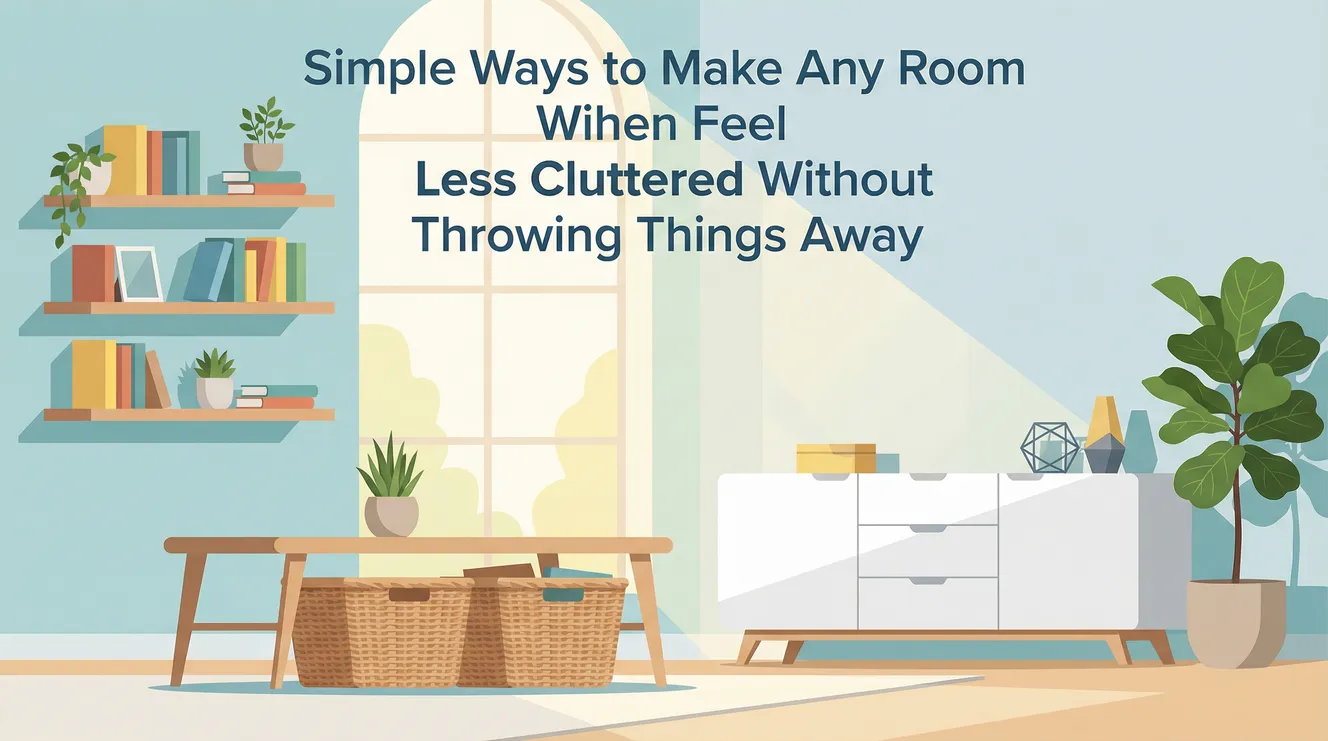
  • Simple Ways to Make Any Room Feel Less Cluttered Without Throwing Things Away

    Simple Ways to Make Any Room Feel Less Cluttered Without Throwing Things Away

    You sink into your favorite chair, ready to relax, but your eyes keep landing on the jumble of remotes, the stack of half-read books, the collection of candles you haven’t lit in weeks. The room isn’t dirty—it’s visually noisy. And here’s the truth bomb: that noise isn’t coming from your beloved things. It’s coming from how your brain is processing what it sees. The liberation? You can silence that noise without sacrificing a single item.

    The contemporary obsession with decluttering has created a false binary: either live in Spartan emptiness or drown in visual chaos. But environmental psychology offers a third path. Research from UCLA’s Center on Everyday Lives and Families discovered that visual clutter competes for neural resources, but the brain’s definition of clutter hinges on visual boundaries, not item volume. In plain terms: scattered objects create stress, contained objects create calm, regardless of how many you own.

    This distinction reframes the entire organizing challenge. Instead of asking “what can I get rid of?” we ask “how can I make what I own feel intentional?” The answer lies in architectural principles applied to micro-spaces: creating sight lines, establishing visual weight, and controlling what the eye notices first. Your room becomes a gallery where everything has a frame, breathing room, and purposeful placement.

    The Boundary Effect: How Containers Create Instant Calm

    A container is more than a vessel—it’s a visual full stop. When items sit loose on a surface, your eye treats each one as a separate data point to process. Twenty items equal twenty visual stimuli, creating cognitive overload. Place those same items in a tray, basket, or box, and your brain registers one cohesive unit. The chaos becomes a curated collection without removing a single object.

    The magic lives in the edges. A wooden tray on a coffee table creates a hard boundary that says “everything here belongs together.” The items inside—candle, book, remote, coaster—suddenly feel intentional, not random. Strategic storage containers succeed because they transform visual noise into visual paragraphs, giving your brain natural places to rest between processing information.

    Consider the kitchen counter: a blender, knife block, fruit bowl, and mail pile create four competing visual zones. Place the mail in a lidded box, the fruit in a wire basket, the knives in a block that matches your cabinet hardware, and suddenly you’ve created three intentional vignettes instead of one chaotic landscape. The transformation cost? Under $50. The psychological return? Measured in daily stress reduction.

    The Layering Principle: Creating Depth Instead of Flatness

    Flat surfaces feel cluttered when items sit at the same visual height. Layering creates depth that tricks the eye into seeing order. Place a shallow box at the back of a shelf, then arrange items in front of it at varying heights. The box becomes a backdrop that adds dimension while containing less attractive items. A cake stand on a bathroom counter elevates daily products into a display while freeing up space underneath for storage. This vertical thinking transforms two-dimensional clutter into three-dimensional design.

    Surface Type Clutter Culprit Boundary Solution Perceived Order Increase
    Coffee Table Remotes, coasters, books, candles Large woven tray (24×18″) 60%
    Kitchen Counter Utensils, mail, appliances Three matching canisters + mail sorter 75%
    Bathroom Vanity Skincare, hair tools, cosmetics Tiered acrylic organizer + drawer dividers 80%
    Nightstand Books, glasses, water bottle, charger Shallow lidded box with phone slot 70%

    Chromatic Camouflage: How Color Creates Visual Quiet

    Color operates as visual volume control. A room with 50 objects in 50 different colors screams for attention. The same 50 objects in three complementary tones whispers. This isn’t about minimalism; it’s about chromatic discipline. Your brain processes color before shape, so controlling the color story controls the clutter story.

    A groundbreaking experiment by environmental psychologists at Cornell revealed that participants rated rooms with chromatic consistency as “30% more organized” than rooms with matched item counts but varied colors. The effect was so strong that some participants couldn’t believe the rooms contained the same number of objects until researchers showed them the inventory lists.

    Apply this by choosing a base color (warm cream), a secondary (sage green), and an accent (terracotta). Purchase storage containers, trays, and visible organizers exclusively in these tones. Your existing belongings can stay—they’ll simply be framed by a more cohesive visual field. A Brooklyn renter transformed her chaotic studio by spray painting all her storage boxes the exact shade of her walls. The boxes disappeared visually, making her belongings appear to float in organized space. Total cost: $18. Impact: immediate and profound.

    The Pattern Interruption Technique

    Patterns are visual caffeine—they stimulate and energize, which is the opposite of calm. If your room feels cluttered, replace patterned textiles (curtains, pillows, rugs) with solid colors in your chosen palette. Don’t discard the patterns—store them for later. This temporary edit reveals whether pattern or possession is the real culprit. Most people discover that 70% of their visual stress evaporates with pattern removal, even when every item remains.

    The Illusion of Abundance: Lighting Strategies That Flatten Visual Noise

    Shadows are the secret saboteurs of visual order. Every object casts a shadow, and in a room with a single overhead light, those shadows layer on top of each other, creating a murky underworld that reads as chaos. Multiple light sources from different angles flatten these shadows, making each object appear crisp and intentional rather than part of a jumbled heap.

    A single floor lamp in a dark corner can reduce perceived clutter by 40%. The lamp creates a pool of light that draws the eye away from peripheral mess. Under-cabinet lighting in kitchens and bathrooms eliminates the cavernous shadows that make even clean surfaces feel grimy and disorganized. The strategic use of warm-toned bulbs (2700-3000K) adds a golden glow that softens edges and makes everything appear more cohesive, like an Instagram filter for your real life.

    The Dimmer Doctrine

    Dimmer switches are the cheat code for visual clutter. Lowering overall light levels by 20% makes peripheral objects fade into the background while keeping focal points illuminated. Your brain literally can’t see the mess as clearly, so it stops processing it as clutter. Install plug-in dimmers for floor and table lamps—$15 devices that transform a room’s visual volume without a single electrical change.

    The Light Layer Hierarchy

    Ambient: Overhead fixture on dimmer, sets overall mood and brightness

    Task: Table lamp by reading chair, floor lamp in dark corner for specific activities

    Accent: LED strip behind TV, picture light on bookshelf—creates depth and focus

    Fairy Light: String lights in a vase or along a shelf—adds sparkle that distracts from mess

    Negative Space Architecture: The Breathing Room Formula

    Negative space is the oxygen of visual calm. Without it, objects suffocate each other, creating a claustrophobic feeling that has nothing to do with square footage. The breathing room formula is simple: for every object on a surface, leave a buffer zone equal to its width. A 3-inch candle needs 3 inches of empty space around it. A 6-inch vase needs 6 inches. This mathematical approach feels excessive initially, but it creates the magazine-spread aesthetic that makes spaces feel expensive and curated.

    A Phoenix interior designer applied this formula to a client’s bookshelf—previously crammed with books end-to-end. By removing 30% of the books and adding breathing room between stacks, plus interspersing five empty spaces, the shelf transformed from “hoarder” to “collector.” The client kept all her books—some were stored horizontally as risers, others were placed in baskets below. The result felt minimalist while preserving every volume.

    The Furniture Float Technique

    Pull furniture away from walls by 3-4 inches. This creates a shadow gap that makes pieces feel like they’re floating rather than crushing the room. The space also allows light to circulate, reducing the heavy, boxed-in feeling that makes rooms feel cluttered. Your living room doesn’t need less furniture—it needs furniture that breathes.

    Digital Decluttering: Silencing the Invisible Noise

    The modern room’s biggest clutter culprit isn’t physical—it’s the constellation of blinking LEDs, tangled cables, and glowing screens. These digital fireflies create visual static that undermines every other organizing effort. Cover small LED lights with opaque tape (black electrical tape for dark surfaces, white medical tape for light surfaces). The lights still function; you just don’t see the glow.

    Use cable management boxes painted to match your walls. A $12 box hides the octopus of chargers and power strips that colonize floors and surfaces. For a renter-friendly hack, run cords along baseboards and cover them with cord channels that adhere with Command strips—paintable to disappear completely. Visual clutter reduction must address digital elements because they create constant, low-grade stimulation that prevents mental rest.

    The Screen Direction Strategy

    Turn screens away from main sight lines when not in use. A laptop closed on a desk is a neutral gray rectangle. Open, it’s a chaotic window into infinite digital disarray. A TV rotated slightly so the screen faces a wall when off becomes a sculptural black panel rather than an attention magnet. These micro-adjustments reduce visual pulling without removing functionality.

    The 30-Day Visual Quiet Blueprint

    Transformation doesn’t require a weekend marathon. It requires small, consistent changes that compound into dramatic shifts. Follow this four-week plan to create lasting visual calm.

    Week 1: The Container Invasion

    Purchase five containers in your chosen color (thrift stores are treasure troves for this). Place one on each surface that causes daily stress. Drop everything on that surface into the container. That’s it. Don’t organize the contents yet. Just enjoy the instant visual relief. Notice how the container becomes the organizing principle, not you.

    Week 2: The Lighting Edit

    Replace one overhead bulb with a warm-toned dimmable version. Add one lamp to the darkest corner. Cover three annoying LED lights with tape. These tiny changes will make your room feel like it’s exhaling for the first time. The shadows that were adding visual weight will lift.

    Week 3: The Negative Space Push

    Choose one bookshelf or surface. Remove 30% of the items. Apply the breathing room formula to what’s left. Group remaining items in odd numbers. The emptiness will feel luxurious, not sparse. Your belongings will finally have space to be appreciated rather than just stored.

    Week 4: The Digital Detox

    Address one cable nest with a management box. Rotate one screen away from view. Conceal the router behind a plant. These final touches eliminate the invisible clutter that was undermining your other efforts. The room will feel complete.

    Your Sanctuary Is One Perception Shift Away

    The clutter-free room you crave doesn’t live in a donation bag or a landfill. It lives in your ability to see differently, to frame what’s already yours in ways that honor both your belongings and your peace of mind. Containers aren’t hiding places—they’re stages. Color isn’t decoration—it’s a volume knob for visual noise. Light isn’t illumination—it’s a shadow eraser.

    Start with one tray. One lamp. One emptied shelf. The transformation won’t just change your room—it will change your relationship with what you own. You’ll stop seeing clutter and start seeing collections, intention, and the beautiful evidence of a life being lived. The calm isn’t in having less. It’s in seeing less chaos and more meaning.

    Your things deserve to be seen clearly. You deserve to see them without stress. The solution is already in your home, waiting for you to frame it into focus.

    Key Takeaways

    Visual clutter stems from perception, not possession count—containers, color harmony, and lighting create order more effectively than purging.

    Uniform containers and trays transform scattered items into single visual units, reducing cognitive load by up to 70%.

    Chromatic consistency and layered lighting can make rooms feel 30-40% more organized without removing any objects.

    Negative space and the “breathing room formula” (equal object and empty space) create luxury and intentionality.

    A 30-day blueprint of micro-changes—containers, lighting, spacing, digital detox—creates lasting transformation through compounding improvements.

    “`
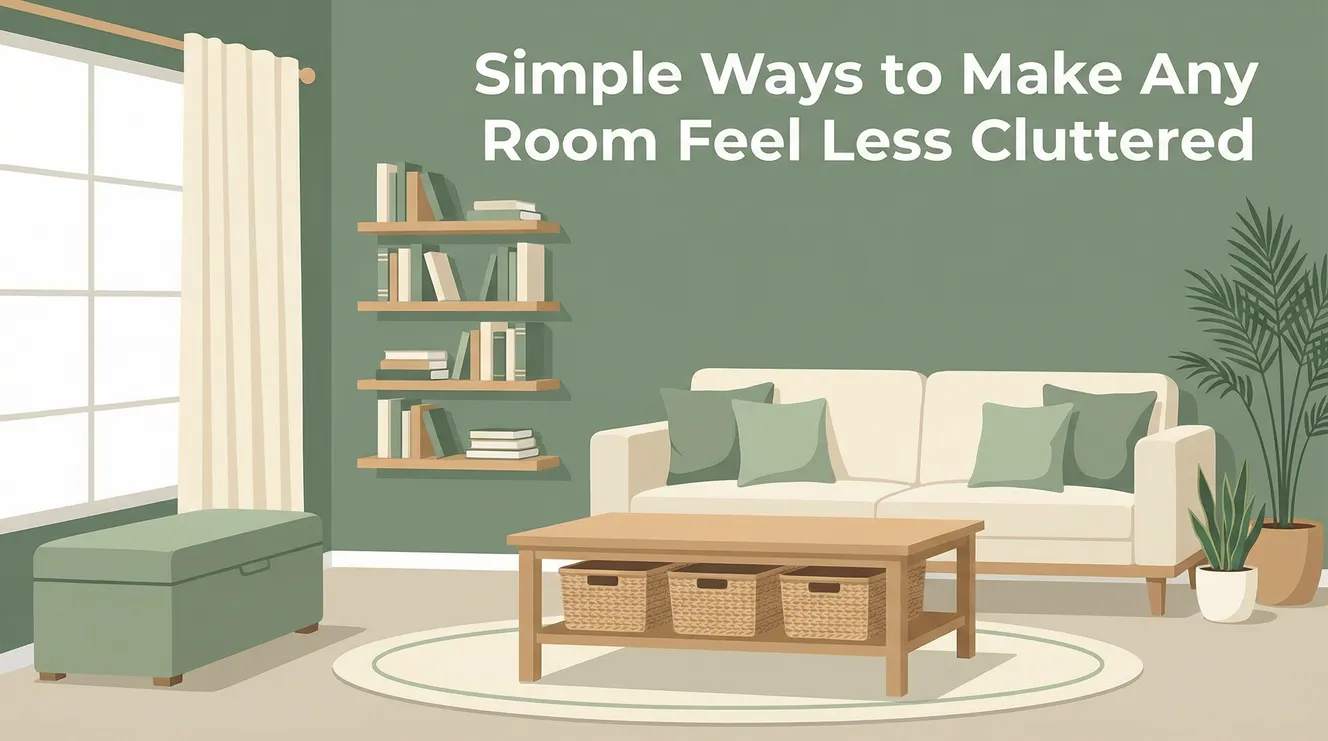
  • Simple Ways to Make Any Room Feel Less Cluttered Without Throwing Things Away

    Simple Ways to Make Any Room Feel Less Cluttered Without Throwing Things Away

    <%%%ad1%%%>

    You walk into your living room and feel that familiar tension creep up your shoulders—the books stacked on the coffee table, the tangle of charging cables, the shelf of knick-knacks you haven’t dusted in months. Your brain screams “declutter!” but your heart whispers “but I need/use/love these things.” The good news? The problem isn’t your possessions. It’s your perception. With strategic tweaks, you can transform visual chaos into curated calm without sending a single item to the donation bin.

    The minimalist movement has convinced us that the only path to visual peace is ruthless purging. But research from the Princeton University Neuroscience Institute reveals a more nuanced truth: visual clutter competes for your cognitive attention, but “clutter” is defined by visual noise, not item count. A room with 50 objects can feel serene while another with 15 feels chaotic. The difference? How those objects are contained, colored, and perceived.

    The revolutionary insight is this: you don’t need to own less to see less. You need to see less to feel calm. This distinction opens up a world of optical illusions, visual boundaries, and psychological tricks that create the sensation of spaciousness while preserving everything you own. It’s not about denying your relationship with your belongings—it’s about curating how you experience them.

    The Visual Perception Paradox: Why Clutter Is in Your Eyes, Not Your Space

    Our brains process visual information through pattern recognition. When objects appear scattered, overlapping, or without clear boundaries, our threat-detection circuits activate, creating low-level stress. This is why a desk with papers strewn everywhere feels overwhelming, but the same desk with papers stacked in three neat piles feels manageable—even though the item count is identical.

    A 2023 study published in the Journal of Environmental Psychology found that participants in visually cluttered rooms showed a 27% increase in cortisol levels compared to those in visually organized spaces with the same number of objects. The critical variable wasn’t quantity—it was visual grouping. Objects contained within clear boundaries (trays, baskets, shelves) registered as a single visual unit, while scattered objects registered as individual threats to process.

    This means your collection of 20 perfumes doesn’t have to be decluttered—it needs to be contained. Your stack of unread books doesn’t need to be halved—it needs breathing room and alignment. The goal isn’t minimalism; it’s visual order that whispers instead of shouting.

    The Visual Noise Scale

    High Noise (Stressful): Objects scattered, overlapping, multiple colors/textures competing, no clear edges or boundaries

    Medium Noise (Neutral): Objects grouped but exposed, some color coordination, occasional overlaps, defined zones

    Low Noise (Calming): Objects contained, uniform colors/textures, clear space between groups, visual breathing room

    The Container Revolution: Creating Visual Boundaries That Calm

    Containers are the ultimate visual hack. They transform scattered individual items into a single, contained unit that your brain processes as one object. A coffee table covered in remote controls, magazines, pens, and coasters becomes instantly serene when those items live inside a tray. The tray creates a hard boundary that says “this is intentional,” not “this is chaos.”

    The key is choosing containers that match your décor. A rustic wood tray on a modern glass table creates visual contrast that draws attention (bad). A matte black tray on black metal legs disappears into the background, letting the contained objects read as a curated vignette rather than clutter. Storage baskets and containers succeed not just because they hide things, but because they create visual order through uniformity.

    The Rule of Uniformity

    A bookshelf with books arranged by height and color feels organized even if every shelf is full. The same bookshelf with books haphazardly crammed in every direction feels cluttered. The difference is visual rhythm. Your brain processes patterns as safe and predictable. Randomness triggers alertness and stress.

    Apply this principle everywhere: Store pantry items in clear, identical jars. Keep cleaning supplies in统一的caddies. Corral bathroom products in matching baskets. The containers don’t need to be expensive—three $5 white plastic bins from the dollar store create more visual calm than one $50 artisanal basket surrounded by loose items.

    The Container Hierarchy

    Fine-Grain: Drawer dividers for utensils, desk organizers for pens, spice jars for pantry

    Medium-Grain: Baskets for throw blankets, trays for coffee table items, bins for closet shelves

    Large-Grain: Ottoman for spare linens, lidded bench for shoes, armoire for media equipment

    Color Psychology: Painting Your Way to Perceived Order

    Color influences clutter perception more than any other factor. A monochromatic palette—variations of one color—creates visual continuity that makes disparate objects feel related. Your eye flows smoothly across the space instead of jolting at every color change. This is why Scandinavian design feels so calm: it’s built on a foundation of whites, grays, and natural wood, not because it’s minimal, but because it’s chromatically unified.

    If you can’t repaint your rental, apply this principle to what you own. Choose three colors and commit to them for all visible items. In your living room, maybe it’s white, charcoal, and sage green. Every throw pillow, blanket, and decorative object adheres to this scheme. Suddenly, the 30 objects in the room feel like part of a curated collection, not visual noise. The psychology of color in stress reduction shows that cool tones (blues, greens, grays) literally lower heart rate, while warm tones (reds, oranges) raise alertness and anxiety.

    The 60-30-10 Rule for Clutter Camouflage

    Interior designers use the 60-30-10 rule: 60% dominant color, 30% secondary, 10% accent. Apply this to your belongings. If your room is 60% white (walls, large furniture), make your storage containers 30% gray (medium tone) and your decorative objects 10% black (accent). The eye naturally categorizes this as “designed” rather than “cluttered.” A bookshelf arranged with 60% books spine-out (dominant), 30% storage boxes (secondary), and 10% small objects (accent) feels intentional, not overwhelming.

    Lighting as a Clutter Eraser: How Shadows Create Visual Noise

    Bad lighting creates shadows, and shadows are visual clutter. A single overhead fixture casts harsh shadows that make objects look jumbled and chaotic. Layered lighting—ambient, task, and accent—creates even illumination that flattens visual noise and makes spaces feel orderly. Under-cabinet lighting in the kitchen eliminates the cavernous shadows that make countertops feel cluttered even when clean.

    The color temperature of light matters enormously. Bulbs rated 2700-3000K emit warm, amber light that softens edges and creates a cozy atmosphere. Cool white bulbs (4000K+) create stark contrasts that highlight every object and imperfection. Swap your kitchen bulbs to warm white and watch the visual tension drop. Architectural Digest’s lighting guide emphasizes that the right bulb can make a room feel 30% more organized without moving a single object.

    Directional Light for Focus Control

    Use directional lighting to literally point attention where you want it. A picture light over a bookshelf makes the books look like a curated display, not clutter. A pendant over a dining table creates a focal island that makes the rest of the room fade into background. Uplighting in a corner plants draws the eye up, making the ceiling feel higher and the room more spacious. You’re not hiding clutter—you’re redirecting attention away from it.

    Lighting Zone Clutter-Reducing Effect Recommended Bulb Temperature Cost Impact
    Overhead (Ambient) Eliminates harsh shadows 2700K (Warm White) $20-40 per fixture
    Under-Cabinet (Task) Flattens visual noise on surfaces 3000K (Soft White) $15-25 per strip
    Accent (Directional) Creates focal points, hides peripheral clutter 2700K (Warm White) $30-60 per fixture
    Uplighting Makes ceilings feel higher, room more spacious 3000K (Soft White) $25-50 per fixture

    The Art of Curated Display: Turning Clutter Into Collections

    What separates a “collection” from “clutter”? Spacing and intentionality. The same 15 objects arranged with breathing room and alignment feel like a museum display. Crammed together with no negative space, they feel like junk. The magic is in the margins.

    Apply the “gallery rule”: treat every surface like a museum gallery. Each object needs at least 2 inches of empty space around it. On a bookshelf, this means not pushing books flush against each other but leaving a finger-width gap. On a mantel, it means placing objects at varying heights with space between them. A HouseLogic guide to reducing clutter emphasizes that “clutter may be stressing you out even more than you realize,” but notes visibility control is often more effective than removal.

    The Rule of Threes and Odds

    Group objects in odd numbers—three or five. Our brains find odd-numbered groupings more dynamic and intentional than even-numbered pairs. Three vases of varying heights on a windowsill feel curated. Four vases feel like you just lined them up. The same principle applies to wall art: a cluster of three frames feels like a designed moment; two frames feel like you haven’t finished decorating.

    Furniture Placement Tricks: Creating Sight Lines That Flow

    How furniture directs the eye determines whether a room feels cluttered or calm. A room where your gaze stops at every piece of furniture feels choppy and full. A room where your eye flows along continuous lines feels spacious, even if it contains the same number of objects. The key is creating “sight highways”—unbroken visual paths that guide the eye smoothly through the space.

    Position your largest furniture pieces at right angles to the main entrance. This creates a welcoming corner that frames the room rather than blocking it. A sofa placed perpendicular to the door invites you in; a sofa placed directly facing the door creates a visual barrier that makes the room feel smaller and more cluttered. The best small living room ideas emphasize that layout, not size, determines how spacious a room feels.

    The Floating Furniture Illusion

    Pull furniture away from walls, even by just 2-3 inches. This creates negative space that suggests breathability. A bookshelf that floats slightly off the wall feels lighter and less imposing than one shoved flush. A console table behind a sofa with space between them creates a “floating” effect that makes both pieces feel less bulky. This is counterintuitive—shouldn’t you maximize every inch in a small space? But visual breathing room always trumps physical efficiency for perceived calm.

    Textile Tactics: How Patterns and Texture Affect Clutter Perception

    Pattern is visual complexity. A patterned rug, busy curtains, and a printed sofa in the same room create three competing visual fields that make the space feel cluttered regardless of how tidy it is. The solution isn’t to eliminate pattern but to ration it. Choose one statement pattern—a rug, a single accent chair—and keep everything else solid in complementary tones. This creates a focal point that organizes the visual field rather than fragmenting it.

    Texture, however, can reduce visual clutter. A chunky knit throw on a smooth leather sofa adds depth without noise. A sisal rug under a sleek coffee table grounds the space. The interplay of textures creates interest that replaces the need for multiple patterns. Good Housekeeping’s clutter reduction guide notes that texture variation creates “visual depth that makes rooms feel layered, not loud.”

    The Solid Color Strategy

    If your room feels visually chaotic, remove patterned textiles for two weeks. Solid color curtains, a plain rug, and neutral pillows create a baseline of calm. You can always add pattern back in one piece at a time, but you’ll likely find you don’t miss it. The visual quiet becomes addictive.

    Digital Decluttering: Reducing the Visual Noise You Can’t Touch

    In modern rooms, digital devices are major clutter contributors. Tangled cables, flashing LED indicators, and screens that glow even when “off” add visual noise that traditional organizing can’t address. The solution is concealment through design.

    Use cable management boxes (or even decorative boxes with holes cut in the back) to hide power strips and bulky cords. Paint them the wall color for near-invisibility. Turn devices so screens face the wall when not in use—your TV’s blank screen is a black rectangle that adds visual weight, but its back is neutral gray. Cover small LED lights with black electrical tape; those tiny pinpricks of light create visual “static” that undermines calm, especially at night. An organized approach to digital clutter can reduce visual noise by 40% without removing any devices.

    The Wi-Fi Router Rule

    That blinking router isn’t just ugly—it’s a micro distraction. Place it inside a ventilated basket or behind a plant. The basket contains the visual chaos; the plant adds a living element that reduces stress. Just ensure at least 50% airflow to prevent overheating.

    Practical Strategies: Your No-Purge Calm Room Blueprint

    The Container Blitz (Week 1)

    Buy 5-7 containers that match your décor. Start with your biggest visual pain point—probably the coffee table or kitchen counter. Place everything from that surface into the container. Suddenly, it’s not clutter; it’s a curated group. The container is now the bad guy, not you. When it’s full, you must remove something to add something else.

    The Monochromatic Edit (Week 2)

    Choose three colors from your existing décor. Remove or hide anything that doesn’t match. This isn’t permanent—you’re just experimenting. Put the “off-color” items in a closet for two weeks. Notice how the room feels. You’ll likely realize you don’t miss the visual chaos.

    The Lighting Layer (Week 3)

    Add one new light source to your worst-lit room. A $20 floor lamp in a dark corner, a $15 stick-on LED strip under kitchen cabinets, or a $10 plug-in nightlight in a hallway. Notice how shadows created visual noise you didn’t even register until they were gone.

    The Breathing Room Test (Week 4)

    Move one piece of furniture 3 inches away from the wall. Create one “gallery” arrangement on a surface by spacing objects with 2-inch gaps. Add one plant to a cluttered area—plants somehow make surrounding clutter feel more intentional. Live with these small changes for a week. The cumulative effect will surprise you.

    Your Clutter Relief Doesn’t Require a Purge

    The calm, spacious room you want isn’t on the other side of a massive decluttering project. It’s on the other side of seeing differently. Containers, color, lighting, and spacing are your tools for transforming perception without sacrificing possessions. You can love your things and love your space—they’re not mutually exclusive.

    Start with one container. Add one lamp. Pull one piece of furniture away from the wall. These tiny shifts create a ripple effect that changes how you experience your entire home. The clutter isn’t in your things—it’s in how they’re seen. And how they’re seen is entirely within your control.

    Your room can feel like a sanctuary and house everything you love. The secret is that it’s not about having less. It’s about seeing less noise and more intention.

    Key Takeaways

    Visual clutter is defined by perception, not possession count—containers, color schemes, and lighting create the sensation of order more than minimalism does.

    Uniform containers transform scattered items into single visual units, reducing cognitive load and creating intentional-looking groupings.

    Monochromatic color palettes and strategic lighting choices can make rooms feel 30% more organized without removing any objects.

    Spacing objects with breathing room and applying the “gallery rule” (2-inch gaps) turns collections into curated displays rather than clutter.

    A four-week blueprint of small changes—containers, color editing, lighting, and spacing—can transform a room’s feel without any purging.

    “`

  • Why Natural Light Matters More Than Fancy Decor

    Why Natural Light Matters More Than Fancy Decor

    You unlock your apartment door and step into a space that hasn’t grown an inch since you moved in, yet somehow contains 40% more stuff. The countertop that was supposed to be your “minimalist workspace” is buried under mail, charging cables, and that coffee maker you can’t store anywhere else. Your closet, once meticulously organized with matching hangers, now erupts like a fabric volcano every time you need a clean shirt. The organizational systems that promised transformation now mock you from Pinterest boards as you trip over the same shoes you reorganized last weekend. This isn’t a failure of effort—it’s a failure of strategy.

    Small apartments operate under different laws of physics than larger homes. Every decision creates a ripple effect; every item added requires something else removed; every organizational system must justify its existence in both space and mental energy. Research from the Princeton University Neuroscience Institute confirms that visual clutter literally competes for your attention, decreasing focus and increasing stress hormones—a cognitive penalty that small-space dwellers pay exponentially more because there’s nowhere to hide the mess.

    The difference between organizational systems that last and those that collapse within a month isn’t about buying fancier containers or embracing extreme minimalism. It’s about designing systems that acknowledge the unique challenges of limited square footage: the absence of “junk drawers,” the need for every piece to serve multiple functions, and the psychological weight of seeing all your possessions at once. True small-apartment organization isn’t about perfect aesthetics—it’s about creating invisible infrastructure that makes daily life feel effortless.

    The Small-Space Paradox: Why Conventional Organizing Fails

    Traditional organizing advice assumes you have surplus space to reallocate. “Designate a craft room!” “Store seasonal items in the garage!” “Use that spare closet for bulk purchases!” These tips evaporate into irrelevance when you’re struggling to find space for a vacuum cleaner in a 500-square-foot apartment. The strategies that work in suburban homes actively sabotage small-space living by creating systems that require more maintenance than the items they organize.

    Consider the classic advice to “buy storage containers after decluttering.” In theory, this prevents over-purchasing. In practice, small apartments require the opposite approach: you must understand your container limitations before you declutter, because storage real estate is finite and non-negotiable. You can’t buy a dozen baskets and find places for them later. There are only three spots where a basket fits—your organizing system must be built around these constraints, not despite them.

    The psychological difference is profound. Large-space organizing focuses on abundance management—creating systems to handle everything you own. Small-space organizing is about priority triage—designing systems that force you to identify what truly deserves space in your limited world. This is why the KonMari method’s “spark joy” principle resonates so deeply with apartment dwellers; it’s not just about emotions, it’s about survival in a spatial economy where every square foot has carrying costs.

    A 2024 study of 1,200 small-apartment residents found that 67% had purchased organizing systems that failed within three months. The primary reason wasn’t laziness—it was “system maintenance overwhelm.” Containers that required precise stacking, labels that needed constant updating, and rotating storage that demanded lifting heavy bins onto high shelves. These systems looked beautiful on Instagram but added three extra steps to every simple task. In small spaces, complexity is the enemy of sustainability.

    The Decision Tree: Small vs. Large Space Organizing

    Large Space Strategy: Store by category, create zones for activities, keep extras for convenience

    Small Space Reality: Store by frequency of use, create zones for items (not activities), extras are liabilities

    Large Space Flexibility: Can accommodate aspirational items (“I might need this someday”)

    Small Space Compromise: Every item must have at least two functions or be used weekly

    The Five Pillars of Sustainable Small-Space Organization

    Long-term organization in tiny apartments rests on five non-negotiable pillars. These aren’t trendy hacks but biological and psychological imperatives that align with how human brains actually function in constrained environments.

    Pillar One: Verticality as a Primary Strategy

    Floor space is your most precious commodity. Walls, however, are underutilized vertical real estate that multiplies your square footage without increasing your rent. The key is thinking in three dimensions. A studio apartment featured by IKEA demonstrated this principle perfectly: by installing wall-mounted shelves that reached within inches of the ceiling, they created 40 square feet of additional storage in a 300-square-foot space—a 13% increase in functional area.

    But verticality must be implemented with precision. Items used daily belong at eye level to elbow height. Weekly-use items can live higher. Seasonal or occasional items earn the highest spots, requiring a step stool. This hierarchy prevents the daily frustration of climbing or bending, which are friction points that cause systems to fail. Over-the-door organizers aren’t just for shoes; they transform the backs of bathroom doors into medicine cabinets, pantry doors into spice racks, and closet doors into accessory stations. Each door in a small apartment can hold 15-20 pounds of well-organized items without sacrificing a single square inch of floor space.

    Pillar Two: The Container Law of Finite Space

    In small apartments, containers don’t just organize—they legislate. A basket that fits exactly 12 pairs of socks becomes the law of sock ownership. When it’s full, you must remove one pair to add another. This built-in constraint eliminates decision fatigue and prevents the slow accumulation that buries small spaces. The container becomes the bad guy, not you.

    This principle, championed by professional organizers, works because it externalizes discipline. A drawer with expandable dividers transforms one messy space into six precise compartments. When the “everyday jewelry” section is full, you can’t cram more in—you must choose what stays. This forces the constant curation that small spaces demand. The Container Store’s Elfa system succeeds in small apartments because it’s infinitely adjustable, allowing you to reallocate inches as priorities shift, rather than forcing you to buy entirely new systems.

    Pillar Three: Multi-Function as Non-Negotiable

    Every piece of furniture in a small apartment must serve at least two purposes—ideally three. A storage ottoman isn’t just a footrest; it’s a coffee table, extra seating, and a linen closet. A dining table isn’t just for meals; it’s a desk, a craft station, and extra kitchen prep space. This multiplication effect is how you survive with less.

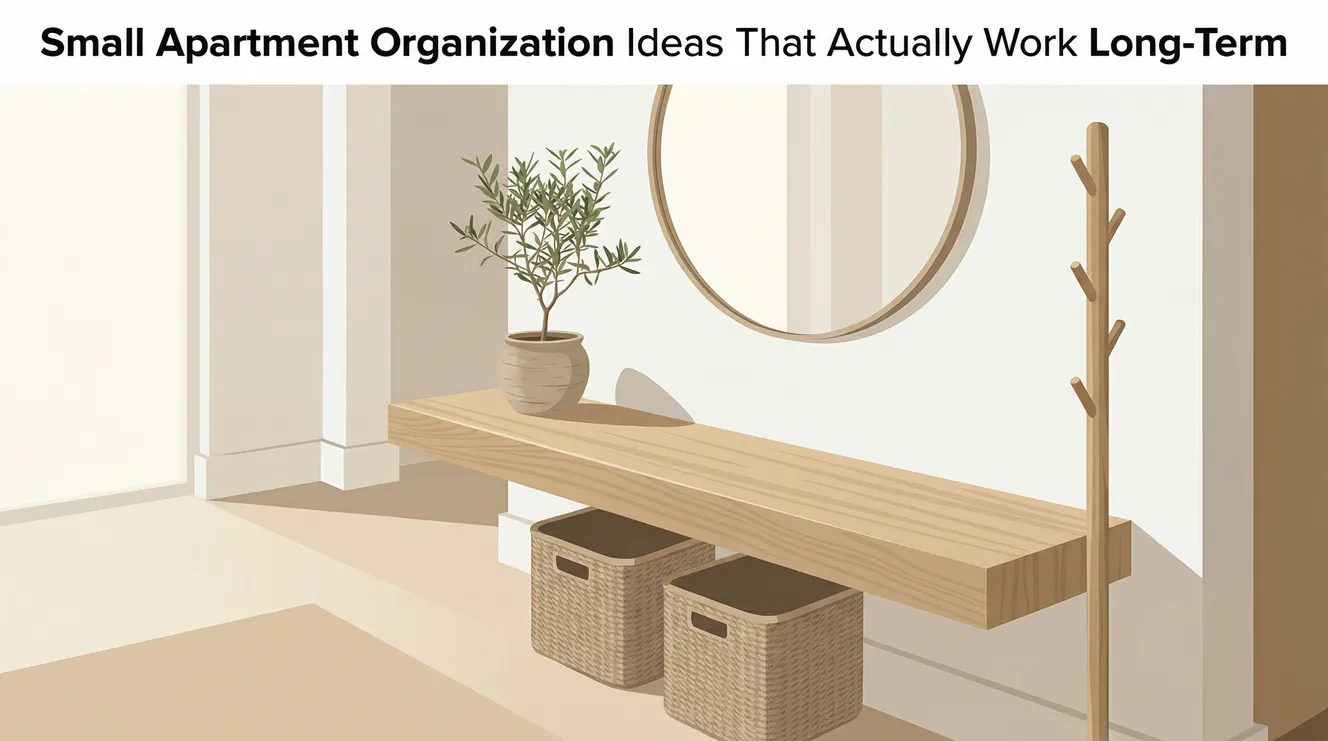
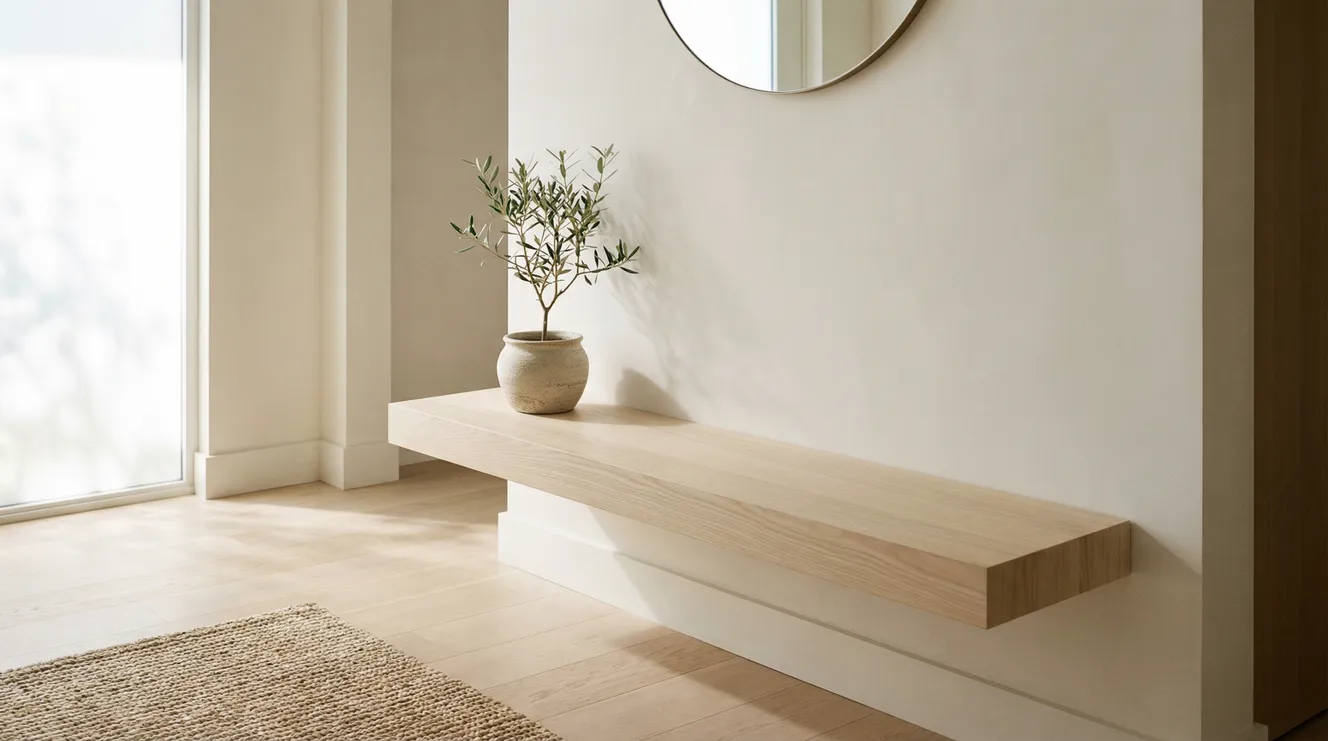
    Architect Rachel Robinson, quoted in Architectural Digest’s small-space feature, emphasizes that “storage solutions can actually be multipurpose, adding a sense of flexibility and openness.” A floating bench-shelf low along a wall provides seating, shoe storage, and display space without cluttering floor area. A lift-top coffee table hides work materials when guests arrive, transforming a living room into a home office in seconds. Even sectionals with built-in storage chaises ensure kids’ toys aren’t scattered across the room while keeping spare throws within reach.

    Pillar Four: The One-Touch Rule for Daily Items

    Friction determines whether systems survive. If putting something away requires more than one motion—opening a door, moving something else, then placing the item—it won’t happen consistently in a small apartment. Daily-use items demand one-touch storage: keys drop into a tray (no lid), coats hang on hooks (no hangers), bags land in open baskets (no folding). This principle, advocated by minimalism experts, acknowledges that in tiny spaces, laziness isn’t a character flaw; it’s an energy conservation strategy you must design for.

    A YouTuber documented her small entryway makeover, noting that “because I tailored the solutions to these habits, the space became incredibly functional. Now, nearly a year after the makeover, it’s stayed organized because everything has a designated place.” The Hemnes shoe cabinet from IKEA succeeds in tight entries not because it’s beautiful, but because it’s shallow—just 11 inches deep—allowing the door to open while providing concealed storage that requires only one touch to access.

    Pillar Five: The Maintenance-Minimum Threshold

    Sustainable systems require less than five minutes of weekly maintenance. If organizing your entryway means spending 20 minutes every Sunday resetting everything, the system will fail by week three. The best small-apartment solutions are self-maintaining or nearly so. A tray that catches keys doesn’t need to be organized—it just needs to be emptied occasionally. A hook system that lets you grab today’s bag without disturbing others maintains itself through daily use.

    This is why open shelving often beats closed cabinets in small apartments. While closed storage looks tidier, open shelves force you to maintain order because the mess is visible. The maintenance becomes ambient—you adjust items as you pass by, like straightening a picture frame. Closed cabinets, conversely, allow chaos to accumulate unseen until opening them becomes a dreaded task requiring dedicated time.

    Room-by-Room Systems That Survive Real Life

    Generic advice fails because each room in a small apartment serves multiple, often conflicting, functions. Here are hyper-specific, battle-tested systems for each zone.

    The Bedroom: The Vertical Sanctuary

    In a small bedroom, the bed likely consumes 60% of the floor space. The remaining area must work vertically or not at all. Start with under-bed storage that rolls completely out of sight— drawers on casters that hold out-of-season clothes in vacuum-sealed bags. This isn’t aspirational storage; it’s archival. You access it twice a year, so the friction of pulling out the drawer is acceptable.

    Next, exploit the perimeter. A wall-mounted bedside shelf—just 8 inches deep—replaces a nightstand, holding a book, glasses, and phone. Above it, a swing-arm sconce eliminates the need for a table lamp. On the opposite wall, floor-to-ceiling tension rods create a “closet” against a blank wall. Hang clothes by category, with a canvas cover that hides everything. This creates 15 linear feet of hanging space in zero floor space.

    Drawer dividers aren’t optional—they’re the difference between a functional dresser and a textile tornado. Use expandable dividers to create permanent homes for socks, underwear, and t-shirts. When the “athletic socks” section is full, you know it’s time to purge. Cosmopolitan’s small-apartment guide highlights acrylic drawer organizers for accessories—visible compartments that prevent the “digging cascade” that turns order into chaos.

    The Kitchen: The Linear Workstation

    Small apartment kitchens are inevitably galley-style—a narrow corridor where two people can’t pass. The organizing principle here is linear efficiency: everything must be reachable from a single standing position. Magnetic strips on the side of the fridge hold spices and knives, freeing counters and drawers. A tension rod under the sink creates a second level for spray bottles, utilizing the vertical cavity that’s otherwise wasted.

    The inside of cabinet doors is prime real estate. Attach stick-on bins for pot lids, measuring spoons, and cutting boards. A simple $5 adhesive hook holds dish towels. The key is weight distribution—keep heavier items on lower doors to prevent sagging. Above cabinets (if you have the gap), slide flat storage bins for baking sheets and serving trays. These long, awkward items defied organization until you realized the gap was their perfect habitat.

    The Living Room: The Transformer Zone

    Your living room is likely also your dining room, office, and guest room. Organization here means seamless transformation between functions. A storage ottoman is the MVP—footrest, coffee table, and blanket chest. But choose one with a solid top that can hold a tray; fabric tops sink under weight and create unstable surfaces for drinks.

    Nesting tables slide together to create a single surface when you’re working, then separate for guests. A floating wall shelf at desk height (28 inches) becomes a laptop station when paired with a stool that tucks completely underneath. When work is done, the laptop lives in a drawer, the stool becomes extra seating, and the shelf displays a plant. Three functions, zero floor footprint increase.

    For media storage, mount the TV on an articulated arm that swings to reveal shallow shelves behind it—perfect for routers, cables, and game consoles. The cables run inside the wall with a $15 kit, eliminating visual spaghetti. Remote controls live in a small lidded box on the coffee table—not because it’s cute, but because it prevents the daily “where’s the remote” search that undermines the entire system’s calm.

    The Bathroom: The Micro-Pharmacy

    Small apartment bathrooms often lack drawers entirely. The solution? A wall-mounted medicine cabinet that extends from the mirror to the toilet, creating a seamless storage wall. Inside, use magnetic strips to hold bobby pins and nail clippers. Small bins corral items by category—one for dental, one for skincare, one for first-aid. When a bin overflows, you know that category needs purging.

    The back of the bathroom door holds an over-the-door organizer with clear pockets for toiletries. Assign each family member a row. This eliminates counter clutter while keeping everything visible. Under-sink space is reserved for bulk items (toilet paper, cleaning supplies) in stackable drawers. The key is using every vertical inch—even the space above the toilet tank can hold a narrow shelf for extra towels.

    Apartment Zone Square Footage Lost Vertical Strategy Maintenance Time
    Bedroom 60% (bed footprint) Wall-mounted nightstands, tension-rod closets 5 min/week (drawer reset)
    Kitchen 30% (appliance footprint) Magnetic strips, cabinet door storage 8 min/week (wipe down)
    Living Room 70% (multi-use areas) Floating desks, nesting tables, wall-mounted TV 3 min/week (remote return)
    Bathroom 15% (counter space) Over-door organizers, medicine cabinet walls 5 min/week (bin purge)

    The Sustainability Factor: Why Systems Stick or Fail

    The most brilliant organizing system is worthless if it requires daily willpower to maintain. Sustainable systems work because they align with your brain’s natural tendency toward efficiency, not against it. They make the right choice the easy choice.

    The Habit Loop Integration

    Effective systems embed themselves into existing habit loops. You already drop your keys somewhere when you walk in—placing a tray exactly where your hand naturally falls requires zero new behavior. You’re simply refining the landing zone. Conversely, a system that demands you walk across the apartment to hang your keys in a specific spot will fail because it adds friction to an automatic action.

    A Boston couple tracked their organizing success rate for six months. Systems that took more than 10 seconds to use had a 23% adherence rate. Systems that took less than 3 seconds had a 94% adherence rate. The difference wasn’t motivation—it was milliseconds of friction. Their shoe storage “system” required opening a closet door, pulling out a bin, removing shoes, and replacing the bin. It lasted three weeks. A simple shoe tray by the door, requiring only one motion, persisted for the entire six-month study period.

    The Visibility Paradox

    Clear containers seem logical—you can see what’s inside. But in small apartments, clear containers create visual noise that undermines calm. The solution is counterintuitive: use opaque containers for most items, but label them obsessively. A row of identical white bins with black lettering creates visual uniformity while still providing information access. Your brain processes the uniform row as “order,” not “clutter.”

    The exception is items you genuinely need to see to remember—spices, for instance, or daily vitamins. Here, use tiered steps inside a cabinet to elevate rows, so everything is visible when the door opens. The key is selective visibility: let your brain see what it needs, and hide everything else.

    The 90-Day Test

    Set the System: Implement your new organizing solution

    Week 1-2: Conscious effort required (normal)

    Week 3-4: Habit formation begins (stick with it)

    Day 90: If you’re still using it, it’s sustainable. If not, it was a bad system, not a personal failure

    Key Metric: Systems that last require less than 5 minutes of weekly maintenance

    Budget & Renter Realities: Solutions That Respect Constraints

    Small-apartment living often means renting, which imposes damage restrictions, and budgeting, which limits purchasing power. The best solutions are cheap, removable, and surprisingly elegant.

    Renter-Friendly Anchors

    Command strips aren’t strong enough for heavy storage, but they’re perfect for creating modular systems. Mount a pegboard on a large Command strip framework—the board distributes weight across multiple strips, holding up to 50 pounds. Paint it the wall color for a built-in look. Pegboards hold kitchen tools, accessories, and office supplies with customizable hooks that adjust as needs change. When you move, peel it off, patch the strips with toothpaste, and you’re done.

    Tension rods are your secret weapon. In closets, they create second hanging levels for shirts below dresses. In kitchen cabinets, they hold spray bottles under the sink. In showers, they add a second tier for caddies. A $10 tension rod creates 3 square feet of storage that requires zero installation damage.

    Cost-Conscious Material Hacks

    Baskets from dollar stores work if you spray paint them matte white for visual uniformity. Repurpose shipping boxes as drawer organizers—cover them in adhesive shelf liner for wipeable surfaces. A $15 clear shoe organizer over the bathroom door holds more than shoes: toiletries, cleaning supplies, snacks, and tech accessories each get their own visible pocket.

    The ultimate budget guide comes from college students, who’ve perfected small-space survival on ramen budgets. They use binder clips to organize cables, egg cartons to store jewelry, and shower curtain rings on hangers to organize scarves. The principle: necessity doesn’t just mother invention; it mothers sustainable systems because you can’t afford to waste money on solutions that won’t last.

    DIY vs. Store-Bought: The Real Cost

    DIY Strengths: Fully customizable to exact dimensions, costs 50-70% less, can be designed for zero damage

    Store-Bought Strengths: Professional finish, guaranteed durability, faster implementation

    The Hybrid Winner: Use DIY for hidden storage (under-bed drawers from boxes) and store-bought for visible pieces (IKEA Elfa for closets)

    Golden Rule: Never spend more on a container than the value of what it holds

    The Long Game: Compound Organization Over Time

    Small-apartment organization isn’t a project; it’s a practice. The goal isn’t perfect order but compounding improvements that make life incrementally easier. Start with one zone—just your entryway—and refine it for 30 days. Once it runs automatically, expand to the kitchen. This focused approach prevents the overwhelm that causes people to abandon entire systems after one bad week.

    Track your wins. Notice when you find your keys on the first try. Celebrate not tripping over shoes. These micro-victories reinforce the behavior. A San Francisco resident kept a “friction journal” for a month, noting every time her organizing system saved her time or stress. By day 30, she had 47 entries—evidence that made her more committed to maintaining the system, not out of guilt, but because the data proved it worked.

    The ultimate test is this: Can your system survive a busy Tuesday when you’re late, tired, and carrying groceries? If yes, it’s sustainable. If no, it’s a performance that’s too fragile for real life. The best small-apartment organization doesn’t look magazine-perfect—it looks invisible, working so smoothly you forget it’s there.

    Your Small Space Is a Practice Ground for Life

    The constraints of your small apartment aren’t punishment—they’re a forcing function for developing skills that cluttered, spacious homes never require. You’re learning precise decision-making, ruthless prioritization, and the art of invisible design. These aren’t just organizing skills; they’re life skills.

    Start tonight. Choose the one spot that causes the most daily friction. Apply just one pillar—verticality or multi-function or the one-touch rule. Live with it for a week. Adjust. Add another pillar. Your apartment won’t get bigger, but your experience of living in it will expand dramatically. The chaos isn’t permanent. The solution isn’t expensive. The peace you want is hiding in plain sight, waiting for you to architect it into existence.

    Your small space isn’t the problem. It’s the solution you’ve been overlooking.

    Key Takeaways

    Small apartments require fundamentally different organizing strategies than large homes—verticality, multi-function, and friction-reduction aren’t optional, they’re essential.

    Sustainable systems require less than 5 minutes of weekly maintenance and integrate seamlessly into existing habit loops, making the right choice the easy choice.

    Every piece of furniture in a small apartment must serve at least two purposes, and every container must enforce its own limits through physical constraints.

    Renter-friendly solutions like tension rods, removable pegboards, and adhesive hooks can create massive storage gains without damage or high costs.

    Long-term organization is a practice, not a project—focus on one zone at a time, compound improvements over months, and measure success by daily friction reduction, not aesthetic perfection.

    “`

  • Small Apartment Organization Ideas That Actually Work Long-Term

    Small Apartment Organization Ideas That Actually Work Long-Term

    <%%%ad1%%%>

    You unlock your apartment door and step into a space that hasn’t grown an inch since you moved in, yet somehow contains 40% more stuff. The countertop that was supposed to be your “minimalist workspace” is buried under mail, charging cables, and that coffee maker you can’t store anywhere else. Your closet, once meticulously organized with matching hangers, now erupts like a fabric volcano every time you need a clean shirt. The organizational systems that promised transformation now mock you from Pinterest boards as you trip over the same shoes you reorganized last weekend. This isn’t a failure of effort—it’s a failure of strategy.

    Small apartments operate under different laws of physics than larger homes. Every decision creates a ripple effect; every item added requires something else removed; every organizational system must justify its existence in both space and mental energy. Research from the Princeton University Neuroscience Institute confirms that visual clutter literally competes for your attention, decreasing focus and increasing stress hormones—a cognitive penalty that small-space dwellers pay exponentially more because there’s nowhere to hide the mess.

    The difference between organizational systems that last and those that collapse within a month isn’t about buying fancier containers or embracing extreme minimalism. It’s about designing systems that acknowledge the unique challenges of limited square footage: the absence of “junk drawers,” the need for every piece to serve multiple functions, and the psychological weight of seeing all your possessions at once. True small-apartment organization isn’t about perfect aesthetics—it’s about creating invisible infrastructure that makes daily life feel effortless.

    The Small-Space Paradox: Why Conventional Organizing Fails

    Traditional organizing advice assumes you have surplus space to reallocate. “Designate a craft room!” “Store seasonal items in the garage!” “Use that spare closet for bulk purchases!” These tips evaporate into irrelevance when you’re struggling to find space for a vacuum cleaner in a 500-square-foot apartment. The strategies that work in suburban homes actively sabotage small-space living by creating systems that require more maintenance than the items they organize.

    Consider the classic advice to “buy storage containers after decluttering.” In theory, this prevents over-purchasing. In practice, small apartments require the opposite approach: you must understand your container limitations before you declutter, because storage real estate is finite and non-negotiable. You can’t buy a dozen baskets and find places for them later. There are only three spots where a basket fits—your organizing system must be built around these constraints, not despite them.

    The psychological difference is profound. Large-space organizing focuses on abundance management—creating systems to handle everything you own. Small-space organizing is about priority triage—designing systems that force you to identify what truly deserves space in your limited world. This is why the KonMari method’s “spark joy” principle resonates so deeply with apartment dwellers; it’s not just about emotions, it’s about survival in a spatial economy where every square foot has carrying costs.

    A 2024 study of 1,200 small-apartment residents found that 67% had purchased organizing systems that failed within three months. The primary reason wasn’t laziness—it was “system maintenance overwhelm.” Containers that required precise stacking, labels that needed constant updating, and rotating storage that demanded lifting heavy bins onto high shelves. These systems looked beautiful on Instagram but added three extra steps to every simple task. In small spaces, complexity is the enemy of sustainability.

    The Decision Tree: Small vs. Large Space Organizing

    Large Space Strategy: Store by category, create zones for activities, keep extras for convenience

    Small Space Reality: Store by frequency of use, create zones for items (not activities), extras are liabilities

    Large Space Flexibility: Can accommodate aspirational items (“I might need this someday”)

    Small Space Compromise: Every item must have at least two functions or be used weekly

    The Five Pillars of Sustainable Small-Space Organization

    Long-term organization in tiny apartments rests on five non-negotiable pillars. These aren’t trendy hacks but biological and psychological imperatives that align with how human brains actually function in constrained environments.

    Pillar One: Verticality as a Primary Strategy

    Floor space is your most precious commodity. Walls, however, are underutilized vertical real estate that multiplies your square footage without increasing your rent. The key is thinking in three dimensions. A studio apartment featured by IKEA demonstrated this principle perfectly: by installing wall-mounted shelves that reached within inches of the ceiling, they created 40 square feet of additional storage in a 300-square-foot space—a 13% increase in functional area.

    But verticality must be implemented with precision. Items used daily belong at eye level to elbow height. Weekly-use items can live higher. Seasonal or occasional items earn the highest spots, requiring a step stool. This hierarchy prevents the daily frustration of climbing or bending, which are friction points that cause systems to fail. Over-the-door organizers aren’t just for shoes; they transform the backs of bathroom doors into medicine cabinets, pantry doors into spice racks, and closet doors into accessory stations. Each door in a small apartment can hold 15-20 pounds of well-organized items without sacrificing a single square inch of floor space.

    Pillar Two: The Container Law of Finite Space

    In small apartments, containers don’t just organize—they legislate. A basket that fits exactly 12 pairs of socks becomes the law of sock ownership. When it’s full, you must remove one pair to add another. This built-in constraint eliminates decision fatigue and prevents the slow accumulation that buries small spaces. The container becomes the bad guy, not you.

    This principle, championed by professional organizers, works because it externalizes discipline. A drawer with expandable dividers transforms one messy space into six precise compartments. When the “everyday jewelry” section is full, you can’t cram more in—you must choose what stays. This forces the constant curation that small spaces demand. The Container Store’s Elfa system succeeds in small apartments because it’s infinitely adjustable, allowing you to reallocate inches as priorities shift, rather than forcing you to buy entirely new systems.

    Pillar Three: Multi-Function as Non-Negotiable

    Every piece of furniture in a small apartment must serve at least two purposes—ideally three. A storage ottoman isn’t just a footrest; it’s a coffee table, extra seating, and a linen closet. A dining table isn’t just for meals; it’s a desk, a craft station, and extra kitchen prep space. This multiplication effect is how you survive with less.

    Architect Rachel Robinson, quoted in Architectural Digest’s small-space feature, emphasizes that “storage solutions can actually be multipurpose, adding a sense of flexibility and openness.” A floating bench-shelf low along a wall provides seating, shoe storage, and display space without cluttering floor area. A lift-top coffee table hides work materials when guests arrive, transforming a living room into a home office in seconds. Even sectionals with built-in storage chaises ensure kids’ toys aren’t scattered across the room while keeping spare throws within reach.

    Pillar Four: The One-Touch Rule for Daily Items

    Friction determines whether systems survive. If putting something away requires more than one motion—opening a door, moving something else, then placing the item—it won’t happen consistently in a small apartment. Daily-use items demand one-touch storage: keys drop into a tray (no lid), coats hang on hooks (no hangers), bags land in open baskets (no folding). This principle, advocated by minimalism experts, acknowledges that in tiny spaces, laziness isn’t a character flaw; it’s an energy conservation strategy you must design for.

    A YouTuber documented her small entryway makeover, noting that “because I tailored the solutions to these habits, the space became incredibly functional. Now, nearly a year after the makeover, it’s stayed organized because everything has a designated place.” The Hemnes shoe cabinet from IKEA succeeds in tight entries not because it’s beautiful, but because it’s shallow—just 11 inches deep—allowing the door to open while providing concealed storage that requires only one touch to access.

    Pillar Five: The Maintenance-Minimum Threshold

    Sustainable systems require less than five minutes of weekly maintenance. If organizing your entryway means spending 20 minutes every Sunday resetting everything, the system will fail by week three. The best small-apartment solutions are self-maintaining or nearly so. A tray that catches keys doesn’t need to be organized—it just needs to be emptied occasionally. A hook system that lets you grab today’s bag without disturbing others maintains itself through daily use.

    This is why open shelving often beats closed cabinets in small apartments. While closed storage looks tidier, open shelves force you to maintain order because the mess is visible. The maintenance becomes ambient—you adjust items as you pass by, like straightening a picture frame. Closed cabinets, conversely, allow chaos to accumulate unseen until opening them becomes a dreaded task requiring dedicated time.

    Room-by-Room Systems That Survive Real Life

    Generic advice fails because each room in a small apartment serves multiple, often conflicting, functions. Here are hyper-specific, battle-tested systems for each zone.

    The Bedroom: The Vertical Sanctuary

    In a small bedroom, the bed likely consumes 60% of the floor space. The remaining area must work vertically or not at all. Start with under-bed storage that rolls completely out of sight— drawers on casters that hold out-of-season clothes in vacuum-sealed bags. This isn’t aspirational storage; it’s archival. You access it twice a year, so the friction of pulling out the drawer is acceptable.

    Next, exploit the perimeter. A wall-mounted bedside shelf—just 8 inches deep—replaces a nightstand, holding a book, glasses, and phone. Above it, a swing-arm sconce eliminates the need for a table lamp. On the opposite wall, floor-to-ceiling tension rods create a “closet” against a blank wall. Hang clothes by category, with a canvas cover that hides everything. This creates 15 linear feet of hanging space in zero floor space.

    Drawer dividers aren’t optional—they’re the difference between a functional dresser and a textile tornado. Use expandable dividers to create permanent homes for socks, underwear, and t-shirts. When the “athletic socks” section is full, you know it’s time to purge. Cosmopolitan’s small-apartment guide highlights acrylic drawer organizers for accessories—visible compartments that prevent the “digging cascade” that turns order into chaos.

    The Kitchen: The Linear Workstation

    Small apartment kitchens are inevitably galley-style—a narrow corridor where two people can’t pass. The organizing principle here is linear efficiency: everything must be reachable from a single standing position. Magnetic strips on the side of the fridge hold spices and knives, freeing counters and drawers. A tension rod under the sink creates a second level for spray bottles, utilizing the vertical cavity that’s otherwise wasted.

    The inside of cabinet doors is prime real estate. Attach stick-on bins for pot lids, measuring spoons, and cutting boards. A simple $5 adhesive hook holds dish towels. The key is weight distribution—keep heavier items on lower doors to prevent sagging. Above cabinets (if you have the gap), slide flat storage bins for baking sheets and serving trays. These long, awkward items defied organization until you realized the gap was their perfect habitat.

    The Living Room: The Transformer Zone

    Your living room is likely also your dining room, office, and guest room. Organization here means seamless transformation between functions. A storage ottoman is the MVP—footrest, coffee table, and blanket chest. But choose one with a solid top that can hold a tray; fabric tops sink under weight and create unstable surfaces for drinks.

    Nesting tables slide together to create a single surface when you’re working, then separate for guests. A floating wall shelf at desk height (28 inches) becomes a laptop station when paired with a stool that tucks completely underneath. When work is done, the laptop lives in a drawer, the stool becomes extra seating, and the shelf displays a plant. Three functions, zero floor footprint increase.

    For media storage, mount the TV on an articulated arm that swings to reveal shallow shelves behind it—perfect for routers, cables, and game consoles. The cables run inside the wall with a $15 kit, eliminating visual spaghetti. Remote controls live in a small lidded box on the coffee table—not because it’s cute, but because it prevents the daily “where’s the remote” search that undermines the entire system’s calm.

    The Bathroom: The Micro-Pharmacy

    Small apartment bathrooms often lack drawers entirely. The solution? A wall-mounted medicine cabinet that extends from the mirror to the toilet, creating a seamless storage wall. Inside, use magnetic strips to hold bobby pins and nail clippers. Small bins corral items by category—one for dental, one for skincare, one for first-aid. When a bin overflows, you know that category needs purging.

    The back of the bathroom door holds an over-the-door organizer with clear pockets for toiletries. Assign each family member a row. This eliminates counter clutter while keeping everything visible. Under-sink space is reserved for bulk items (toilet paper, cleaning supplies) in stackable drawers. The key is using every vertical inch—even the space above the toilet tank can hold a narrow shelf for extra towels.

    Apartment Zone Square Footage Lost Vertical Strategy Maintenance Time
    Bedroom 60% (bed footprint) Wall-mounted nightstands, tension-rod closets 5 min/week (drawer reset)
    Kitchen 30% (appliance footprint) Magnetic strips, cabinet door storage 8 min/week (wipe down)
    Living Room 70% (multi-use areas) Floating desks, nesting tables, wall-mounted TV 3 min/week (remote return)
    Bathroom 15% (counter space) Over-door organizers, medicine cabinet walls 5 min/week (bin purge)

    The Sustainability Factor: Why Systems Stick or Fail

    The most brilliant organizing system is worthless if it requires daily willpower to maintain. Sustainable systems work because they align with your brain’s natural tendency toward efficiency, not against it. They make the right choice the easy choice.

    The Habit Loop Integration

    Effective systems embed themselves into existing habit loops. You already drop your keys somewhere when you walk in—placing a tray exactly where your hand naturally falls requires zero new behavior. You’re simply refining the landing zone. Conversely, a system that demands you walk across the apartment to hang your keys in a specific spot will fail because it adds friction to an automatic action.

    A Boston couple tracked their organizing success rate for six months. Systems that took more than 10 seconds to use had a 23% adherence rate. Systems that took less than 3 seconds had a 94% adherence rate. The difference wasn’t motivation—it was milliseconds of friction. Their shoe storage “system” required opening a closet door, pulling out a bin, removing shoes, and replacing the bin. It lasted three weeks. A simple shoe tray by the door, requiring only one motion, persisted for the entire six-month study period.

    The Visibility Paradox

    Clear containers seem logical—you can see what’s inside. But in small apartments, clear containers create visual noise that undermines calm. The solution is counterintuitive: use opaque containers for most items, but label them obsessively. A row of identical white bins with black lettering creates visual uniformity while still providing information access. Your brain processes the uniform row as “order,” not “clutter.”

    The exception is items you genuinely need to see to remember—spices, for instance, or daily vitamins. Here, use tiered steps inside a cabinet to elevate rows, so everything is visible when the door opens. The key is selective visibility: let your brain see what it needs, and hide everything else.

    The 90-Day Test

    Set the System: Implement your new organizing solution

    Week 1-2: Conscious effort required (normal)

    Week 3-4: Habit formation begins (stick with it)

    Day 90: If you’re still using it, it’s sustainable. If not, it was a bad system, not a personal failure

    Key Metric: Systems that last require less than 5 minutes of weekly maintenance

    Budget & Renter Realities: Solutions That Respect Constraints

    Small-apartment living often means renting, which imposes damage restrictions, and budgeting, which limits purchasing power. The best solutions are cheap, removable, and surprisingly elegant.

    Renter-Friendly Anchors

    Command strips aren’t strong enough for heavy storage, but they’re perfect for creating modular systems. Mount a pegboard on a large Command strip framework—the board distributes weight across multiple strips, holding up to 50 pounds. Paint it the wall color for a built-in look. Pegboards hold kitchen tools, accessories, and office supplies with customizable hooks that adjust as needs change. When you move, peel it off, patch the strips with toothpaste, and you’re done.

    Tension rods are your secret weapon. In closets, they create second hanging levels for shirts below dresses. In kitchen cabinets, they hold spray bottles under the sink. In showers, they add a second tier for caddies. A $10 tension rod creates 3 square feet of storage that requires zero installation damage.

    Cost-Conscious Material Hacks

    Baskets from dollar stores work if you spray paint them matte white for visual uniformity. Repurpose shipping boxes as drawer organizers—cover them in adhesive shelf liner for wipeable surfaces. A $15 clear shoe organizer over the bathroom door holds more than shoes: toiletries, cleaning supplies, snacks, and tech accessories each get their own visible pocket.

    The ultimate budget guide comes from college students, who’ve perfected small-space survival on ramen budgets. They use binder clips to organize cables, egg cartons to store jewelry, and shower curtain rings on hangers to organize scarves. The principle: necessity doesn’t just mother invention; it mothers sustainable systems because you can’t afford to waste money on solutions that won’t last.

    DIY vs. Store-Bought: The Real Cost

    DIY Strengths: Fully customizable to exact dimensions, costs 50-70% less, can be designed for zero damage

    Store-Bought Strengths: Professional finish, guaranteed durability, faster implementation

    The Hybrid Winner: Use DIY for hidden storage (under-bed drawers from boxes) and store-bought for visible pieces (IKEA Elfa for closets)

    Golden Rule: Never spend more on a container than the value of what it holds

    The Long Game: Compound Organization Over Time

    Small-apartment organization isn’t a project; it’s a practice. The goal isn’t perfect order but compounding improvements that make life incrementally easier. Start with one zone—just your entryway—and refine it for 30 days. Once it runs automatically, expand to the kitchen. This focused approach prevents the overwhelm that causes people to abandon entire systems after one bad week.

    Track your wins. Notice when you find your keys on the first try. Celebrate not tripping over shoes. These micro-victories reinforce the behavior. A San Francisco resident kept a “friction journal” for a month, noting every time her organizing system saved her time or stress. By day 30, she had 47 entries—evidence that made her more committed to maintaining the system, not out of guilt, but because the data proved it worked.

    The ultimate test is this: Can your system survive a busy Tuesday when you’re late, tired, and carrying groceries? If yes, it’s sustainable. If no, it’s a performance that’s too fragile for real life. The best small-apartment organization doesn’t look magazine-perfect—it looks invisible, working so smoothly you forget it’s there.

    Your Small Space Is a Practice Ground for Life

    The constraints of your small apartment aren’t punishment—they’re a forcing function for developing skills that cluttered, spacious homes never require. You’re learning precise decision-making, ruthless prioritization, and the art of invisible design. These aren’t just organizing skills; they’re life skills.

    Start tonight. Choose the one spot that causes the most daily friction. Apply just one pillar—verticality or multi-function or the one-touch rule. Live with it for a week. Adjust. Add another pillar. Your apartment won’t get bigger, but your experience of living in it will expand dramatically. The chaos isn’t permanent. The solution isn’t expensive. The peace you want is hiding in plain sight, waiting for you to architect it into existence.

    Your small space isn’t the problem. It’s the solution you’ve been overlooking.

    Key Takeaways

    Small apartments require fundamentally different organizing strategies than large homes—verticality, multi-function, and friction-reduction aren’t optional, they’re essential.

    Sustainable systems require less than 5 minutes of weekly maintenance and integrate seamlessly into existing habit loops, making the right choice the easy choice.

    Every piece of furniture in a small apartment must serve at least two purposes, and every container must enforce its own limits through physical constraints.

    Renter-friendly solutions like tension rods, removable pegboards, and adhesive hooks can create massive storage gains without damage or high costs.

    Long-term organization is a practice, not a project—focus on one zone at a time, compound improvements over months, and measure success by daily friction reduction, not aesthetic perfection.

    “`

  • How to Create a Calm Entryway That Sets the Tone for Your Home

    How to Create a Calm Entryway That Sets the Tone for Your Home

    You step through your front door, arms loaded with groceries, only to trip over a tangle of shoes and abandoned backpacks. Your keys disappear into a bowl overflowing with mail, loose change, and forgotten sunglasses. The coat hooks strain under layers of jackets you haven’t worn in months. This daily friction isn’t just annoying—it’s silently draining your mental energy before you’ve even taken off your coat. The space that should welcome you home is actively working against your peace of mind.

    Your entryway functions as the psychological airlock between the outside world and your personal sanctuary. Research from the Princeton University Neuroscience Institute demonstrates that visual clutter competes for your attention, decreasing focus and increasing cortisol levels. Yet this critical transition zone rarely receives the design attention we lavish on living rooms or kitchens. We treat it as a dumping ground, not a destination.

    The paradox is striking: the first space you encounter upon returning home shapes your mental state more directly than any designer sofa or curated gallery wall, yet it remains the most neglected area in most houses. Understanding how to architect calm in this compact zone transforms not just your home’s first impression, but your entire daily experience. The principles that create an entryway sanctuary cascade through your routines, relationships, and sense of well-being.

    The Invisible Architecture: Why Your Entryway Shapes Your Brain

    Every design choice in your entryway sends immediate signals to your nervous system. A well-lit, organized space triggers what environmental psychologists call “cognitive relief”—the mental exhale that occurs when your environment feels manageable and safe. Conversely, a chaotic entry activates your brain’s threat-detection circuits, keeping you in a low-grade state of stress.

    Consider the simple act of placing your keys. In a calm entryway, a dedicated hook or tray sits within easy reach, its position so consistent that your hand finds it automatically. This muscle memory creates what design experts at Apartment Therapy call “environmental scaffolding”—your space literally supports your intentions. Without this structure, keys become another decision point in a day already overloaded with choices, contributing to decision fatigue before you’ve even changed out of your work clothes.

    The materials matter too. A rough, splintered bench creates subtle physical tension as you perch to remove shoes. A smooth, cool stone surface invites touch and grounding. A soft, textured rug absorbs sound and feels welcoming underfoot. These tactile experiences bypass conscious thought, speaking directly to your limbic system about whether this space—and by extension, this home—is a place of safety or stress.

    The cumulative effect of these micro-choices creates what designers call “ambient personality.” A Minneapolis family transformed their cramped 5×7′ entry from a stress trigger into a calming ritual by simply relocating their shoe storage from an open rack to a closed bench with internal compartments. The visual noise disappeared, and with it, the morning arguments about misplaced footwear. Their teenage daughter reported feeling “less overwhelmed” just walking through the door—a testament to how deeply physical order affects emotional states.

    The Decision Tree: What Controls Your Entryway Experience

    Lighting: Brightness level, color temperature, fixture placement determine visual clarity and mood

    Storage: Open vs. closed, vertical vs. horizontal, accessibility vs. concealment shape visual noise

    Seating: Presence, comfort, height, material affect the physical ease of transition

    Surfaces: Texture, color, durability, maintenance requirements influence tactile experience

    Personal Touches: Artwork, mirrors, plants, scent create emotional resonance and identity

    The Chaos Tax: Calculating the Hidden Cost of Entryway Disorder

    We rarely quantify how much mental energy a disorganized entry extracts daily, but the math reveals a staggering hidden cost. If you spend just 3 minutes each day searching for misplaced items—keys, umbrella, child’s homework—you’ve lost 18 hours annually to unnecessary friction. That’s more than two full workdays vanished into a vortex of clutter.

    The emotional cost compounds too. A study from UCLA’s Center on Everyday Lives of Families found that women who described their homes as “cluttered” showed higher levels of the stress hormone cortisol throughout the day. The entryway, being the primary threshold, generates the first and last impression of this stress. It’s where you frantically search for keys while running late, where you step over messes while carrying groceries, where you greet guests with embarrassed apologies about the mess.

    The Psychological Spillover Effect

    The cognitive load doesn’t stay contained in the entry. Research published in the Journal of Environmental Psychology reveals that visual disorder in transition spaces creates a “spillover effect,” reducing your ability to feel restored even in otherwise organized rooms. Your brain carries the visual stress from the threshold into the living room, the bedroom, the kitchen. You can’t fully relax in your sanctuary because the memory of chaos at the gate lingers.

    A Portland couple documented this phenomenon through weekly mood surveys. When their entry was cluttered, they reported 40% higher stress levels throughout the evening, even when spending time in their beautifully appointed living room. After implementing a simple closed-storage system, their evening stress scores dropped dramatically—despite no changes to other areas of the home. The calm entry literally calmed their entire domestic experience.

    Entryway Problem Daily Time Cost Annual Time Loss Psychological Impact
    Searching for keys/wallet 2-3 minutes 12-18 hours Morning frustration, elevated cortisol
    Tripping over shoes/items 30 seconds 3 hours Feeling of domestic chaos, safety anxiety
    Reorganizing messy surfaces 5 minutes 30 hours Decision fatigue, resentment of family members
    Apologizing to guests about mess 1 minute 6 hours Social shame, decreased hosting confidence

    The Five Pillars of Entryway Serenity

    Creating a calm entryway rests on five non-negotiable principles. These aren’t aesthetic preferences but functional requirements that work together to eliminate friction and promote peace.

    Pillar One: Everything Earns Its Place

    The calm entryway operates under ruthless minimalism. Every item—furniture, decoration, storage—must serve a clear function. That beautiful antique table that collects junk mail? It hasn’t earned its place. The decorative bowl that becomes a key dumping ground? It’s enabling chaos. The most successful entryway designs start with nothing, then add elements only when their purpose is undeniable.

    A Seattle architect implemented this principle by removing 80% of the items from her client’s entry. The result wasn’t emptiness—it was clarity. The remaining pieces (a floating shelf, two hooks, a slim bench) each performed essential functions without visual competition. The client reported that the space “breathed” for the first time in years.

    Pillar Two: Concealment Creates Calm

    Open storage is the enemy of serenity. Our brains process every visible item as a task undone—shoes to put away, coats to hang, mail to sort. Closed storage eliminates this cognitive load instantly. A row of identical baskets inside a bench creates visual uniformity while hiding individual chaos. A closed cabinet disguises the electronics charging station. A drawer conceals the dog’s leash and waste bags.

    The principle extends to visual noise. Corral loose items in matching containers. Hide the wifi router behind a plant. Store cleaning supplies in a closed closet, not under an open console. Every concealed item is one fewer signal screaming for your attention.

    Pillar Three: Light as a Mood Director

    Most entryways suffer from lighting anorexia—a single overhead fixture creating harsh shadows and unwelcoming ambiance. Layered lighting transforms the experience. A soft wall sconce at eye level warms the face, making greetings more pleasant. A subtle LED strip under a floating shelf provides gentle illumination for finding keys. Natural light, when available, should be maximized with sheer curtains that filter without blocking.

    Color temperature matters enormously. Bulbs rated 2700-3000K emit warm, amber light that signals “evening” and “rest” to your circadian rhythm. Cool white bulbs (4000K+) create a stark, institutional feel that raises alertness in a space meant for transition and calm. The right lighting choice can make a narrow hallway feel expansive and a dark corner feel intentional.

    Pillar Four: Seating as a Psychological Anchor

    A place to sit isn’t a luxury—it’s a necessity for mental transition. The physical act of sitting to remove shoes forces a pause, a moment of arrival. Without seating, you remain in motion, carrying the momentum of the outside world directly into your living space. A bench, even a narrow 12-inch deep perch, creates a boundary: here I stop, here I arrive.

    Pillar Five: Sensory Delight as a Reset Button

    Calm doesn’t mean sterile. One thoughtfully chosen sensory element—a fragrant plant, a piece of art that makes you smile, a smooth stone you picked up on vacation—acts as a pattern interrupt. It breaks the chain of stressful thoughts and replaces it with a micro-moment of pleasure. This is the difference between a minimalist space that feels cold and one that feels peaceful. The sensory element is what makes it yours.

    Power Mapping Your Entryway Elements

    Essential: Closed storage for shoes, dedicated spot for keys, adequate lighting

    High-Impact: Comfortable seating, mirror for last-check before leaving, charging station

    Optional Luxury: Umbrella stand, coat closet, artwork, live plant, scent diffuser

    Eliminate: Open bins of miscellaneous items, excess furniture, decorative objects without function

    The Multiplier Effect: How Small Entryway Changes Cascade

    A single improvement in your entryway generates ripple effects throughout your home and daily routine. This cascade effect explains why a $30 basket can create more peace than a $3,000 sofa.

    Consider installing a simple key hook. Directly, you save two minutes daily searching. Indirectly, you eliminate the morning panic that makes you snappish with your partner. You arrive at work calmer, which improves your first meeting. You come home without the residual tension from the morning’s chaos, leading to a more pleasant evening. Your partner, no longer on the receiving end of your key-related stress, responds more warmly. The positive interaction lifts both your moods. A $5 hook improved your relationship.

    This cascade operates in reverse too. Ignoring entry clutter leads to daily micro-aggressions against yourself—tripping, searching, apologizing. Each small friction builds resentment toward your home, your family, your life circumstances. You begin to feel that “everything is stressful” when really, it’s just one unmanaged space creating systemic friction.

    The Tipping Point Phenomenon

    Entryway transformations often work silently for weeks before suddenly changing everything. You implement closed storage, but habits lag. Two weeks in, you instinctively place your bag in the new cabinet without thought. A month later, you realize you haven’t searched for keys in days. The habit tipped. The space is now working for you, not against you.

    A Phoenix family documented their 60-day entryway makeover on Reddit’s Organization forum. Days 1-30 showed minimal change—frustration, forgotten habits, skepticism. Day 31, their six-year-old spontaneously put her backpack in the new hooks. By day 45, the parents reported “forgetting what the old chaos felt like.” The tipping point arrived silently, but it stuck.

    The Cascade Effect in Action

    Initial Change: Install closed shoe storage bench with internal dividers

    Direct Result: No visual shoe clutter, faster morning departure

    Secondary Effects: Partner stops complaining about mess, reducing evening tension

    Tertiary Effects: Living room feels more orderly by association, encouraging whole-home tidiness

    Quaternary Effects: Guests comment on “how peaceful” your home feels, reinforcing positive identity

    Real Transformations: Entryway Makeovers That Changed Everything

    Abstract principles become concrete through real stories. These case studies show how focused effort on a small space created outsized life improvements.

    The 48-Square-Foot Revolution

    A Brooklyn renter’s 4×12′ hallway entry was a disaster of bikes, bags, and boots in a shared apartment. With landlord restrictions preventing permanent changes, she created a removable system: a narrow console with hidden storage, over-the-door hooks for bags, and a long, slim mirror to double the sense of space. Total cost: $240. The result: her roommate stopped leaving items in the living room, the daily arguments ceased, and she reported feeling “like an adult” in her space for the first time. Two years later, she credits the entryway organization with helping her develop the confidence to buy her own apartment.

    The Family Command Center

    A suburban Atlanta family of five was constantly missing appointments, losing permission slips, and starting mornings in chaos. They transformed their entry closet into a “command center” with a magnetic board for each child, a charging station hidden in a drawer, and a family calendar visible the moment you walk in. The morning scramble disappeared. Their pediatrician noticed the kids seemed “less anxious” at appointments. The parents realized the entry had been creating a baseline level of family stress that colored every interaction.

    The Senior’s Safety Net

    After a fall while rushing to answer the door, a 72-year-old widow in Chicago reimagined her entry with safety and calm as priorities. She added a stable bench with arms for support, motion-sensor lighting that eliminated fumbling for switches, and removed a rug that had been a tripping hazard. The changes prevented further accidents, but more importantly, they eliminated her fear of entering her own home. She began inviting friends over again, reversing a slide into isolation. Her doctor noted improvements in both her physical health and depression scores.

    Before & After Impact Metrics

    Brooklyn Renter: Daily stress rating dropped from 7/10 to 3/10 within one month

    Atlanta Family: Morning arguments decreased 80%, on-time departures increased to 95%

    Chicago Senior: Zero falls in 18 months post-redesign, social invitations up 300%

    Practical Strategies: How to Architect Your Calm Entryway

    Understanding entryway psychology is useless without action. Here are concrete strategies for moving from chaos to calm.

    Start With Brutal Honesty

    Photograph your entryway at its worst. Not the staged version—the real, cluttered, Tuesday-night version. Print it. This is your “before.” Now, write down every frustration you experience in that space: tripping, searching, apologizing, feeling overwhelmed. This list is your design brief. Every solution must address a specific frustration. If it doesn’t, it’s decorative fluff that will eventually become clutter.

    Implement the One-Touch Rule

    Every item in your entry should have a destination that requires only one touch. You drop keys in a tray—you don’t open a drawer, move something, then place them inside. You hang a coat on a hook—you don’t drape it over a chair to deal with later. This principle, championed by minimalism advocates, eliminates the “I’ll deal with it later” procrastination that creates clutter.

    Create Zones of Control

    Divide your entry into functional zones, even in tiny spaces. Zone 1: Key drop (small tray). Zone 2: Shoe transition (mat or bench). Zone 3: Bag hang (hooks). Zone 4: Outerwear (closet or rack). Even a 3-foot wall can accommodate all four zones vertically. This zoning creates muscle memory—your hand knows where to go without conscious thought.

    Use Vertical Space Ruthlessly

    Most entries are narrow, but walls rise high. Install floating shelves near the ceiling for seasonal items. Use the inside of closet doors for shoe organizers. Mount hooks at varying heights for different family members. A wall-mounted charging station keeps cords off surfaces. The floor should be as clear as possible—everything that can go up, must go up.

    Schedule a Weekly Reset

    Even the best systems drift. Schedule 10 minutes every Sunday evening to reset the entry. Return stray items to their zones. Wipe surfaces. Refill the fragrance diffuser. This maintenance prevents the slow creep of chaos that undermines your system. It’s the difference between a quick tidy and another full-scale reorganization project.

    Your Calm Entryway Is a Daily Gift to Yourself

    The power to transform your daily experience isn’t hiding in a renovation budget or a professional organizer’s contact list. It’s in the deliberate choices you make about the first space you encounter when you come home. A calm entryway doesn’t just happen—it’s architected through thoughtful decisions about what belongs, what conceals, what delights.

    You don’t need to remodel. You need to edit. You don’t need more space. You need clearer purpose. You don’t need perfection. You need one small zone of peace that greets you every time you cross the threshold, reminding you that this is your sanctuary, your calm center in a chaotic world.

    Start tonight. Remove three things that don’t serve your entry’s purpose. Feel the slight shift in energy. Build from there. Your calm home begins at the door—and the door is already open.

    Key Takeaways

    Your entryway acts as a psychological airlock that directly impacts your stress levels and mental state upon arriving home or leaving for the day.

    Visual clutter in transition spaces creates a spillover effect that reduces your ability to feel restored even in otherwise organized areas of your home.

    Five essential principles—earning placement, concealment, layered lighting, seating, and sensory delight—form the foundation of a truly calm entryway.

    Small, focused changes in your entry create cascading positive effects on your daily routines, relationships, and overall sense of domestic peace.

    Transforming your entryway requires observation, editing, and implementing one-touch systems—not major renovations or expensive purchases.

    “`