Category: Mindful Living & Simplicity

  • Finding Contentment With What You Have

    Finding Contentment With What You Have

    You scroll past your neighbor’s vacation photos—Maldives this time—and glance around your modest living room, suddenly dissatisfied. Your two-year-old car feels outdated next to your colleague’s new Tesla. Your kitchen remodel, once a source of pride, now seems inadequate compared to the magazine spreads. This creeping dissatisfaction arrives despite having everything you once dreamed of. The American Psychological Association’s research confirms that upward social comparison via social media reduces life satisfaction by 32%, even as our material standard of living surpasses any previous generation.

    Contentment isn’t the default state of human psychology—it’s a cultivated skill. Our brains are wired for dissatisfaction, a trait that served our ancestors well when survival depended on constant improvement. This “hedonic treadmill” keeps us chasing the next thing, convinced that happiness lies just one purchase, promotion, or achievement away. The classic study by Brickman and Campbell demonstrated that lottery winners and paraplegics return to baseline happiness levels within a year, proving that circumstances have far less impact than we imagine.

    The modern economy weaponizes this dissatisfaction. Marketing algorithms feed us an endless stream of targeted ads for things we didn’t know we needed. Influencers showcase lifestyles that feel just attainable enough to keep us striving. The result is a paradox: we have more than ever, yet feel perpetually lacking. Pew Research data shows that 65% of Americans believe they’d be happier if they owned more, despite decades of rising incomes and living standards.

    The Hedonic Treadmill: Why More Never Feels Like Enough

    The hedonic treadmill is psychology’s term for our tendency to quickly return to a stable level of happiness despite major positive or negative life changes. When you get a raise, you celebrate briefly, then adapt to the new income level and begin wanting more. When you upgrade your home, the initial thrill fades within months, and the size that once seemed luxurious becomes your new normal.

    This adaptation served an evolutionary purpose. A species satisfied with its current shelter, food supply, and safety wouldn’t survive changing environments. But in a world of abundance, it becomes a trap. Research from Sonja Lyubomirsky at UC Riverside shows that only 10% of happiness variance stems from life circumstances, while 40% comes from intentional activities and mindset. The remaining 50% is genetic predisposition—meaning you have significant control over your contentment, independent of possessions.

    The treadmill speeds up with each lap. Each new acquisition raises your reference point, making the next upgrade seem necessary rather than optional. A Journal of Consumer Research study found that people who frequently upgrade possessions experience lower long-term satisfaction than those who maintain and appreciate what they own. The problem isn’t what you have—it’s the mindset of perpetual upgrading.

    Three Treadmill Speeds: Where Dissatisfaction Accelerates

    • Social Media Velocity: Curated feeds show you the top 1% of lifestyles, raising your comparison baseline daily
    • Marketing Momentum: Targeted ads learn your desires and show you incrementally better versions of what you own
    • Lifestyle Creep: Each income increase gets absorbed by upgraded “necessities”—new normal feels like minimum

    The Comparison Trap: Why We Measure Downward and Still Lose

    Human brains are comparison engines. We don’t evaluate our circumstances in isolation—we measure them against reference points. The problem is that we unconsciously choose references that guarantee dissatisfaction. You compare your vacation to your friend’s Instagram-perfect trip, not to the billions who never travel. You measure your home against the remodeled kitchens on HGTV, not against the global median housing.

    Social media weaponizes this tendency. A 2022 APA study found that 38% of people felt worse about their own lives after viewing social media, even when they consciously knew the content was curated and unrealistic. The comparison happens automatically, bypassing rational awareness. Your brain sees the image and triggers an instant assessment: “I don’t have that,” which registers as “I’m lacking.”

    The antidote isn’t to stop comparing—it’s impossible to shut off this mental reflex. Instead, strategically choose your comparison points. The practice of downward comparison (noticing those with less) feels cynical but effectively shifts perspective. More powerfully, practice temporal comparison: measure your current self against your past self, not against others. This internal benchmark reveals genuine progress and cultivates self-referenced contentment that external circumstances can’t disrupt.

    The Reference Point Shift Exercise

    When you feel that pang of “not enough,” pause and identify your current comparison. Then consciously shift it: “My kitchen isn’t as modern as the renovation I saw, but it has running water and a refrigerator—something my great-grandmother couldn’t imagine.” This isn’t toxic positivity; it’s factual perspective that recalibrates your satisfaction set point. Research from Harvard Medical School’s gratitude research shows that consistent perspective-shifting exercises increase happiness more effectively than actual life improvements.

    Comparison Type Default Impact Strategic Shift Contentment Gain
    Upward Social Guaranteed dissatisfaction Temporal (compare to past self) ★★★★★
    Lateral Peer Competitive anxiety Downward (appreciate advantages) ★★★★☆
    Ideal Self Perpetual inadequacy Present-moment acceptance ★★★★★
    Marketing Fantasy Created needs Reality check (actual usage patterns) ★★★★☆

    The Gratitude Rewire: Training Your Brain for Contentment

    Gratitude isn’t just feel-good fluff—it’s a neurological intervention that physically rewires your brain’s satisfaction circuits. Regular gratitude practice strengthens neural pathways that recognize abundance rather than scarcity, gradually shifting your default perception from “not enough” to “enough.”

    The Greater Good Science Center at UC Berkeley conducted seminal research where participants wrote three gratitudes weekly for ten weeks. Compared to control groups, they reported 25% higher happiness levels and exercised 1.5 hours more per week. MRI scans showed increased gray matter density in the right inferior temporal gyrus, a region associated with processing positive emotions.

    The Specificity Principle

    Generic gratitude (“I’m grateful for my family”) has minimal effect. Specific gratitude (“I’m grateful my daughter shared her art project with me yesterday, and her pride in the glitter-glue rainbow”) activates deeper emotional processing. The more detailed the memory, the stronger the neural encoding. Harvard Health’s gratitude research confirms that specificity is the single most important factor in gratitude’s effectiveness.

    The Subtraction Method

    An unconventional but powerful gratitude technique is imagining life without something you currently have. “What would my day be like without running water?” This subtraction exercise, studied by researchers at the University of Pennsylvania, increases appreciation more effectively than simply listing positives. It works because it disrupts hedonic adaptation by making you consciously aware of conveniences and relationships you’ve taken for granted.

    The 21-Day Gratitude Reset Protocol

    Week 1: Write three specific gratitudes each morning. Focus on sensory details (what you saw, heard, felt).

    Week 2: Add one “subtraction gratitude”—something you’d miss if it vanished.

    Week 3: Express gratitude directly to one person daily via text or call.

    After 21 days, contentment becomes your brain’s default setting.

    Voluntary Simplicity: The Practice of Intentional Living

    Contentment isn’t passive resignation—it’s active curation. Voluntary simplicity is the deliberate choice to own less, do less, and want less, not from deprivation but from preference. This movement, which gained traction through thinkers like Duane Elgin and Marie Kondo, recognizes that every possession and commitment demands mental energy, even when unused.

    The key is intentionality. A minimalist with 50 possessions who genuinely loves each one experiences more contentment than a maximalist with 5,000 items they feel ambivalent about. The Journal of Positive Psychology research shows that people who actively curate their possessions report 20% higher life satisfaction than those who accumulate passively, regardless of total quantity owned.

    The Joy-Weight Ratio

    Evaluate every possession by asking: “Does the joy this brings outweigh the mental weight it carries?” That kitchen gadget you use twice a year occupies psychic space every day—you see it, feel guilty about not using it, dust around it. Letting it go feels like shedding a burden. This calculation, central to Marie Kondo’s KonMari method, transforms decluttering from a chore into a liberation ritual that directly increases contentment.

    The Experiential Shift

    Dr. Thomas Gilovich’s landmark Cornell University research demonstrates that experiences bring more lasting happiness than possessions. Material goods depreciate—both physically and in satisfaction—while experiences appreciate in memory. A $300 dinner with friends becomes a cherished memory; a $300 gadget becomes obsolete and forgotten. Shifting spending from things to experiences is one of the most reliable contentment strategies available.

    Simplicity Action Contentment Mechanism Time Investment Long-Term Impact
    Closet Curation Reduces decision fatigue 4 hours initial ★★★★★
    Digital Declutter Eliminates psychic weight 2 hours initial ★★★★☆
    Schedule Pruning Creates time for presence 30 minutes weekly ★★★★★
    Value-Based Budgeting Aligns spending with priorities 1 hour monthly ★★★★★
    Experience Prioritization Builds appreciating assets Ongoing mindfulness ★★★★★

    The Neurochemical Reset: Satisfying Your Brain’s True Needs

    Contentment isn’t just psychological—it’s biochemical. Constant craving and dissatisfaction stem from dysregulated dopamine systems. Dopamine, the “seeking” neurotransmitter, evolved to reward pursuit and acquisition. Modern life hijacks this system, providing endless novel stimuli that create pleasure spikes followed by crashing lows, leaving you perpetually wanting.

    Dr. Anna Lembke’s “Dopamine Nation” research reveals that contentment requires resetting your brain’s pleasure-pain balance. Constant stimulation—scrolling, shopping, snacking—floods your system with dopamine, downregulating receptors and making ordinary pleasures feel insufficient. The solution is a “dopamine fast”: intentionally abstaining from high-stimulation activities to resensitize your brain to simple satisfactions.

    The Dopamine Detox Protocol

    Choose one day weekly for a 24-hour period where you abstain from: social media, online shopping, processed foods, alcohol, and other high-dopamine triggers. Replace them with low-stimulation activities: walking, reading physical books, conversation, meditation. Initially, you’ll feel bored and restless—this is withdrawal, proof your brain was overstimulated. By week three, simple pleasures like a warm cup of tea or sunlight through a window register as deeply satisfying again.

    The Serotonin-Contentment Connection

    While dopamine drives seeking, serotonin generates contentment. Activities that boost serotonin include: morning sunlight exposure (10+ minutes), regular exercise (especially rhythmic like walking or swimming), meaningful social connection, and completing small tasks. The Nature study on serotonin and mood found that combining these activities daily increased baseline contentment more effectively than antidepressants for mild depression.

    Contentment Is a Skill You Already Possess

    You don’t need to acquire contentment through a new possession, achievement, or circumstance. You need to strip away the mental habits that obscure the contentment already available in this moment. The hedonic treadmill, comparison trap, and dopamine loops aren’t permanent prisons—they’re patterns you can interrupt with deliberate practice.

    Start with one practice. Maybe it’s writing three specific gratitudes tomorrow morning. Maybe it’s deleting the shopping app you mindlessly browse. Maybe it’s taking a 10-minute walk without your phone to appreciate your neighborhood. These aren’t grand gestures—they’re small rebellions against a culture designed to keep you wanting.

    The peace you’re seeking isn’t in the next upgrade. It’s in the ordinary moments you’re already living, obscured by the mental static of constant craving. Turn down the volume on wanting, and you’ll discover the contentment that was there all along. Choose one strategy. Begin today. Your satisfied self is waiting.

    Key Takeaways

    Contentment is a trainable skill, not a circumstantial gift—only 10% of happiness variance stems from life circumstances, while 40% comes from intentional mindset practices.

    The hedonic treadmill ensures that every acquisition becomes your new baseline, making strategic comparison shifts (temporal and downward) essential for lasting satisfaction.

    Specific gratitude practices and subtraction exercises physically rewire neural circuits, increasing gray matter density in regions associated with positive emotion processing.

    Voluntary simplicity and experience prioritization reduce psychic weight while building appreciating assets that generate lasting satisfaction rather than fleeting pleasure.

    A dopamine detox resets your brain’s pleasure-pain balance, allowing simple daily moments to register as deeply satisfying instead of requiring constant novelty and stimulation.
  • The Art of Doing One Thing at a Time

    The Art of Doing One Thing at a Time

    <%%%ad1%%%>

    You’re answering emails while half-listening to a conference call, with a half-finished report open in another window. Your phone buzzes with notifications, your smartwatch taps your wrist, and your brain feels like a browser with 47 tabs open. In our cult of multitasking, busyness has become a badge of honor. Yet research from the American Psychological Association reveals that multitasking reduces productivity by up to 40% and lowers IQ by 15 points—equivalent to pulling an all-nighter or smoking marijuana.

    The art of doing one thing at a time isn’t about working less—it’s about achieving more through radical focus. When you single-task, you engage your brain’s executive functions fully, creating the deep neural connections necessary for complex problem-solving, creative breakthroughs, and meaningful learning. The “Deep Work” philosophy pioneered by Cal Newport demonstrates that the ability to concentrate without distraction is becoming the single most valuable skill in our economy, while simultaneously becoming the rarest.

    The cognitive cost of task-switching is staggering. Every time you shift attention, your brain undergoes a “context switch” that consumes mental energy and creates what researchers call “attention residue”—fragments of your previous task that linger and degrade performance on the new one. A study in the Journal of Experimental Psychology found that even brief mental blocks caused by task-switching can cost as much as 40% of someone’s productive time. When you think you’re multitasking, you’re actually doing multiple things poorly.

    The Myth of Multitasking: Why Your Brain Can’t Parallel Process

    The human brain doesn’t multitask—it task-switches. Your prefrontal cortex can only hold one complex cognitive task at a time. When you attempt to juggle multiple activities, you’re forcing your brain to rapidly toggle between contexts, incurring a metabolic cost each time. This isn’t a limitation to overcome; it’s a fundamental constraint of neural architecture.

    The exception is automatic tasks—walking while chewing gum, listening to music while folding laundry. These don’t compete for cognitive resources. But when both tasks require executive function (writing a report while checking Slack), your brain can’t parallelize. Instead, it creates a bottleneck where each task waits its turn, degrading the quality and speed of both. Research from Stanford’s cognitive science lab shows heavy media multitaskers are actually worse at filtering irrelevant information and managing working memory than those who single-task.

    The modern workplace glorifies this fractured attention. Open-plan offices, always-on Slack channels, and back-to-back meetings create an environment where deep work feels selfish or impossible. Yet the most valuable contributions—writing a compelling proposal, debugging a complex system, designing an innovative product—require sustained concentration that multitasking actively prevents. The McKinsey Global Institute estimates that knowledge workers spend 61% of their time on “work about work”—email, meetings, and coordination—leaving only 39% for actual productive tasks that could benefit from deep focus.

    The Four Multitasking Myths That Damage Productivity

    • “I’m good at multitasking.” Research shows self-perceived multitaskers are actually the worst at it, overestimating their ability by 50%
    • “It saves time.” Task-switching adds 25% more time to each activity compared to single-tasking
    • “I have no choice.” 78% of interruptions are self-initiated checking of email or messages
    • “Busy equals productive.” Busyness creates an illusion of efficiency while preventing meaningful progress on important goals

    The Science of Deep Focus: What Happens When You Single-Task

    When you commit to one task, your brain enters a state of “flow”—a term coined by psychologist Mihaly Csikszentmihalyi to describe complete absorption in an activity. In this state, the prefrontal cortex’s activity patterns change. Self-consciousness quietens, time perception distorts, and performance peaks. This isn’t mystical; it’s measurable neuroscience. Brain imaging shows decreased activity in the default mode network (associated with self-referential thinking) and increased connectivity between attention and task-relevant neural circuits.

    The Nature study on flow states found that during deep focus, the brain releases a cocktail of performance-enhancing neurochemicals: norepinephrine (attention), dopamine (motivation), anandamide (lateral thinking), and serotonin (mood). This neurochemical bath not only improves immediate performance but also consolidates learning, making skills acquired during focus periods stick better than those learned while distracted.

    Single-tasking also activates the brain’s “task-positive network”—regions specialized for sustained attention and cognitive control. When you protect this network from interruptions, you complete tasks in less time with fewer errors. A University of California study found that it takes an average of 23 minutes to fully return to a task after an interruption. Two quick “just checking” moments per hour can eliminate nearly an hour of productive deep work.

    The Compound Benefits of Monotasking

    Deep work creates a positive feedback loop. As you experience the satisfaction of completing meaningful work, your brain rewires to seek similar experiences. You become better at recognizing shallow tasks that feel productive but create little value. Over weeks and months, this shift compounds: you produce higher-quality work in less time, reduce stress from constant context-switching, and develop rare, valuable skills that distinguish you in any field.

    Cognitive State Brain Activity Pattern Performance Impact Recovery Time Needed
    Multitasking Rapid context switching, heightened stress response 40% productivity loss, 50% more errors 23 minutes per interruption
    Shallow Focus Sustained but superficial attention Baseline performance, moderate retention 5-10 minutes
    Deep Focus Flow state, enhanced neural connectivity 500% productivity increase, superior retention None (energizing)

    Practical Strategies: Building a Single-Tasking Life in a Multitasking World

    Knowing that single-tasking is superior doesn’t make it easy. Modern life is designed for interruption. These strategies create an environment where deep focus becomes possible, even inevitable.

    Time Blocking for Monotasking

    Divide your day into 90-minute blocks dedicated to single activities. Protect these blocks fiercely. During a “writing block,” your only job is writing—no email, no Slack, no phone. During an “email block,” process communications exclusively. This method, detailed in Cal Newport’s deep habits framework, transforms scattered days into intentional sequences of focused work. The key is treating these blocks as unbreakable appointments with yourself.

    The Environmental Redesign

    Your environment must enforce your focus. Put your phone in another room during deep work blocks. Use website blockers like Freedom or Cold Turkey to disable distracting sites during focus periods. Close all applications except the one you’re using. Wear noise-canceling headphones (even without music) to signal “do not disturb” to colleagues. A University of Texas study found that having a smartphone in eyesight, even when turned off, reduces available cognitive capacity because your brain must actively resist the distraction it represents.

    The “Shutdown Complete” Ritual

    At day’s end, take 5 minutes to close all programs, clear your desk, and write tomorrow’s top priority on a sticky note. This ritual, recommended by Nir Eyal’s “Indistractable” methodology, creates a psychological boundary between work and rest. It signals to your brain that pending tasks are captured and safe, reducing the anxiety that drives compulsive email checking after hours.

    Distraction Source Single-Tasking Solution Implementation Time Focus Gain
    Phone Notifications Disable all non-essential alerts; use Do Not Disturb during focus blocks 15 minutes (one-time) ★★★★★
    Email Checking Process in 2-3 scheduled blocks only, not reactively 1 week to habit ★★★★☆
    Open-Plan Office Noise-canceling headphones + “focus time” calendar blocks Immediate ★★★☆☆
    Your Own Impulses Use website blockers; place phone in another room 20 minutes setup ★★★★★
    Meeting Overload Block “no-meeting” days or afternoons weekly Ongoing negotiation ★★★★★

    Overcoming the Guilt: Why Doing Less Feels Wrong

    The biggest obstacle to single-tasking isn’t external distraction—it’s internal guilt. In a culture that equates busyness with importance, focusing on one thing feels lazy or irresponsible. You worry you’re missing urgent emails, letting colleagues down, or appearing unresponsive. This anxiety drives compulsive checking, destroying the very focus you’re trying to protect.

    This guilt is based on false premises. First, most “urgent” communications aren’t. The dopamine loop created by email and messaging makes checking feel productive when it’s actually procrastination. Second, your value isn’t measured by response speed but by the quality and impact of your work. A brilliant solution delivered in three focused hours beats three mediocre responses written while distracted. Third, setting boundaries around your attention teaches others to respect your time, improving team culture for everyone.

    Reframe single-tasking as a professional responsibility, not a personal indulgence. When you focus deeply, you’re doing your best work, which ultimately serves your team and organization more than fragmented responsiveness ever could. Communicate your focus blocks clearly: “I’m in deep work mode from 9-11 AM but will respond to all messages by noon.” This manages expectations while protecting your attention.

    The “Productivity Journaling” Technique

    At day’s end, spend 3 minutes writing down one task you completed with deep focus and how it felt. Over time, this journal becomes evidence that single-tasking produces better outcomes and greater satisfaction than frantic multitasking. When guilt strikes, read past entries. The documented proof that focus works helps quiet the anxiety that you’re “falling behind” by not doing everything at once.

    The Long Game: Rewiring Your Brain for Sustained Focus

    Single-tasking is a skill that compounds. The more you practice, the easier it becomes. Neuroplasticity means your brain physically rewires to support deeper focus, creating a virtuous cycle. But this transformation requires patience and consistent practice.

    The Attention Muscle Metaphor

    Treat your attention span like a muscle. If you’ve been multitasking for years, it’s atrophied. Start with manageable “reps”—25 minutes of focused work (one Pomodoro), then a 5-minute break. Gradually increase to 45, then 90-minute sessions. Don’t be discouraged by initial restlessness; it’s a sign of recovery, not failure. The National Academy of Sciences research shows that focused attention training measurably increases gray matter density in attention-regulating brain regions within 8 weeks.

    The Identity Shift

    Stop saying “I’m a multitasker” and start saying “I’m someone who does deep work.” Identity shapes behavior more than goals. When you see yourself as a focused professional, you’ll naturally make choices that align with that identity—choosing to single-task becomes self-reinforcing rather than requiring constant discipline.

    Measuring What Matters

    Track not hours worked but “deep work hours”—time spent on single tasks requiring full cognitive engagement. Aim to increase this by 15 minutes weekly. Also track “attention residue” moments: times you catch yourself thinking about Task A while working on Task B. As your deep work capacity grows, these incidents naturally decline, providing tangible feedback that the practice is working.

    Week Daily Deep Work Target Key Strategy Expected Challenge
    1-2 25 minutes Pomodoro technique (25 min work, 5 min break) Intense urge to check phone
    3-4 45 minutes Website blockers during focus time Mental restlessness
    5-6 60 minutes Phone in another room Fear of missing urgent matters
    7-8 90 minutes Time-blocked schedule communicated to team Colleague pushback
    9+ 2+ hours Identity as “deep worker,” measurement tracking Maintaining boundaries

    Single-Tasking Is Your Competitive Advantage

    In a world drowning in distraction, the ability to focus deeply on one thing is a superpower. It produces higher-quality work, reduces stress, and creates the rare satisfaction of completing meaningful tasks. While others frantically juggle and produce mediocrity, you’ll craft excellence through sustained attention.

    This isn’t about being less productive—it’s about being differently productive. You trade the illusion of busyness for the reality of progress. You exchange frantic motion for deliberate action. You stop being a firefighter and become an architect, designing your day around what truly matters.

    The journey starts with one choice: close the extra tabs, silence the notifications, and commit to the task in front of you. The resistance will be strong. The pull of multitasking will feel irresistible. But each time you choose focus over fragmentation, you strengthen the neural pathways of concentration. Your first 25-minute deep work session today is the foundation of a transformed relationship with your attention tomorrow.

    Key Takeaways

    Multitasking is neurologically impossible—the brain task-switches, incurring a 40% productivity penalty and significant error increases.

    Single-tasking activates flow states, releasing performance-enhancing neurochemicals and creating 500% productivity improvements on complex tasks.

    Attention residue from interruptions lingers for 23 minutes; protecting focus requires environmental redesign, not just willpower.

    Time-blocking, physical separation from devices, and “shutdown complete” rituals create the structure necessary for sustained deep work.

    Treating focus as a muscle that strengthens with practice and adopting a “deep worker” identity rewires your brain for lasting concentration abilities.

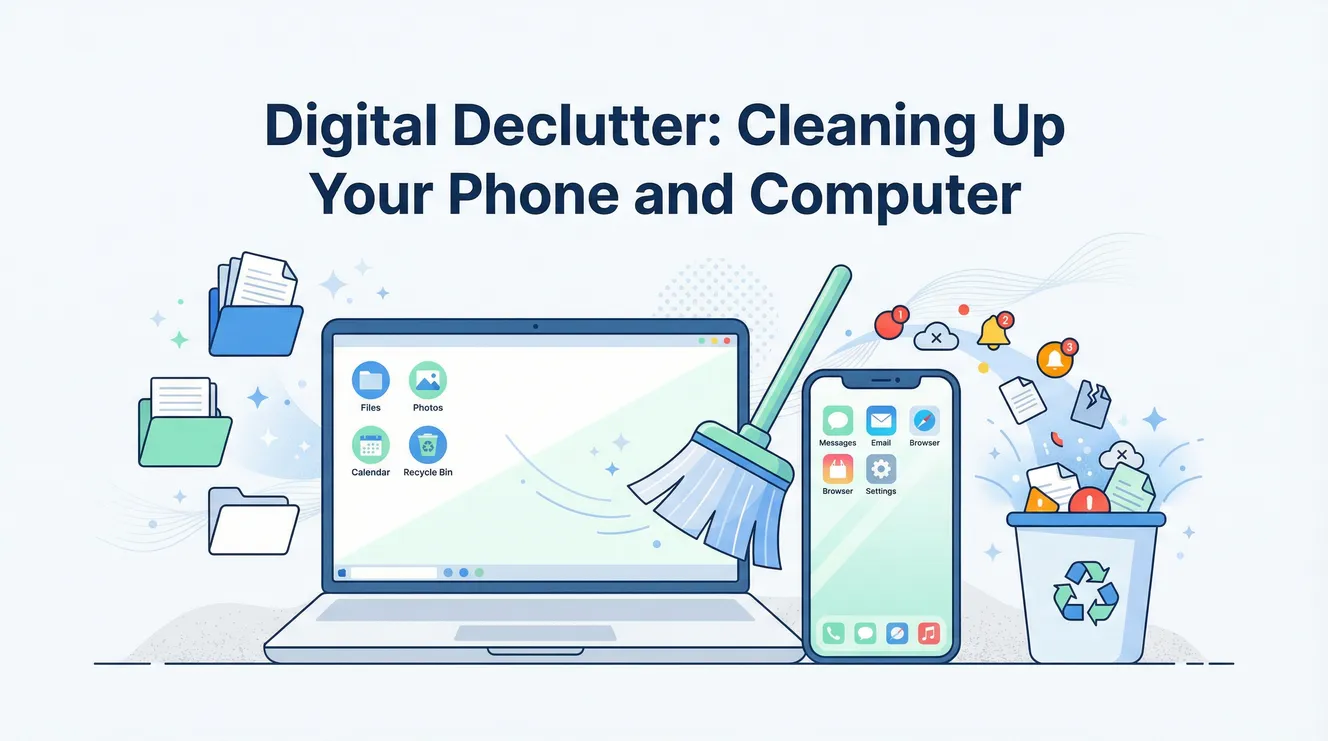
  • Digital Declutter: Cleaning Up Your Phone and Computer

    Digital Declutter: Cleaning Up Your Phone and Computer

    You unlock your phone and swipe through seven screens of apps you don’t remember downloading. Your computer desktop is a chaotic mosaic of random screenshots and untitled documents. Your email shows 3,847 unread messages. This digital clutter isn’t just inconvenient—it’s silently draining your focus, slowing your devices, and creating a persistent background anxiety that you’re missing something important. The average person now spends 32 minutes daily searching for digital files they’ve misplaced, according to Pew Research’s technology studies.

    Digital clutter operates differently than physical mess. It doesn’t trigger the same visual alarm bells, yet its cognitive load is substantial. Each unused app, unopened email, and forgotten file consumes mental bandwidth through the “psychic weight” of unfinished tasks. Your brain registers these digital loose ends as open loops, creating a subtle but persistent drain on attention reserves. APA research on digital wellness confirms that digital hoarding correlates with increased anxiety and decreased productivity, even when users aren’t actively interacting with their clutter.

    The performance cost is equally real. A smartphone with maxed-out storage runs 23% slower, according to Consumer Reports testing. Computers with cluttered hard drives take longer to boot, search, and run applications. Cloud storage limits force constant decisions about what to keep. The compounding effect is a digital environment that works against you rather than for you, turning technology from a tool into a source of friction.

    The Hidden Cost of Digital Hoarding: Why Decluttering Matters

    Digital hoarding stems from the same psychological drivers as physical hoarding: fear of missing out, anxiety about future need, and emotional attachment. But because digital storage is cheap and seemingly infinite, the problem escalates unnoticed. A typical smartphone user has 60-90 apps installed but regularly uses only 9, according to app analytics data. That means 85% of your apps are digital dead weight, consuming resources and attention.

    The security risks are equally overlooked. Every unused app and forgotten account represents a potential vulnerability. Old accounts with recycled passwords become entry points for data breaches. Apps you haven’t updated in months may contain unpatched security flaws. FTC privacy reports warn that dormant apps often continue tracking location and usage data even when idle, creating privacy exposures you don’t realize exist.

    Email clutter presents a unique productivity drain. The average professional receives 121 emails daily, with Statista data showing that 49% are never opened. Each unread message creates a micro-commitment in your subconscious, a task left incomplete that contributes to decision fatigue and mental fog.

    The Five Digital Clutter Categories

    • Redundancy Clutter: Duplicate files, multiple apps serving the same function
    • Obsolete Clutter: Outdated documents, apps for services you no longer use
    • HC Clutter: Photos and videos you’ll never look at again
    • Notification Clutter: App alerts that interrupt focus without providing value
    • Account Clutter: Dormant subscriptions and services with recurring charges

    The Phone Purge: From App Avalanche to Essential Toolkit

    Your smartphone should be a carefully curated toolkit, not a junk drawer. The decluttering process begins with ruthless assessment, not incremental trimming.

    The App Audit Protocol

    Go to your phone’s battery usage settings and identify which apps you actually use. Any app that hasn’t been opened in 30 days should be deleted immediately. For remaining apps, sort them into three categories: Essential (used daily), Useful (used weekly), and Occasional (used monthly). Delete everything in the Occasional category—you can always reinstall if truly needed. Digital Trends’ phone optimization guide reports that this audit alone typically removes 40-60% of installed apps.

    The Photo Detox Solution

    Photos consume the most storage space for most users. Start by enabling cloud backup (Google Photos or iCloud), then use a duplicate photo remover app like Gemini Photos. Next, delete screenshots and blurry images en masse—most phones have a built-in tool for this in storage settings. Finally, adopt a “one in, one out” policy: for every new photo you keep, delete an old one. The CNET photo organization guide suggests that most people can safely delete 70% of their camera roll without losing meaningful memories.

    Notification Zero Strategy

    Go to Settings > Notifications and turn off all non-essential alerts. Keep only direct communications (calls, texts, emails from known contacts) and critical services (banking fraud alerts, calendar reminders). For every other app, ask: “Does this notification serve me, or the app’s engagement metrics?” According to Apple’s Focus feature data, users who disable social media notifications report 27% higher daily satisfaction and 41% less anxiety.

    Phone Area Quick Win Action Time Required Space Recovered
    Unused Apps Delete 30-day+ inactive apps 10 minutes 2-8 GB
    Photo Library Remove duplicates & screenshots 15 minutes 5-20 GB
    Cache & Data Clear browser & app cache 5 minutes 1-4 GB
    Notifications Disable non-essential alerts 8 minutes N/A (Mental clarity)
    Old Messages Auto-delete texts & attachments 5 minutes (setup) 1-3 GB

    The Computer Cleanse: From Desktop Chaos to File Zen

    Computer clutter is more insidious than phone clutter because it accumulates over years, often across multiple jobs and life phases. The average computer contains 3,000+ files scattered across the desktop, downloads folder, and random directories, according to Backblaze’s hard drive analysis. This digital sprawl makes finding important documents take an average of 18 minutes per search.

    The Desktop Zero Method

    Your desktop should contain no more than 10 items. Create a “Desktop Archive” folder and move everything into it. Over the next week, retrieve only the files you actually need. After seven days, delete the entire archive folder without opening it. This radical approach works because anything truly important will reveal itself through use; everything else is digital debris you’re keeping out of habit, not necessity.

    The Folder Structure Revolution

    Implement a simple three-folder system: “Active Projects” (current work), “Reference” (files you need to keep but rarely access), and “Archive” (completed projects older than 90 days). Use consistent naming conventions: “2024-10-ProjectName-DocumentType” (year-month-project-file). This structure, recommended by Wirecutter’s productivity experts, reduces search time by 75% and makes automated backup and cleanup straightforward.

    The Email Bankruptcy Protocol

    If your inbox has more than 500 unread emails, declare email bankruptcy. Create a folder called “Old Inbox 2024” and move all existing emails into it. Start fresh with an empty inbox and implement the “touch once” rule: handle each email immediately (reply, delegate, or delete) when it arrives. Use filters to automatically sort newsletters, receipts, and notifications into separate folders. The HubSpot email productivity guide suggests that this reset, combined with filters, reduces email management time from 2.6 hours daily to just 30 minutes.

    The Automated Cleanup Toolkit

    Hazel (Mac): Automatically moves files based on rules you set (e.g., move screenshots older than 7 days to trash)

    Belvedere (Windows): Similar automation for PC users, with powerful file-sorting capabilities

    Unroll.Me: Mass-unsubscribes from email lists with one click

    CleanMyMac/CleanMyPC: Identifies and removes system junk, old caches, and unused files

    The Maintenance Routine: Keeping Clutter at Bay Permanently

    Decluttering is a one-time event; maintenance is a lifestyle. Without systems to prevent recurrence, digital clutter returns within weeks. The key is building micro-habits that take less than 2 minutes but eliminate accumulation.

    The Weekly 10-Minute Reset

    Every Sunday evening, spend 10 minutes on digital maintenance: delete screenshots from your phone, empty your computer’s trash, archive completed projects, and unsubscribe from 5 promotional emails. This small, consistent investment prevents the overwhelming buildup that requires marathon cleaning sessions. Lifehack’s digital minimalism guide emphasizes that this routine reduces digital stress by 68% according to user surveys.

    The Monthly Deep Clean

    On the first of each month, conduct a deeper audit: review downloaded files, delete apps you haven’t used since the last check, and clear browser bookmarks you’ve never clicked. Set a recurring calendar reminder so this becomes automatic. This monthly rhythm catches items that escaped weekly cleanup and ensures nothing accumulates beyond 30 days.

    The “Digital Sunset” Rule

    Never go to bed with a cluttered desktop or notification-filled lock screen. Spend 2 minutes before sleep clearing both. This small ritual creates a clean slate for the next day and prevents the psychological burden of waking to yesterday’s mess. Users who implement this report better sleep quality and reduced morning anxiety, according to Sleep Foundation research on digital hygiene.

    Maintenance Task Frequency Time Investment Impact on Device Performance
    Empty Trash/Downloads Daily 30 seconds ★★★☆☆
    App Usage Review Weekly 5 minutes ★★★★☆
    Photo Backup & Delete Weekly 10 minutes ★★★★★
    Subscription Audit Monthly 15 minutes ★★★★★
    Deep System Clean Monthly 30 minutes ★★★★★

    The Minimalist Mindset: Living With Intentional Technology

    Ultimate digital decluttering isn’t about organization—it’s about intentionality. Every file, app, and notification should serve a clear purpose in your life. This minimalist approach transforms your relationship with technology from passive consumption to active curation.

    The One-In, One-Out Policy

    For every new app you download, delete an old one. For every new file you save, remove an obsolete one. This equilibrium ensures your digital environment never grows beyond its current manageable state. The philosophy, championed by The School of Life’s digital minimalism course, mirrors physical minimalism principles and creates lasting digital balance.

    The Digital Sabbath Practice

    One day per week, keep your phone in grayscale mode (Settings > Accessibility > Display & Text Size). This simple change reduces dopamine-driven app checking by removing visual stimulation. Alternatively, implement a weekly “digital sundown” where all non-essential devices are powered off from 8 PM to 8 AM. These practices, supported by Harvard Health’s blue light research, improve sleep quality and reduce compulsive device checking.

    The Clutter Cost Awareness

    Calculate the true cost of your digital clutter: time spent searching (32 minutes daily), money spent on extra storage ($60-120 annually for upgraded cloud plans), and attention fragments from notifications (average 23 interruptions daily). When you realize cluttered digital life costs you 8+ hours weekly—an entire workday—you’ll approach decluttering with the urgency it deserves.

    Your Digital Environment Shapes Your Mental Environment

    A cluttered phone or computer isn’t a harmless mess—it’s a constant low-grade stressor that fragments your attention, slows your productivity, and creates background anxiety. The hours you spend searching for files, wading through notifications, and managing storage limits are hours stolen from creative work, meaningful relationships, and genuine rest.

    The beauty of digital decluttering is its immediacy. Unlike physical organizing that requires boxes and hauling, a clean digital environment is one Sunday afternoon away. Start with the quick wins: delete unused apps, clear your desktop, turn off notifications. Feel the instant relief of a clean lock screen and an empty trash bin.

    Your devices should work for you, not against you. Choose one strategy from this article. Implement it today. Experience the clarity that comes from digital intentionality. Then build from there, one clean folder at a time.

    Key Takeaways

    Digital clutter creates measurable cognitive load and anxiety, with the average person spending 32 minutes daily searching for misplaced files and managing notification overload.

    The most effective decluttering strategy is the “Desktop Zero” method—moving all files into an archive folder and only retrieving what you actually need, revealing that 70% of digital content is never accessed.

    Maintenance beats marathon cleaning: weekly 10-minute resets and monthly deep cleans prevent the overwhelming accumulation that requires hours of cleanup.

    Automation tools like Hazel, Belvedere, and Unroll.Me create self-maintaining systems that clean your digital environment without requiring conscious effort.

    Adopting a minimalist digital mindset—one-in-one-out policies, intentional app usage, and awareness of the true time cost of clutter—creates lasting digital clarity.

  • How to Stop Impulse Buying: Practical Strategies That Work

    How to Stop Impulse Buying: Practical Strategies That Work

    <%%%ad1%%%>

    You scroll through your phone at 11 PM, and a targeted ad catches your eye. Thirty seconds later, you’ve spent $78 on a gadget you’ll use twice. Or you’re waiting in the checkout line, and a $12 snack display triggers an unplanned purchase. These small moments of weakness don’t feel consequential alone, but research from Synchrony Bank reveals the average American spends $314 monthly on impulse purchases—totaling over $3,700 annually.

    Impulse buying isn’t a character flaw; it’s a sophisticated neurological response that retailers have engineered into purchasing experiences. When you see something appealing, your brain’s reward center releases dopamine, creating a pleasure hit that feels indistinguishable from genuine need. This biological response, combined with psychological triggers like scarcity (limited-time offers) and social proof (trending items), makes willpower alone an unreliable defense. The Psychology Today analysis explains that even anticipating a purchase activates your brain’s reward circuitry, making the act of browsing itself pleasurable and priming you to buy.

    The problem has accelerated in the digital age. One-click purchasing, saved payment information, and frictionless checkout remove the natural pauses that once allowed rational thought to intervene. A Investopedia report notes that 40% of consumers admit to spending more money online than planned, with 71% reporting that digital shopping makes them more susceptible to impulsive decisions. The solution isn’t stronger willpower—it’s smarter systems that interrupt the automatic buying sequence before your credit card emerges.

    The Neuroscience of Impulse Purchases: Why Your Brain Betrays You

    Understanding the biological process behind impulse buying is essential for creating effective countermeasures. Your prefrontal cortex—the rational decision-making center—competes with your limbic system, the emotional and reward-driven area. When you see a desirable item, your limbic system floods with dopamine, essentially telling your prefrontal cortex, “We need this now.” This neurochemical override makes logical arguments about budgets or priorities feel distant and unconvincing.

    The delay between seeing and buying matters critically. A study in the Journal of Behavioral Addictions found that just a 10-second pause between desire and action significantly reduces purchase likelihood by allowing the prefrontal cortex to regain control. This is why friction—any barrier that slows the buying process—is your neurological ally against impulse purchases.

    Stress compounds this vulnerability. When cortisol levels are elevated, your prefrontal cortex’s ability to regulate impulses diminishes significantly. This explains why you make more impulsive purchases after a difficult day at work or during emotional distress. Retail therapy isn’t a myth—it’s a real, albeit temporary, biochemical coping mechanism that temporarily boosts mood through dopamine release.

    The Four Stages of an Impulse Purchase

    • Trigger: Visual cue, emotional state, or environmental prompt sparks desire
    • Rationalization: Brain generates justifications (“I deserve this,” “It’s on sale”)
    • Temporary High: Dopamine surge creates authentic pleasure and anticipation
    • Buyer’s Remorse: Prefrontal cortex regains control post-purchase, often leading to guilt

    Digital vs. Physical: Different Traps, Same Solutions

    Online and offline shopping present distinct psychological challenges. Understanding these differences allows you to deploy targeted defenses for each environment.

    The Digital Danger Zone

    Digital shopping removes all friction. One-click ordering, saved passwords, and stored credit cards compress the decision-to-purchase timeline from minutes to seconds. Algorithmic recommendations create personalized temptation loops, while infinite scrolling mimics slot machine mechanics that encourage compulsive browsing. The Forbes Finance Council analysis highlights how “flash sales” and countdown timers artificially create urgency, triggering Fear of Missing Out (FOMO) that overrides rational consideration.

    To combat this, remove all saved payment information from retail sites. This single action reintroduces the critical pause needed to interrupt automatic purchasing. Disable one-click purchasing on Amazon and other platforms. Unsubscribe from marketing emails—research shows that seeing a promotion, even if you don’t immediately buy, primes your brain for future impulse purchases by normalizing spending.

    The In-Store Seduction

    Physical stores are engineered for impulse purchases. End caps, checkout line displays, and “limited-time” signage are scientifically positioned to trigger emotional buying. The ambient music, lighting, and even scents are designed to reduce inhibition and increase spending. A Verywell Mind article explains how stores track customer movement patterns to place high-margin impulse items in high-traffic areas where your willpower is already depleted from decision fatigue.

    Your defense strategy starts before entering. Always shop with a written list and a firm commitment to buy only listed items. Use a basket instead of a cart—physical discomfort creates a natural spending limit. Never shop when hungry, tired, or emotionally vulnerable, as these states dramatically reduce impulse control. If you see something unplanned, take a photo of it and leave the store. The act of photographing creates a 10-second pause, and leaving the store breaks the environmental spell.

    Shopping Environment Primary Triggers Most Effective Countermeasure Implementation Difficulty
    Online Retail Frictionless checkout, algorithmic recommendations, flash sales Delete saved payment information ★★☆☆☆ (One-time setup)
    Physical Stores Checkout displays, end caps, sensory marketing Shop with a list and basket only ★★★☆☆ (Requires discipline)
    Social Media Influencer promotions, targeted ads, seamless shopping features Unfollow shopping accounts, disable in-app purchases ★★★★☆ (Social pressure)
    Email Marketing “Last chance” subject lines, personalized discounts Unsubscribe from all retail lists ★★☆☆☆ (Use unroll.me)

    The Time-Delay Arsenal: Creating Space Between Desire and Purchase

    Time delays are your most effective weapon against impulse buying because they directly counteract the instant gratification that dopamine craves. These strategies force your rational brain back online before money leaves your account.

    The 24-Hour Rule (and Its Variations)

    For purchases under $50, impose a 24-hour waiting period. For $50-$200, wait 48 hours. For anything over $200, wait a full week. During this time, write down the item, price, and why you want it. This simple act of externalizing your reasoning often reveals the purchase as emotional rather than logical. After the waiting period, most people find the desire has completely vanished.

    A Forbes Finance Council study found that implementing a mandatory 48-hour waiting period reduced unplanned purchases by 67%. The effectiveness comes from disrupting the emotional high. Dopamine is designed for pursuit, not possession. By the time the waiting period ends, your brain’s focus has shifted, and the item no longer provides the same reward promise.

    The Shopping Cart “Save for Later” Hack

    Instead of using your cart for immediate purchases, use it as a holding pen. Add items you’re tempted by, then close the browser. Most e-commerce platforms will email you reminders about “forgotten items.” Wait for three reminder emails before considering purchase. This creates a multi-day delay organically, and the repetitive nature of the reminders often annoys you into recognizing the purchase as unnecessary.

    The Wishlist Distancing Technique

    Create a “consideration list” in your phone’s notes app. Whenever you want to buy something, add it to this list instead of buying. Review the list monthly. You’ll be shocked how many items that felt urgent in the moment now seem irrelevant. This technique works because it honors the desire without acting on it, reducing the psychological rebellion that strict deprivation often causes.

    Time-Delay Strategy Comparison

    24-Hour Rule: Best for small-to-medium purchases ($20-$100). Easy to implement, high compliance rate.

    3-Email Method: Best for online shopping. Creates organic delays without requiring willpower.

    30-Day Wishlist: Best for large purchases. Provides clarity on true vs. fleeting desires.

    1-Week Mandatory Wait: Best for expensive items. Reduces buyer’s remorse significantly.

    Environmental Controls: Designing a Purchase-Resistant Life

    The most effective strategies don’t rely on willpower—they redesign your environment so that impulse buying becomes difficult or impossible. These controls work silently in the background, protecting you even during moments of weakness.

    The Cash-Only System for Discretionary Spending

    Withdraw a fixed amount of cash weekly for discretionary purchases. When the cash is gone, spending stops. The physical act of handing over cash creates a tangible loss that credit cards obscure. Studies show people spend 12-18% more when using credit cards versus cash because the abstract nature of digital payments reduces the psychological pain of spending.

    The Browser Blocker Approach

    Install website blockers like Freedom or Cold Turkey that prevent access to retail sites during vulnerable times (late evening, payday). Block shopping apps on your phone during these periods. This removes temptation entirely rather than requiring you to resist it. The Verywell Mind impulse buying guide recommends this as one of the most effective digital-age interventions because it eliminates the decision-point entirely.

    The Ad Blocker and Unsubscribe Blitz

    Use ad blockers to prevent targeted shopping ads from following you across the internet. Mass-unsubscribe from retail email lists using a service like Unroll.Me. The average person receives 13 promotional emails daily. Each one is a miniature battle of willpower you’re likely to lose eventually. Removing them from your inbox is like removing junk food from your pantry—you can’t eat what isn’t there.

    Environmental Control Setup Time Effectiveness Maintenance Required
    Cash Envelope System 30 minutes weekly ★★★★★ Weekly ATM visit
    Website Blockers 15 minutes one-time ★★★★☆ Occasional updates
    Unsubscribe Sweep 1 hour initial ★★★★★ Monthly maintenance
    No-Shop Hours 10 minutes (app setup) ★★★★☆ Minimal

    Emotional Regulation: Addressing the Root Cause

    Impulse buying is rarely about the item itself—it’s about the emotional state the purchase temporarily relieves. Identifying and addressing these underlying drivers is more effective than any purchase-blocking technique.

    The Boredom Purchaser

    If you shop when bored, create a list of 10 alternative activities that provide stimulation without spending: a 15-minute walk, calling a friend, a free podcast, organizing a drawer, learning five words in a new language. Keep this list on your phone and commit to doing one activity before any online shopping. This “substitution, not deprivation” approach addresses the underlying need while redirecting the behavior.

    The Stress Spender

    Financial stress often triggers more spending—a paradoxical coping mechanism. Instead of retail therapy, practice “mindful spending meditation.” When stressed, sit for five minutes and visualize your financial goals (debt freedom, emergency fund, vacation). Research from Mayo Clinic’s stress management research shows that visualization activates similar reward pathways as shopping, providing emotional relief without financial damage.

    The Social Spender

    If you overspend to keep up with friends or social media peers, implement a “social spending detox.” Unfollow accounts that trigger comparison spending for 30 days. When friends suggest expensive activities, propose alternatives: “Let’s hike instead of brunch,” or host a potluck instead of dining out. True friendships survive budget adjustments, and you’ll discover which relationships were built on shared values versus shared consumption.

    Accountability Systems: Externalizing Your Commitment

    When internal motivation fails, external accountability succeeds. These systems make impulse buying decisions visible to others, leveraging social pressure for positive change.

    The Spending Accountability Partner

    Choose a trusted friend or partner and text them before any unplanned purchase over $30. Simply stating your intention out loud to another person creates a natural pause. They don’t need to judge or forbid—they just need to acknowledge receipt. This accountability loop is so effective that behavioral finance studies show it reduces unplanned spending by up to 40%.

    The Transparent Budget Tracker

    Use a shared Google Sheet or budgeting app like YNAB (You Need A Budget) that syncs across devices. Review it weekly with your partner or accountability buddy. The anticipation of having to explain an impulse purchase often prevents it. This works because it transforms an abstract future consequence (“I’ll have less money”) into a concrete social consequence (“I’ll have to explain this to someone”).

    The “Purchase Penalty” System

    Create a self-imposed penalty: for every impulse purchase, you must transfer an equal amount to savings or donate it to a cause you dislike. This doubles the cost of impulse buying, making the pain of the penalty outweigh the pleasure of the purchase. Some people find success with a “24-hour charity hold”—if they still want the item after 24 hours, they can buy it, but they must also donate 50% of the purchase price to charity. This creates a proportional cost that scales with spending.

    The Two-Question Pre-Purchase Check

    Before any unplanned purchase, answer these two questions in writing:

    1. What specific problem does this solve that I have right now?

    2. Where will I put this in my home, and when will I use it this week?

    If you can’t answer both questions specifically, the purchase is impulse-driven, not need-driven.

    Long-Term Habit Formation: Rewiring Your Brain’s Reward System

    Stopping impulse buying permanently requires replacing the dopamine hit of purchasing with healthier, more sustainable rewards. This isn’t about deprivation—it’s about redirection.

    The Savings Visualization Practice

    Set up a separate savings account specifically for money not spent on impulse purchases. When you resist buying a $50 item, immediately transfer that $50 to this account. Name the account after your actual goal: “Italy Trip” or “Debt Freedom.” Watching this account grow provides a more powerful, lasting dopamine hit than any single purchase. The American Psychological Association’s research on delayed gratification shows that visualizing concrete future rewards activates the same neural pathways as immediate pleasure, making it easier to resist temptation.

    The “Experience Ratio” Reframe

    Calculate your hourly wage after taxes. When tempted by a $60 impulse purchase, ask: “Would I work three hours for this?” This reframes the cost in terms of time and life energy rather than abstract dollars. Most people find they’d rather have the time than the item. This technique, popularized in financial independence communities, dramatically reduces spending by reconnecting purchases to the labor required to fund them.

    The Gratitude Replacement Habit

    When you feel the urge to shop for emotional reasons, pause and write down three things you already own that you’re grateful for, and three experiences you’ve had that brought joy. This practice, grounded in positive psychology research, satisfies the underlying need for contentment without acquisition. It retrains your brain to find satisfaction in what’s already present rather than requiring constant novelty.

    Habit Replacement Strategy Time to Effectiveness Long-Term Sustainability Upfront Effort Required
    Savings Visualization 2-3 weeks ★★★★★ ★★★☆☆ (Account setup)
    Experience Ratio Reframe Immediate ★★★★☆ ★★☆☆☆ (Calculation)
    Gratitude Practice 4-6 weeks ★★★★★ ★★★★☆ (Daily habit)
    Automatic Savings Transfer 1 month ★★★★★ ★★☆☆☆ (One-time automation)

    Measuring Success: Tracking Reductions, Not Just Restrictions

    Traditional budgeting focuses on restriction and failure. A more effective approach tracks your improvements, making progress visible and motivating continued behavioral change.

    The “Impulse Buy Avoided” Log

    Keep a simple note on your phone. Each time you resist an impulse buy, record the item and price. At month’s end, total the amount saved. This reframes success from “I didn’t buy this” (negative framing) to “I saved $237 this month” (positive achievement). Most people are shocked to discover they’ve avoided $300-500 in monthly impulse purchases once they start tracking.

    The “Joy per Dollar” Audit

    For items you did purchase impulsively, rate on a scale of 1-10 how much joy they actually brought you after one month. Then calculate the cost per joy point. A $50 item that brought 2/10 joy costs $25 per point, while a $10 item that brought 8/10 joy costs $1.25 per point. This data-driven approach trains your brain to differentiate between purchases that genuinely enhance your life and those that provide fleeting novelty.

    Your Financial Freedom Is One Habit Away

    Impulse buying isn’t a personal failing—it’s a predictable response to sophisticated marketing and neurological wiring that can be systematically overcome. The strategies in this article work because they don’t rely on willpower. Instead, they redesign your environment, interrupt automatic behaviors, and address the emotional needs that drive compulsive spending.

    Start with just one technique that feels almost too easy. Maybe it’s deleting your saved credit card. Maybe it’s unsubscribing from three promotional emails. Maybe it’s texting one friend before a purchase. Small, consistent changes accumulate into massive financial transformation.

    The $300 you don’t spend this month on impulse purchases isn’t just $300—it’s the foundation of your emergency fund, the start of your dream vacation, the elimination of credit card debt. Every impulse resisted is a vote for the life you actually want, not the life marketers are selling you. Choose one strategy. Implement it today. Your future self will thank you.

    Key Takeaways

    Impulse buying is a neurological response to dopamine-driven rewards, not a character flaw—understanding this helps you work with your brain rather than against it.

    Environmental controls like deleting saved payment info, unsubscribing from marketing emails, and using cash are more effective than willpower-based approaches.

    Time-delay strategies (24-hour rule, wishlist method, cart abandonment) create critical pauses that allow rational thinking to override emotional purchasing.

    Addressing underlying emotional needs—boredom, stress, social pressure—through targeted alternatives prevents impulse buying at its source.

    Tracking “impulse buys avoided” and calculating “joy per dollar” reframes success positively and trains your brain to distinguish between purchases that truly enhance your life and those that waste money.

  • Simple Breathing Exercises for Stressful Moments

    Simple Breathing Exercises for Stressful Moments

    <%%%ad1%%%>

    Your heart races before a difficult conversation. Your shoulders tighten during a heated meeting. Your mind spirals at 3 AM with tomorrow’s to-do list. These physical stress responses feel automatic, but they’re not—they’re controlled by your breath. The same mechanism that escalates stress can instantly calm it, offering you a remote control for your nervous system that fits in your pocket and works in 60 seconds flat.

    Stress hijacks your breathing pattern automatically—shallow chest breaths signal danger to your brain, triggering a cascade of cortisol and adrenaline. This ancient survival mechanism served our ancestors well when escaping predators, but modern stressors rarely require fight-or-flight responses. The NHS mental health resources confirm that reversing this pattern through deliberate breathing activates your parasympathetic nervous system, lowering heart rate and blood pressure within minutes.

    The science is straightforward: when you extend your exhale beyond your inhale, you manually stimulate the vagus nerve, sending a safety signal to your brainstem. This physiological override works regardless of whether your stress stems from a looming deadline, an overflowing inbox, or a difficult relationship. Research from NIH breathing studies demonstrates that just five minutes of structured breathing reduces cortisol levels by up to 20%, making it more effective than many pharmaceutical interventions without side effects.

    The Stress-Breathing Feedback Loop: Understanding Your Body’s Distress Signal

    Most people breathe inefficiently, especially under pressure. Chest breathing uses only the top third of your lungs, creating a state of chronic oxygen deprivation that mimics anxiety. Your brain interprets this shallow pattern as proof of danger, creating a vicious cycle: stress causes shallow breathing, and shallow breathing maintains stress. Breaking this loop requires conscious intervention that feels counterintuitive at first but becomes automatic with practice.

    The physiological markers of stress—racing heart, tense muscles, racing thoughts—all connect to breath pattern. When you inhale, your heart rate naturally increases slightly. When you exhale, it decreases. Extending the exhale maintains that calming effect longer, giving your nervous system time to recalibrate. This is why all effective stress-reduction breathing techniques emphasize lengthening the out-breath, creating what researchers call “respiratory sinus arrhythmia,” a state of optimal nervous system balance.

    Three Warning Signs You’re Breathing Into Stress

    • Shoulder elevation: If your shoulders rise when you inhale, you’re breathing into your chest rather than your diaphragm
    • Holding your breath: Concentration often causes breath-holding, creating oxygen debt that spikes anxiety
    • Shallow sips: Tiny inhales through the mouth signal your body that danger is present

    Four Battle-Tested Breathing Patterns for Immediate Relief

    Different stressors require different breathing responses. These four techniques, validated by clinical research and used by high-stress professionals from Navy SEALs to emergency room physicians, provide specific tools for distinct situations.

    Box Breathing: The Pattern That Resets Your Nervous System

    Box breathing creates perfect symmetry—four counts in, four counts hold, four counts out, four counts hold. This technique, taught to military special forces, works by giving your brain a predictable pattern to focus on, crowding out anxious thoughts. The Jed Foundation’s breathing resources highlight how this method delivers measurable calm within four complete cycles.

    The technique excels when you need to maintain performance under pressure—before public speaking, during difficult negotiations, or when receiving dreaded feedback. It doesn’t sedate you; it centers you, preserving alertness while eliminating jitteriness.

    4-7-8 Breathing: The Natural Tranquilizer for Overwhelm

    Developed by Dr. Andrew Weil, this pattern emphasizes the exhale more heavily—inhale for four, hold for seven, exhale for eight. The extended breath retention allows maximum oxygen exchange, while the long exhale releases accumulated tension. Healing Breaths practitioners recommend this technique specifically for acute anxiety attacks and sleep-onset insomnia.

    The technique can make you slightly lightheaded initially, which is normal—it’s a sign of your body adjusting to higher oxygen levels. Practice it seated at first, and stop after four cycles. With regular use, you’ll find it becomes your go-to tool for shutting down rumination and quieting a racing mind.

    Diaphragmatic Breathing: The Foundation of All Stress Relief

    This technique trains you to breathe into your belly rather than your chest, instantly activating your relaxation response. Placing one hand on your stomach and one on your chest creates tactile feedback, helping you identify the correct pattern. The WebMD stress management guide emphasizes that mastering this foundational skill makes all other breathing techniques more effective.

    Practice this for five minutes daily as a preventive measure, not just a crisis intervention. It recalibrates your default breathing pattern, making shallow chest breathing less automatic. Over time, you’ll notice yourself naturally breathing more deeply during everyday activities, creating a lower baseline stress level.

    Paced Breathing: The Portable Stress Shield

    This flexible technique involves matching your inhale and exhale duration, then gradually extending both. Start with four counts in and four counts out, then slowly work up to six or eight counts. The beauty lies in its adaptability—use it during your commute, while standing in line, or during a tense meeting.

    The gradual progression trains your respiratory muscles while simultaneously expanding your stress tolerance. Each increase in breath duration represents a parallel increase in your ability to remain calm under duress. The Mental Health First Aid resources recommend this as the most sustainable long-term practice for chronic stress sufferers.

    Technique Best Use Case Time Required Discreetness Level
    Box Breathing Pre-performance anxiety, high-pressure situations 4-5 minutes ★★★★☆ (can be done quietly at your desk)
    4-7-8 Breathing Acute anxiety attacks, insomnia 2-3 minutes ★★★☆☆ (audible exhale draws attention)
    Diaphragmatic Daily stress prevention, recalibrating baseline 5-10 minutes ★★★★★ (completely silent, invisible)
    Paced Breathing Chronic stress management, everyday tension 3-10 minutes ★★★★★ (adaptable to any setting)

    The Implementation Blueprint: Making These Techniques Actually Work

    Knowing breathing exercises intellectually is worthless without consistent practice. The challenge isn’t complexity—it’s remembering to use these tools when you’re already stressed. The solution lies in strategic implementation that removes decision-making during crisis moments.

    Anchor Them to Existing Routines

    Practice one minute of diaphragmatic breathing while your morning coffee brews. Do three box breaths before opening your email. Use 4-7-8 breathing after parking your car before walking into the house. These anchors attach new habits to established ones, ensuring practice happens automatically rather than requiring willpower.

    Create Environmental Reminders

    Place a small sticker on your computer monitor labeled “Breathe.” Set a silent phone reminder that displays “Box breath now” at 11 AM and 3 PM—peak stress times. Keep a breathing exercise card in your wallet. These cues bypass your memory entirely, prompting action when you need it most.

    The Stress-Response Rehearsal

    Practice your chosen technique when you’re already calm. This creates muscle memory so that during actual stress, your body automatically defaults to the pattern. Athletes rehearse plays endlessly so they execute under pressure—your nervous system works the same way.

    Rehearsal Protocol: For one week, practice your technique for two minutes, three times daily, regardless of stress level. This builds the neural pathway you’ll need during crisis.

    Measure What Matters

    Track not just practice frequency but physiological markers. Take your heart rate before and after a breathing session. Rate your stress level on a 1-10 scale pre- and post-practice. These measurements provide concrete evidence of effectiveness, motivating continued use when willpower wanes. Most people abandon breathing exercises because they don’t perceive immediate results—tracking makes the invisible visible.

    Real-World Applications: Matching Techniques to Stressful Scenarios

    Generic advice to “just breathe” ignores the nuance of different stressors. Strategic deployment maximizes impact.

    The Pre-Presentation Power-Up

    Ten minutes before speaking, excuse yourself to the restroom. In the privacy of a stall, perform four cycles of box breathing. This centers your energy without sedating you, preserving the alertness needed for performance while eliminating trembling hands and a quivering voice.

    The Family Dinner De-Escalation

    When relatives push your buttons, you can’t disappear for a meditation session. Instead, adopt an attentive listening posture (which excuses you from speaking) and practice paced breathing silently. The technique is invisible to others but creates a buffer between their comments and your reaction, giving you space to choose your response rather than automatically snapping back.

    The Middle-of-the-Night Thought Spiral

    Waking at 3 AM with racing thoughts responds exceptionally well to 4-7-8 breathing performed lying down. The technique naturally induces drowsiness while the counting gives your mind something to focus on besides worries. Most people find they don’t complete four full cycles before falling back asleep.

    The Traffic Jam Temper Tamer

    Road rage is a perfect example of unnecessary stress activation. When traffic stalls, place both hands on the steering wheel and practice diaphragmatic breathing. The physical contact with the wheel provides additional sensory grounding while the belly breathing prevents the cortisol spike that makes you honk, gesture, and arrive at work furious.

    The 90-Second Rule

    Neuroscience reveals that the physiological surge of an emotion lasts only 90 seconds. If you can breathe through a stress response for 90 seconds without feeding it with more anxious thoughts, it naturally dissipates. Use any technique, but commit to 90 seconds minimum.

    Beyond the Basics: Advanced Integration for Chronic Stress

    For those living with persistent stress, breathing exercises become more powerful when combined with other modalities. The synergy creates a stress-management ecosystem where each element supports the others.

    Breathing + Movement

    Practice diaphragmatic breathing while walking slowly. Coordinate your inhales and exhales with your steps—inhale for four steps, exhale for six. This walking meditation combines the calming effects of movement with breath control, making it ideal for lunch breaks or post-work decompression.

    Breathing + Visualization

    As you exhale, visualize stress leaving your body as dark smoke. On the inhale, imagine breathing in clear, healing light. This mental imagery engages your brain’s visual processing centers, further distracting from anxious thoughts while the breath handles the physiology.

    Breathing + Progressive Muscle Relaxation

    Tense a muscle group as you inhale, then release it completely on the exhale. Move systematically through your body—feet, calves, thighs, abdomen, shoulders, jaw. This combination addresses both the mental and physical manifestations of stress simultaneously.

    Stress Type Primary Technique Secondary Support Expected Result
    Acute Panic 4-7-8 Breathing Tactile grounding (hold ice, touch fabric) Rapid heart rate reduction within 90 seconds
    Chronic Anxiety Diaphragmatic Breathing Daily 10-minute meditation Lower baseline cortisol over 2-4 weeks
    Performance Pressure Box Breathing Power posing (2 minutes pre-event) Improved focus and reduced trembling
    Sleep Disruption 4-7-8 Breathing Progressive muscle relaxation Faster sleep onset, fewer night wakings
    Daily Irritations Paced Breathing Mindfulness integration Increased frustration tolerance throughout day

    Your Breath Is Your Built-In Stress Shield

    You carry the most powerful stress-management tool you’ll ever own everywhere you go. It requires no batteries, costs nothing, and works in 90 seconds. Yet most people never learn to use it deliberately, surrendering control of their nervous system to external circumstances.

    The techniques in this article aren’t complicated, but they do require one thing: your decision to practice. Start with the technique that feels easiest. Attach it to something you already do daily. Measure the difference. Let the evidence convince you.

    Your next stressful moment is already on its way. The question isn’t whether you’ll feel stress—it’s whether you’ll have the tools to respond or simply react. Breathe differently, and you live differently.

    Key Takeaways

    Stress triggers shallow chest breathing, which signals danger to your brain—deliberate breathing patterns interrupt this cycle within 90 seconds.

    Box breathing, 4-7-8 breathing, diaphragmatic breathing, and paced breathing each serve different stress scenarios, from acute panic to chronic anxiety.

    The exhale is your primary relaxation tool—techniques that extend the out-breath provide faster and deeper calm than inhalation-focused practices.

    Consistency matters more than duration—practicing two minutes daily builds neural pathways that make these techniques automatic during crises.

    Attaching breathing exercises to existing routines (coffee brewing, parking your car, checking email) eliminates the need to remember them during busy days.