The kitchen gadget industry is a $15 billion behemoth built on solving problems you didn’t know you had. According to research from Statista, the average American kitchen contains 36 single-use gadgets, yet professional chefs consistently work with fewer than 20 tools total. The disconnect reveals a fundamental truth: the best kitchen tools earn their space through versatility and daily use, not specialized promises.
The minimalist kitchen philosophy isn’t about deprivation—it’s about ruthless functionality. Every tool must serve multiple purposes, survive daily wear, and deliver results that justify its real estate. A $200 sous vide machine that sees monthly use is a poorer investment than a $40 cast iron skillet that becomes your daily workhorse. Learning to distinguish marketing hype from genuine utility transforms your kitchen from cluttered storage into a streamlined workshop where everything earns its keep.
The Chef’s Reality: What Professionals Actually Use
Professional chefs operate under space constraints that would shock most home cooks. In a commercial kitchen, every tool must justify its existence immediately and repeatedly. This pressure creates a natural selection process that eliminates gimmicks quickly. When a tool fails during dinner service, it disappears from the lineup permanently.
Celebrity chef Masaharu Morimoto, when interviewed by CNET, dismissed the mandoline as overrated, stating: “Mastering proper knife skills gives you more control, precision and safety in the long run. Mandolins can be bulky, hard to clean and risky if you’re not extremely careful.” This sentiment echoes across professional kitchens: a sharp knife replaces dozens of specialized slicers, cutters, and corers.
The 7-Tool Foundation
Professional chef and culinary instructor Eric Rowse from the Institute of Culinary Education identifies the core seven tools that cover 95% of kitchen tasks: a sharp 8-inch chef’s knife, a heavy 3-quart saucepan, a 12-inch stainless or non-stick skillet, an instant-read thermometer, a silicone spatula, half-sheet pans, and a digital kitchen scale. With these seven items, you can sauté, braise, roast, bake, and accurately measure ingredients for virtually any recipe.
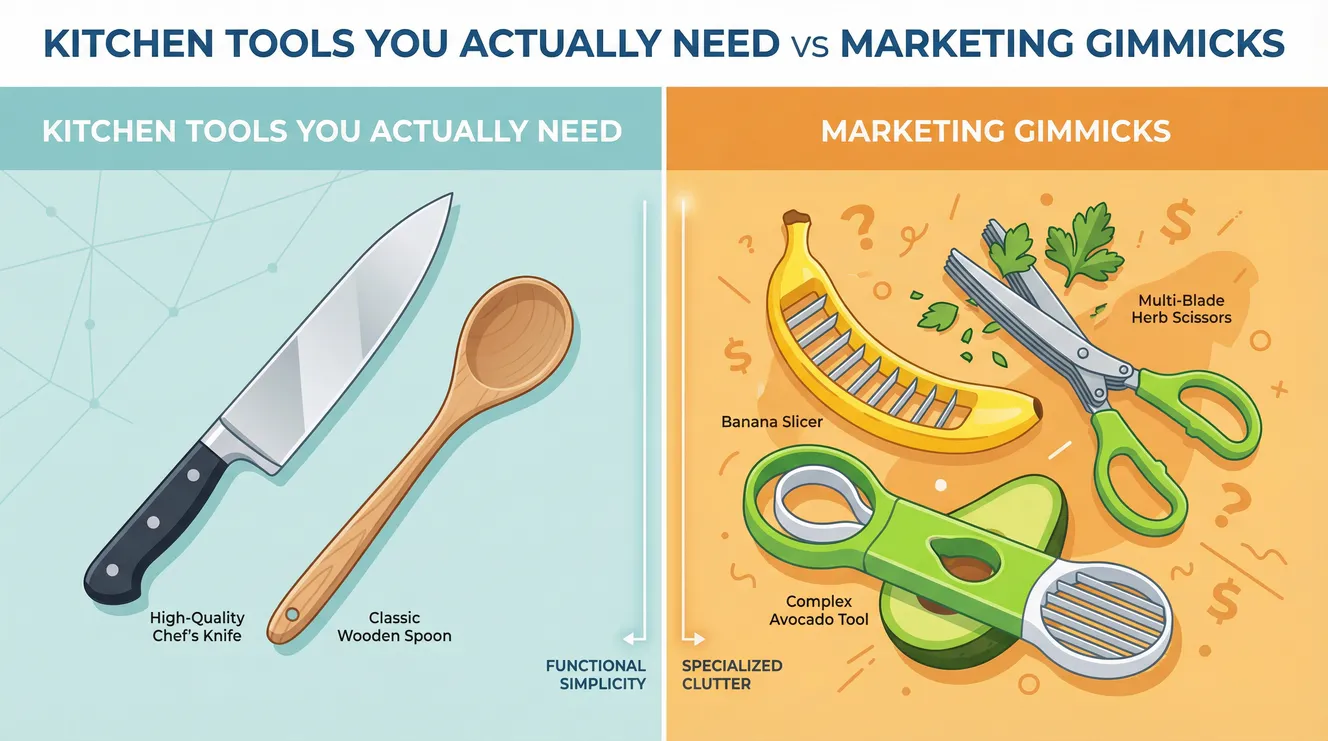
The beauty of this foundation is its multiplicative power. A chef’s knife doesn’t just cut—it minces, slices, dices, crushes garlic, and even tenderizes meat. A stainless steel skillet sears, sautés, braises, and goes directly from stovetop to oven. Compare this to the “unitasker” gadgets that clutter drawers: an avocado slicer that only slices avocados, a butter cutter that only cuts butter, a pizza scissors that only cuts pizza. Each of these solves a minor inconvenience while creating a major storage problem.
The Professional’s Pareto Principle
80% of cooking: Chef’s knife, cutting board, skillet, saucepan, spatula
15% of cooking: Sheet pan, Dutch oven, vegetable peeler, colander
5% of cooking: Everything else (garlic press, mandoline, apple corer, etc.)
The Gimmick Hall of Shame: Tools That Fail the Test
Some kitchen tools are so spectacularly useless they become case studies in marketing over substance. These gadgets promise convenience but deliver complication, cleaning headaches, and ultimately, buyer’s remorse.
The Avocado Slicer: A Solution in Search of a Problem
The avocado slicer promises perfect slices every time, but requires the avocado be precisely ripe and precisely sized for the tool. A sharp knife and a spoon accomplish the same task in the same amount of time, with zero storage requirement and a 100% success rate regardless of avocado size. Personal chef Richard Ingraham, who cooks for Dwyane Wade and Gabrielle Union, told CNET: “A knife and spoon do the job just as easily, and the specialized tool rarely fits all avocado sizes properly. It’s a one-trick pony that clutters drawers.”
The Electric Can Opener: Countertop Clutter
Once a wedding registry staple, the electric can opener is a monument to unnecessary mechanization. It takes up precious counter space, requires electricity, and fails when the power goes out. A quality manual can opener like the Oxo Soft-Handled model costs $15, fits in a drawer, opens any can size, and lasts decades. Cookbook author Peter Som notes: “Most of us grew up with an electric can opener permanently stationed on the kitchen counter, like it was a vital appliance. But truthfully, they’re more nostalgia than necessity.”
The Garlic Peeler Tube: Silicon Confusion
A silicone tube that promises to peel garlic cloves when you roll them inside sounds clever until you realize that smashing a clove with the flat of a chef’s knife achieves the same result in one second. The smashed clove releases its oils, making it more flavorful, while the papery skin sticks to the cutting board. The tube requires storage, cleaning, and frustratingly often, manual removal of stubborn skins. Master the knife technique and you’ll never look back.
The Essential Arsenal: Tools That Earn Their Space
If the gimmick list represents what to avoid, the essential list represents what to prioritize. These tools are the workhorses that professional chefs replace immediately when they break because cooking without them is unthinkable.
The Indispensable Trio
1. The 8-Inch Chef’s Knife: This is the kitchen’s primary tool. A quality chef’s knife (from brands like Mac, Made In, or Wusthof) replaces 20 specialized cutting tools. It minces garlic, breaks down chicken, slices tomatoes, chops vegetables, and even crushes spices. The key is maintaining it with regular honing and professional sharpening annually. An $80-150 investment that lasts decades beats buying five $20 gadgets that break in a year.
2. The 12-Inch Stainless Steel Skillet: This is your stovetop workhorse. Sear steaks, sauté vegetables, make pan sauces, and transfer directly to a 500°F oven for roasting. The tri-ply construction (stainless surrounding aluminum core) provides even heat distribution that cheaper pans can’t match. Calphalon and All-Clad offer excellent options that last generations.
3. The Instant-Read Thermometer: The Thermapen ONE or ThermoPro Lightning eliminates guesswork from cooking meat, bread, and even candy. At $30-100, it prevents overcooking expensive proteins and ensures food safety. Unlike Bluetooth probes with apps and batteries, these simple, fast devices just work—no pairing, no charging, no frustration.
The Supporting Cast
Half-sheet pans: Not just for cookies. Roast vegetables, bake chicken, toast nuts, and even organize mise en place. Buy commercial-grade aluminum pans—they’re cheaper and more durable than consumer versions with nonstick coatings that fail.
Dutch oven: A 5-quart enameled Dutch oven (Lodge or Staub) braises, bakes bread, makes soup, and serves as a deep fryer. It’s the original multi-cooker, no electricity required.
Silicone spatulas: Heat-resistant, flexible spatulas scrape bowls clean, fold delicate batters, and stir sauces without scratching pans. One high-quality spatula replaces wooden spoons, rubber scrapers, and metal spoons for most tasks.
The ROI Test
High ROI: Chef’s knife (used daily, lasts decades) – $0.02 per use
Moderate ROI: Stand mixer (used weekly, lasts years) – $0.50 per use
Low ROI: Avocado slicer (used monthly, breaks in a year) – $1.50 per use
Negative ROI: Electric can opener (used rarely, takes up counter space) – Costs you space and electricity
The Storage Equation: When Space Costs More Than Money
In small kitchens, the true cost of a gadget isn’t its price tag—it’s the square footage it consumes. A drawer organizer dedicated to 15 single-use tools represents approximately 2 square feet of premium kitchen real estate. In a 100-square-foot kitchen, that’s 2% of your total space dedicated to items you use less than monthly.
The One-Drawer Challenge
If you can’t fit your kitchen tools in one drawer (excluding knives and large pans), you own too many. This constraint forces honest evaluation. Does this tool earn its space? Could I achieve the same result with something that lives in the drawer? The garlic press fails this test—it only does one job poorly (it crushes instead of mincing, leaving bitter juice) while requiring drawer space. A microplane grater for garlic lives in the drawer and also zests citrus, grates cheese, and spices nutmegs.
The Maintenance Factor: Tools That Last vs. Tools That Languish
A critical factor in tool value is maintenance requirements. High-maintenance tools that require special cleaning, battery charging, or calibration quickly become shelf queens.
The Battery-Free Kitchen
Bluetooth thermometers, electric salt grinders, and wireless scales all promise convenience but add a layer of technological fragility. When the battery dies mid-cook, you’re stranded. Analog alternatives like a simple instant-read thermometer or a mechanical scale never fail. The Serious Eats testing confirms that the Thermapen ONE’s instant-read accuracy beats Bluetooth alternatives that require app pairing and constant charging.
The Dishwasher Test
If a tool can’t go in the dishwasher, its usage will plummet. Hand-washing is a friction point that kills momentum. A garlic press with 12 small holes requires a brush and five minutes of scrubbing. A knife rinses clean in 30 seconds. The dishwasher test predicts real-world usage more accurately than any marketing claim.
Your Kitchen’s Liberation Is 7 Tools Away
The path to kitchen confidence doesn’t run through a gadget store. It runs through mastering a few fundamental tools until they become extensions of your hands. When you can break down a chicken with a chef’s knife, you don’t need a chicken shredder. When you can dice an onion properly, you don’t need onion goggles.
Start with the indispensable trio: chef’s knife, stainless skillet, instant thermometer. Master them completely. Only then consider adding tools that solve specific, recurring problems in your cooking style. The best kitchen is the one where everything earns its space, where drawers aren’t junkyards, and where cooking feels like flow, not friction.
Your kitchen isn’t a museum of culinary aspirations. It’s a workshop for daily creation. Equip it accordingly.
Key Takeaways
Professional chefs operate with fewer than 20 tools, relying on versatile fundamentals like an 8-inch chef’s knife, stainless skillet, and instant-read thermometer rather than single-use gadgets.
Gimmicky tools like avocado slicers, electric can openers, and garlic peeler tubes fail the ROI test—they cost more per use than the friction they eliminate and consume valuable storage space.
The best kitchen tools earn their space through daily use, durability, and multi-functionality, with a quality chef’s knife alone replacing 20+ specialized cutting tools.
Analog tools that pass the dishwasher test and require no batteries or charging outperform “smart” gadgets that add technological fragility to simple tasks.
A minimalist kitchen with 7-10 essential tools reduces decision fatigue, maximizes workspace, and fosters cooking confidence through mastery rather than accumulation.
“`