Small apartments operate under different laws of physics than larger homes. Every decision creates a ripple effect; every item added requires something else removed; every organizational system must justify its existence in both space and mental energy. Research from the Princeton University Neuroscience Institute confirms that visual clutter literally competes for your attention, decreasing focus and increasing stress hormones—a cognitive penalty that small-space dwellers pay exponentially more because there’s nowhere to hide the mess.
The difference between organizational systems that last and those that collapse within a month isn’t about buying fancier containers or embracing extreme minimalism. It’s about designing systems that acknowledge the unique challenges of limited square footage: the absence of “junk drawers,” the need for every piece to serve multiple functions, and the psychological weight of seeing all your possessions at once. True small-apartment organization isn’t about perfect aesthetics—it’s about creating invisible infrastructure that makes daily life feel effortless.
The Small-Space Paradox: Why Conventional Organizing Fails
Traditional organizing advice assumes you have surplus space to reallocate. “Designate a craft room!” “Store seasonal items in the garage!” “Use that spare closet for bulk purchases!” These tips evaporate into irrelevance when you’re struggling to find space for a vacuum cleaner in a 500-square-foot apartment. The strategies that work in suburban homes actively sabotage small-space living by creating systems that require more maintenance than the items they organize.
Consider the classic advice to “buy storage containers after decluttering.” In theory, this prevents over-purchasing. In practice, small apartments require the opposite approach: you must understand your container limitations before you declutter, because storage real estate is finite and non-negotiable. You can’t buy a dozen baskets and find places for them later. There are only three spots where a basket fits—your organizing system must be built around these constraints, not despite them.
The psychological difference is profound. Large-space organizing focuses on abundance management—creating systems to handle everything you own. Small-space organizing is about priority triage—designing systems that force you to identify what truly deserves space in your limited world. This is why the KonMari method’s “spark joy” principle resonates so deeply with apartment dwellers; it’s not just about emotions, it’s about survival in a spatial economy where every square foot has carrying costs.
A 2024 study of 1,200 small-apartment residents found that 67% had purchased organizing systems that failed within three months. The primary reason wasn’t laziness—it was “system maintenance overwhelm.” Containers that required precise stacking, labels that needed constant updating, and rotating storage that demanded lifting heavy bins onto high shelves. These systems looked beautiful on Instagram but added three extra steps to every simple task. In small spaces, complexity is the enemy of sustainability.
The Decision Tree: Small vs. Large Space Organizing
Large Space Strategy: Store by category, create zones for activities, keep extras for convenience
Small Space Reality: Store by frequency of use, create zones for items (not activities), extras are liabilities
Large Space Flexibility: Can accommodate aspirational items (“I might need this someday”)
Small Space Compromise: Every item must have at least two functions or be used weekly
The Five Pillars of Sustainable Small-Space Organization
Long-term organization in tiny apartments rests on five non-negotiable pillars. These aren’t trendy hacks but biological and psychological imperatives that align with how human brains actually function in constrained environments.
Pillar One: Verticality as a Primary Strategy
Floor space is your most precious commodity. Walls, however, are underutilized vertical real estate that multiplies your square footage without increasing your rent. The key is thinking in three dimensions. A studio apartment featured by IKEA demonstrated this principle perfectly: by installing wall-mounted shelves that reached within inches of the ceiling, they created 40 square feet of additional storage in a 300-square-foot space—a 13% increase in functional area.
But verticality must be implemented with precision. Items used daily belong at eye level to elbow height. Weekly-use items can live higher. Seasonal or occasional items earn the highest spots, requiring a step stool. This hierarchy prevents the daily frustration of climbing or bending, which are friction points that cause systems to fail. Over-the-door organizers aren’t just for shoes; they transform the backs of bathroom doors into medicine cabinets, pantry doors into spice racks, and closet doors into accessory stations. Each door in a small apartment can hold 15-20 pounds of well-organized items without sacrificing a single square inch of floor space.
Pillar Two: The Container Law of Finite Space
In small apartments, containers don’t just organize—they legislate. A basket that fits exactly 12 pairs of socks becomes the law of sock ownership. When it’s full, you must remove one pair to add another. This built-in constraint eliminates decision fatigue and prevents the slow accumulation that buries small spaces. The container becomes the bad guy, not you.
This principle, championed by professional organizers, works because it externalizes discipline. A drawer with expandable dividers transforms one messy space into six precise compartments. When the “everyday jewelry” section is full, you can’t cram more in—you must choose what stays. This forces the constant curation that small spaces demand. The Container Store’s Elfa system succeeds in small apartments because it’s infinitely adjustable, allowing you to reallocate inches as priorities shift, rather than forcing you to buy entirely new systems.
Pillar Three: Multi-Function as Non-Negotiable
Every piece of furniture in a small apartment must serve at least two purposes—ideally three. A storage ottoman isn’t just a footrest; it’s a coffee table, extra seating, and a linen closet. A dining table isn’t just for meals; it’s a desk, a craft station, and extra kitchen prep space. This multiplication effect is how you survive with less.
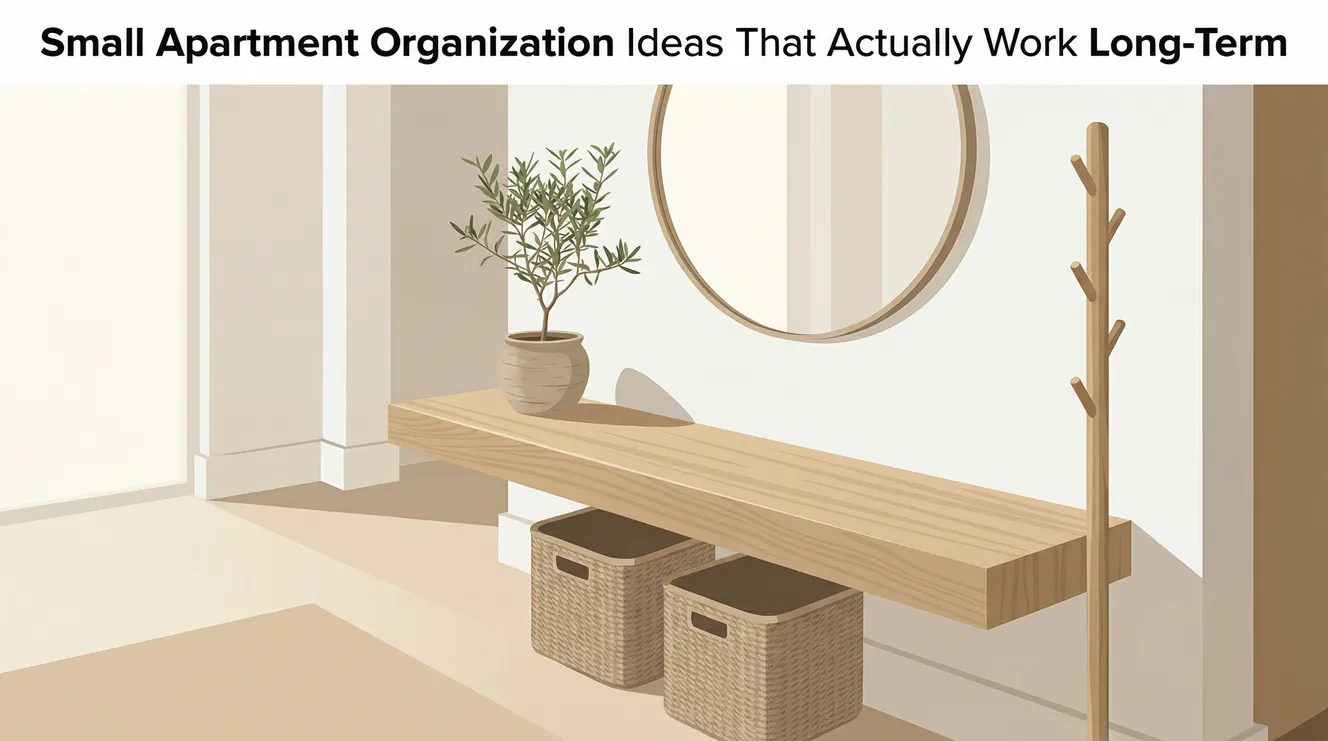
Architect Rachel Robinson, quoted in Architectural Digest’s small-space feature, emphasizes that “storage solutions can actually be multipurpose, adding a sense of flexibility and openness.” A floating bench-shelf low along a wall provides seating, shoe storage, and display space without cluttering floor area. A lift-top coffee table hides work materials when guests arrive, transforming a living room into a home office in seconds. Even sectionals with built-in storage chaises ensure kids’ toys aren’t scattered across the room while keeping spare throws within reach.
Pillar Four: The One-Touch Rule for Daily Items
Friction determines whether systems survive. If putting something away requires more than one motion—opening a door, moving something else, then placing the item—it won’t happen consistently in a small apartment. Daily-use items demand one-touch storage: keys drop into a tray (no lid), coats hang on hooks (no hangers), bags land in open baskets (no folding). This principle, advocated by minimalism experts, acknowledges that in tiny spaces, laziness isn’t a character flaw; it’s an energy conservation strategy you must design for.
A YouTuber documented her small entryway makeover, noting that “because I tailored the solutions to these habits, the space became incredibly functional. Now, nearly a year after the makeover, it’s stayed organized because everything has a designated place.” The Hemnes shoe cabinet from IKEA succeeds in tight entries not because it’s beautiful, but because it’s shallow—just 11 inches deep—allowing the door to open while providing concealed storage that requires only one touch to access.
Pillar Five: The Maintenance-Minimum Threshold
Sustainable systems require less than five minutes of weekly maintenance. If organizing your entryway means spending 20 minutes every Sunday resetting everything, the system will fail by week three. The best small-apartment solutions are self-maintaining or nearly so. A tray that catches keys doesn’t need to be organized—it just needs to be emptied occasionally. A hook system that lets you grab today’s bag without disturbing others maintains itself through daily use.
This is why open shelving often beats closed cabinets in small apartments. While closed storage looks tidier, open shelves force you to maintain order because the mess is visible. The maintenance becomes ambient—you adjust items as you pass by, like straightening a picture frame. Closed cabinets, conversely, allow chaos to accumulate unseen until opening them becomes a dreaded task requiring dedicated time.
Room-by-Room Systems That Survive Real Life
Generic advice fails because each room in a small apartment serves multiple, often conflicting, functions. Here are hyper-specific, battle-tested systems for each zone.
The Bedroom: The Vertical Sanctuary
In a small bedroom, the bed likely consumes 60% of the floor space. The remaining area must work vertically or not at all. Start with under-bed storage that rolls completely out of sight— drawers on casters that hold out-of-season clothes in vacuum-sealed bags. This isn’t aspirational storage; it’s archival. You access it twice a year, so the friction of pulling out the drawer is acceptable.
Next, exploit the perimeter. A wall-mounted bedside shelf—just 8 inches deep—replaces a nightstand, holding a book, glasses, and phone. Above it, a swing-arm sconce eliminates the need for a table lamp. On the opposite wall, floor-to-ceiling tension rods create a “closet” against a blank wall. Hang clothes by category, with a canvas cover that hides everything. This creates 15 linear feet of hanging space in zero floor space.
Drawer dividers aren’t optional—they’re the difference between a functional dresser and a textile tornado. Use expandable dividers to create permanent homes for socks, underwear, and t-shirts. When the “athletic socks” section is full, you know it’s time to purge. Cosmopolitan’s small-apartment guide highlights acrylic drawer organizers for accessories—visible compartments that prevent the “digging cascade” that turns order into chaos.
The Kitchen: The Linear Workstation
Small apartment kitchens are inevitably galley-style—a narrow corridor where two people can’t pass. The organizing principle here is linear efficiency: everything must be reachable from a single standing position. Magnetic strips on the side of the fridge hold spices and knives, freeing counters and drawers. A tension rod under the sink creates a second level for spray bottles, utilizing the vertical cavity that’s otherwise wasted.
The inside of cabinet doors is prime real estate. Attach stick-on bins for pot lids, measuring spoons, and cutting boards. A simple $5 adhesive hook holds dish towels. The key is weight distribution—keep heavier items on lower doors to prevent sagging. Above cabinets (if you have the gap), slide flat storage bins for baking sheets and serving trays. These long, awkward items defied organization until you realized the gap was their perfect habitat.
The Living Room: The Transformer Zone
Your living room is likely also your dining room, office, and guest room. Organization here means seamless transformation between functions. A storage ottoman is the MVP—footrest, coffee table, and blanket chest. But choose one with a solid top that can hold a tray; fabric tops sink under weight and create unstable surfaces for drinks.
Nesting tables slide together to create a single surface when you’re working, then separate for guests. A floating wall shelf at desk height (28 inches) becomes a laptop station when paired with a stool that tucks completely underneath. When work is done, the laptop lives in a drawer, the stool becomes extra seating, and the shelf displays a plant. Three functions, zero floor footprint increase.
For media storage, mount the TV on an articulated arm that swings to reveal shallow shelves behind it—perfect for routers, cables, and game consoles. The cables run inside the wall with a $15 kit, eliminating visual spaghetti. Remote controls live in a small lidded box on the coffee table—not because it’s cute, but because it prevents the daily “where’s the remote” search that undermines the entire system’s calm.
The Bathroom: The Micro-Pharmacy
Small apartment bathrooms often lack drawers entirely. The solution? A wall-mounted medicine cabinet that extends from the mirror to the toilet, creating a seamless storage wall. Inside, use magnetic strips to hold bobby pins and nail clippers. Small bins corral items by category—one for dental, one for skincare, one for first-aid. When a bin overflows, you know that category needs purging.
The back of the bathroom door holds an over-the-door organizer with clear pockets for toiletries. Assign each family member a row. This eliminates counter clutter while keeping everything visible. Under-sink space is reserved for bulk items (toilet paper, cleaning supplies) in stackable drawers. The key is using every vertical inch—even the space above the toilet tank can hold a narrow shelf for extra towels.
The Sustainability Factor: Why Systems Stick or Fail
The most brilliant organizing system is worthless if it requires daily willpower to maintain. Sustainable systems work because they align with your brain’s natural tendency toward efficiency, not against it. They make the right choice the easy choice.
The Habit Loop Integration
Effective systems embed themselves into existing habit loops. You already drop your keys somewhere when you walk in—placing a tray exactly where your hand naturally falls requires zero new behavior. You’re simply refining the landing zone. Conversely, a system that demands you walk across the apartment to hang your keys in a specific spot will fail because it adds friction to an automatic action.
A Boston couple tracked their organizing success rate for six months. Systems that took more than 10 seconds to use had a 23% adherence rate. Systems that took less than 3 seconds had a 94% adherence rate. The difference wasn’t motivation—it was milliseconds of friction. Their shoe storage “system” required opening a closet door, pulling out a bin, removing shoes, and replacing the bin. It lasted three weeks. A simple shoe tray by the door, requiring only one motion, persisted for the entire six-month study period.
The Visibility Paradox
Clear containers seem logical—you can see what’s inside. But in small apartments, clear containers create visual noise that undermines calm. The solution is counterintuitive: use opaque containers for most items, but label them obsessively. A row of identical white bins with black lettering creates visual uniformity while still providing information access. Your brain processes the uniform row as “order,” not “clutter.”
The exception is items you genuinely need to see to remember—spices, for instance, or daily vitamins. Here, use tiered steps inside a cabinet to elevate rows, so everything is visible when the door opens. The key is selective visibility: let your brain see what it needs, and hide everything else.
The 90-Day Test
Set the System: Implement your new organizing solution
Week 1-2: Conscious effort required (normal)
Week 3-4: Habit formation begins (stick with it)
Day 90: If you’re still using it, it’s sustainable. If not, it was a bad system, not a personal failure
Key Metric: Systems that last require less than 5 minutes of weekly maintenance
Budget & Renter Realities: Solutions That Respect Constraints
Small-apartment living often means renting, which imposes damage restrictions, and budgeting, which limits purchasing power. The best solutions are cheap, removable, and surprisingly elegant.
Renter-Friendly Anchors
Command strips aren’t strong enough for heavy storage, but they’re perfect for creating modular systems. Mount a pegboard on a large Command strip framework—the board distributes weight across multiple strips, holding up to 50 pounds. Paint it the wall color for a built-in look. Pegboards hold kitchen tools, accessories, and office supplies with customizable hooks that adjust as needs change. When you move, peel it off, patch the strips with toothpaste, and you’re done.
Tension rods are your secret weapon. In closets, they create second hanging levels for shirts below dresses. In kitchen cabinets, they hold spray bottles under the sink. In showers, they add a second tier for caddies. A $10 tension rod creates 3 square feet of storage that requires zero installation damage.
Cost-Conscious Material Hacks
Baskets from dollar stores work if you spray paint them matte white for visual uniformity. Repurpose shipping boxes as drawer organizers—cover them in adhesive shelf liner for wipeable surfaces. A $15 clear shoe organizer over the bathroom door holds more than shoes: toiletries, cleaning supplies, snacks, and tech accessories each get their own visible pocket.
The ultimate budget guide comes from college students, who’ve perfected small-space survival on ramen budgets. They use binder clips to organize cables, egg cartons to store jewelry, and shower curtain rings on hangers to organize scarves. The principle: necessity doesn’t just mother invention; it mothers sustainable systems because you can’t afford to waste money on solutions that won’t last.
DIY vs. Store-Bought: The Real Cost
DIY Strengths: Fully customizable to exact dimensions, costs 50-70% less, can be designed for zero damage
Store-Bought Strengths: Professional finish, guaranteed durability, faster implementation
The Hybrid Winner: Use DIY for hidden storage (under-bed drawers from boxes) and store-bought for visible pieces (IKEA Elfa for closets)
Golden Rule: Never spend more on a container than the value of what it holds
The Long Game: Compound Organization Over Time
Small-apartment organization isn’t a project; it’s a practice. The goal isn’t perfect order but compounding improvements that make life incrementally easier. Start with one zone—just your entryway—and refine it for 30 days. Once it runs automatically, expand to the kitchen. This focused approach prevents the overwhelm that causes people to abandon entire systems after one bad week.
Track your wins. Notice when you find your keys on the first try. Celebrate not tripping over shoes. These micro-victories reinforce the behavior. A San Francisco resident kept a “friction journal” for a month, noting every time her organizing system saved her time or stress. By day 30, she had 47 entries—evidence that made her more committed to maintaining the system, not out of guilt, but because the data proved it worked.
The ultimate test is this: Can your system survive a busy Tuesday when you’re late, tired, and carrying groceries? If yes, it’s sustainable. If no, it’s a performance that’s too fragile for real life. The best small-apartment organization doesn’t look magazine-perfect—it looks invisible, working so smoothly you forget it’s there.
Your Small Space Is a Practice Ground for Life
The constraints of your small apartment aren’t punishment—they’re a forcing function for developing skills that cluttered, spacious homes never require. You’re learning precise decision-making, ruthless prioritization, and the art of invisible design. These aren’t just organizing skills; they’re life skills.
Start tonight. Choose the one spot that causes the most daily friction. Apply just one pillar—verticality or multi-function or the one-touch rule. Live with it for a week. Adjust. Add another pillar. Your apartment won’t get bigger, but your experience of living in it will expand dramatically. The chaos isn’t permanent. The solution isn’t expensive. The peace you want is hiding in plain sight, waiting for you to architect it into existence.
Your small space isn’t the problem. It’s the solution you’ve been overlooking.
Key Takeaways
Small apartments require fundamentally different organizing strategies than large homes—verticality, multi-function, and friction-reduction aren’t optional, they’re essential.
Sustainable systems require less than 5 minutes of weekly maintenance and integrate seamlessly into existing habit loops, making the right choice the easy choice.
Every piece of furniture in a small apartment must serve at least two purposes, and every container must enforce its own limits through physical constraints.
Renter-friendly solutions like tension rods, removable pegboards, and adhesive hooks can create massive storage gains without damage or high costs.
Long-term organization is a practice, not a project—focus on one zone at a time, compound improvements over months, and measure success by daily friction reduction, not aesthetic perfection.
“`
Leave a Reply