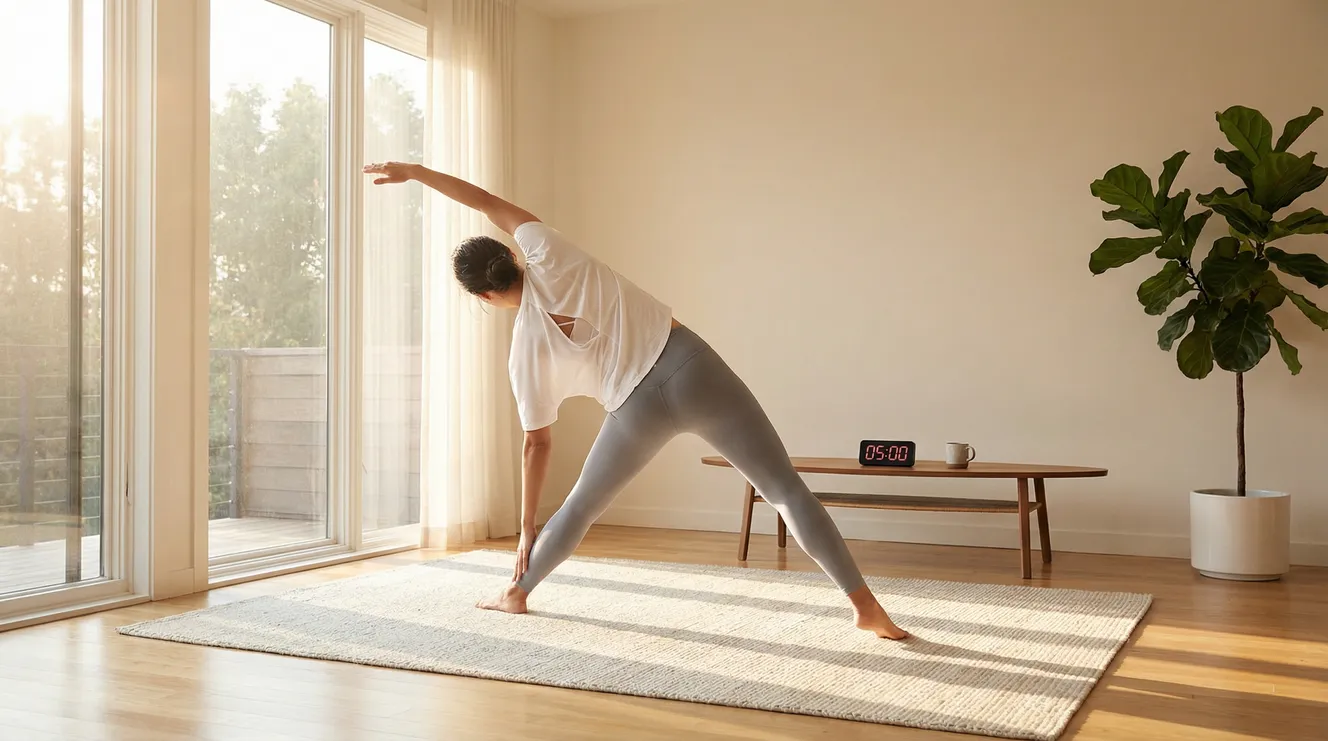
The modern epidemic of tight muscles and poor mobility isn’t caused by lack of stretching programs—it’s caused by the belief that effective stretching requires massive time commitments. Research from the Mayo Clinic confirms that even brief stretching sessions, when done regularly, can increase flexibility, improve range of motion, and reduce injury risk. A 5-minute daily routine done consistently yields better results than an occasional 30-minute session.
The secret lies in compound stretches—movements that target multiple muscle groups simultaneously—and strategic sequencing that flows naturally from one position to the next. This approach, championed by physical therapists and mobility specialists, transforms stretching from a chore into a sustainable daily ritual that fits into the margins of your life: while coffee brews, after a workout, or before bed.
The Science of Micro-Stretching: Why 5 Minutes Works
Your muscles don’t need lengthy stretches to maintain mobility—they need regular signaling that tells them it’s safe to lengthen. A 2022 study in the Journal of Strength and Conditioning Research found that participants who stretched just 5 minutes daily for 8 weeks showed the same flexibility gains as those who stretched 15 minutes daily. The key was consistency, not duration.
The physiological mechanism is simple: brief, regular stretching maintains muscle spindle sensitivity, preventing the “creeping tightness” that develops from static positions. When you sit for 8 hours, your hip flexors gradually shorten. A 30-second stretch interrupts this process, signaling the muscle to maintain its length. Done daily, this prevents the cumulative shortening that leads to pain and poor posture.
The 30-Second Rule
Each stretch should be held for 30 seconds. This duration, confirmed by multiple studies, is the minimum effective dose for muscle lengthening. Less than 20 seconds provides minimal benefit, while more than 60 seconds offers diminishing returns. Holding for 30 seconds allows the muscle spindle to reset without triggering a protective contraction.
The Morning Wake-Up Flow: Decompress from Sleep
This sequence targets the tightness that develops from 8 hours of immobility. Do it while your coffee brews or before you check your phone.
1. Cat-Cow Spinal Mobilization (60 seconds)
Target: Entire spine, core muscles, shoulder mobility
How to: Start on all fours—hands under shoulders, knees under hips. Round your back toward the ceiling while tucking your chin (Cat pose), hold for 3 seconds. Then arch your back, lifting your tailbone and chest while looking up (Cow pose). Perform 7-8 slow cycles. According to back pain expert Dr. Stuart McGill, this is the optimal dose for spinal mobility.
Modification: If wrists hurt, make fists and place knuckles on the floor. If knees are sensitive, place a folded towel under them.
2. World’s Greatest Stretch (30 seconds per side)
Target: Hip flexors, thoracic spine, chest, shoulders, hamstrings
How to: Start in a plank position. Step your right foot forward to the outside of your right hand into a deep lunge. Place your right elbow on your right knee and gently rock your knee forward and back to loosen hips. Then drop your right elbow toward the ground while keeping knee pushed out. Finally, rotate your torso to the right, reaching your right arm toward the ceiling. Return to plank and switch sides. This compound stretch hits multiple problem areas simultaneously.
Regression: Keep your back knee on the ground if balance is challenging. Place hands on a yoga block if reaching the floor is difficult.
3. Asian Squat Hip Opener (30 seconds hold + 30 seconds rocking)
Target: Hip flexors, groin, ankles, lower back
How to: Place a rolled towel under your heels if needed. Stand with feet shoulder-width apart, toes turned out slightly. Squat down as low as comfortable, keeping your chest up. Place elbows inside your knees and gently push knees outward. Hold for 30 seconds. Then rock side to side for 30 seconds to mobilize each ankle individually. This is the antidote to sitting.
Progression: As mobility improves, use a thinner towel under heels until you can squat flat-footed.
4. Half-Kneeling Thoracic Rotation (30 seconds per side)
Target: Thoracic spine, chest, shoulders
How to: Kneel with your right knee on the ground and left foot forward, left knee bent 90 degrees. Place your right hand on your right knee and left hand behind your head. Rotate your torso and left elbow toward your right knee, then reverse and rotate up and back. Keep your hips stationary—movement comes from your upper back only. This combats the forward-hunch posture of desk work.
Tip: Face a wall and keep your elbow close to it to prevent cheating with shoulder movement.
5. Wall Slides (60 seconds)
Target: Mid-back muscles, shoulder mobility, posture
How to: Stand with your back against a wall, feet about 6 inches away. Flatten your lower back against the wall by engaging your core. Place your arms in a “W” position against the wall. Slowly slide them up to a “Y” position, keeping contact with the wall throughout. Lower and repeat. This activates the postural muscles that become dormant from sitting.
Modification: If you can’t keep arms on the wall, move your feet further away. If shoulders are tight, slide only to a “V” position.
The Desk Decompression Flow: Office-Friendly Relief
This sequence requires no floor work and can be done in business attire. Perfect for a mid-afternoon break or post-work reset.
1. Seated Spinal Twist (30 seconds per side)
Target: Spine, lower back, obliques
How to: Sit tall in your chair with feet flat on the floor. Cross your arms over your chest. Rotate your torso to the right, using the chair back for gentle leverage. Hold, then return to center and twist left. This decompresses spinal discs compressed from sitting.
2. Chest Opener (30 seconds)
Target: Chest, anterior shoulders
How to: Sit forward in your chair. Clasp hands behind your back, palms together. Straighten arms and lift hands up while opening your chest forward. Drop your chin slightly to avoid neck strain. This immediately counteracts the forward hunch.
3. Standing Hip Flexor Stretch (30 seconds per side)
Target: Hip flexors, improves standing posture
How to: Stand behind your chair for balance. Step your right foot back into a mini lunge. Keep both feet pointing forward, back knee straight. Gently tuck your pelvis under to feel a stretch in the front of your right hip. Switch sides. This prevents the hip shortening that causes lower back pain.
4. Doorway Chest Stretch (30 seconds)
Target: Chest, biceps, anterior shoulders
How to: Stand in a doorway. Place your forearms on the doorframe at 90 degrees. Step forward slowly until you feel a stretch across your chest. Keep your core engaged to avoid arching your lower back.
5. Standing Calf Raise and Stretch (30 seconds)
Target: Calves, ankle mobility
How to: Stand near a wall for support. Rise onto your toes (calf raise), hold for 2 seconds, then lower your heels below floor level if possible. This combination strengthens and stretches the calves, improving circulation after sitting.
The Safety Framework: Stretching Without Injury
The Mayo Clinic emphasizes several non-negotiable safety principles for stretching:
The Warm-Up Rule
Never stretch cold muscles. Do 2-3 minutes of light movement first—march in place, shoulder rolls, or the Cat-Cow sequence. Stretching cold muscles increases injury risk and reduces effectiveness. The best time to stretch is after your morning walk, post-workout, or following a hot shower when muscles are warm.
The Pain-Free Principle
Stretch until you feel a gentle pull, never pain. Pain is your body’s “stop signal.” Discomfort is okay; sharp pain is not. If you feel pain, back off immediately. Overstretching can cause micro-tears in muscle tissue, leading to stiffness and injury.
The Breath Connection
Breathe deeply and steadily during stretches. Holding your breath creates tension that fights against the stretch. Inhale as you move into position, exhale as you deepen the stretch. This signals your nervous system that it’s safe to relax the muscle.
The Bounce Avoidance
Never bounce into a stretch. This triggers the stretch reflex, causing muscles to contract and protect themselves, which is the opposite of what you want. Static holds (30 seconds of steady pressure) are safer and more effective than ballistic stretching.
The Consistency Blueprint: Making 5 Minutes Stick
The best stretching routine is the one you’ll actually do. Here are evidence-based strategies for consistency:
The Habit Stacking Method
Attach your stretching routine to an existing daily habit: “After I pour my morning coffee, I will do the morning flow.” This piggybacks on established neural pathways, making the new behavior automatic.
The Visibility Principle
Keep a yoga mat visible in your living space. Out of sight means out of mind. Visual cues trigger behavior without requiring conscious decision-making.
The Two-Day Rule
Never skip more than two consecutive days. Missing one day is life; missing two is the start of a new habit (not stretching). This rule prevents the all-or-nothing thinking that derails consistency.
The Tracking Trigger
Use a simple calendar checkmark. The visual streak becomes motivational. Jerry Seinfeld famously used this method for writing—”don’t break the chain”—and it works for any habit.
Your Mobility Is 5 Minutes Away
The body you want to live in—the one that moves freely, stands tall, and doesn’t ache—isn’t built in hour-long yoga classes. It’s built in 5-minute increments, done daily, with intention. While your coffee brews, after your shower, before bed—these tiny windows contain massive transformation potential.
Start tomorrow. Choose one routine. Set a timer for 5 minutes. Feel the difference in how you move and how you feel. In two weeks, it will be automatic. In two months, you’ll wonder how you ever lived without it.
Your future, flexible self is waiting. Five minutes at a time.
Key Takeaways
Five minutes of daily stretching is as effective as longer sessions for maintaining flexibility and preventing stiffness, provided it’s done consistently.
Holding each stretch for 30 seconds with deep breathing targets muscle spindles effectively without triggering protective contractions.
Compound stretches like the “World’s Greatest Stretch” maximize efficiency by targeting multiple muscle groups simultaneously.
Safety is paramount: always warm up first, avoid bouncing, stop before pain, and breathe steadily throughout each stretch.
Sustainable stretching habits rely on habit stacking (attaching to existing routines), visibility, and the “two-day rule” (never skip more than two consecutive days).
“`
Leave a Reply