Save this number now, before you need it:
1-800-222-1222
The Poison Help line — free, confidential, staffed by experts, 24 hours a day. Program it into every phone in the house.
A toddler’s job, biologically speaking, is to explore the world by putting it in their mouth. That instinct is healthy and normal, and it is also exactly what makes a curious one-year-old so vulnerable. They cannot read a warning label. They do not know that the bright blue liquid smells like candy but burns like acid. They will climb a drawer like a ladder to reach the shiny thing on the counter, and they can do it in the ten seconds it takes you to answer the door. Childproofing against poisons is not about assuming the worst of your kid. It is about respecting how fast and how fearless they are, and arranging your home so that their curiosity cannot reach the things that could hurt them.
The Usual Suspects: What’s Actually Dangerous
Before you can lock things away, you have to know what deserves locking. The AAP names the substances that can cause the most serious harm even in small amounts, and the list is worth knowing room by room. It includes prescription and over-the-counter medicines, cleaning and laundry products including detergent packets, liquid nicotine, antifreeze and windshield washer fluid, certain pesticides and furniture polishes, and hydrocarbon fuels such as gasoline, kerosene, and lamp oil. None of those are unusual to have in a home. That is precisely the problem.
Medicines — the number one hazard
If you do nothing else after reading this article, secure your medicines. They are the leading cause of child poisoning by a wide margin. The American Academy of Pediatrics reports that roughly 50,000 children under the age of five end up in emergency departments every year after swallowing medicine they were not supposed to. And this is not just the prescription bottles you think of as drugs. It includes everyday over-the-counter pain relievers, and it very much includes vitamins, supplements, and melatonin — especially the gummy versions. The CDC has warned that gummy vitamins and melatonin are a growing problem precisely because they are designed to look and taste like candy. A child cannot tell the difference between a treat and a dose.
Under the sink and by the washer
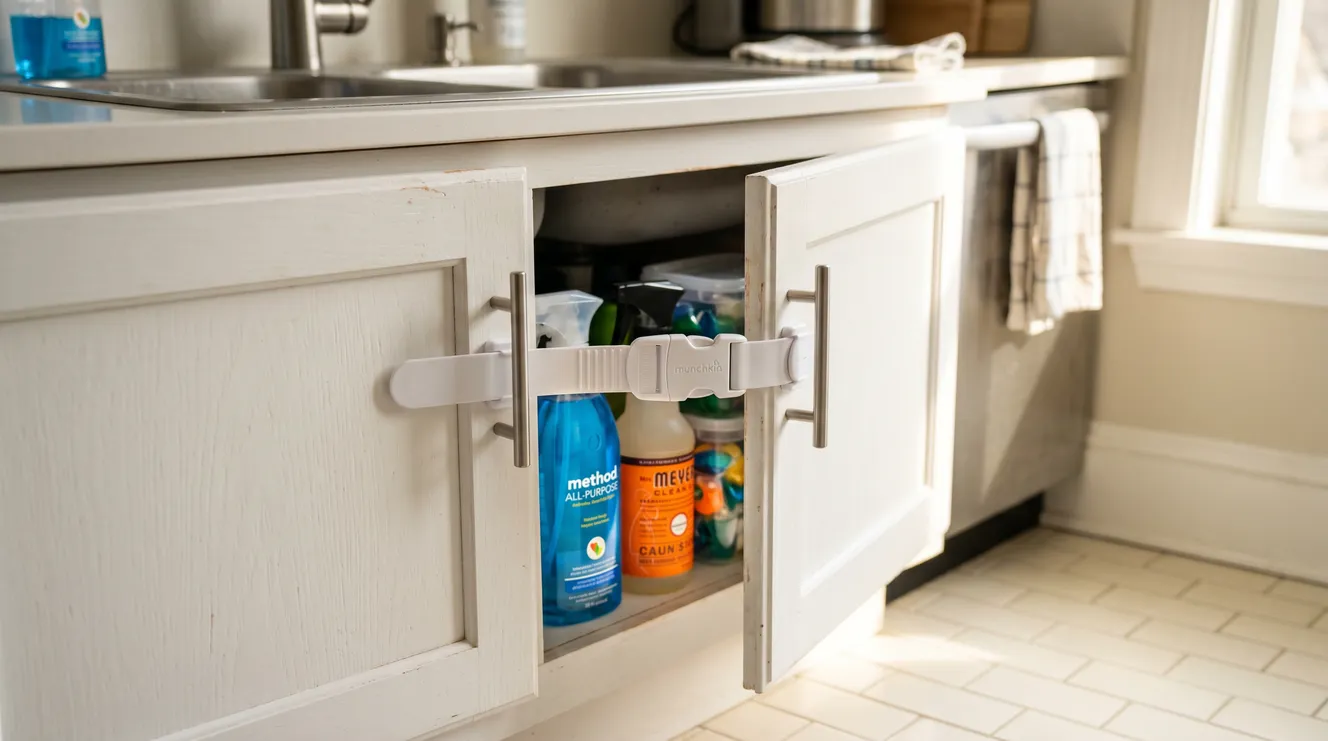
The cabinet under the kitchen sink is, in most homes, a toxic waste site at toddler height: dish soap, drain cleaner, bleach, oven cleaner, all within easy reach of someone learning to crawl. Laundry and dishwasher detergent deserve special mention because the modern single-dose packets — the squishy, colorful “pods” — are uniquely dangerous. They look like candy or a teething toy, they are highly concentrated, and a child who bites one gets a sudden mouthful of caustic chemical that can be far worse than swallowing the same detergent in liquid form. Keep them sealed in their original container, up high, and locked away.
The bathroom and the bag
Personal care products are easy to overlook because they feel harmless: mouthwash, nail polish remover, hand sanitizer, hair dye, even certain essential oils can poison a small child. And then there is the most commonly forgotten reservoir of danger in the house — the handbag. A visiting grandparent’s purse on the floor, with its blood-pressure pills and ibuprofen loose in a side pocket, is one of the classic poisoning scenarios. The AAP specifically warns that the risk spikes during changes in routine: holidays, travel, and visits to or from grandparents, when the usual safeguards are not in place and unfamiliar medications come into the home.
The garage and the new hazards
The garage and shed hold the heavy hitters: antifreeze, which is famously sweet-tasting and intensely toxic, plus windshield washer fluid, pesticides, weed killers, and fuels. Beyond the traditional list, two newer threats have earned urgent attention from Poison Control. The first is button and coin batteries, the small shiny discs in remotes, key fobs, greeting cards, and toys. The second is cannabis edibles, which in legal states have caused a surge in young children eating gummies and chocolates that are impossible to distinguish from ordinary candy. Both are covered in more detail below, because they behave differently from a typical poison and the response is different too.
The Childproofing Playbook: Up, Away, and Locked
The national safety campaign built around this gets the message into four words: Up and Away. Store anything dangerous up high, out of a child’s reach, and out of their sight — because what they cannot see, they are far less likely to hunt for. But “up high” alone is not enough, and here is the uncomfortable truth most parents underestimate: children climb. Pediatric experts note that a large share of medication poisonings happen after a child has dragged a chair over and scaled the counter to reach something they spotted. High is good. High and locked is the standard.
A few principles turn that idea into a system that actually holds:
Lock it, don’t just latch it. Cabinet safety latches help, but the AAP is candid that they can malfunction and that a determined child can eventually defeat them. For the most dangerous items — medicines especially — consider a small lockbox or a lockable cabinet rather than relying on a plastic latch alone. Trust the cap less than you think. Child-resistant does not mean childproof; those caps slow a toddler down, they do not stop one, and a surprising number of small children can work them open. The cap is a backup, not a plan.
Original containers, always. Never decant a cleaner, a fuel, or any chemical into an empty soda bottle, water bottle, or food container. It is one of the deadliest shortcuts there is, because it strips away the warning label and disguises poison as a drink. Keep everything — medicines, cleaners, pesticides, paint — in its original packaging with its label intact. Re-store immediately. The riskiest moment is mid-task: the pill bottle on the nightstand, the cleaner left on the bathroom floor “just for a second.” Put dangerous things away the instant you are done, every single time, even when you are tired and especially when you are interrupted.
Never call medicine “candy.” It is tempting when coaxing a reluctant toddler to take a dose, but it teaches exactly the wrong lesson — that the bottle in the cabinet is a treat worth seeking out. Call medicine what it is. And brief everyone who cares for your child — partners, grandparents, babysitters — on the same rules, because childproofing only works if the adult with the purse full of pills is following it too.
The Room-by-Room Sweep
Kitchen: Move all cleaners, detergent packets, and dishwasher tabs from under the sink to a high, locked cabinet. Secure vitamins and supplements too.
Bathroom: Medicines into a locked box, not the cabinet a child can climb to. Mouthwash, nail products, and cosmetics up and away.
Bedrooms: Clear nightstands of pills. Check coat pockets, nightstand drawers, and any “daily” medications left out for convenience.
Bags & visitors: Purses, backpacks, and overnight bags go up high — yours and every guest’s. Remind grandparents before they arrive.
Garage & shed: Antifreeze, fuels, pesticides, and washer fluid locked up, in original containers, never decanted.
Everywhere: Walk the house at your child’s eye level — literally on your knees — and grab whatever is within reach.
Two That Deserve Special Fear: Button Batteries and Pods
Most poisons give you time. A child swallows something, symptoms develop, you call for help, treatment begins. Button and coin batteries do not play by those rules. Poison Control warns that a swallowed coin-cell battery can burn through a child’s esophagus in as little as two hours. The most dangerous are the 20-millimeter, 3-volt lithium coin cells — about the size of a nickel — because they are large enough to lodge in a small throat and they discharge quickly, causing severe internal burns. The danger is not chemical poisoning in the usual sense; it is an electrical current generating tissue-destroying damage. Tape over the battery compartments of remotes and toys, keep loose batteries locked away, and if you ever suspect a child has swallowed one, treat it as a true emergency — this is a call-now situation, not a wait-and-see one.
Liquid laundry packets earn their own warning for a different reason: they are perfectly engineered to fool a toddler. Soft, squishy, brightly colored, and roughly bite-sized, a detergent pod looks like a piece of candy or a small water toy. But it contains a concentrated dose of detergent under pressure, so a curious bite does not just taste bad — it can spray caustic chemicals into the mouth, throat, and eyes, causing vomiting, breathing trouble, and chemical burns more severe than ordinary detergent would. If you have a child under six, the simplest safe choice is to keep the pods sealed, high, and locked, or to switch back to traditional liquid or powder until your child is older.
If It Happens: What to Do, and What Not To
Even careful homes have close calls. The minutes after a suspected poisoning are where good information saves a child and bad information — the kind still circulating from decades ago — can make things worse. Here is the response that today’s experts actually recommend.
If your child is awake and breathing but you think they swallowed, touched, or inhaled something poisonous, stay calm and call Poison Control at 1-800-222-1222 right away, or use the webPOISONCONTROL online tool. The service is free, confidential, and staffed around the clock by toxicology experts who will tell you exactly what to do for that specific substance. Have the container in your hand when you call — the product name, ingredients, and amount help them give precise guidance. The vast majority of these calls are handled right over the phone, without any trip to the hospital.
If your child has collapsed, is having a seizure, is struggling to breathe, or cannot be woken up, call 911 immediately. Those are emergency signs that cannot wait for anything else.
And now the part that overturns old advice: do not try to make your child vomit. Do not give syrup of ipecac. Do not give activated charcoal on your own. Do not follow the folk remedies — milk, salt water, mustard — that older generations were taught. Pediatric guidance changed years ago because forcing vomiting can cause more harm than the poison itself, particularly with caustic chemicals and fuels that damage a second time coming back up. If you still have a bottle of ipecac in a cabinet from years past, throw it out. The right move is always the same: call Poison Control first and let an expert tell you what this specific situation needs.
The Mistakes That Undo Childproofing
Childproofing fails in predictable ways, almost always through a small lapse in an otherwise careful home. Knowing the common failure points is how you stay ahead of them.
A Walk-Through This Weekend
The most effective thing you can do takes about an hour and costs nothing but a little dignity: get down on your hands and knees and crawl through your home at your child’s eye level. The world looks completely different from down there. You will spot the cleaner under the sink, the dishwasher pods in the low cabinet, the purse on the entryway chair, the battery-powered remote on the coffee table — all the things that are invisible from an adult’s height and irresistible from a toddler’s. Whatever you can see and reach from the floor, your child can too. Move it up, lock it down, and you have just closed most of the gaps in one pass.
Then finish with the two-minute jobs that matter most. Program 1-800-222-1222 into every phone in the household and write it somewhere visible, like the side of the refrigerator, so a panicked babysitter can find it instantly. Round up any old syrup of ipecac and throw it away. Tape the battery compartments on remotes and toys. Move the medicines — all of them, including the vitamins — into something that actually locks. None of this is expensive or complicated. It is just the difference between a scare you laugh about later and one you never recover from.
The Danger Is Already Home. So Is the Solution.
Childproofing against poisons is humbling precisely because it asks you to look at your own house differently — to see the medicine cabinet, the cleaning supplies, and the handbag by the door not as ordinary objects but as the exact things a curious toddler is drawn to. The threats are not lurking somewhere out in the world. They are sitting on your shelves right now, which is the bad news and, in a way, the good news too: you control every one of them.
Move it up. Lock it away. Keep it in its own labeled container. Never call it candy. And if something does go wrong, skip the old remedies and make one call to the experts who do this all day. A weekend of small changes buys years of peace of mind — and the knowledge that your child’s fearless curiosity, which is exactly as it should be, has nothing dangerous left to find.
Poison Help: 1-800-222-1222 — save it tonight.
This article is for general safety education and is not medical advice. In a poisoning emergency, call Poison Control at 1-800-222-1222, or call 911 if the child has collapsed, is having a seizure, is not breathing, or cannot be woken. For official guidance, consult Poison Control, the American Academy of Pediatrics, and your child’s pediatrician.
Leave a Reply