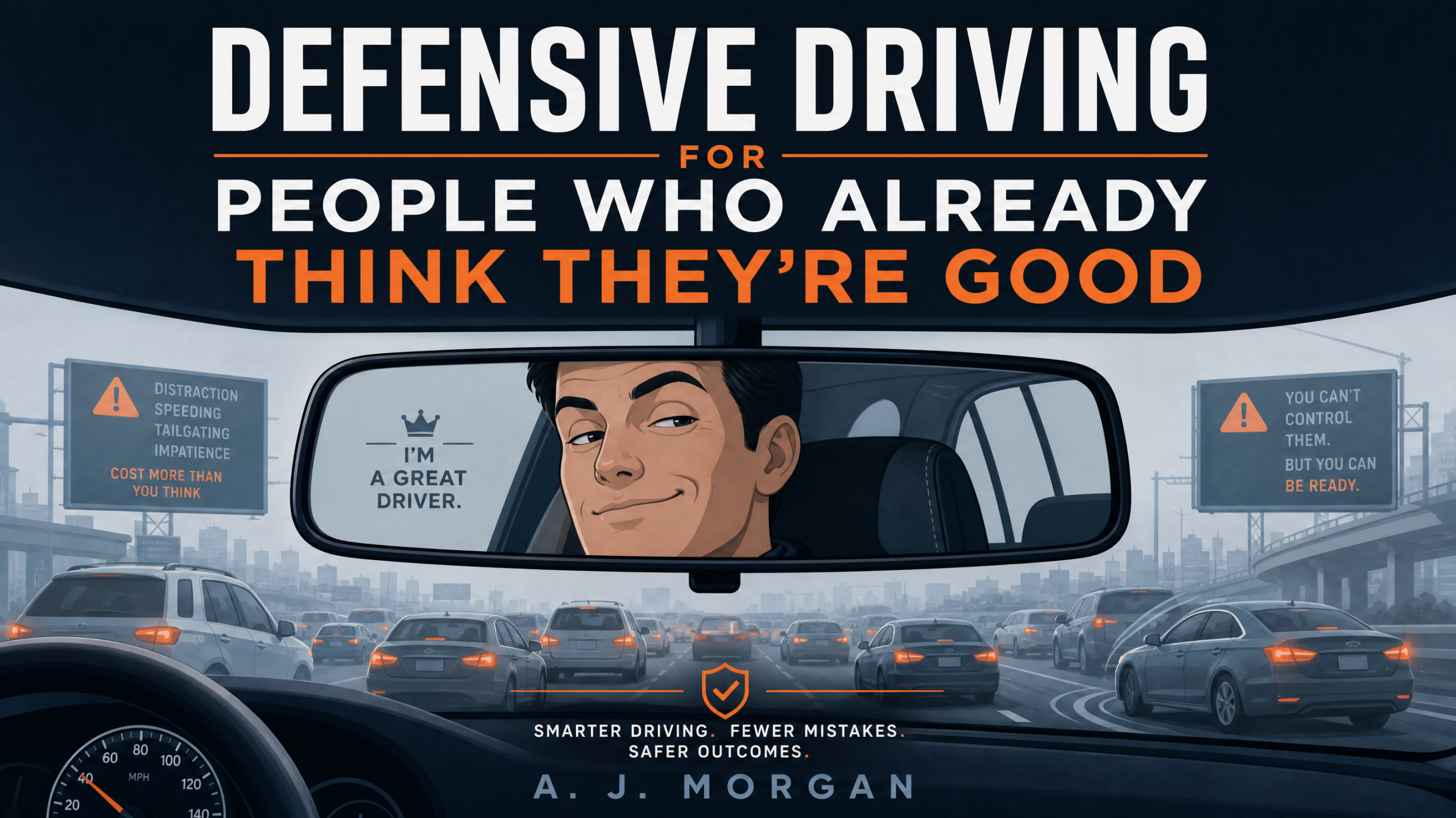
Here’s the uncomfortable framing worth sitting with: defensive driving is not a remedial course for people who are bad at driving. It’s the actual discipline that good drivers practice — the difference between someone who has simply avoided a crash so far and someone who is actively, continuously lowering their odds of one. Roughly 39,000 to 41,000 people die on U.S. roads every year, and the overwhelming majority of those crashes trace back not to a lack of raw skill but to lapses in attention, judgment, and habit. Skill isn’t what keeps you alive out there. Discipline is. Let’s talk about what that discipline actually looks like.
The Confidence Trap
The trouble with being a competent, experienced driver is that competence breeds autopilot. Once driving feels effortless, your brain starts treating it as a background task — something it can do while also planning dinner, rehearsing an argument, or glancing at a phone. That feeling of ease is precisely the danger. The skill that lets you drive without conscious effort is the same skill that lets you drive without conscious attention, and attention is the thing crashes are made of.
The data on this is almost funny, in a grim way. Drivers know exactly what’s dangerous and do it anyway. In the AAA Foundation’s surveys, drivers overwhelmingly rate drowsy driving as very or extremely dangerous — and then about one in five admit to having done it in the past month. Nearly half admit to speeding. More than a third admit to reading texts or emails while driving. This isn’t ignorance; it’s a disconnect between what we believe about risk and how we behave, powered by a quiet certainty that the rules are really about other people, the genuinely bad drivers out there. The first act of defensive driving is admitting you’re not exempt from that pattern. You’re in it, like everyone else.
What Defensive Driving Actually Means
Defensive driving has an image problem. People hear it and picture someone timid — crawling along, brake lights flickering, holding up traffic. That’s not it at all. Real defensive driving is the opposite of timid; it’s alert and deliberate. The core of it is a single mental shift: you stop assuming everyone else will do the right thing, and start driving as though any of them might do the wrong thing at any moment. The car waiting to turn might pull out in front of you. The driver beside you might drift into your lane. The light that’s green for you means nothing about whether the cross traffic is actually stopping.
You cannot control any of those other drivers. What you can control is your own position, your speed, and your attention — and defensive driving is simply the practice of managing those three things so that other people’s mistakes can’t reach you. The recurring theme, the one every other technique flows from, is this: always leave yourself an out. A space to brake into, a lane to move toward, a gap you’ve preserved on purpose. Good drivers don’t just react well to emergencies. They arrange their driving so that fewer situations ever become emergencies in the first place.
The First Skill: Look Far Ahead, and Keep Your Eyes Moving
Most drivers stare at the bumper directly in front of them. Skilled defensive drivers aim their eyes high and far — scanning the road ten to fifteen seconds ahead of where they are, which in city driving is a block or more, and on the highway is a quarter-mile out. Looking that far ahead is what buys you time. You see the brake lights cascading before they reach you, the merging truck before it merges, the pedestrian stepping off the curb while you still have room to react gently instead of violently.
Pair that long view with eyes that never settle. Keep them moving in a constant loop — far ahead, near, mirrors, instruments, and back out — rather than fixating on any one thing. Driving instructors often frame this as a continuous cycle: scan the scene, identify what matters, predict what those things might do, decide your response, and execute it — then immediately start the loop again. Check your mirrors every several seconds so you always know what’s beside and behind you, not just ahead. A driver who knows where everything around them is, at all times, has already solved most of the problems a crash is built from.
The Space Cushion: Following Distance
If there’s one habit that separates the genuinely safe from the merely lucky, it’s following distance. Tailgating — even at a distance that feels normal — removes the one thing you most need in an emergency: time. The standard guideline is the three-second rule. Pick a fixed object ahead, like a sign or an overpass. When the vehicle in front of you passes it, start counting: “one-one-thousand, two-one-thousand, three-one-thousand.” If you reach that object before you finish counting, you’re following too closely — back off until you don’t.
Three seconds is the dry-pavement minimum, not a target. In rain, fog, snow, heavy traffic, or at night, double it to four, five, or six seconds and more — your stopping distance grows dramatically when traction or visibility drops. This matters because of physics that no amount of skill can override. Your total stopping distance is your reaction distance (how far you travel before you even hit the brake) plus your braking distance (how far the car travels while stopping) — and both of those grow as speed increases. The faster you go, the more road you need, and the less of it a tailgater leaves themselves. A bigger cushion is the cheapest insurance on the road.
The Three-Second Rule
How: When the car ahead passes a fixed point, count “one-one-thousand, two-one-thousand, three-one-thousand.” Reach the point before you finish? Too close.
When to extend it: Double to 4–6+ seconds in rain, snow, fog, darkness, heavy traffic, or when being tailgated yourself (so you can brake gradually instead of hard).
Distraction Catches the Good Ones Too
Here’s where confidence does its worst damage, because the better you think you are, the more you believe you can safely split your attention. You can’t — nobody can. Distracted driving killed 3,208 people in 2024, and the most quoted statistic in road safety is quoted so often because it’s so stark: sending or reading a text takes your eyes off the road for about five seconds, and at 55 mph that’s like driving the length of an entire football field with your eyes closed. No reflexes save you from what you never saw.
Distraction comes in three flavors — taking your eyes off the road, your hands off the wheel, or your mind off the task — and texting manages all three at once. The trap for skilled drivers is the belief that hands-free fixes it. It doesn’t. Hands-free devices remove the manual and some of the visual distraction but leave the cognitive one fully intact: your mind is still on the conversation, not the road, and your brain doesn’t actually process the driving scene the way it should. The honest move isn’t to multitask better. It’s to put the phone where you can’t reach it — in the glovebox, on Do Not Disturb, out of the conversation entirely — and let driving have your whole mind.
Speed and the Limits You Can’t Argue With
Speeding is the confident driver’s signature move, justified by exactly the skill they’re proud of: I can handle it. And maybe you can handle the car — right up until the moment something unexpected happens, which is the only moment that counts. Speeding is a factor in about 29% of all traffic fatalities — close to a third — and the reason is pure physics, indifferent to your talent. Higher speed steals the reaction time you’d need to avoid a hazard, lengthens your stopping distance, and multiplies the energy in a crash, so the same impact becomes far more likely to kill.
Defensive driving means treating the posted limit as a ceiling for ideal conditions, then driving to the actual conditions — slower in rain, fog, heavy traffic, construction, or unfamiliar roads, regardless of what the sign allows. It also means matching the flow of traffic rather than weaving through it; a car moving much faster or slower than everyone else is the one creating risk. The skilled response to a road full of variables isn’t to push your speed to the edge of your ability. It’s to keep enough margin that the unexpected stays survivable.
The Impairments You Talk Yourself Into
Everyone knows not to drive drunk, and alcohol still factors into thousands of deaths a year — but the impairment confident drivers most often rationalize is fatigue. Drowsy driving feels manageable in a way that being drunk doesn’t; you tell yourself you’ll push through the last hour, crack a window, turn up the music. The AAA Foundation estimates drowsy driving plays a role in hundreds of thousands of crashes annually, including thousands of fatal ones, and the mechanism is brutal: a drowsy brain can slip into “microsleeps” of a few seconds without your permission or awareness — the same eyes-closed-on-the-highway scenario as texting, except you don’t even know it’s happening.
You cannot will yourself alert, and the tricks don’t work — cold air and loud music buy you minutes at most. The only real fix for drowsiness is sleep. If you’re fighting to keep your eyes open, drifting in your lane, or missing exits, the defensive move is to stop: pull off somewhere safe for a short nap, swap drivers, or call it for the night. The same humility applies to driving on medications that warn against it, or after any substance that slows your reactions. “I’m probably fine” is the exact thought that precedes a lot of crashes.
Buckle Up — Yes, Even You
It’s the simplest, most proven safety step there is, and confident drivers still skip it on the short trips because they trust their own control. But your seat belt isn’t protection against your mistakes — it’s protection against everyone else’s, and against the physics of a sudden stop. Of the passenger-vehicle occupants killed on U.S. roads in a recent year, roughly 44% were not wearing a seat belt, even though belt use nationwide sits above 90%. That overrepresentation tells the story: the unbelted minority makes up a wildly outsized share of the dead.
The reason is largely ejection. In a serious crash, an unbelted occupant becomes a projectile, and being thrown from a vehicle is one of the most lethal things that can happen to a person — the large majority of people totally ejected are killed. Seat belts are overwhelmingly effective at preventing that ejection in the first place. No skill you possess changes what happens to an unbelted body in a 50-mph collision. Two seconds and a click is the highest-return habit in this entire article.
The Humble Driver Is the Skilled Driver
Notice the thread running through every technique here: none of them is about car-handling talent. Looking far ahead, keeping a cushion, killing distraction, respecting speed and fatigue, wearing the belt — these are habits of attention and humility, not feats of skill. That’s the real lesson hiding inside the joke about everyone thinking they’re above average. The drivers who are genuinely safest aren’t the ones most confident in their abilities. They’re the ones who never quite trust the road, who assume they can be surprised at any moment, and who build that assumption into how they drive.
You probably are a good driver. That’s exactly why this matters: good drivers have the most to gain from staying humble and the most to lose from coasting on their reputation. Defensive driving isn’t a skill level you graduate past. It’s a mindset you renew every time you turn the key.
Drive Like You Can Still Be Surprised
The point was never that you’re a bad driver. It’s that confidence is the thing that quietly erodes the habits keeping you safe — and the only antidote is to keep questioning yourself. Look farther ahead than feels necessary. Leave more space than feels needed. Put the phone away even on the empty road. Slow down for the conditions, rest when you’re tired, and buckle up every single time, no exceptions for the quick trip.
None of it requires more talent than you already have. It just requires the humility to admit that talent isn’t what’s been keeping you alive out there — attention and margin are. Assume the other driver will make the mistake, and always leave yourself an out. That’s the whole game, and the best drivers play it on every trip, no matter how many years they’ve been behind the wheel.
The safest driver isn’t the one who’s sure. It’s the one who’s paying attention.
This article is for general educational purposes. For authoritative data and guidance, see the National Highway Traffic Safety Administration and the AAA Foundation for Traffic Safety. Always follow the traffic laws and conditions where you drive.
Leave a Reply