Start With the Two Official Sources
Before anything else, read what your government already knows about your destination. The State Department’s Travel Advisories rate every country on a four-level scale: Level 1 (exercise normal precautions), Level 2 (exercise increased caution), Level 3 (reconsider travel), and Level 4 (do not travel). Crucially, don’t stop at the headline number — open the full country information page, which breaks down the specific risks behind the rating using indicators like crime, terrorism, civil unrest, health, natural disasters, and kidnapping. A country can be Level 2 overall while one region is far more dangerous than the rest, and that detail only appears in the full page. These advisories are reviewed regularly and updated whenever conditions shift.
The second source covers your health. The CDC’s Travelers’ Health site has a destination-specific page for nearly every country, listing the vaccines you need, the diseases present, and the food, water, and insect precautions that matter there. The two agencies are complementary, not redundant: the State Department assesses safety and security, while the CDC focuses specifically on health. A place can be perfectly calm yet have a serious disease outbreak, or vice versa, so check both. Reading these two pages takes fifteen minutes and is the single most valuable thing you can do before booking.
Enroll in STEP — the Five-Minute Step Most People Skip
This one is free, fast, and genuinely important, yet most travelers have never heard of it. The State Department’s Smart Traveler Enrollment Program (STEP) lets you register your trip with the nearest U.S. embassy or consulate. Once enrolled, you receive their safety alerts and updates for your destination — and, far more importantly, the embassy knows you’re there. If a natural disaster, political crisis, or security incident hits while you’re in the country, you’re on the list of citizens they’re trying to reach and help. STEP also works in the other direction: if there’s an emergency back home, it gives the State Department a way to help your family reach you. Enrolling takes about five minutes at step.state.gov, and it costs nothing.
Keep These Handy While Abroad
• Enroll in STEP at step.state.gov before you go.
• Nearest U.S. embassy/consulate — look up its address and phone before arrival.
• Local emergency number — it is usually not 911; look up police/ambulance/fire for your destination.
• State Dept 24/7 Consular line: 1-888-407-4747 (from U.S./Canada) or 1-202-501-4444 (from overseas).
Documents: Passports, Visas, and Copies
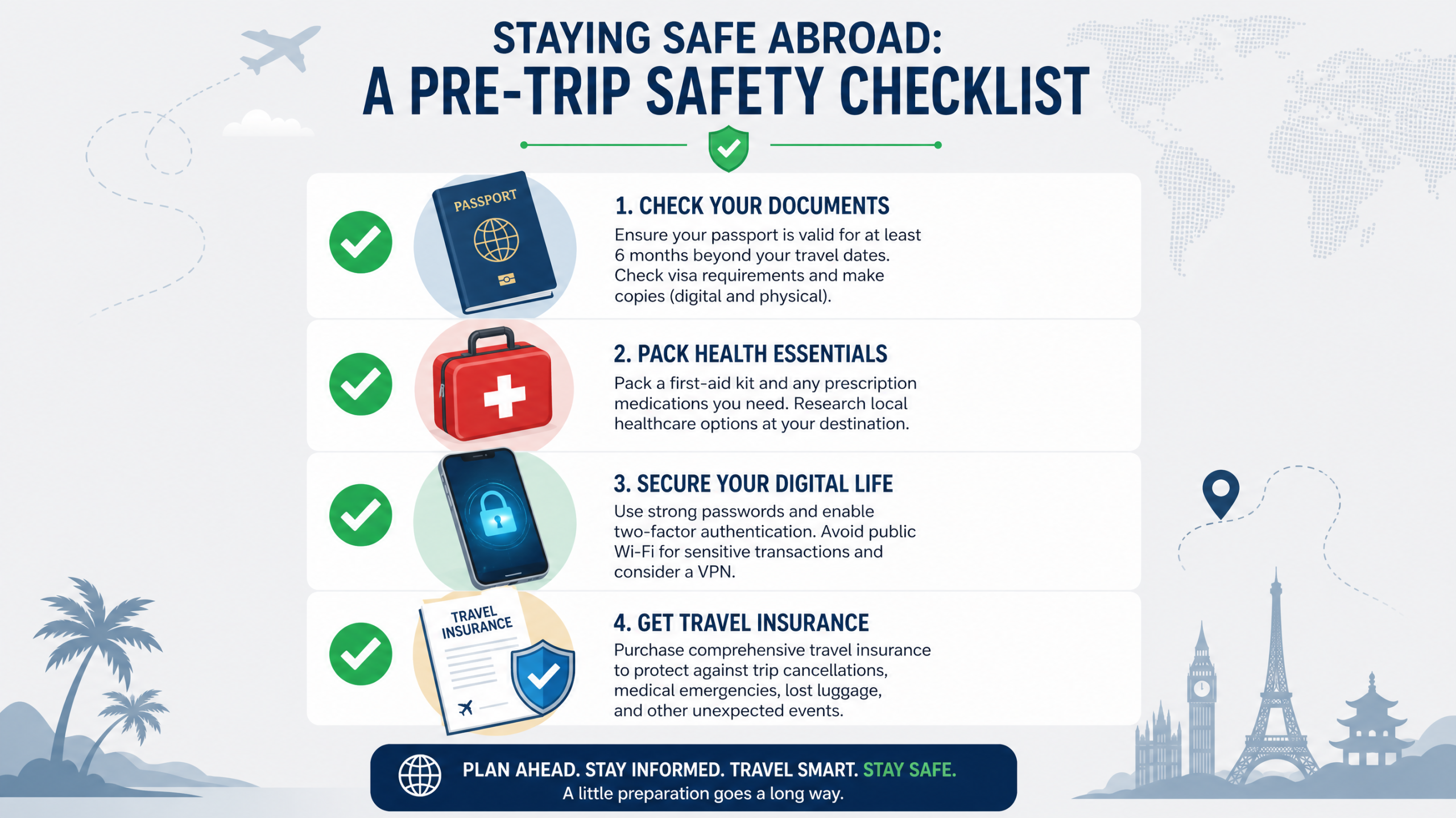
Check your passport’s expiration date the moment you start planning, because of a rule that strands travelers constantly: the six-month validity rule. Many countries won’t let you enter unless your passport is valid for at least six months beyond your travel dates — meaning a passport that hasn’t technically expired can still get you denied at the gate. (Some destinations require only three months, and a few only validity at entry, so confirm the exact rule for your country.) If you’re cutting it close, renew early; routine renewals take several weeks. And note one scam-prevention point: the only official passport renewal site is travel.state.gov — the web is full of fraudulent third-party “renewal” services.
Next, sort out entry requirements: many destinations need a visa, an electronic travel authorization, or an arrival form arranged in advance, and these vary enormously by country and nationality. Finally, make copies of your key documents — passport, travel insurance, itinerary, and the cards in your wallet. Keep a digital set (in secure cloud storage or your email) and a paper set, store them separately from the originals, and leave a copy with someone at home. If your passport is lost or stolen abroad, a copy dramatically speeds up getting a replacement at the embassy.
Health: See Someone Before You Go
Ideally about four to six weeks before departure, see your doctor or a travel-medicine clinic — that lead time matters because some vaccines need multiple doses or time to take effect. Make sure your routine vaccinations are up to date (the CDC specifically flags being current on polio and measles before international travel), and get any destination-specific shots your CDC page recommends or requires, such as typhoid, hepatitis A, or yellow fever. If your destination has malaria, ask about preventive medication.
For prescription medications, pack enough for the whole trip plus a buffer, keep them in their original labeled containers, and carry a copy of the prescription or a doctor’s note — some medicines that are routine at home are restricted or illegal in other countries, so check before you fly. Throw together a small health kit too: any personal medications, pain relievers, anti-diarrheal and rehydration supplies, bandages, and hand sanitizer. And read the CDC’s food and water guidance for your destination, since traveler’s diarrhea is the most common travel illness and is largely avoidable with a few simple habits. In many places the rule of thumb is to drink only sealed or treated water, skip ice of unknown origin, and favor food that’s been thoroughly cooked and served hot — “boil it, cook it, peel it, or forget it” is a crude but useful guide. If you take regular medications or have a chronic condition, it’s also wise to carry a brief note from your doctor summarizing your history and medication list, which can be invaluable if you need care from a clinician who doesn’t have your records.
Insurance: The Gap That Surprises People
Here’s the assumption that costs travelers the most: that your regular health insurance covers you abroad. Very often it doesn’t, and Medicare generally provides no coverage outside the United States at all. That leaves a dangerous gap, because a medical emergency in another country can run into serious money — and a medical evacuation, flying you to adequate care or home, can cost tens of thousands of dollars out of pocket.
The fix is travel insurance, but know that it comes in distinct types. Travel health insurance covers medical care while you’re abroad; medical evacuation insurance covers that very expensive transport; and trip-cancellation insurance covers your prepaid costs if you have to cancel — a different product entirely. For international trips, the first two are the ones that protect you from catastrophe. Before buying, check what you may already have: some credit cards and existing policies include limited travel medical or evacuation benefits, and it’s worth knowing the gaps before you fill them.
Money and Staying Connected
Tell your bank and card issuers your travel dates and destinations so they don’t freeze your cards for “suspicious” foreign activity at the worst possible moment. Then build in redundancy: carry more than one way to pay — at least two cards from different networks plus some local cash — and never keep it all in one place. Stash a backup card and some emergency cash separately from your wallet, so a single theft can’t leave you stranded with nothing. As at home, a credit card is your safest day-to-day payment abroad because of its fraud protections, while a money belt or a hidden pouch keeps your cash and passport off the surface for pickpockets.
Sort out connectivity before you land: an international plan, a local SIM, or an eSIM, so you can reach maps, translation, your bank, and emergency services. Download offline maps of where you’re going, and save key addresses and numbers somewhere they’ll work without signal. Being reachable and able to navigate is itself a safety feature.
Plan for Staying Safe on the Ground
A few decisions made before you leave shape how safe you’ll be once you arrive. Learn the local laws and customs, and take them seriously — abroad you’re subject to their laws, not your country’s, and things that are legal or trivial at home (certain medications, photographing government or military sites, drug possession, dress in religious places, alcohol in some countries) can carry severe penalties elsewhere. Read up on the common scams at your destination — every tourist hotspot has its signature tricks, from rigged taxi meters to distraction-pickpocket teams — so they don’t catch you off guard.
Give real thought to transportation, because traffic crashes are one of the leading causes of injury and death for travelers abroad. Use licensed taxis or established rideshare apps rather than unmarked cars, wear a seatbelt even where locals don’t, be cautious about driving in unfamiliar and chaotic conditions, and think hard before renting a motorbike — a helmet and your travel insurance terms both matter. Practice ordinary situational awareness: keep valuables out of sight, stay alert in crowds and at ATMs, and trust your instincts about places and situations that feel wrong.
Protect your digital self too. On hotel and cafe Wi-Fi, avoid logging into banking or sensitive accounts unless you’re using a VPN, since public networks abroad are easy to snoop on. Be cautious about posting your real-time location and travel plans on social media, which can advertise to the wrong people that you’re away or alone. And before you go, share your itinerary with someone you trust at home and set a simple check-in plan — a quick message on arrival and at key points — so someone always has a rough idea of where you are.
If Something Goes Wrong Abroad
Even with perfect preparation, things occasionally go sideways — so it helps to know the plan before you need it. If your passport is lost or stolen, contact the nearest U.S. embassy or consulate; with your copies in hand, they can issue a replacement, often quickly in an emergency. For a medical emergency, call your travel insurer’s 24/7 assistance line (save it in your phone) — they help locate appropriate care and coordinate payment or evacuation — and the embassy can also help you find local medical services and contact family.
If you’re robbed or run out of money, the embassy can help you reach family or your bank to arrange an emergency transfer. And if you’re ever detained or arrested, understand the limits clearly: the embassy cannot get you out of jail or override local law, but it can provide a list of local attorneys, notify your family, and monitor your treatment. In any serious crisis, the State Department’s Consular Affairs line — 1-888-407-4747 from the U.S. and Canada, or 1-202-501-4444 from overseas — is staffed around the clock. Knowing these channels exist turns a panic into a procedure.
Prepare Once, Relax the Whole Trip
None of this is meant to make travel sound frightening — it’s meant to make it carefree. The traveler who has read the advisories, enrolled in STEP, checked their passport, seen the doctor, bought real insurance, and copied their documents isn’t anxious abroad; they’re free to enjoy themselves, because the things that derail trips have already been handled. An afternoon of preparation buys you weeks of peace of mind.
Work the checklist in order, lean on the two free government resources that exist precisely for this, and carry your embassy and emergency numbers where you can find them. Then go — see the world, eat the food, get a little lost in the good way. The whole point of preparing for the worst is that you almost never have to think about it again.
Check the advisory, enroll in STEP, copy your documents — then enjoy the trip.
This article is for general guidance and isn’t legal, medical, or insurance advice; entry rules and conditions change, so confirm specifics for your destination and nationality before traveling. For authoritative, up-to-date information, see the U.S. State Department’s travel advisories and the CDC’s Travelers’ Health. Enroll in STEP at step.state.gov.
Leave a Reply