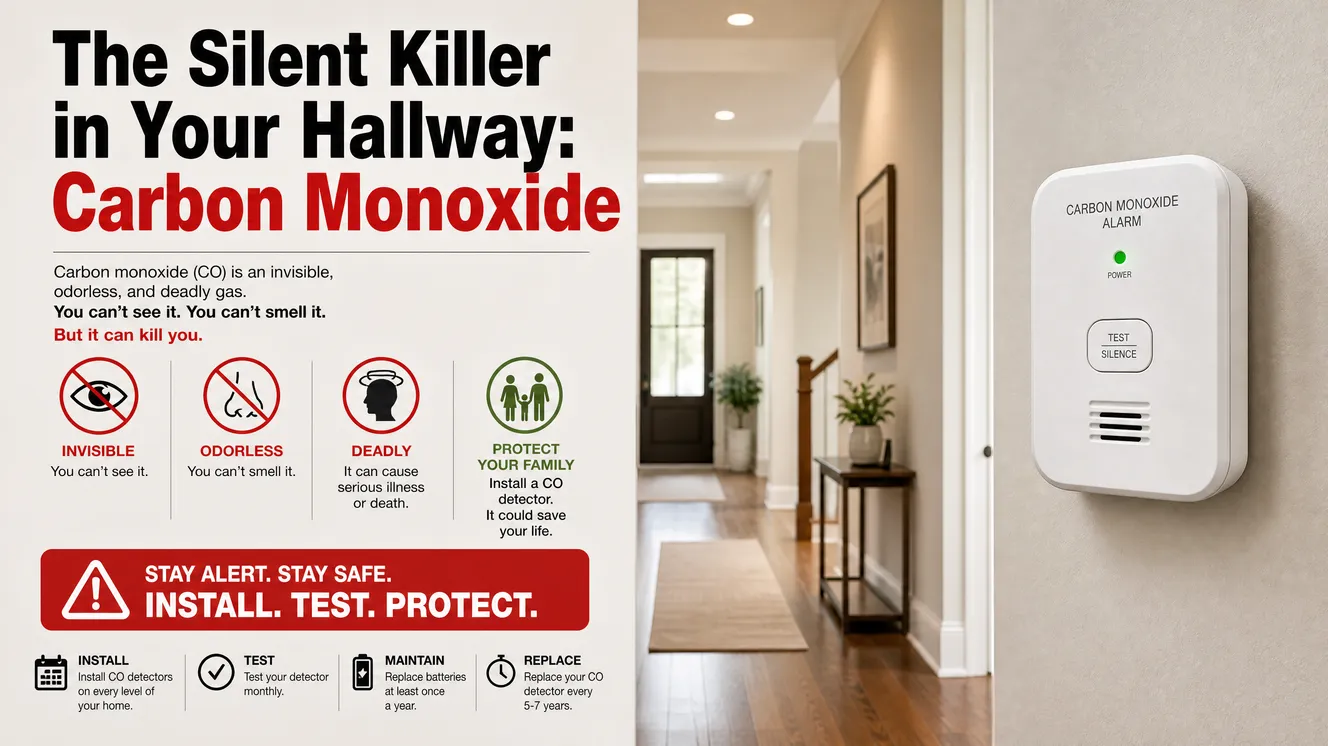
Most people know carbon monoxide is dangerous in the same vague way they know radiation is dangerous — a hazard that happens to other people, somewhere else. The reality is closer to home, often literally. The gas comes from ordinary appliances most of us use every day: the furnace in the basement, the water heater, the gas range, the fireplace, the car in the garage. When those things work correctly and vent properly, the carbon monoxide they produce goes outside and you never think about it. When something goes wrong — a cracked heat exchanger, a blocked chimney, a generator running too close to the house — it has nowhere to go but in. This article is the basic knowledge that keeps a normal winter night from becoming a tragedy.
What Carbon Monoxide Actually Is
Carbon monoxide, written as CO, is a gas produced whenever a carbon-based fuel burns without enough oxygen to burn completely. Gas, oil, wood, coal, propane, charcoal, gasoline — burn any of them in a closed or poorly ventilated space and you get carbon monoxide as a byproduct. As the CDC describes it, CO is odorless and colorless, which is the entire problem. Natural gas companies deliberately add that rotten-egg smell to their product so you will notice a leak. Carbon monoxide has no such warning built in. Your nose, the organ you trust to detect danger in the air, is completely blind to it.
The reason it is so deadly comes down to chemistry. Your red blood cells carry oxygen around your body using a protein called hemoglobin. Carbon monoxide binds to that same hemoglobin, but it grips far more tightly than oxygen does — so when CO is present, your blood starts ferrying carbon monoxide instead of the oxygen your brain, heart, and organs need to survive. You are, in a slow and quiet way, suffocating from the inside while breathing what feels like normal air. The effect builds up. Low levels over a long period can be as damaging as high levels over a short one, which is why a slow leak you barely notice can still do serious, lasting harm.
One persistent myth is worth correcting because it leads people to put their detectors in the wrong place. Carbon monoxide is not significantly heavier than air, and it does not pool near the floor the way some imagine. Its weight is close to that of ordinary air, so it mixes and drifts throughout a room much like smoke does. That single fact shapes everything about how you protect your home.
Where It Comes From in Your Home
Naming the sources is the first step to controlling them, because nearly every case of poisoning traces back to a short, familiar list. According to the CDC, the usual culprits are gas- and oil-burning furnaces, water heaters, gas ranges and ovens, fireplaces and wood stoves, portable generators, charcoal grills, and the exhaust from cars and small engines. None of these are exotic. They are the machinery of an ordinary household, which is exactly why the danger is so easy to underestimate.
Certain scenarios show up again and again. A furnace with a cracked heat exchanger leaks combustion gases into the home’s air instead of sending them up the flue. A chimney blocked by a bird’s nest or years of soot forces the smoke and gas from a fireplace back into the living room. A water heater that is not vented properly trickles CO into the basement, which then rises through the house. And the most dangerous of all, the ones that kill whole families in a single night, almost always involve combustion where it was never meant to happen: a portable generator running in an attached garage or just outside a bedroom window during a power outage, a charcoal grill brought indoors for warmth, a car left idling in a closed garage, or a gas oven used to heat a cold apartment. These are not freak accidents. They are predictable, and they are preventable.
The one rule that prevents the worst cases: Never run a generator, grill, camp stove, or any other fuel-burning engine inside a home, basement, or garage — even with the doors and windows open. The CDC is specific: generators belong outdoors, more than 20 feet from any window, door, or vent. “Outside near an open window” is still inside, as far as the gas is concerned.
The Symptoms That Pretend to Be the Flu
Here is what makes carbon monoxide poisoning so insidious: its early symptoms are a near-perfect imitation of something harmless. The CDC lists the most common ones as headache, dizziness, weakness, upset stomach, vomiting, chest pain, and confusion — and notes that people often describe the feeling as “flu-like.” In the dead of winter, when the heating system is running hardest and CO leaks are most likely, those are also the exact symptoms of the seasonal illness going around. A family wakes up tired, headachy, and nauseous, assumes they have caught a bug, and goes back to bed in the very room that is poisoning them.
There are a few clues that separate carbon monoxide from a genuine virus, and they are worth memorizing. The first is that CO poisoning tends to strike everyone in the household at once, including pets, rather than passing from person to person over days the way a cold does. The second is that the symptoms often improve when you leave the building and return when you go back inside. If your headache lifts at work and comes roaring back an hour after you get home, that is not a coincidence to shrug off. The third and most dangerous detail is that high concentrations can skip the warning stage entirely. As the CDC bluntly puts it, people who are asleep or who have been drinking can die from carbon monoxide before they ever feel a symptom. That is why a detector matters so much: it does the noticing that your body cannot.
Everyone is vulnerable, but not equally. Infants, older adults, and people with chronic heart disease, anemia, or breathing problems get sick faster and suffer worse outcomes, because their bodies have less margin to spare when oxygen delivery falters. A level of CO that gives a healthy adult a mild headache can be far more serious for a newborn or an elderly relative in the next room.
The CO Alarm: Your Only Real Defense
Since you cannot see, smell, or taste carbon monoxide, you need a machine that can. A carbon monoxide alarm is the single most important thing in this entire article. It is cheap, it runs for years, and it is the difference between waking up to a loud warning and not waking up at all. If your home burns any fuel or has an attached garage and you do not own one, stop reading and order one tonight.
Where to put it
Placement is where most people go wrong. The NFPA recommends installing a CO alarm on every level of the home and outside each separate sleeping area, so that an alarm in the night is loud enough to wake everyone. If a level has bedrooms, the alarm goes in the hallway right outside them — close enough that it pierces a closed door and a sound sleeper’s fog. The National Safety Council gives the same advice: a CO alarm in the hallway near each sleeping area. It is also smart to place one near an attached garage, where a car left running can flood the house with exhaust.
A couple of placement cautions matter too. Keep alarms at least about ten feet away from fuel-burning appliances like the furnace or stove, because the small, harmless puffs those produce during normal startup can trigger nuisance alarms that tempt you to disable the unit. And because CO mixes with air rather than sinking, you do not need to mount it near the floor — follow the manufacturer’s instructions, which typically allow wall or ceiling placement much like a smoke alarm.
It is not the same as a smoke alarm
This trips up a surprising number of households. A smoke alarm detects smoke. A carbon monoxide alarm detects CO. One does not do the other’s job. A great many fatal poisonings happen in homes that had working smoke alarms and no CO alarm at all, because the family assumed the device on the ceiling covered both threats. If you want one unit for both, buy a combination smoke and CO alarm that explicitly says so on the box. Otherwise, you need both kinds.
Testing and replacement
A CO alarm only protects you if it is alive. The CDC’s guidance is simple to remember: install battery-operated or battery-backup alarms so an outage cannot silence them, and check the batteries when you change your clocks each spring and fall. Test the alarm with its button regularly. And here is the rule people forget — the sensor inside a CO alarm wears out, so the entire unit should be replaced about every five years, or sooner if the manufacturer says so. That is shorter than a smoke alarm’s ten-year lifespan, so do not assume the two are on the same schedule. A digital-readout model is worth the few extra dollars, because it shows the CO concentration in real time, not just an on-or-off alarm.
The Carbon Monoxide Prevention Checklist
Alarms: One on every level and outside each sleeping area; test them and check batteries at each clock change; replace the whole unit every 5 years.
Heating system: Have your furnace, water heater, and any fuel-burning appliance serviced by a qualified technician once a year.
Chimney & vents: Have the chimney inspected and cleaned yearly; make sure flues and vent pipes are clear and properly pitched.
Generators: Outdoors only, more than 20 feet from windows, doors, and vents — never in a home, basement, or garage.
Cars: Never idle a vehicle in an attached garage, even with the door open; have the exhaust checked annually.
Never improvise heat: No gas oven, charcoal grill, or portable camp stove used to warm a room. Ever.
When the Alarm Sounds
A carbon monoxide alarm is not a smoke alarm, and the response is slightly different — you are not fighting flames, you are fleeing an invisible gas. If your CO alarm goes off, treat it as real every single time. Do not waste a minute hunting for the source or airing out the room first. Get everyone outside into fresh air immediately, including pets, and do a head count the way you would in a fire. Once you are outside, call 911 or your local emergency number. If anyone is showing symptoms — headache, dizziness, nausea, confusion, drowsiness — tell the dispatcher, because that changes how quickly help arrives and how they treat you.
Then, the hard part: stay out until emergency responders or a qualified technician tells you the air is safe. Do not go back in for a phone, a pet, or to “check if it stopped.” The level inside can keep climbing even after the alarm sounds, and the readout on a digital unit may lag behind the real concentration. People have been overcome while running back inside to investigate. Let the professionals, who carry meters and protective equipment, be the ones to enter and find the leak.
The Mistakes That Kill
Carbon monoxide deaths are rarely caused by bad luck. They are caused by a handful of understandable, human decisions made by people who did not know the risk. Here are the ones that show up over and over, and how to never make them.
A Half-Hour This Week
Protecting your home from carbon monoxide is not a weekend project, and it is not expensive. It is a short to-do list you can finish in an afternoon. Count your CO alarms and make sure there is one on every level and outside every sleeping area — if there is a gap, a basic alarm costs about as much as a takeout dinner. Press the test button on the ones you already have, and flip them over to check the date; anything pushing five years old is due for replacement. Put a recurring reminder on your phone to check the batteries every time the clocks change. And book the appointment you have been putting off: an annual service for your furnace, water heater, and chimney by a qualified technician, who can catch a cracked heat exchanger or a blocked flue before it ever becomes dangerous.
If you use a generator, decide right now — before the next storm knocks the power out and the pressure is on — exactly where it will go: outside, far from the house, nowhere near a window or vent. The middle of an emergency is the worst possible time to be making that call for the first time. The whole point of learning this on a calm, ordinary day is so that the dangerous decisions are already made when the lights go out.
You Can’t Smell It. You Can Still Stop It.
Carbon monoxide earns its reputation as the silent killer honestly. It gives no warning your senses can catch, it imitates a harmless illness, and it does its worst damage while people sleep. But for all its stealth, it is one of the most preventable household dangers there is. A working alarm in the right place catches what your body never will. An annual furnace check closes off the most common leak. And a single firm rule — nothing that burns fuel runs inside an enclosed space — eliminates the scenarios that kill whole families at once.
None of it requires expertise or money you do not have. It requires knowing the gas is real, taking the alarm seriously, and doing the small, boring maintenance before winter rather than after a scare. That is the entire defense against something you will never see coming.
Buy the alarm. Check the date. Service the furnace. Then breathe easy.
This article is for general safety education and is not medical advice. If you suspect carbon monoxide poisoning, get to fresh air and call emergency services immediately. For official guidance, consult the Centers for Disease Control and Prevention, the National Fire Protection Association, the National Safety Council, and your local fire department.
Leave a Reply