Winter Driving and the Emergency Kit for Your Trunk
Part 1: Get the Car Ready Before the First Storm
Winter safety starts in the driveway, not on the highway. Before the cold settles in, give your vehicle a once-over. Your tires matter most — check that the tread is deep enough to grip and that they’re inflated to the right pressure, since cold air lowers it and bald tires are nearly useless on snow. Have your battery tested, because cold dramatically cuts its power and a marginal battery dies on the first frigid morning. Top off the coolant to the manufacturer’s spec, make sure the defrosters and heater work, and replace worn wiper blades — ideally with winter blades — while filling the reservoir with cold-weather washer fluid that won’t freeze, because a single snowstorm can drain it fast. Check that every light works, and keep your gas tank at least half full all winter to reduce the risk of a frozen fuel line and to give you a reserve if you’re ever stuck.
If you live somewhere with real winters, consider dedicated winter (snow) tires rather than all-season tires. All-season tires harden and lose grip as temperatures drop, while winter tires use softer rubber and an aggressive tread designed to bite into snow and ice — the difference in stopping distance and cornering grip is substantial, and it applies to every kind of vehicle, AWD included. Mount them in sets of four, not just on the drive wheels, and swap them off once the cold breaks so they don’t wear prematurely. It’s an investment, but on regularly snowy roads it’s one of the most effective safety upgrades you can make.
Then there’s the habit too many drivers skip: clear the snow and ice off the entire car before you move, not just a peephole on the windshield. That means all the windows, the mirrors, the headlights and taillights, any cameras or sensors — and the roof, because a slab of snow sliding off your roof at speed blinds you or the driver behind you. Two minutes with a brush is the price of actually being able to see and be seen.
The Golden Rule: Slow Down and Leave Room
Almost everything about safe winter driving flows from one principle: give yourself more time and space than you think you need. Slow down — it takes far longer to stop or steer on a slick surface, and the posted limit assumes dry pavement. Increase your following distance dramatically; where three seconds is the dry-road minimum, winter calls for five or six seconds at least, and AAA recommends stretching it to eight to ten seconds on snow and ice. That cushion is what gives you room to brake gently instead of slamming the pedal and losing control.
Make every input smooth and gradual — accelerate slowly, brake early and softly, and steer gently. Sudden moves are what break traction, so the goal is to do everything in slow motion. Don’t use cruise control on snow or ice; it can keep applying power when you’ve lost grip, and you want full manual control to react. And let go of one dangerous myth: all-wheel drive and four-wheel drive help you accelerate, but they do nothing to help you stop or turn. On ice, an AWD vehicle stops no faster than any other — the confidence it gives going forward is exactly what puts overconfident drivers in the ditch. Traction to go is not traction to stop.
Braking, Skids, and the Ice You Can’t See
Knowing how to brake on a slick road is its own skill. If your car has antilock brakes (ABS) — nearly all modern cars do — apply firm, continuous pressure and hold it; you’ll feel the pedal pulse and may hear grinding, which is normal, and you should keep steering. Don’t pump ABS brakes. If you drive an older vehicle without ABS, pump the pedal gently instead. Either way, braking earlier and softer beats braking hard and late every time.
Watch especially for black ice — the thin, transparent glaze that looks like wet pavement and is nearly invisible. It forms first on bridges, overpasses, and shaded patches, which freeze before the rest of the road because cold air circulates above and below them. Ease off the gas as you approach these spots and avoid braking or steering on them. A couple more rules round it out: try not to stop while going uphill, since you may not get moving again — build a little momentum before the climb and let it carry you. And don’t crowd snow plows; they move slowly, make wide turns, and throw snow, so stay well back and pass only with great care.
If You Start to Skid
1. Stay calm and ease off the gas. Don’t slam the brakes — that usually makes a skid worse.
2. Look and steer where you want to go. Keep your eyes on your intended path, not on what you’re sliding toward; your hands follow your eyes.
3. Make gentle corrections. Steer smoothly into the direction the rear is sliding, then straighten out. Avoid sudden, large movements.
Plan Before You Pull Out
The safest winter drive is sometimes the one you postpone. Before heading out in bad weather, check the forecast and road conditions, and if a serious storm is coming, ask honestly whether the trip can wait — staying home keeps the roads clearer for plows and first responders, too. If you do go, allow extra time so you’re never rushing on ice, and tell someone your route and expected arrival so that if you don’t show up, people know where to look. It’s also worth practicing: take your car to an empty, snowy parking lot in daylight and feel how it brakes and slides, so the sensations aren’t a surprise at 45 mph on the highway. Confident winter driving comes from preparation, not bravado.
Part 2: The Emergency Kit for Your Trunk
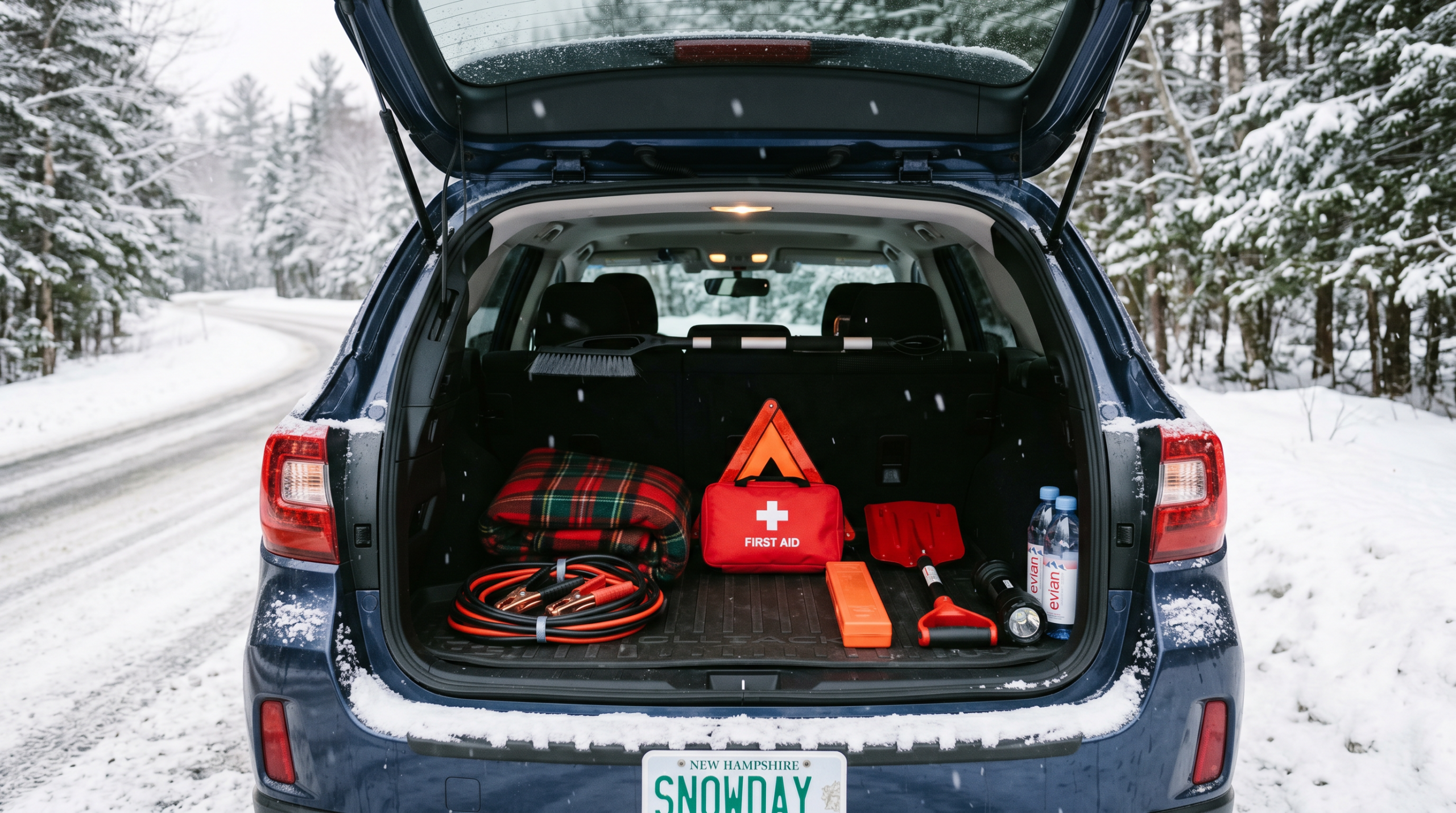
Even careful drivers get caught out — a spinout on black ice, a dead battery in a parking lot, a road closed by a whiteout with you stuck behind it. In summer that’s an inconvenience; in winter it can become life-threatening within hours, and in a major storm, help may take a long time to reach you. A well-stocked trunk is what bridges that gap. One important tip before the list: when severe weather threatens, keep the most critical items — warmth, water, light, phone power — in the passenger compartment, not the trunk, because a frozen or jammed trunk can lock your supplies away exactly when you need them.
Think of the kit in four jobs: getting unstuck, staying warm, staying fed and powered, and being seen.
A few notes that make the kit actually work when you need it. Store flashlight batteries reversed so the light can’t switch on accidentally and drain in the trunk. Keep water from bursting its bottle by leaving room for it to expand if it freezes. Check the whole kit once a year — food expires, batteries lose charge, and a power bank left for a season may be flat. And if you have children or pets who ride with you, pack for them too: extra warmth, water, and a snack sized for them.
Knowing how to use the get-unstuck gear matters as much as having it. If a wheel is spinning, don’t just floor it — that polishes the snow into ice and digs you deeper. Instead, clear snow from around the tires with your shovel, sprinkle sand or cat litter directly in front of and behind the drive wheels for grip, and ease onto the gas gently. The classic technique is to rock the car: shift slowly between drive and reverse, building a little momentum each way until the car works free. Straightening your front wheels and easing off the gas pedal pressure also helps the tires find traction. If a few calm attempts don’t work, stop before you overheat the transmission or exhaust yourself, and call for help instead.
If You Get Stranded: The Rules That Save Lives
If you slide off the road or get stuck in a storm, what you do next matters enormously. The first and most important rule, echoed by the National Weather Service and AAA alike: stay with your vehicle. Your car is shelter, it’s far easier for rescuers to spot than a person on foot, and walking off into a storm is how people get lost, exhausted, and killed by the cold. Call for help if you can, give your location, and wait.
To stay warm, run the engine and heater only intermittently — about ten minutes per hour is the common guidance — which conserves fuel and limits a hidden danger covered below. Bundle up in your blankets and layers between runs, and use floor mats, maps, or anything else to insulate yourself. Don’t overexert yourself trying to dig out or push the car; heavy effort in the cold can trigger a heart attack or leave you sweaty, and wet clothing robs your body of heat and invites hypothermia. Make yourself visible — tie a bright cloth to your antenna or window, and run the interior dome light when you hear traffic. Don’t let everyone sleep at once; keep one person watching.
⚠ The Carbon Monoxide Warning You Must Not Forget
This is the one that quietly kills people every winter. When you run the engine for heat, snow and ice can pack around your exhaust pipe and force deadly carbon monoxide back into the cabin instead of out the back. Carbon monoxide is colorless and odorless — you won’t smell it, see it, or feel it coming, and it can render you unconscious before you realize anything is wrong. The CDC has documented exactly these deaths in snowstorms, often striking children and older adults in idling, snow-buried cars.
Before running the engine, get out and clear snow from the tailpipe and the area a few feet behind the car — and always crack a downwind window an inch for fresh air while the engine runs. Recheck the exhaust as snow keeps falling. These two habits — clear pipe, cracked window — are the difference between staying warm and not waking up.
That carbon monoxide risk is the thread connecting your trunk kit to everything else: the gear keeps you warm, but only safe technique keeps the warmth from becoming a hazard. Respect the exhaust pipe, ration the engine, keep a window cracked, and your car becomes the safe shelter it’s meant to be while you wait for help.
Drive for the Conditions, Pack for the Worst
Winter doesn’t reward confidence; it rewards preparation. Ready the car before the first storm, then drive like the road is trying to surprise you — slow, smooth, with a big cushion of space, no cruise control, and full respect for ice you can’t see. Remember that all-wheel drive helps you go but never helps you stop. Most winters, that caution is all you’ll ever need.
But build the trunk kit anyway, for the day caution isn’t enough. A shovel, traction, warmth, water, light, and a way to signal can turn a terrifying night into a survivable inconvenience. And if you’re ever stranded, hold onto the three rules that matter most: stay with the car, don’t overexert yourself, and never run the engine without a clear exhaust pipe and a cracked window. Do that, and winter stays what it should be — beautiful, and survivable.
Slow down, pack smart, and respect the exhaust pipe.
This article is for general educational purposes. For authoritative guidance, see NHTSA’s winter driving tips, the National Weather Service, and AAA. Always follow current local conditions and official advisories where you drive.
Leave a Reply